Watch


The same territory, swept — the Fast treatment
One or two seconds at each of eighteen to twenty close places
The Fast treatment formula is not the Normal formula performed quickly. It is a different stimulus delivered over the same ground, and the therapy is explicit that the result is even better than with the Normal formula.
Table 2 — Card: Fast Treatment Formula Supine
| Written | Fast : Gas : Gas I : Gal : Spl : Liv : Mu : |
|---|---|
| Family | Built from the therapy's own logic |
| Position | Supine throughout Supine |
| The timing | Do not stay more than one or two seconds at any point. No six-second hold is counted anywhere in this formula — which is what the colons in the written line are telling you. Table 13, How a Formula Is Built |
| Step 1 | Gas — both thighs, the Gas Only thigh form Both sides |
| Step 2 | Gas 'I' — both calves, the intestine variant Both sides |
| Step 3 | Gal — left thigh Left |
| Step 4 | Spl — right thigh Right |
| Step 5 | Liv — left arm + left thigh Left |
| Step 6 | Mu — right arm + right thigh Right |
| Conditional addition | After these, Rt. Ov., Lt. Ov. or WD may be given — if there is need according to the disease and the patient's pains. Not optional decoration: a gate |
| The stations | The place of the pressure is changed continually, the places kept so close together that pressure comes to be applied at about eighteen to twenty places on the hand or the foot |
| What it is for | The same list as the Normal formula — all problems of the stomach; and muscular dystrophy, motor neuron disorders, Guillain-Barré syndrome |
| The claim | From this the result is even better than with the Normal formula |
| Its part in a combination | Part I of FAN. Giving (10) Medulla before it makes it better still |
| Points taught in | Gas, Gas 'I', Gal, Spl, Liv, Mu — The Front of the Body I; Rt. Ov., Lt. Ov., WD — The Front of the Body II |
The difference, stated exactly. While giving the Normal formula we apply pressure at three (or four) places on the thigh or the hand for six seconds. While giving the Fast formula we do not stay more than one or two seconds at any point, and we go on changing the place of the pressure, keeping the places so close together that pressure comes to be applied at about eighteen to twenty places on the hand or the foot.
Notice what has changed and what has not. The territory is the same — the same thighs, the same arms, the same limb-to-navel correspondences. The dwell has gone from six seconds to one or two. The number of contacts has gone from three or four to eighteen or twenty. Total time under the therapist's foot comes out broadly similar; what is entirely different is that no single place is loaded long enough to do what a six-second hold does, and a much larger surface is reached.
The formula defined by what it leaves out — Ajay Normal
Spl is left out, and the omission is the prescription
Where the Normal and Fast formulas improve the digestive power, the Ajay Normal formula sees to it that the absorption of digested elements takes place properly. It is another form of the Normal formula, and its defining feature is a deliberate absence.
Table 3 — Card: Ajay Normal Formula Supine 6 sec

| Written | (8) Pan (3) Gal (7) Liv (6) Gas 'I' – 3 points |
|---|---|
| Family | Built from the therapy's own logic. Named for a person — a proper name tells you nothing about the indication; look it up |
| Position | Supine throughout Supine |
| Step 1 | (8) Pan — both thighs together Both sides , as in the Normal formula |
| Step 2 | (3) Gal — left thigh, hip → knee Left , as in the Normal formula |
| Step 3 | (7) Liv — left arm + left thigh Left , as in the Normal formula |
| Step 4 | (6) Gas 'I' – 3 points — both calves Both sides . The equivalent is also written (1) Gas 'I' – 6 points; giving it provokes the jejunum and ileum, by which the absorption of digested things takes place properly |
| The omission | Spl is not given. This is the formula |
| Why Spl is omitted | Provoking Spl will increase the working of the lymphocytes. An auto-immune disorder is the name given to that condition in which the cells of the thymus gland begin to kill the body's own cells; and in auto-immune disorder the lymphocytes are hyper — that is, they work more than is needed. Therefore provoking them will increase the disease still further |
| What it is for | Absorption. And, because of the omission, patients of auto-immune disorders have received great benefit from it — MD, muscular dystrophy; MND, motor neuron disorder; myopathy, and so on |
| Given with | The Normal formula or the Fast treatment, one after the other — as NAN or FAN |
| A lighter form | Ajay Normal Mild — (8) Pan (1) Gal (2) Liv – 3 points (1) Gas 'I' – 6 points — used as part II of the New Gal formula |
| Points taught in | Pan, Gal, Liv, Gas 'I' — The Front of the Body I; Spl and the conditions in which it is refused — Each Point in Use |
Learn the shape of that argument, because repeats it a dozen times. An omission is an instruction. The blank space where Spl should be carries as much weight as any bracket in the line, and a therapist who copies this formula onto a card and quietly restores Spl — because the Normal formula has it, because the line looks unfinished — has not tidied a prescription. He has given a different one, to exactly the patient for whom the point was removed.
Two formulas given as one — NAN and FAN
Digestion then absorption — and the rescue for an adverse effect
When the digestion formula and the absorption formula are given together, the pair has a name and a number.
NAN and FAN
NAN = I Normal formula, II Ajay Normal formula.
FAN = I Fast treatment, II Ajay Normal formula.
If, before the Fast formula, we give (10) Medulla, and afterwards give the Fast treatment, it will be better still. (10) Medulla provokes the vagus nerve — the tenth cranial nerve — by which the digestive system will work still better.
And the use every therapist should know before the day he needs it: if, from any of our treatments, the patient should have an adverse effect, then in order to normalise the effect of the treatment given earlier, we can give NAN or FAN.
Table 4 — Card: NAN and FAN Supine Seated
| NAN, written in full | I (8) Pan (3) Gal (3) Spl (7) Liv (5) Mu · II (8) Pan (3) Gal (7) Liv (6) Gas 'I' – 3 points |
|---|---|
| FAN, written in full | I Fast : Gas : Gas I : Gal : Spl : Liv : Mu : · II (8) Pan (3) Gal (7) Liv (6) Gas 'I' – 3 points |
| What the Roman numerals mean | Part one, then part two, as one treatment, in that order |
| Position | Supine throughout — unless (10) Medulla is prefixed to FAN, which is seated Seated |
| The optional prefix, FAN only | (10) Medulla before the Fast treatment — better still. It provokes the vagus, the tenth cranial nerve |
| What it is for | Everything the three formulas are for — digestion and absorption together, so that all the elements of the food are properly digested and their absorption too happens correctly |
| The second use | The named rescue. If any treatment of ours has produced an adverse effect in a patient, one treatment of NAN or FAN normalises it |
| The caution that comes with the prefix | (10) Medulla — do not give to patients of diabetes and of cancer. To heart patients, give only (10) Left Medulla ▲ Take care |
| Where the prefix is taught | Seated I — Brain, Medulla, Neck, "Seated — I", for the point; The Medulla Family, "The Medulla Family", for the graded series |
There is one further fact about (10) Medulla, printed among the Medulla series and easy to walk past, which explains something in a formula five pages further on. (10) Medulla, by means of the vagus nerve, stimulates every part of the digestive system except the descending colon. It also contracts the lungs and reduces the fast rate of the heart — and to patients of heart disease, only (10) Left Medulla is given. Hold on to the exception about the descending colon. It is the reason the CCK Normal formula ends where it ends.
Table 5 — What the Normal, Fast and Ajay Normal formulas are used for
| In Hindi, as a patient will say it | In English |
|---|---|
| अपचन / मन्दाग्नि (apacan / mandāgni) | Indigestion; weak digestive fire |
| अजीर्ण (ajīrṇa) | Dyspepsia |
| डकार (ḍakār) | Belching |
| भूख नहीं लगना (bhūkh nahīṁ lagnā) | No appetite |
| गैस की तकलीफ़ (gas kī taklīf) | Trouble from gas |
| पेट में अल्सर (peṭ meṁ alsar) | Ulcer in the stomach |
| नाभि के ऊपरी भाग में दर्द | Pain in the upper part of the navel |
| — | And besides these, in these major diseases: muscular dystrophy, motor neuron disorders, Guillain-Barré syndrome |
One item in that list is not like the others, and a therapist who does not notice will one day be sorry. Indigestion, belching, no appetite, gas are complaints. Ulcer in the stomach is a diagnosis, and it has causes that can be found and treatment that cures it. Treat the digestion of a patient who has one, by all means; but pain in the upper belly that comes with weight loss, with vomiting, with black stool, with difficulty swallowing, or with a low haemoglobin, is a patient to be sent, today, to somebody who can look inside.
And the case that belongs to this page — the woman at the Chandigarh camp in 2001, who was given yesterday's treatment without examination, wept from pain she had not arrived with, and was relieved by one treatment of NAN — is told in full, with Guruji's own two instructions, in How a Formula Is Built. Read it again before you read the next section, because everything from here on is a formula that is right for somebody and wrong for the person standing behind them in the queue.
The formula made out of a mistake — Ulta Normal
Reversed, underlined, and stopped when the stool is formed
A a little earlier it was said that we cannot provoke the organs in an order of our own choosing. Here is the example of that, and it is an indication of Guruji's unique power of observation.
In the Normal formula we give Spl after Gal and Mu after Liv, which maintains normal peristalsis — the wave-like motion inside the intestines that keeps going of its own accord. But if a patient is treated with this order changed, then it was seen that the motion of the intestines becomes slow, and he also gets constipation. So it was decided that this treatment could be used to correct ordinary loose motions — that is, diarrhoea.
A formula was made out of an accident, by taking the accident seriously. That is worth saying plainly to a student, because it is the whole method of this therapy in one sentence: somebody noticed that a mistake had a reliable direction, and turned the direction into a prescription.
Table 6 — Card: Ulta Normal Formula Supine 6 sec
| Written | (8) Pan (1) Spl (1) Gal (1) Mu – 3 points (1) Liv – 3 points — a line is ruled beneath Spl, Gal, Mu – 3 points and Liv – 3 points |
|---|---|
| Family | Built from the therapy's own logic — out of an observed reversal |
| Position | Supine throughout Supine |
| Step 1 | (8) Pan — both thighs together Both sides . Unchanged from the Normal formula |
| Step 2 | (1) Spl — right thigh, hip → knee Right . Reversed: Spl now precedes Gal |
| Step 3 | (1) Gal — left thigh, hip → knee Left . Reversed |
| Step 4 | (1) Mu – 3 points — right arm + right thigh Right . Reversed: Mu now precedes Liv |
| Step 5 | (1) Liv – 3 points — left arm + left thigh Left . Reversed |
| Direction | Against peristalsis — which rule 4 of sequence permits only for a certain limited period, for some particular problem |
| Who it is for | Only for those whose motions are soft and who have to go two or three times a day |
| What it is for | Ordinary loose motions, that is diarrhoea; high BP. And: if there is slight itching of the skin (khujlī) and loose motions together, that too can be corrected by the Ulta Normal treatment |
| Why the underline is there | Because the normal order has been changed, a line is drawn beneath some of the points so that the therapist's attention is caught and he does not give the Normal order out of habit |
| The daily duty the underline carries | Every day, on seeing that line, remember that the patient must be asked every day about his motions |
| When to stop | After a few days, as soon as the motions become firm — formed like a banana — this treatment must be changed, and for at least one day the Normal formula must be given |
| The caution | Even after the motions have become firm, giving this same treatment can cause them to complain of constipation ▲ Take care |
| Taught with its step table and its comparison | How a Formula Is Built, "How a Formula Is Built" |
Three cautions of a different kind belong beside this formula, and they belong to you rather than to the card. "Ordinary" loose motions is a phrase doing serious work. Blood in the stool at any age; black tarry stool; fever with abdominal pain; severe or localised pain with a hard, guarding belly; a small child or a frail elder going dry; weight coming off; a change in bowel habit lasting more than a few weeks, especially after fifty — none of these is ordinary, and none of them is a treatment question before it is a referral question. Second, the formula names those whose motions are soft and who have to go two or three times a day, and some people who fit that description have always been like that and are perfectly well; treat the patient who has changed, not the patient whose habit is merely brisk. Third, high BP appears in the use column, and a blood pressure is not diagnosed from one reading taken by the person who has just treated you.
These three treatments were the very first to be made, and they are so effective that even today, in many centres across the country, many people become completely well from these alone. But it was seen that for some people these were not enough. So after the year 2000 many further treatments were made for improving the digestive system — and the first of them began with a complaint that everybody in India believes they already understand.
When the burning is not the acid — the Chole treatment
The acid is normal; the meal has not left the stomach
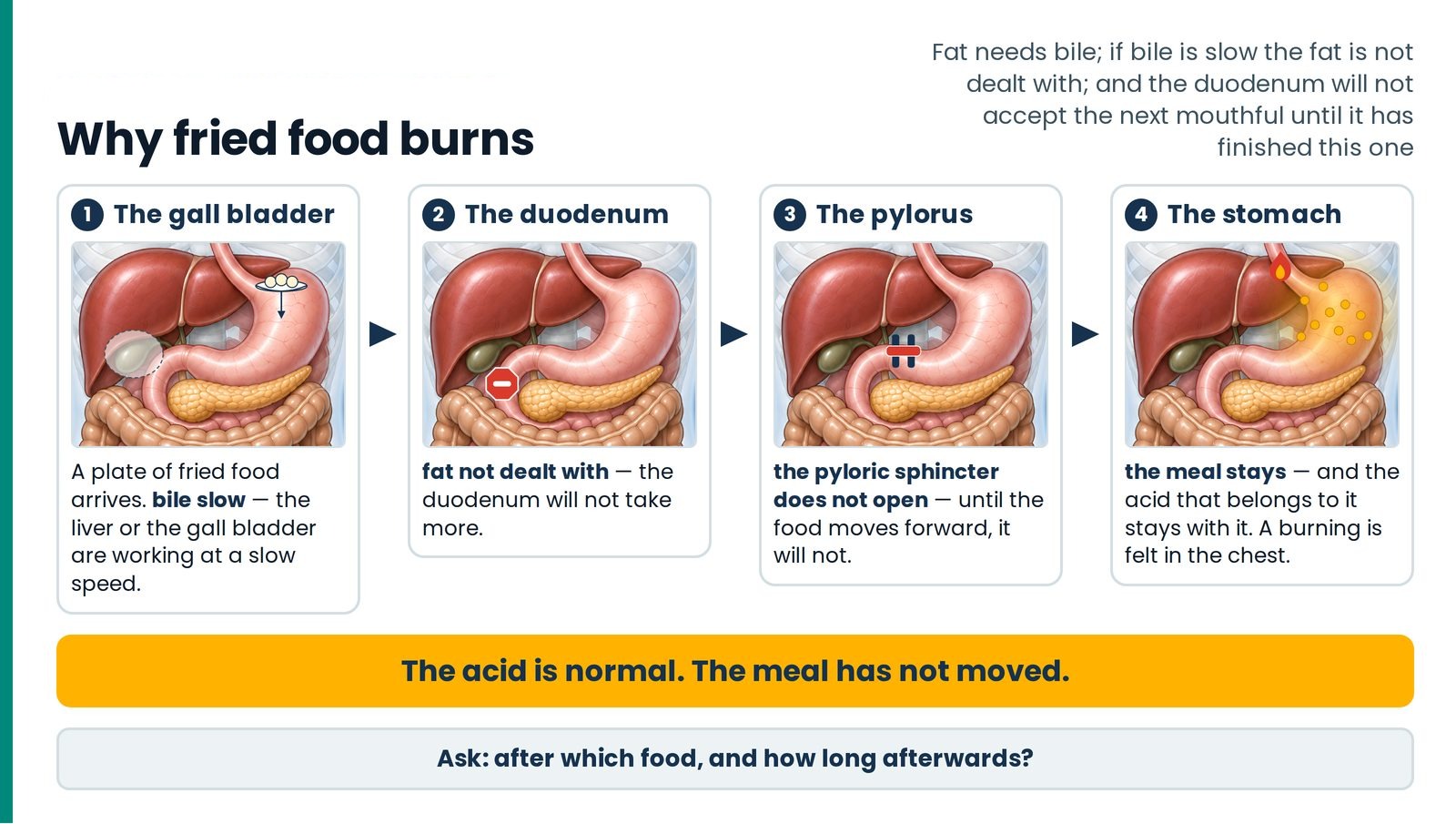
Often people used to come who said that after eating fried things they get a burning-like sensation in the chest. After giving them the NAN formula there was ease for a while, but then the burning would start again.
It is generally said that the burning is happening only because the acid in the stomach has increased — whereas this is not always so. It is Guruji's unique discovery that the burning in the chest happens from the following causes:
The liver or the gall bladder are sluggish — working at a slow speed.
Cholecystokinin or secretin are not being made in the body.
Or there is some blockage in the ampoulla of Vater.
If the patient reports that some while after eating fried things the stomach feels heavy, or sour belches come, or there is a burning in the chest — then their liver or gall bladder is sluggish, that is, not working properly. And the therapy's own footnote to that sentence is worth keeping exactly as it stands, with its qualifier intact: perhaps more than 80% of patients have exactly this. (Figure 27.2)
The rule of the digestive system that explains the burning
The motility of the duodenum and jejunum will remain low so long as the food which is in the duodenum is not properly digested.
Therefore the food does not move forward quickly; and until the food moves forward, the pyloric sphincter will not open. Because of this the acid-bearing food stays longer in the stomach itself, from which burning is felt — and it seems that the acid has increased, when the truth is that the acid is normal, but the liver or gall bladder are working less.
Read that as a chain and you can say it to a patient in fifteen seconds: fat needs bile; if bile is slow, the fat is not dealt with; the duodenum will not accept the next mouthful until it has finished this one; so the meal sits in your stomach, and the acid that belongs with it sits there too, and burns.
This is the most important piece of reasoning in the article, and not because of the formula it produced. It is important because it is a causal ordering, and a therapist who has it can ask a better question than do you get acidity? He can ask after which food, and how long afterwards? — and the answer tells him where in the chain to work.
The first answer is not the Chole formula. It is a preparatory pair, given before anything else.
Table 7 — Card: the preparatory gall bladder and liver treatment Supine 6 sec × 3
| Written | (3) Gal (7) Liv × 2 treatments — or (1) Gal (4) Liv × 2 treatments |
|---|---|
| Position | Supine Supine |
| Step 1 | Gal — therapist's right sole down the patient's left thigh, hip crease to knee Left |
| Step 2 | Liv — right sole on the patient's left arm above the elbow, left sole on the left thigh, pressed inward, together Left |
| The rounds | The whole pair is given, then the rest, then the whole pair again — two rounds. The rest between rounds is part of the instruction: see Table 8 in How a Formula Is Built |
| What it is for | To put right the digestion of fats. Given first, before the Chole formula. From this itself the patient gets a good deal of relief at once |
| If the illness is chronic — an old one | (1) Single point Liv × 6 trts. is extremely beneficial. Given as the single-point form requires — six seconds at each place, one minute's stop, then the next — four to six times in a day. See Table 8 in How a Formula Is Built, and The Front of the Body I for the point |
The second matter is protein. The motility of the jejunum will also remain low so long as the proteins in the duodenum are not properly digested. Such patients say that after peanuts, rajma, chholé, or non-veg — heavy proteins — they get sour belches, or the stomach feels heavy. Learn that list by heart; it is the question that separates the fat patient from the protein patient, and Indian households will give you the answer readily because these are foods with names and occasions attached to them.
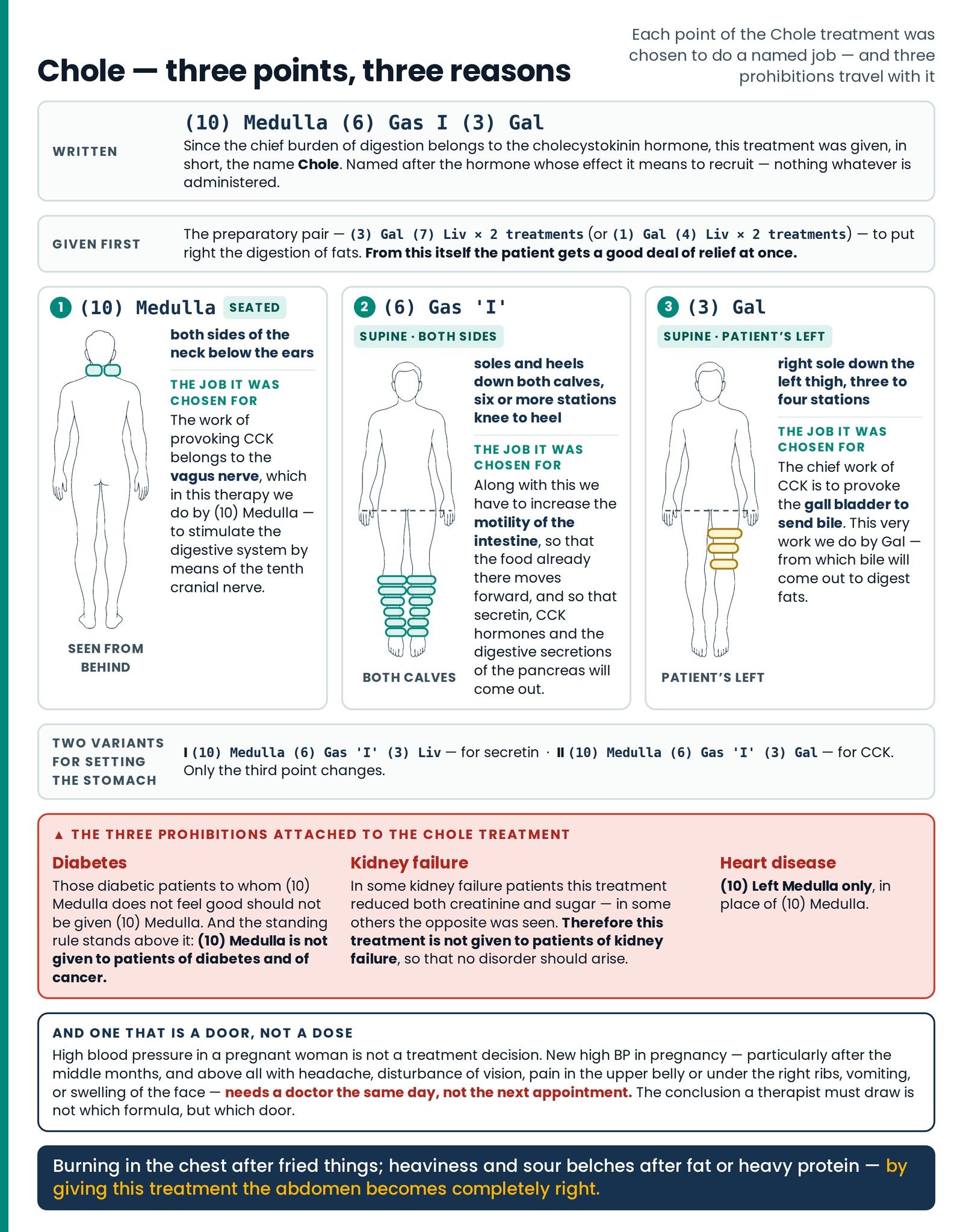
From there the formula assembled itself out of three requirements. (Figure 27.3)
How the three points of Chole were chosen
Cholecystokinin is the hormone which will send a message to the pancreas that it should send the digestive enzymes.
First — the work of provoking CCK belongs to the vagus nerve, which in this therapy we do by (10) Medulla.
Second — along with this we have to increase the motility of the intestine, so that the food already there moves forward, and so that secretin, CCK hormones and the digestive secretions of the pancreas will come out. It has been found that by the Gas 'I' treatment the working of the intestine and its motility increase.
Third — the chief work of CCK is to provoke the gall bladder to send bile. This very work we do by Gal.
From these three the treatment was made. After it, it was seen that fats and heavy proteins begin to be digested well. Since the chief burden of digestion belongs to the cholecystokinin hormone, this treatment was given, in short, the name Chole.
Table 8 — Card: Chole Treatment Formula Seated Supine
| Written | (10) Medulla (6) Gas I (3) Gal |
|---|---|
| Family | Built from the therapy's own logic. Named after the hormone whose effect it means to recruit — nothing whatever is administered |
| Positions, in order | Seated for step 1 Seated , then supine for steps 2 and 3 Supine |
| Step 1 | (10) Medulla — seated; both sides of the neck below the ears. To stimulate the digestive system by means of the vagus, the tenth cranial nerve |
| Step 2 | (6) Gas 'I' — soles and heels down both calves, six or more stations knee to heel Both sides . To stimulate the jejunum and ileum, from which secretin, CCK and the digestive secretions will come out |
| Step 3 | (3) Gal — right sole down the left thigh, three to four stations Left . To stimulate the gall bladder, from which bile will come out to digest fats |
| Given first | The preparatory (3) Gal (7) Liv × 2 trts. (or (1) Gal (4) Liv × 2 trts.) — Table 7 |
| What it is for | Burning in the chest after fried things; heaviness and sour belches after fat or heavy protein; fats and heavy proteins not being digested. Also high BP — the systolic BP falls. Also cataract (motiyā), retinitis pigmentosa, night blindness (ratondhī, ratindhā). By giving this treatment the abdomen becomes completely right, and because digestion and absorption become correct, all the glands begin to work properly. It gives great benefit to children of dull intellect |
| Substitution — heart patients | (10) Left Medulla in place of (10) Medulla |
| Prohibition — diabetes | Those diabetic patients to whom (10) Medulla does not feel good should not be given (10) Medulla ▲ Take care |
| Prohibition — kidney failure | This treatment is not given to patients of kidney failure ▲ Take care |
| Prohibition — cancer | (10) Medulla is not given to patients of cancer ▲ Take care |
| Two variants for setting the stomach | I (10) Medulla (6) Gas 'I' (3) Liv — for secretin · II (10) Medulla (6) Gas 'I' (3) Gal — for CCK |
| Its place in a longer treatment | Part V of the New Gal formula |
| Points taught in | Medulla — Seated I — Brain, Medulla, Neck; Gas 'I', Gal, Liv — The Front of the Body I |
Notice the two variants at the foot of that card, because they are a small masterpiece of matching. If this treatment is to be used for setting the stomach, then giving it in the following way brings still better results — and the only thing that changes is the third point. Liv for secretin; Gal for CCK. The pairing is not arbitrary: secretin's business is with the ducts, and the liver belongs to that response; CCK's business is with muscle and with the acinar cells, and the gall bladder belongs to that one. The route by which a thigh reaches either is the therapy's claim; the map of which hormone acts where is simply correct.
What else the Chole treatment was found to do — and what it was withdrawn from
Some patients who had burning in the chest also had high BP. When this treatment was given, it was seen that their systolic BP falls. The reasoning offered for it is this. For our digestive system to work rightly it is very necessary that the PSN — the para-sympathetic nervous system — should work properly; one chief work of the PSN is to increase the flow of blood to the digestive organs at the right time. When the working of the PSN is spoiled, how will the food be digested? And in high BP patients it has been seen that they have a great deal of pain in the part just above the navel — which means their intestines, especially the duodenum and jejunum, are not getting blood properly. From which it was inferred that in their body the functions of secretin and CCK will not be able to happen properly.
Not only this — when the PSN works properly, insulin will increase in the body, and the quantity of sugar in the blood will be reduced. That is perhaps why this treatment suited some diabetic patients. But some other diabetic patients did not feel well on being given (10) Medulla. So perhaps (10) Medulla harms them.
And one further note, which is a warning rather than an indication. If during pregnancy a woman gets high BP, then arterial spasm occurs in her kidneys, brain and liver — a kind of tightening comes into the arteries so that they cannot contract properly, and this same effect will certainly fall on the child's organs too. Because of high BP in pregnancy, proteins pass out in abnormal quantity through the urine, and both the flow of blood inside the kidneys and the glomerular filtration rate are reduced — meaning that from that woman's body the toxins, the unnecessary and waste things, will not be able to come out properly. The effect of all that will certainly fall upon the child.
Opening the door the bile comes through — the Vater treatment
103, 408, 10 — and max., a dose decided at the mat each day
Sometimes patients came who certainly got benefit from the above treatments, but after some days the pain came back. When the pain points were checked, a good deal of pain was found in Gal and Liv. (3) Gal (7) Liv was given, and other treatments too, but even so no special difference was found.
So, after much thought, an inference was drawn: if there is some blockage in the road by which the bile comes — in the ampoulla of Vater — then the bile will begin to congeal in the gall bladder itself, and its effect will fall on the liver too, will it not? And from there the question changed shape. It stopped being which point relieves this pain and became what all must be done to open this ampoulla of Vater.
The four requirements the Vater formula was built to meet
1.
For the digestive system, the vagus, the tenth cranial nerve, is to be stimulated. (10) Medulla will do this work.
2. If this trouble comes again and again, then perhaps the navel has slipped, and that is to be corrected. ONS will set the navel.
3. The pineal gland is called the master gland. If it does not work properly, then too there will be disorder in the body's functions. (½) Ku – 40 seconds stimulates it.
4. The gall bladder and liver are to be stimulated more, so that their secretion comes out fast and whatever obstruction there is gets flushed out — pushed out forcefully. (8) Gal (max.) and (10) Liv (max.).
Read the list as a piece of construction rather than as four good ideas. Each line names a job, and then names the point that does that job. That is how a formula is built when it is built deliberately — and it is the clearest worked example of it anywhere in .
Table 9 — Card: Vater Treatment Seated Supine Prone
| Written | I (10) Medulla (3) ONS (½) Ku – 40 seconds (8) Gal (max.) · II (10) Liv (max.) |
|---|---|
| The memory aid the therapy supplies | 103, 408, 10 |
| Family | Built from the therapy's own logic. Named after the ampoulla of Vater, the structure it was designed to open |
| Positions, in order | Seated → supine → prone → supine Seated Supine Prone |
| I · Step 1 | (10) Medulla — seated; the nape, both sides Seated . To stimulate the vagus, the tenth cranial nerve |
| I · Step 2 | (3) ONS — supine; both big toes gripped, the legs raised slowly to the height of the standing therapist's hand, held six seconds, and lowered very slowly Supine 6 sec . To set the navel |
| I · Step 3 | (½) Ku – 40 seconds — prone, the heels facing each other; the therapist seated between the feet, the mid-sole on the sacrococcygeal region, normal pressure, one application held forty seconds Prone . To stimulate the pineal gland |
| I · Step 4 | (8) Gal (max.) — right sole down the left thigh Left . To stimulate the gall bladder to release bile in greater quantity |
| II · Step 5 | (10) Liv (max.) — right sole on the left arm above the elbow, left sole on the left thigh, together Left |
| What max. means | Not that (8) Gal or (10) Liv is given on all days — see the max. rule below |
| What it is for | To open any blockage in the ampoulla of Vater; to set the stomach, especially where after fried things there is a burning in the chest; to take out a great deal of pain at Gal and Liv; for those whose fats are not properly digested — who get sour belches after fried things or non-veg. By this treatment the whole abdomen gets 'set', and the pain of Gal also goes |
| How the blockage may be detected | An ultrasound may be done. There is one more way: if there is an obstruction in the common bile duct, then LAP — leucine amino-peptidase — will remain raised in the blood. LAP is a protein-digesting enzyme found in the pancreas, liver and small intestine. If LAP is more than normal, we understand there is a blockage in the ampoulla of Vater |
| Cardiac form | I (10) Left Medulla (3) ONS (½) Ku – 40 seconds (1) Gal · II (1) Liv |
| Why the cardiac form is reduced | In most such people cholesterol has been found high in the blood test. Since cholesterol is made only after fats are digested, we have to stimulate Gal and Liv less, so that fats are not digested too much and cholesterol does not increase |
| The prerequisite for heart patients | Patients of heart disease must first be given the Angina treatment only. After two to four days of that, when their health improves a little, this treatment may be given ▲ Take care |
| Its place in a longer treatment | Given before New Gal — see the very best method of treatment, below |
| Points taught in | Medulla — Seated I — Brain, Medulla, Neck; ONS — The Front of the Body II; (½) Ku — Face Down; Gal, Liv — The Front of the Body I |
As soon as this treatment was given, the patient got such relief — what is there to say! So the inference was a hundred percent correct, and this treatment must have opened whatever obstruction there was in the road of the bile as far as the ampoulla of Vater. Therefore it was named the Vater treatment.
And one sentence in the account of it belongs to the whole therapy rather than to this formula. In this therapy we do not treat the disease; rather, we improve the body. Since our treatment brings a change in the body's chemicals, keeping that in mind the treatment is done the next day: this formula was made to improve the gall bladder and liver, so after each day's treatment those glands will work still better. The formula is not repeated because the disease is still there. It is repeated onto a body that is not the same body it met yesterday.
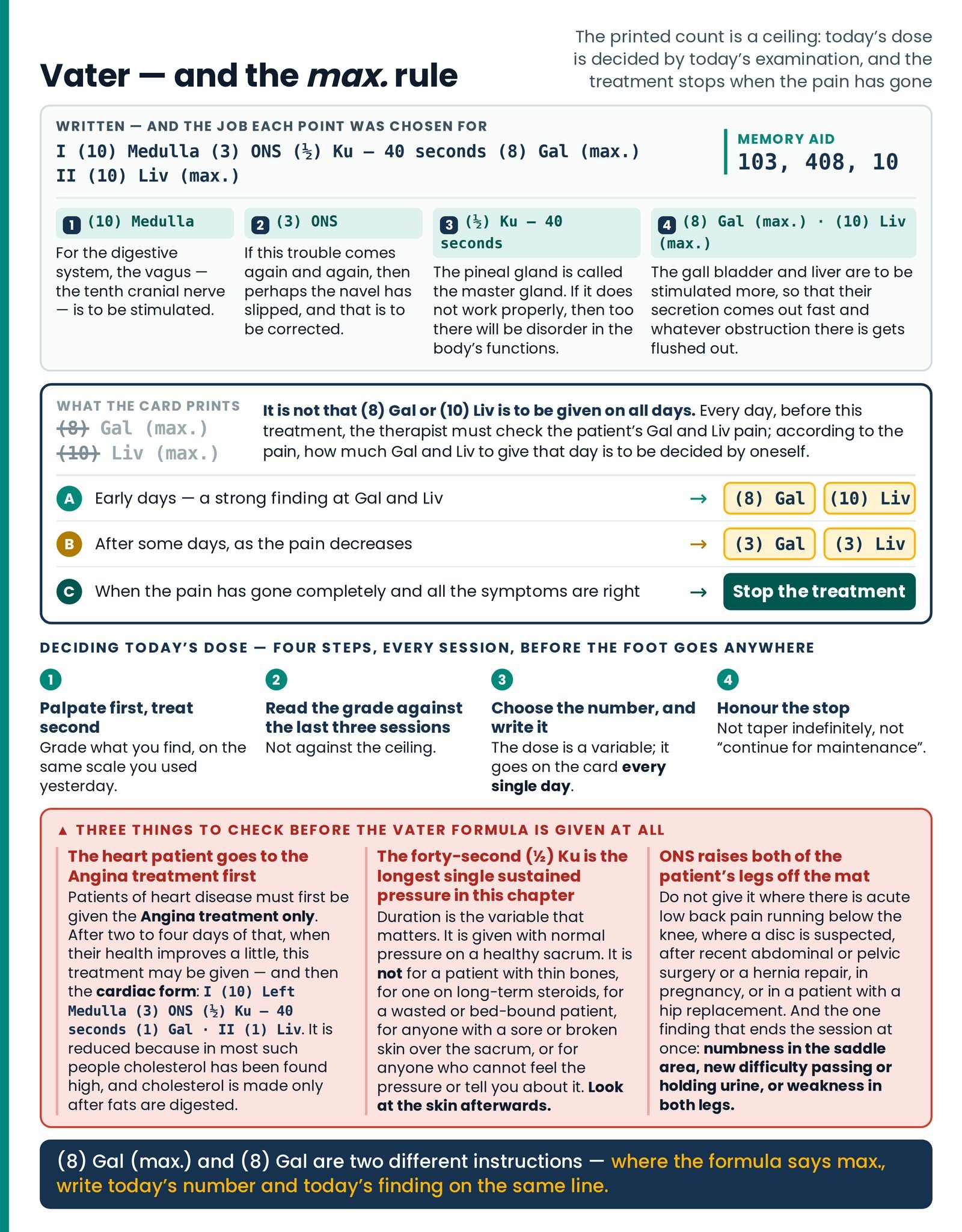
Here the word max., that is maximum, has a special meaning. It is not that (8) Gal or (10) Liv is to be given on all days.
Every day, before this treatment, the therapist must check the patient's Gal and Liv pain. According to the pain, how much Gal and Liv to give that day is to be decided by oneself.
For the first few days give (8) Gal or (10) Liv; but after some days, as the pain decreases, keep reducing the quantity — (3) Gal in place of (8) Gal, or (3) Liv in place of (10) Liv.
The max. rule — the most disciplined dosing instruction in the formulary
When the pain has gone completely and all the symptoms are right, stop the treatment.
That is a ceiling, a titration and a stopping rule written into a single word, and there is nothing else quite like it in . Everywhere else the bracketed integer at a chemical point is exact and may not be varied. Here the bracketed integer is a maximum, and today's number is decided by today's examination. (Figure 27.4)
The formula that came out of what is inside bile — New Gal
Five formulas as one: first the stomach, then the gall bladder
This formula was made in the year 2006 itself. As the number of patients increased, so the knowledge about the functions of the glands increased, and it came to be known that bile looks after several functions in the body. It was found that bile has two chief qualities — antiseptic, protecting from germs, and laxative, driving away constipation.
Then it was seen that those who had any problem whatever in the skin had pain in Gal — and many of them also had constipation. Since in the Chole formula Gal is stimulated, that treatment was given to those patients. The itching certainly reduced, but its effect lasted only a few hours; and such people's stomach was always upset. From which the conclusion that gives the formula its shape: first their stomach should be put right; only then will the gall bladder work properly.
One more piece was needed. Nowadays it has been definitely proved that the (15) Medulla treatment provokes the making of acetylcholine in the brain. Acetylcholine is a neuro-transmitter — necessary for every function of the para-sympathetic nervous system. So wherever we give (10) Medulla, giving (15) Medulla before it brings very good results. Keep that sentence: it is a general rule of construction wearing the clothes of a particular formula, and you will meet (15) Medulla in front of (10) Medulla again and again in the articles that follow.
Table 10 — Card: New Gal Formula Supine Seated 6 sec × 3
| Part I | Fast : Gas : Gas 'I' : Gal : Spl : Liv : Mu — the Fast treatment entire Supine |
|---|---|
| Part II | Ajay Normal mild = (8) Pan (1) Gal (2) Liv – 3 points (1) Gas 'I' – 6 points Supine |
| What I and II do together | These two formulas together will improve the workings of the digestive system — I the digestion, II the absorption |
| Part III | (6) TF 'Gal' + (1) SinglePoint Gal × 6 treatments — to stimulate the gall bladder. Read the + and the × off Table 13, How a Formula Is Built, before you give it |
| Part IV | (15) Medulla Seated — acetylcholine, given before the (10) Medulla that opens part V |
| Part V | The Chole treatment formula — (10) Medulla (6) Gas I (3) Gal — entire Seated Supine |
| Family | Built from the therapy's own logic. Made in 2006 |
| Variant — a very restless child | If the child is very restless indeed, give nine treatments in place of six at part III: (6) TF 'Gal' + (1) SinglePoint Gal × 9 treatments |
| Check before you give it | First the patient's pain points are to be checked. This treatment gives most benefit to those who have pain in the organs of the right side — Gal, Liv |
| Order with the Vater formula | The very best method of treatment: first the ampoulla of Vater is to be opened; afterwards the gall bladder is to be stimulated. So — I. Vater formula · II. New Gal treatment formula |
| Substitutions and prohibitions it inherits | Everything attached to (10) Medulla inside part V — not in diabetes, not in cancer; (10) Left Medulla only in heart patients; and the standing omission argument about Spl, which part I contains ▲ Take care |
| Points taught in | Gas, Gas 'I', Gal, Spl, Liv, Mu, Pan — The Front of the Body I; TF — The Front of the Body II; Medulla — Seated I — Brain, Medulla, Neck |
Read that card from the top and the logic is audible. The whole digestive sequence first, because a gall bladder attached to a bad stomach will not work; then absorption, in its mild form; then the gall bladder itself, worked repeatedly through the day; then the acetylcholine rung, because everything after it is parasympathetic work; and only then the Chole formula, which is the gall bladder treatment proper. It is the longest single prescription in this part of the wiki and the least arbitrary.
What was read about bile, and the conclusion drawn from it
Inside bile are many things, chief among them mucin and lecithin. Of these it was found that —
Mucin is found in saliva, and also in the skin, tendon, cartilage and tissues.
Lecithin is also in the brain, nerves and tissues. From lecithin, choline will be made, and from choline, acetylcholine will be made.
All this one can read in any medical book. But the astonishing thing is now ahead. From these facts a unique conclusion was drawn — that if there is any disturbance whatever in any cartilage, tendon or tissue in the body, or if the waves of peristalsis are to be brought, then it can be put right by the New Gal treatment — because bile provokes peristalsis.
For the past two or three years the results coming from this treatment are beyond belief. It is excellent for all the following:
To remove very hard constipation. To calm those who have extreme anger.
Psoriasis, eczema, warts and moles, fungal infection, or any other skin disease.
If any problem has ever arisen from pus, or there is pus because of some disease — for example, pus or water coming from the ear.
To reduce hyperactivity in autism or in other children.
If from a blow or some illness the tissues or a ligament have been torn or destroyed, or the cartilage of the knee is to be made.
If there are wrinkles in the skin, to correct them — in old age or at a young age.
To correct trembling in the hands — Parkinson's patients too have obtained benefit.
To provoke the wave of peristalsis in the intestines, and to increase hunger.
And the uses as they are set down formally: to 'set' the stomach; to remove constipation; to correct the pains of Gal and Liv; if a ligament or cartilage has been destroyed, to correct it; very good for ringworm, psoriasis or other skin diseases, because bile does the work of an antiseptic, a germ-killer.
Three further instructions travel with that list, and each is a rule of practice rather than an indication.
The first is about children and their mothers' pregnancies. This same treatment is to be given to those children whose mother, during pregnancy, had high BP, or any skin disease, or itching. It has been proved by enquiry that among the women whose children have autism, some were found to have had skin disease during pregnancy. And: if some child comes to you for a long course of treatment, and on enquiry you learn that during pregnancy his mother's BP had gone up — whether they are children of dull intellect, or have come for some other illness — they are first to be given only this treatment for ten to fifteen days, and there will be considerable benefit. Afterwards other suitable treatments may be given.
The second is a claim about prevention. Those whose fats are not digested, if given this treatment once or twice a week, will never get gall stones.
The third is not an instruction at all but an open question, and it is left exactly as it stands. Epinephrine also contracts the muscle of the gall bladder. So in days to come, if (6) Lt. Swt is added to this treatment, perhaps it will become still more effective — this is to be tried.
The shortest of them, and the one that reaches furthest — CCK Normal
Ten seconds between each point, and an ending at the sacrum
This is one more treatment which stimulates the whole digestive system. Its order is as follows.
Table 11 — Card: CCK Normal Formula Seated Supine Prone 6 sec
| Written | (10) Medulla · (1) Gas Only – 6 points · (1) Gal · (1) Gas 'I' – 6 points · (2) S4, S5 |
|---|---|
| Family | Built from the therapy's own logic. Named after the hormone — nothing whatever is administered |
| Positions, in order | Seated → supine → prone Seated Supine Prone |
| Step 1 | (10) Medulla — seated; the nape, both sides. To stimulate the vagus nerve |
| Step 2 | (1) Gas Only – 6 points — both soles on both thighs, hip crease to knee, six or more stations Both sides . To increase the digestion of proteins in the stomach |
| Step 3 | (1) Gal — right sole down the left thigh Left . For hydrochloric acid |
| Step 4 | (1) Gas 'I' – 6 points — soles and heels down both calves, knee to heel, six or more stations Both sides . To increase absorption in the intestine |
| Step 5 | (2) S4, S5 — prone; the fourth and fifth sacral beads Prone . To stimulate the descending colon |
| The rest | Give a gap of ten seconds between each point. By this, digestion and absorption improve |
| What it is for | To stimulate the whole digestive system; mild constipation; and for the eyes |
| What the therapy says about the rest of it | Further research into its other uses is continuing |
| The inseparable pair inside it | Gas Only is followed here by Gas 'I' — the pairing established in How a Formula Is Built. Where the constipation is severe, (2) S4, S5 goes with the Gas 'I', and in this formula it is already there |
| Prohibitions it inherits | Everything attached to (10) Medulla — not in diabetes, not in cancer; (10) Left Medulla only in heart patients ▲ Take care |
| Points taught in | Medulla — Seated I — Brain, Medulla, Neck; Gas Only, Gas 'I', Gal — The Front of the Body I; S4, S5 — Face Down |
Two things about that card are worth more than their length.
The first is the ten-second gap. Everywhere else in this article you are told how many six-second applications to give and in what order; here alone you are told how long to wait between the points. Ten seconds is not a rest in the sense of the one-minute and ninety-second intervals of Table 8 in How a Formula Is Built — it is a breath and a re-positioning, and its work is to stop the five steps running together into one continuous press. It has its own stated purpose, like every written interval in this therapy: by this, digestion and absorption improve.
The second is where the formula ends. Look back at what (10) Medulla does: by means of the vagus nerve it stimulates every part of the digestive system except the descending colon. So a formula whose aim is the whole digestive system has a hole in it at the far end — and the last step, (2) S4, S5, is placed exactly over that hole. The anatomy stated in one place is acted upon in another, a little further on, without comment. That is what it looks like from the inside when a system is coherent, and a student who notices it will read the rest of differently.
And a word about mild constipation, because the adjective is doing real work. Normal bowel habit runs all the way from three times a day to three times a week, and a good many people who describe themselves as mildly constipated are inside it. Treat the patient whose habit has changed, and remember that constipation of recent onset after the age of fifty, or with blood, or with weight loss, is a referral before it is a formula.
The play of Hari — Formula No. 4
The supervisors provoked, not the workers — then the pain of Pan
This formula should be called not the gift of Hari but the very play of Hari. Its results are so wonderful — but the order used in this treatment, and the points, are different from the other treatments. How this marvellous treatment occurred to Guruji's mind — let Hari alone know.
Many kinds of patients used to come. Ordinarily all of them obtained relief within a few days. But among them were some people who, even after some days of all the main treatments, still had very great, indeed extreme pain at the Pan point and around the navel. And they always had a complaint of indigestion.
So the thinking went on for several days: what is to be done for these?
The work force, and the supervisors
Suddenly a thought came. In the formulas so far, only Pan, Gal, Liv and so on — that is, the work force, the executive organs of the digestive system — have been provoked. But when nothing came of that, why not now provoke the major supervisory organs? That is: whichever organ carries the chief responsibility for a given task, that one should be provoked.
The responsibility of provoking the digestive system belongs to the vagus nerve. So it is to be provoked.
If the digestive system does not work properly, then many hormones too will not be made. The responsibility for all the main endocrine functions belongs to the anterior pituitary. So it should be provoked.
Along with this, care must be taken that there is no obstruction in the path by which the message reaches the brain. The path of going inside the brain is the CSF and the spinal cord. In this therapy we provoke both of these by the treatment named Round arrow.
After these three, it is also necessary to take out the pain of Pan.
That is a change of level, not a change of points, and it is the reason this formula sits at the end of the article rather than in the middle of it. Everything before it works on the organs that do the digesting. This one works on the three that order it to be done — and then, having given the orders, takes out the pain that the orders were about.
Table 12 — Card: Formula No. 4 Seated Supine Prone
| Written | (10) Medulla (4) Thrd 'P' (20) ↑\ | ↓ (8) Pan |
|---|---|---|
| Family | Built from the therapy's own logic — though its order and its points are different from the other treatments | |
| Positions, in order | Seated → supine → prone → supine Seated Supine Prone | |
| Step 1 | (10) Medulla — seated; both sides of the nape below the ears Seated . To provoke the vagus nerve | |
| Step 2 | (4) Thrd 'P' — supine; the therapist's feet at the patient's left arm — elbow, shoulder, elbow, shoulder, four contacts making one unit Supine Left . By this we provoke the anterior pituitary | |
| Step 3 | (20) ↑\ | ↓ — prone; the thumb-edge down the right side of the spinous processes to L5, round, and up the left side to the neck, without lifting the finger Prone . By this we provoke the 31 pairs of spinal nerves that lie on both sides of the spine, by which there will be blood flow in all the glands, and the message from the brain to them will also go smoothly |
| Step 4 | (8) Pan — supine; both soles on both thighs together Supine Both sides . For the digestive enzymes to be made properly | |
| How long it takes | About four minutes | |
| What it is for | 1. If, even after the other treatments, there is very great pain in the abdomen — the indication it was built for. 2. Eye diseases — cataract (motiyā); retinitis pigmentosa; night blindness (ratondhī, ratindhā); seeing less; seeing blurred; if the optic nerve dries up | |
| What it does | By giving this formula those patients obtained a great deal of relief at once. The pain of Pan went out, and by this the whole abdomen becomes 'set' | |
| Where the name comes from | It cures the number four pain of the abdomen — that is, intense pain — therefore it was given the name Number Four formula. The grading of pain by numbers, and the signs that replaced it, are taught in Uncommon Problems | |
| The caveat printed with the eye indication | But it is not the case that all kinds of eye-disease patients have had the same benefit | |
| Prohibitions it inherits | Everything attached to (10) Medulla — not in diabetes, not in cancer; (10) Left Medulla only in heart patients ▲ Take care | |
| Points taught in | Medulla — Seated I — Brain, Medulla, Neck; Thrd 'P' — The Front of the Body II; Round arrow ↑\ | ↓ — Face Down; Pan — The Front of the Body I |
The therapy also records, on the same page, how the intensity of abdominal pain was written on the card in the early days — a number above each point before the treatment and a number below it afterwards, so that Pan⁴₂ meant number four pain before, number two after. That notation, and the plus-and-minus signs that replaced it when it became confusable with the application counts, are taught in full in Uncommon Problems, "Points for Uncommon Problems", and used again in The Record That Shows the Truth, "The Record That Shows the Truth". It is mentioned here for one reason only: the formula takes its name from that scale. It is the formula for number four pain.