- Family
- Digestive — preparation
- Explained in
- Setting the Stomach
Watch


From Setting the Stomach
When the burning is not the acid — the Chole treatment
The acid is normal; the meal has not left the stomach
Often people used to come who said that after eating fried things they get a burning-like sensation in the chest. After giving them the NAN formula there was ease for a while, but then the burning would start again.
It is generally said that the burning is happening only because the acid in the stomach has increased — whereas this is not always so. It is Guruji's unique discovery that the burning in the chest happens from the following causes:
The liver or the gall bladder are sluggish — working at a slow speed.
Cholecystokinin or secretin are not being made in the body.
Or there is some blockage in the ampoulla of Vater.
If the patient reports that some while after eating fried things the stomach feels heavy, or sour belches come, or there is a burning in the chest — then their liver or gall bladder is sluggish, that is, not working properly. And the therapy's own footnote to that sentence is worth keeping exactly as it stands, with its qualifier intact: perhaps more than 80% of patients have exactly this. (Figure 27.2)
The rule of the digestive system that explains the burning
The motility of the duodenum and jejunum will remain low so long as the food which is in the duodenum is not properly digested.
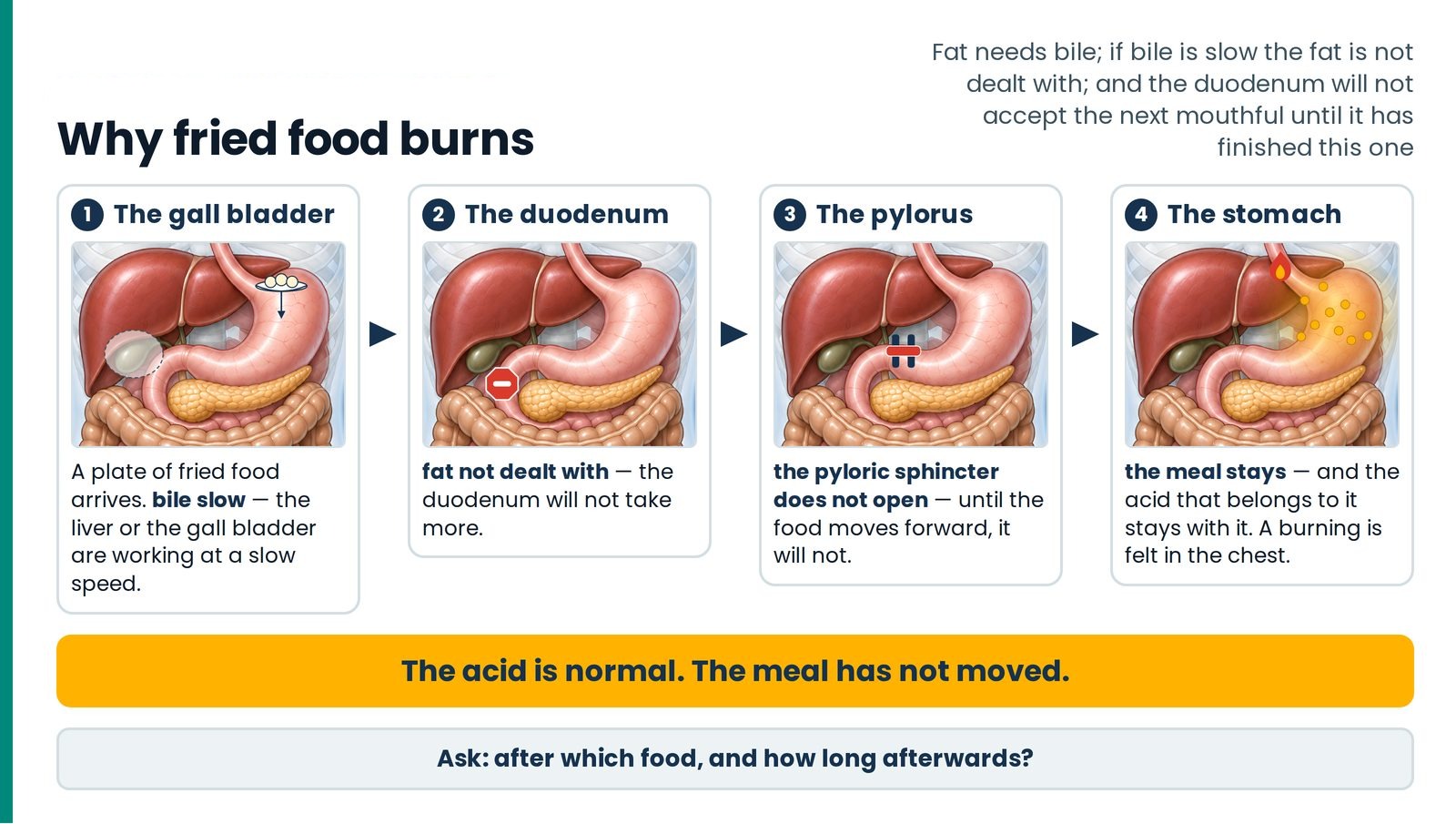
Therefore the food does not move forward quickly; and until the food moves forward, the pyloric sphincter will not open. Because of this the acid-bearing food stays longer in the stomach itself, from which burning is felt — and it seems that the acid has increased, when the truth is that the acid is normal, but the liver or gall bladder are working less.
Read that as a chain and you can say it to a patient in fifteen seconds: fat needs bile; if bile is slow, the fat is not dealt with; the duodenum will not accept the next mouthful until it has finished this one; so the meal sits in your stomach, and the acid that belongs with it sits there too, and burns.
This is the most important piece of reasoning in the article, and not because of the formula it produced. It is important because it is a causal ordering, and a therapist who has it can ask a better question than do you get acidity? He can ask after which food, and how long afterwards? — and the answer tells him where in the chain to work.
The first answer is not the Chole formula. It is a preparatory pair, given before anything else.
Table 7 — Card: the preparatory gall bladder and liver treatment Supine 6 sec × 3
| Written | (3) Gal (7) Liv × 2 treatments — or (1) Gal (4) Liv × 2 treatments |
|---|---|
| Position | Supine Supine |
| Step 1 | Gal — therapist's right sole down the patient's left thigh, hip crease to knee Left |
| Step 2 | Liv — right sole on the patient's left arm above the elbow, left sole on the left thigh, pressed inward, together Left |
| The rounds | The whole pair is given, then the rest, then the whole pair again — two rounds. The rest between rounds is part of the instruction: see Table 8 in How a Formula Is Built |
| What it is for | To put right the digestion of fats. Given first, before the Chole formula. From this itself the patient gets a good deal of relief at once |
| If the illness is chronic — an old one | (1) Single point Liv × 6 trts. is extremely beneficial. Given as the single-point form requires — six seconds at each place, one minute's stop, then the next — four to six times in a day. See Table 8 in How a Formula Is Built, and The Front of the Body I for the point |
The second matter is protein. The motility of the jejunum will also remain low so long as the proteins in the duodenum are not properly digested. Such patients say that after peanuts, rajma, chholé, or non-veg — heavy proteins — they get sour belches, or the stomach feels heavy. Learn that list by heart; it is the question that separates the fat patient from the protein patient, and Indian households will give you the answer readily because these are foods with names and occasions attached to them.
From there the formula assembled itself out of three requirements. (Figure 27.3)
How the three points of Chole were chosen
Cholecystokinin is the hormone which will send a message to the pancreas that it should send the digestive enzymes.
First — the work of provoking CCK belongs to the vagus nerve, which in this therapy we do by (10) Medulla.
Second — along with this we have to increase the motility of the intestine, so that the food already there moves forward, and so that secretin, CCK hormones and the digestive secretions of the pancreas will come out. It has been found that by the Gas 'I' treatment the working of the intestine and its motility increase.
Third — the chief work of CCK is to provoke the gall bladder to send bile. This very work we do by Gal.
From these three the treatment was made. After it, it was seen that fats and heavy proteins begin to be digested well. Since the chief burden of digestion belongs to the cholecystokinin hormone, this treatment was given, in short, the name Chole.
Table 8 — Card: Chole Treatment Formula Seated Supine
| Written | (10) Medulla (6) Gas I (3) Gal |
|---|---|
| Family | Built from the therapy's own logic. Named after the hormone whose effect it means to recruit — nothing whatever is administered |
| Positions, in order | Seated for step 1 Seated , then supine for steps 2 and 3 Supine |
| Step 1 | (10) Medulla — seated; both sides of the neck below the ears. To stimulate the digestive system by means of the vagus, the tenth cranial nerve |
| Step 2 | (6) Gas 'I' — soles and heels down both calves, six or more stations knee to heel Both sides . To stimulate the jejunum and ileum, from which secretin, CCK and the digestive secretions will come out |
| Step 3 | (3) Gal — right sole down the left thigh, three to four stations Left . To stimulate the gall bladder, from which bile will come out to digest fats |
| Given first | The preparatory (3) Gal (7) Liv × 2 trts. (or (1) Gal (4) Liv × 2 trts.) — Table 7 |
| What it is for | Burning in the chest after fried things; heaviness and sour belches after fat or heavy protein; fats and heavy proteins not being digested. Also high BP — the systolic BP falls. Also cataract (motiyā), retinitis pigmentosa, night blindness (ratondhī, ratindhā). By giving this treatment the abdomen becomes completely right, and because digestion and absorption become correct, all the glands begin to work properly. It gives great benefit to children of dull intellect |
| Substitution — heart patients | (10) Left Medulla in place of (10) Medulla |
| Prohibition — diabetes | Those diabetic patients to whom (10) Medulla does not feel good should not be given (10) Medulla ▲ Take care |
| Prohibition — kidney failure | This treatment is not given to patients of kidney failure ▲ Take care |
| Prohibition — cancer | (10) Medulla is not given to patients of cancer ▲ Take care |
| Two variants for setting the stomach | I (10) Medulla (6) Gas 'I' (3) Liv — for secretin · II (10) Medulla (6) Gas 'I' (3) Gal — for CCK |
| Its place in a longer treatment | Part V of the New Gal formula |
| Points taught in | Medulla — Seated I — Brain, Medulla, Neck; Gas 'I', Gal, Liv — The Front of the Body I |
Notice the two variants at the foot of that card, because they are a small masterpiece of matching. If this treatment is to be used for setting the stomach, then giving it in the following way brings still better results — and the only thing that changes is the third point. Liv for secretin; Gal for CCK. The pairing is not arbitrary: secretin's business is with the ducts, and the liver belongs to that response; CCK's business is with muscle and with the acinar cells, and the gall bladder belongs to that one. The route by which a thigh reaches either is the therapy's claim; the map of which hormone acts where is simply correct.