Watch


The sacrum — Ku, the Triangle, and S4–S5
The most forceful work in the atlas, and its clearest prohibitions
The last three treatments are given over the sacrum, the broad triangular plate at the base of the spine, and they are the most forceful things in the atlas. They also carry the group's clearest prohibitions — and those point in opposite directions.
There are two kinds.
One is ½ Ku, in front of which is written how many seconds the treatment is to be given. For example: (½) Ku – 6 secs, (½) Ku – 20 secs, and so on.
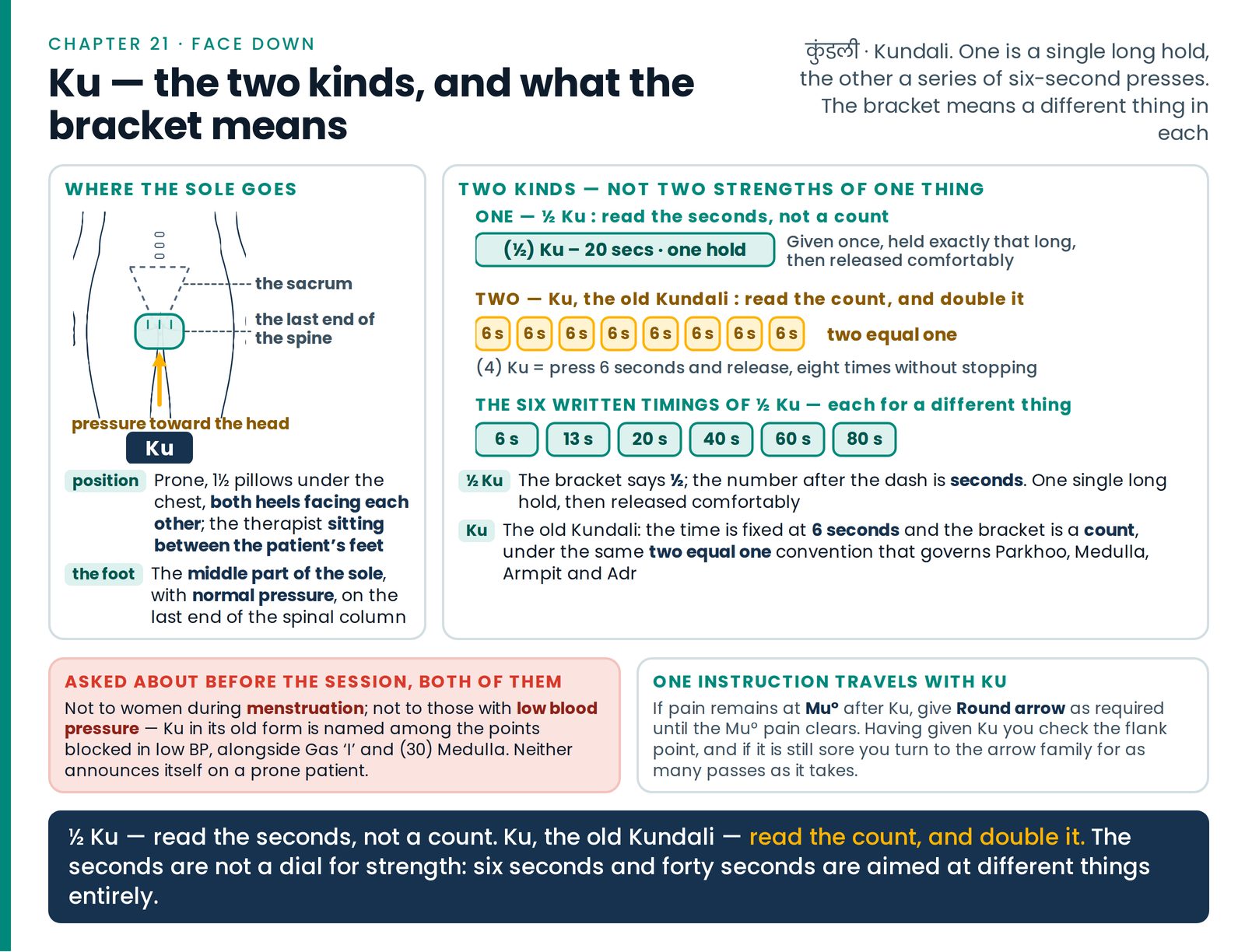
Method of treatment: Lay the patient so that both their heels face each other. Sit between their feet, and with the middle part of your sole, with normal pressure, press on the last end of their spinal column; hold it pressed for as many seconds as is written, and then release comfortably.
There is another kind, called Ku, or the old Kundali. In that the time is 6 seconds; the count is two equal one. If (4) Ku is written, press for 6 seconds and release, and do this 8 times without stopping.
| Patient's position | Prone, 1½ pillows under the chest, both heels facing each other; the therapist sitting between the patient's feet Prone |
|---|---|
| Where the feet are placed | The middle part of the sole, with normal pressure, on the last end of the spinal column |
| Duration and repetitions | ½ Ku: held for as many seconds as is written — for example (½) Ku – 6 secs, (½) Ku – 20 secs — then released comfortably. Ku, the old Kundali: the time is 6 seconds, the count is two equal one, so (4) Ku = press for 6 seconds and release, 8 times without stopping |
| What it is for | Not stated at the point; each written timing carries its own purpose — see below ▲ Take care |
KU — कुंडली · Kundali
The two kinds are not two strengths of one thing. One is a single long hold, the other a series of six-second presses. (Figure 21.5)
½ Ku — read the seconds, not a count. The bracket says ½; the number after the dash is seconds. Given once, held exactly that long, then released comfortably.
Ku, the old Kundali — read the count, and double it. The time is fixed at six seconds and the bracket is a count, under the same two equal one convention that governs Parkhoo, Medulla, Armpit and Adr — so (4) Ku is eight presses of six seconds, without stopping.
Every written timing of Ku, and what each one is for
Each is a different instruction with a different purpose. They are never merged, and a card asking for one is not satisfied by another.
Written as · How it is given · What it is for · When it must not be given
(4) Ku (the old Kundali) · Two count as one — eight applications of 6 seconds, without stopping · To reduce alkali. To reduce spasticity and stiffness in the joints. If pain remains at Mu° after Ku, give Round arrow as required until the Mu° pain clears · Not to women during menstruation. Not to those with low blood pressure ▲ Take care
(½) Ku – 6 secs · Once, for 6 seconds · For the mast cells, which assist in producing heparin · —
(½) Ku – 13 secs · Once, for 13 seconds · For the eosinophils · —
(½) Ku – 20 secs · Once, for 20 seconds · For the neutrophils, which will fight infection. To raise WBC, RBC, monocytes and so on. To correct infection or inflammation in the intestines of those who have had UDF for many years · —
(½) Ku – 40 secs · Once, for 40 seconds · To stimulate the pineal gland — for melatonin. To correct disorders of the brain, speech or CSF — such as MND and MS. Excellent for cerebral atrophy · —
(½) Ku – 60 secs · (½) Ku – 80 secs · Once, for 60 or for 80 seconds · These also stimulate the pineal gland. Research on them is continuing · —
The seconds are not a dial for strength — six seconds and forty seconds are aimed at different things entirely. And the last line stands as written: research on them is continuing. A therapy that marks its own unfinished work deserves the mark kept.
And one instruction travels with Ku rather than with the point it names. If pain remains at Mu° after Ku, give Round arrow as required until the Mu° pain clears. Having given Ku, you check the flank point, and if it is still sore you turn to the arrow family for as many passes as it takes.
What lies beneath. The sacrum and the tail bone, with short strong ligaments and the great buttock muscle taking origin from the back of the plate. Deeper, on the front of the sacrum, lie the last station of the alarm chain and the nerves governing bladder and bowel. Interesting anatomy, a long way short of a demonstrated mechanism.
TRIANGLE FOR PILES — ट्रायंगल फॉर पाईल्स
This is given for piles (बवासीर). That is why it has been given this name.
Method:
As per the figure, stand with the feet on the ground between the waist and the thigh. First place the heel of one foot on their hip near the tail bone — that is, the last end of the spinal column.
Then, taking the full weight of the body on the hands with the support of the chairs, place both heels above the hip, near the S5 bead (at the place marked 1 in the figure).
Simultaneously pressing with the heels in the direction of the head, with one jerk push the muscles below upward.
Then change the position of your heels, placing them slightly outward, near the S3 bead, and give an upward jerk.
Finally, do the same near the S1 bead.
Repeat as many times as needed.
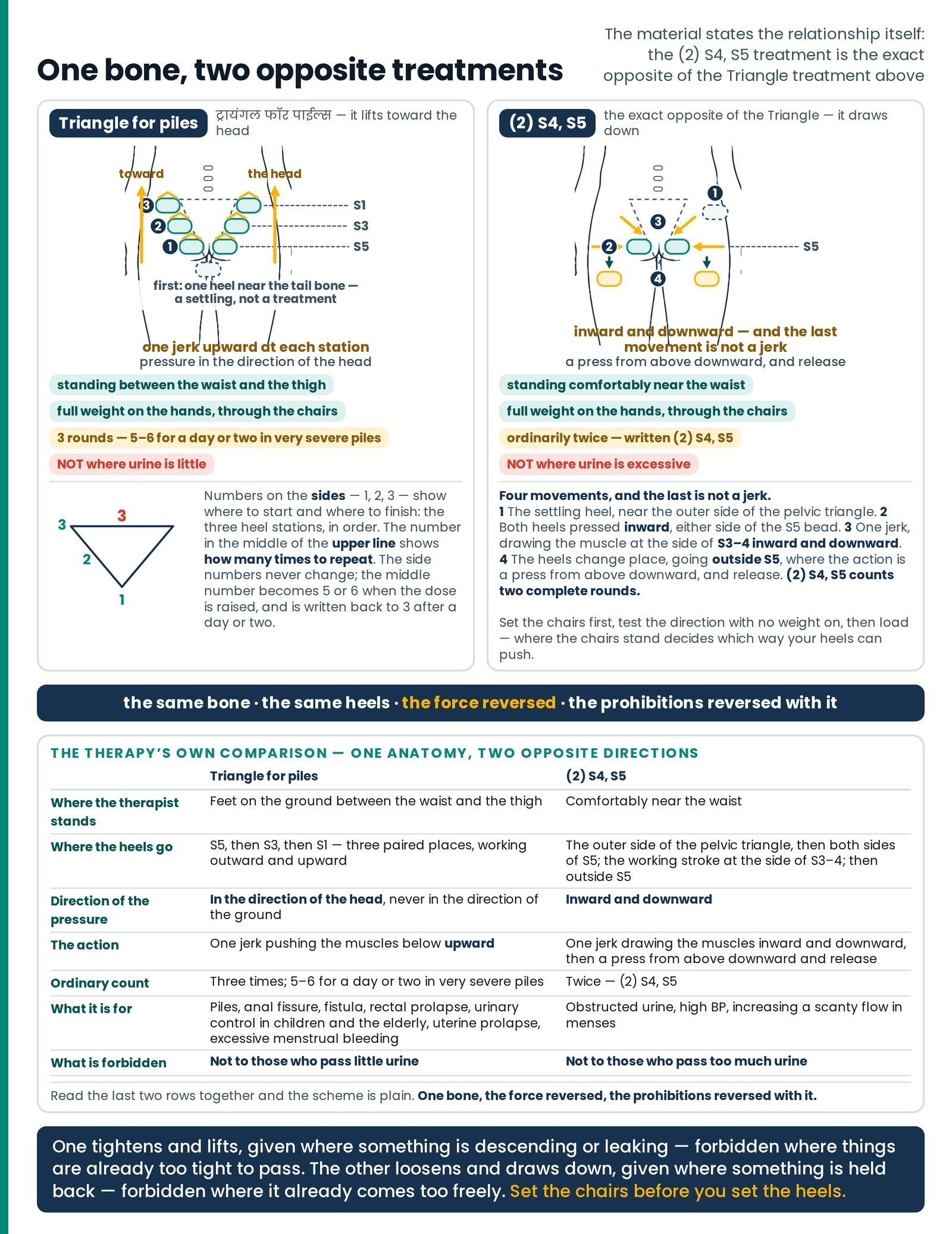
In the symbol above, the numbers '1', '2', '3' on the sides of the triangle show where to start and where to finish; but the number '3' written in the middle of the upper line shows how many times to repeat.
For an ordinary person three times is enough, but for very severe piles one may give 5–6 times for a day or two at first — then the middle number will change to 5 or 6.
Besides piles, it also gives benefit in anal fissure, fistula and prolapse of the rectum. It is also beneficial for control of urine in children and in the elderly, and in women for prolapse of the uterus and for controlling excessive bleeding in menstruation.
| Patient's position | Prone, 1½ pillows; the therapist standing with the feet on the ground between the waist and the thigh, the full weight of the body on the hands with the support of the chairs Prone |
|---|---|
| Where the feet are placed | First the heel of one foot near the tail bone — the last end of the spine. Then both heels above the hip, near the S5 bead (place 1); slightly outward, near S3 (place 2); near S1 (place 3) |
| Duration and repetitions | At each place, pressing with the heels in the direction of the head, with one jerk push the muscles below upward. Three times is enough for an ordinary person; for very severe piles, 5–6 times for a day or two — the middle number then changes to 5 or 6. Repeat as many times as needed |
| Direction | Place the chairs so that the pressure is in the direction of the head, and not in the direction of the ground ▲ Take care |
| What it is for | Piles (बवासीर); anal fissure, fistula, prolapse of the rectum; control of urine in children and the elderly; in women, prolapse of the uterus and excessive bleeding in menstruation |
The three stations trace the shape of the bone — a triangle standing on its point: place 1 low and close to the midline at S5, place 2 further out at S3, place 3 highest and widest at S1. The first placement, one heel near the tail bone, is a settling, not a treatment. Then every station is one jerk, upward — a single quick lift of the tissue toward the head, both heels together, after which the heels are moved. You do not jerk twice from the same place. (Figure 21.6)
Reading the triangle symbol — numbers on the sides, and the number in the middle
The glyph is an inverted triangle with numbers on it, and they mean two different things depending on where they sit.
'1', '2', '3' on the sides show where to start and where to finish — the three heel stations, in order.
'3' in the middle of the upper line shows how many times to repeat.
So the middle number is a dose, and it changes: three times is enough for an ordinary person, but in very severe piles one may give 5–6 times for a day or two — and then the middle number will change to 5 or 6 on the card. The side numbers never change, because there are always three stations. The raised dose is written for a day or two, not for a course.
What lies beneath. The heel sits on the back plate of the sacrum, over the origin of the great buttock muscle and the flat tendon of the long back muscles; the small holes through which the sacral nerves reach the buttock lie in rows under the stations. The nerves running to bladder and back passage come off the same levels but turn forward, where no heel follows. The upward vector is coherent — but coherent is not demonstrated, and both words should be used. And one fact, because patients ask: the cushions inside the back passage are normal anatomy, and piles are what happens when the tissue anchoring them gives way.
S4–S5
Method:
Stand comfortably near the patient's waist. First place the heel of one foot on their hip near the outer side of the pelvic triangle (as per the figure).
Then, taking the full weight of the body on the hands with the support of the chairs, and pressing both heels inward into the hip, place them on both sides of the S5 bead.
Then, with your heels drawing and pressing the muscles at the side of S3–4 inward and downward, give one jerk.
Then change the place, and on both sides of the hip, on the outer side of S5, press from above downward and release.
Ordinarily it is done twice, which is written as (2) S4, S5.
From the method it will be clearly seen that the (2) S4, S5 treatment is the exact opposite of the Triangle treatment above.
If urine is obstructed, the (2) S4, S5 treatment helps to bring it.
So it is beneficial for high BP. And if the flow in menses is scanty, it is useful in increasing it.
| Patient's position | Prone, 1½ pillows; the therapist standing comfortably near the patient's waist, the full weight on the hands with the support of the chairs Prone |
|---|---|
| Where the feet are placed | First the heel of one foot near the outer side of the pelvic triangle; then, pressing both heels inward into the hip, both sides of the S5 bead; the heels drawing and pressing the muscles at the side of S3–4 inward and downward; then, changing place, both sides of the hip outside S5, pressing from above downward and releasing |
| Duration and repetitions | One jerk at the S3–4 stroke; then the press from above downward and release. Ordinarily it is done twice, which is written as (2) S4, S5 |
| What it is for | Bringing obstructed urine; high BP; increasing a scanty flow in menses |
Four movements, and the last is not a jerk. The settling heel at the outer side of the pelvic triangle; both heels pressed inward, either side of S5; one jerk, drawing the muscle at the side of S3–4 inward and downward; then the heels change place, going outside S5, where the action is a press from above downward, and release. (2) S4, S5 counts two complete rounds.
What lies beneath. The same field as the Triangle, worked in reverse. The therapy's own account is plain — to stimulate the sacral nerves, the muscles at both sides of the S3–S5 beads are pulled from above downward — and those levels genuinely are the levels from which bladder, uterus and back passage take their nerve supply. The levels are right. The route from a heel on the back of the bone to nerves running on its front face is the part that has never been shown.