Watch


The two adrenal points
Adr for the cortex, Swt for the medulla — and nothing else is alike
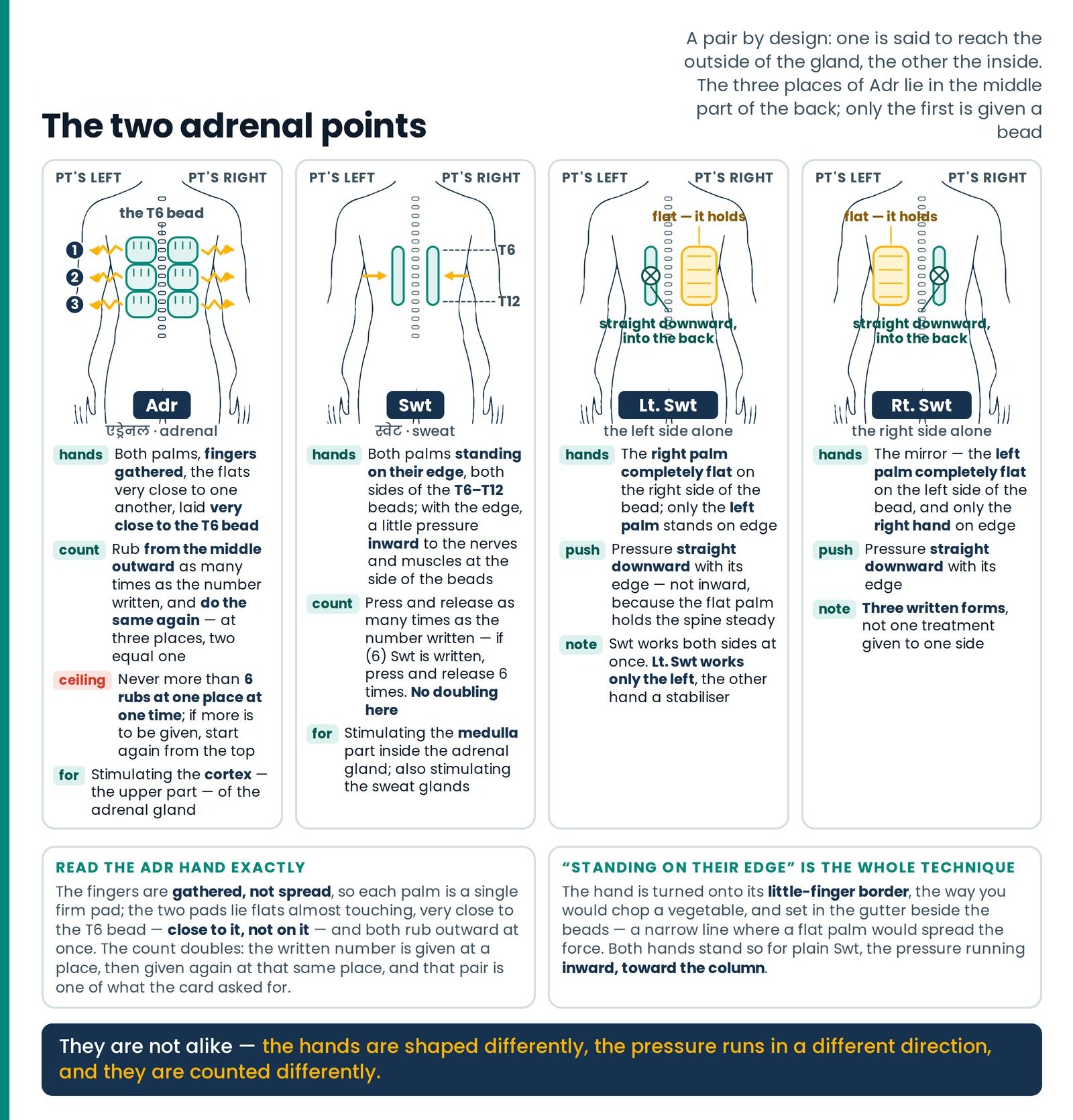
Two points open the group, a pair by design: one is said to reach the outside of a gland, the other the inside. They are not alike — the hands are shaped differently, the pressure runs in a different direction, and they are counted differently.
This is given to stimulate the cortex — that is, the upper part — of the adrenal gland.
Gathering your fingers together, place both palms very close to the T6 bead of the back, so that the flats of the two palms are very close to one another.
In the middle part of the back, at three places, rub from the middle outward as many times as the number written, and do the same again.
That is: at three places, two equal one.
At one place, do not rub more than 6 times at one time. If more is to be given, start again from the top.
| Patient's position | Prone, 1½ pillows under the chest, the chin resting Prone |
|---|---|
| Where the hands are placed | Both palms, fingers gathered, flats very close to one another, laid very close to the T6 bead; then at three places in the middle part of the back |
| Duration and repetitions | Rub from the middle outward as many times as the number written, and do the same again — at three places, two equal one. Never more than 6 rubs at one place at one time; if more is to be given, start again from the top ▲ Take care |
| What it is for | Stimulating the cortex — the upper part — of the adrenal gland |
Read the hand exactly. The fingers are gathered, not spread, so each palm is a single firm pad; the two pads lie flats almost touching, very close to the T6 bead — close to it, not on it — and both rub outward at once. And the count doubles: the written number is given at a place, then given again at that same place, and that pair is one of what the card asked for. (Figure 21.2)
ADR — एड्रेनल · adrenal
The ceiling on Adr, and what to do when the card asks for more
At one place, do not rub more than 6 times at one time. If more is to be given, start again from the top.
If the number written is larger than the ceiling allows, you do not stay and keep rubbing — you go back to the first of the three places and come down again. A large number becomes more passes down the back, never a longer stay in one spot.
(2) Adr, (4) Adr, (6) Adr — three treatments, not three strengths
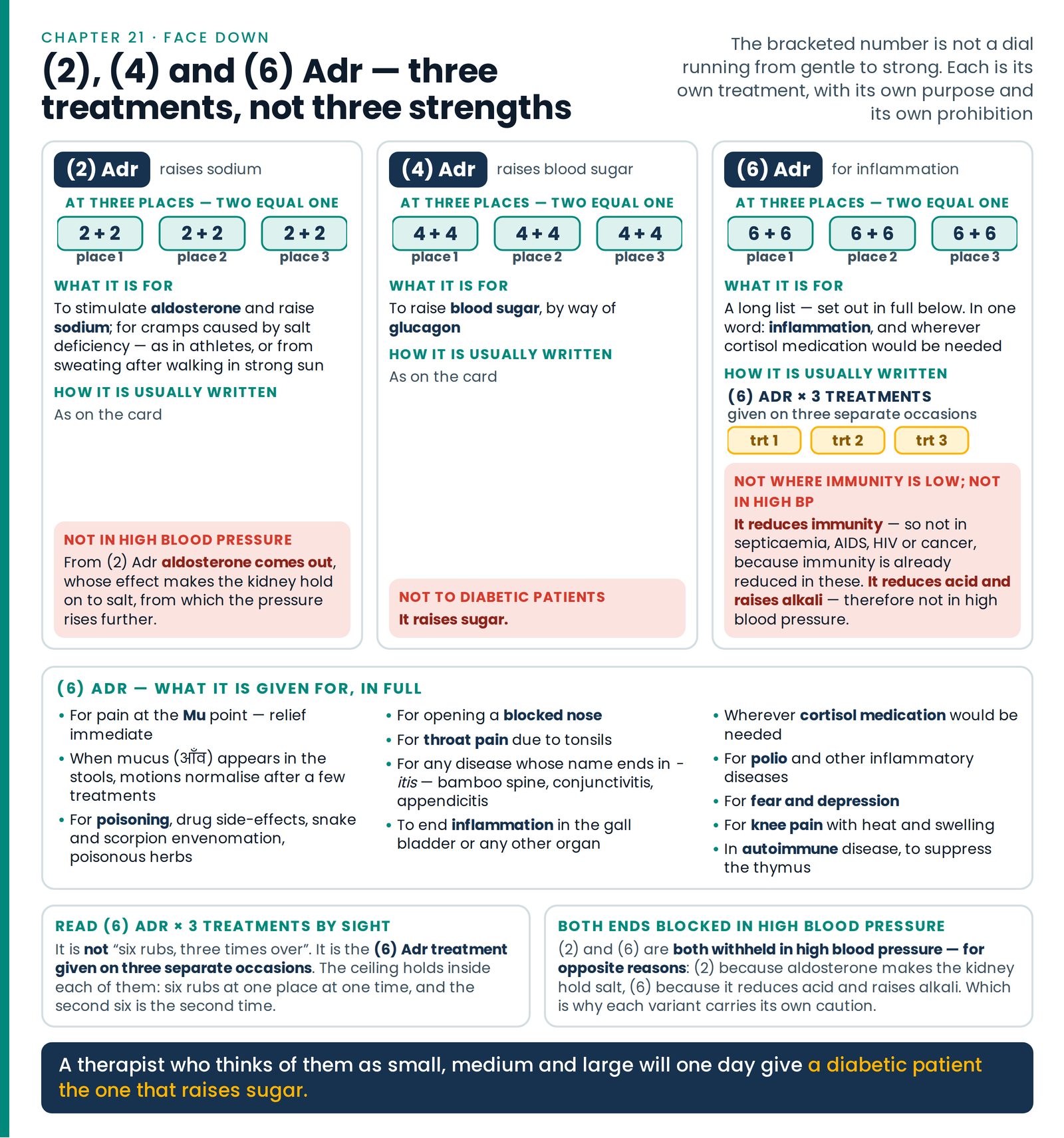
(6) ADR × 3 treatments is a form to learn by sight — not "six rubs, three times over", but the (6) Adr treatment given on three separate occasions. Note too that (2) and (6) are both withheld in high blood pressure for opposite reasons, which is why each variant carries its own caution. The rest of their use, and every condition in which each is blocked, is in Each Point in Use, "Each Point in Use", and When the Hand Must Stop, "When the Hand Must Stop". (Figure 21.3)
What lies beneath. A hand flat on the upper back lies over the broad sheet of muscle running to the shoulder, the two long ropes holding the spine upright, and then the ribs. The adrenal glands are nowhere near — two caps of four to six grams on top of the kidneys at the back of the belly, far lower than T6 and behind all of that. What the palm reaches is real; what it does not do is deliver a message to one named gland.
SWT — स्वेट · sweat
With this treatment we stimulate the medulla part inside the adrenal gland.
It is also useful for stimulating the sweat glands.
Place both palms standing on their edge on both sides of the T6–T12 beads, and with the edge of the hands give a little pressure inward to the nerves and muscles at the side of the beads, pressing and releasing as many times as the number written. If (6) Swt is written, press and release 6 times.
If Left Swt is to be given, place the right palm completely flat on the right side of the bead, and keep only the left palm standing on edge, giving pressure straight downward with its edge. If Right Swt is to be given, place the left palm completely flat on the left side of the bead, and keep only the right hand standing on edge and give pressure.
| Patient's position | Prone, 1½ pillows under the chest Prone |
|---|---|
| Where the hands are placed | Both palms standing on their edge, both sides of the T6–T12 beads; the edge of the hands, a little pressure inward to the nerves and muscles at the side of the beads |
| Duration and repetitions | Press and release as many times as the number written — if (6) Swt is written, press and release 6 times. No doubling convention here |
| Laterality | Left Swt: right palm completely flat on the right side of the bead, only the left palm on edge, pressure straight downward Left · Right Swt: the mirror — left palm flat, only the right hand on edge Right |
| What it is for | Stimulating the medulla part inside the adrenal gland; also stimulating the sweat glands |
"Standing on their edge" is the whole technique. The hand is turned onto its little-finger border, the way you would chop a vegetable, and set in the gutter beside the beads — a narrow line where a flat palm would spread the force. Both hands stand so for plain Swt, the pressure running inward, toward the column.
When one side alone is written, the other hand changes job entirely. For Left Swt the right palm goes down completely flat and stays there, and only the left works — and because the flat palm holds the spine steady, the pressure at Lt. and Rt. Swt is straight downward rather than inward. Three written forms, not one treatment given to one side.
What lies beneath. In the gutter either side of the T6–T12 beads lie the long upright muscles, the short slanting ones beneath, and the nerves supplying both. The sympathetic chain, which does reach the adrenal medulla, runs at these levels — but down the front of the vertebrae, on the far side of the bone from any hand on a back. The therapy has named the right system and the wrong side of it. The sweat half of the name is better founded: sweat glands really are governed by that same chain, segment by segment down the trunk.