Watch


The side-turn — how to lie down and how to get up
Down by way of the side, up by way of the side — always
Why the side-turn matters — the reason given
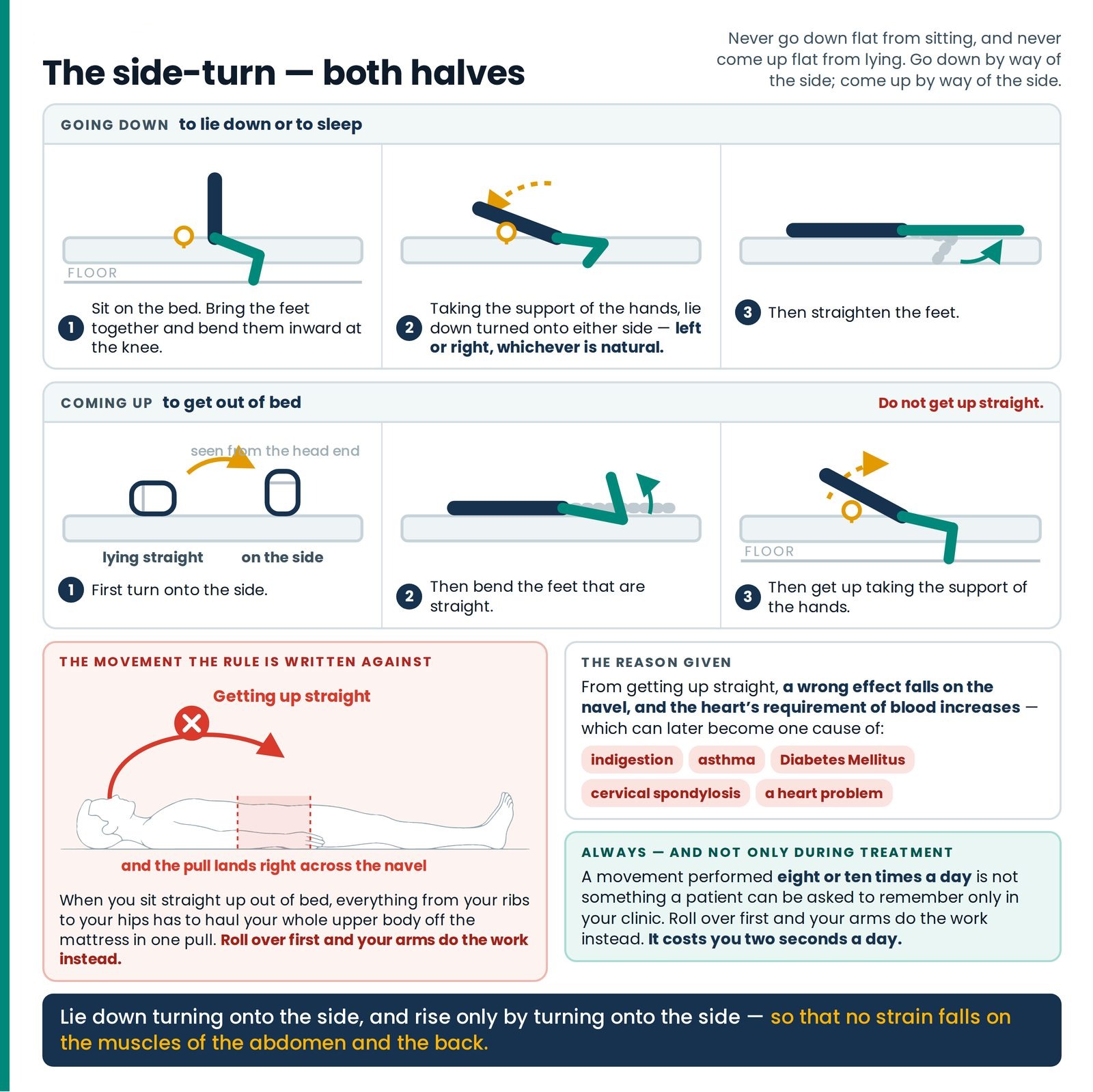
From getting up straight, a wrong effect falls on the navel, and the heart's requirement of blood increases — which can later become one cause of indigestion, asthma, Diabetes Mellitus, cervical spondylosis, or a heart problem.
Teach the rule exactly as it stands. It is one of the very few rules in this article whose stated reason reaches that far forward, and a student who trims it has removed the part that makes a patient take it seriously.
Say it across the mat in the patient's own terms. When you sit straight up out of bed, everything from your ribs to your hips has to haul your whole upper body off the mattress in one pull — and the pull lands right across your navel. Roll over first and your arms do the work instead. It costs you two seconds a day. (Figure 38.2)
Then show her. Do not describe it — lie down on the mat yourself, get up the wrong way, get up the right way, and make her do it twice before she leaves. An instruction about a movement is learnt by moving.
The hour, the dark and the window
Asleep by 10.30, the room dark, the window open — and why each
Table 2 — The rules of sleeping, and the reason for each
| The rule | The reason |
|---|---|
| We should go to sleep before 10.30 at night. | Only from the pineal gland remaining in order do all the body's affairs run smoothly. It is said that in India it awakens between 12.30 and one o'clock at night. Even if it works only for ten minutes, it will work only if we are in good deep sleep — and to reach deep sleep the ordinary person needs at least two hours. |
| Take care that there is complete darkness in the room, so that the pineal gland is properly provoked. Better not to form the habit even of a night lamp — a zero-watt bulb. | From sleeping in a dark room the lifespan becomes long. The tortoise's lifespan is more than two to three hundred years, and it always sleeps in darkness with its neck tucked in. In the old days the rishis and munis lived in dark caves, and many had lifespans of more than two to three hundred years. |
| Lie down keeping the whole body loose; give attention that there be no tension in the mind. | If there is tension in the mind on rising, the head will remain heavy all day. So at night, remembering Hari, sleep with a calm mind; and on rising too, taking Hari's name, get up with good positive thoughts — the whole day will go well. |
| Sleep with the windows opened, so that fresh air comes into the room. | From sleeping in a closed room the quantity of carbon dioxide in the room increases, from which the body will remain tired all day and there will be no wish even to work. |
| Sleep with the legs straight. | Taught with its full reason in Part seven of this article, where the position of the legs is given whole. |
| Do not sleep with the hands placed under the head. | Taught with its full reason below. |
Take the 10.30 rule apart before you give it, because it is the one patients argue with hardest and it is not a rule about 10.30 at all. It is a rule about being two hours deep by half past midnight. The clock time is arithmetic performed backwards from the gland: the ordinary person needs about two hours to reach good deep sleep, so a person who lies down at 10.30 is in that state when the gland does its work, and a person who lies down at half past twelve is not. Give a patient the arithmetic and she will do the arithmetic herself for her own household — which matters, because in a house where the last meal is at ten the rule has to be argued with the kitchen first.
The darkness rule and the hour rule are one rule, not two. The gland is provoked by darkness, and a zero-watt bulb burning all night is not darkness. The instruction is specific about the habit rather than the bulb: better not to form the habit even of a night lamp. A child who cannot sleep without one is a separate conversation; an adult who leaves it on because it was on when she was a child is not.
The open window, and a patient who did not respond
When a treatment fails one patient, stop adjusting it and ask about the life
The instruction is short: sleep with the windows opened, so that fresh air comes into the room — because from sleeping in a closed room the quantity of carbon dioxide in the room increases, from which the body will remain tired all day and there will be no wish even to work.
The case that established it in the teaching is told in full, with the whole of its reasoning, in The Hand That Heals, "The Hand That Heals" — the woman at the Bandra clinic whose rheumatoid pain returned every morning, who slept with her windows shut out of fear of the cold, and who got well on the same treatments that had been failing her for weeks once she opened them.
What belongs here is what the case is for. It is the founding case of the patient's half, and the move in it is one you will make a hundred times: a treatment that works for many patients and not for this one is usually not the wrong treatment. Stop adjusting it. Ask about the life.
The counted breath at bedtime
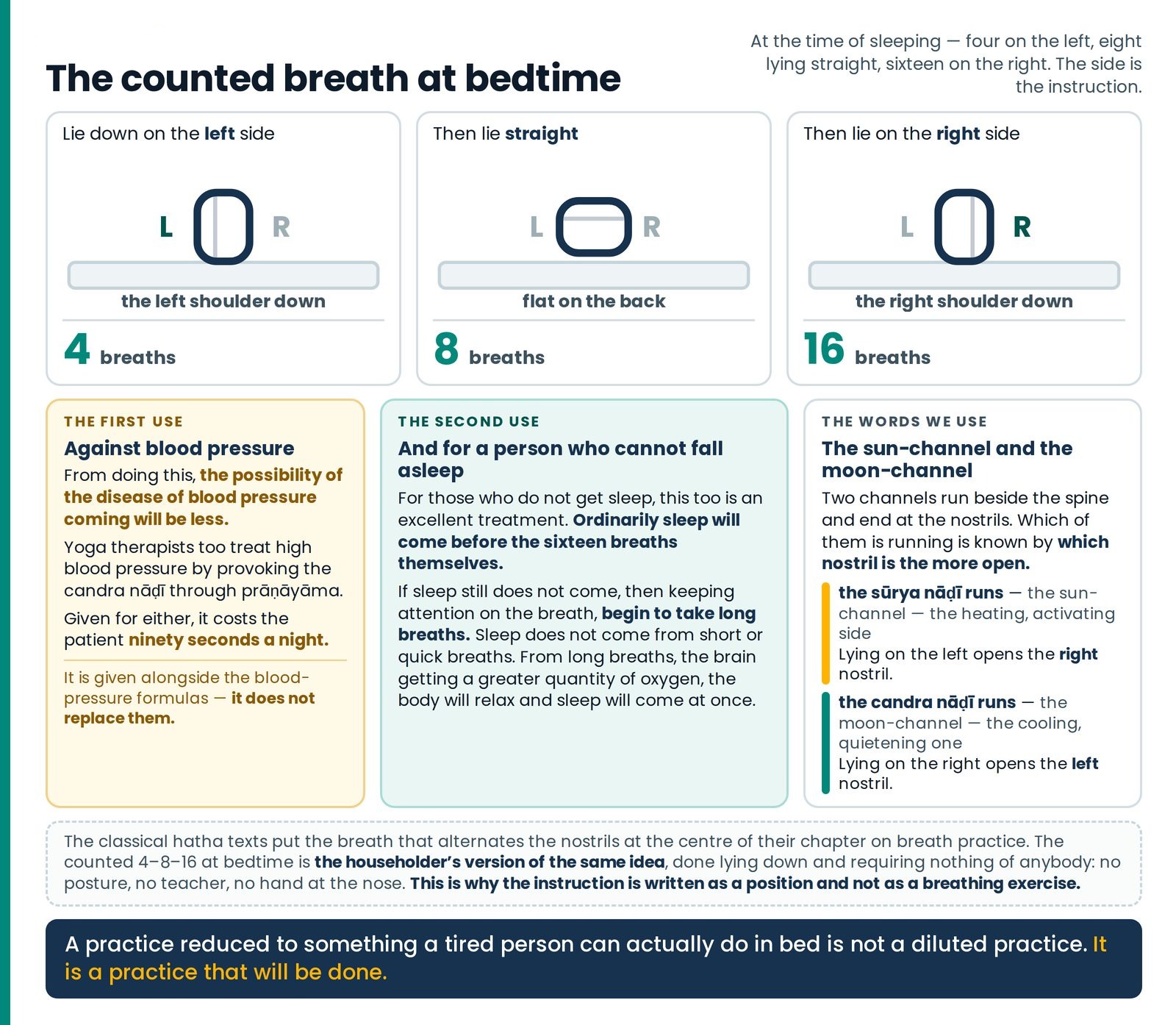
Four on the left, eight lying straight, sixteen on the right
Two uses, one practice. It is given as a preventive against blood pressure, and it is given — in its own bracketed note — as a treatment for a person who cannot fall asleep. Give it for either and it costs the patient ninety seconds a night. (Figure 38.3)
Why the arms must stay down
The pipe to the arm comes out under the collarbone, and the arm is a lever
Never sleep with the hands under the head
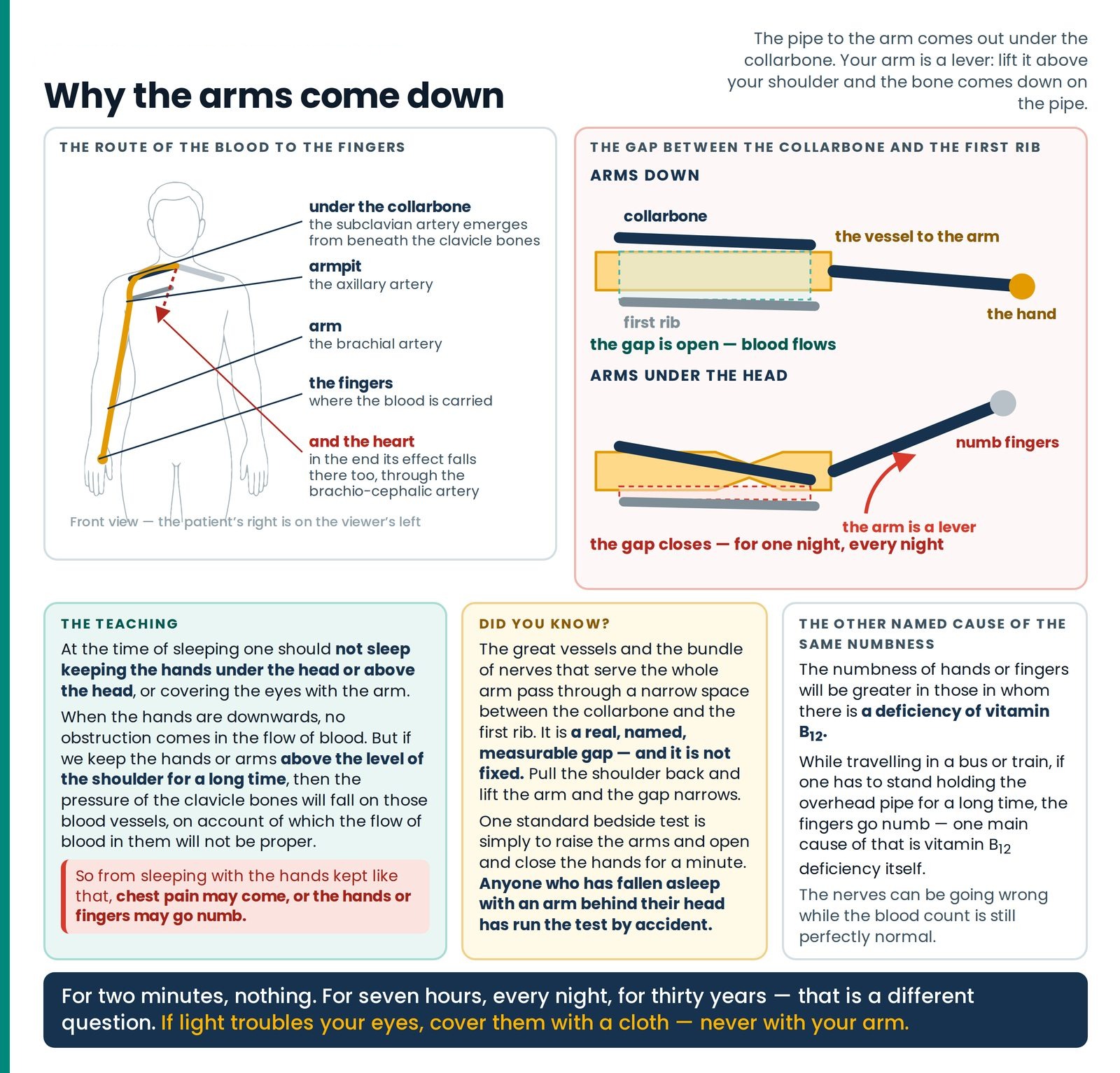
At the time of sleeping one should not sleep keeping the hands under the head or above the head, or covering the eyes with the arm.
If any light is falling on the eyes, cover them with a cloth — but do not place the arm on the eyes.
The reason. From both sides of the neck the subclavian arteries emerge, which, coming out from beneath the clavicle bones above the shoulders, carry blood up to the fingers through the vessels named the axillary and brachial arteries. When the hands are downwards, no obstruction comes in the flow of blood. But if we keep the hands or arms above the level of the shoulder for a long time — as happens when sleeping with them under the head — then the pressure of the clavicle bones will fall on those blood vessels, on account of which the flow of blood in them will not be proper. In the end its effect will fall on the heart too, through the brachio-cephalic artery.
So from sleeping with the hands kept like that, chest pain may come, or the hands or fingers may go numb. ▲ Take care
Trace it for the patient with your own hand on your own collarbone: the pipe to your arm comes out here, under this bone. Your arm is a lever. Lift it above your shoulder and the bone comes down on the pipe. For two minutes, nothing. For seven hours, every night, for thirty years — that is a different question. (Figure 38.4)
And give the second half of the rule its due, because students drop it. The arm across the eyes is forbidden too. A patient who cannot sleep with light on her face is to cover the eyes with a cloth, which costs nothing and puts no arm above a shoulder.
The numbness, and what lies behind it
The numbness of hands or fingers will be greater in those in whom there is a deficiency of vitamin B₁₂.
While travelling in a bus or train, if one has to stand holding the overhead pipe for a long time, the fingers go numb — one main cause of that is vitamin B₁₂ deficiency itself.
That is a piece of ordinary observation worth more than most laboratory slips: the patient who tells you her fingers go dead on the morning bus has told you something to follow up.
And it is worth knowing, when a patient waves a normal blood report at you, that this particular vitamin does its damage in an unusual order. Most people meet it as a cause of anaemia and expect a shortage to show first as a low haemoglobin. It does not have to. The nerves can be going wrong while the blood count is still perfectly normal — pins and needles, dead fingers, an unsteady walk in the dark — because the vitamin's work in the coverings of nerve fibres is a separate job from its work in the marrow. So persistent, symmetrical numbness in both hands is worth a question rather than a shrug.
Rising
Before sunrise, thirty seconds on the bed's edge, slippers before the floor
Table 3 — The rules of rising, and the reason for each
| The rule | The reason |
|---|---|
| At the time of rising in the morning too there should be complete darkness — so rise before the sun rises. | If there is a great deal of light in the room at the time of rising, the head will remain heavy all day. From sleeping early and rising early, the body will be healthy. |
| While rising, rise taking Hari's name, with good thoughts. | If there is tension in the mind on rising, the head will remain heavy all day — so get up with good positive thoughts, and the whole day will go well. |
| Do not get up straight: first turn onto the side, then bend the straight legs, then get up taking the support of the hands. | Given in full above, with the side-turn. |
| At the time of getting up, sit on the bed for at least thirty seconds and then get up. | Given in full in Part five, with the organ of balance. |
| Whether morning, noon or evening, on getting up from the bed do not place the feet immediately on bare ground. Place them on slippers — or after staying a while, they may be placed on bare ground. | Inside the bed your feet were warm, whereas the ground is cold, so placing the feet on bare ground immediately on rising may give you a cold. |
Rise before the sun rises is the rule, and the reason attached to it is about light in the room at the moment of waking, not about virtue. That is worth saying to a patient who works nights and cannot keep it: what the rule is protecting is being woken in darkness rather than in glare, and a shift worker can get most of that with a heavy curtain. Do not pretend the rule is fully kept; say which half of it can be.
The slippers rule is one patients keep more readily than any other in this article, because it costs nothing and because everybody has felt the shock of a cold floor at five in the morning. Take the free compliance. It also happens to be the rule that protects the patients you worry about most — the ones who cannot feel their feet properly.
Bathing looks like the least clinical subject in this wiki and is not. It is a thing done daily, with water, near the ears, near the head, on knees that are already painful, with an article of commerce applied to the whole skin — and every one of those has a rule attached, with a reason.
Table 4 — The rules of bathing, and the reason for each
| The rule | The reason |
|---|---|
| As far as possible bathe with cold water only, in every season. | Those who form the habit of cold-water bathing have less chance of catching cold, because the blood circulation happens well — this is a matter of experience. Bathing with cold water is best for the blood circulation. If this habit is instilled from childhood itself, then troubles like colds and coughs will not occur in children at all. |
| When washing the head, first pour one lota of water on the head, taking care that it does not come onto the ears; then on the back and shoulders below the neck; then on the whole body. | If the first lota's water falls on the shoulders or the ear, then a deep breath coming, water can go into the ears. This water, after thinning the dirt or wax of the ears, becomes a kind of bubble on account of the heat inside, whose pressure coming onto the opening of the ear reduces the hearing. Those who hear less, if besides our treatment they change the manner of bathing, a difference in hearing comes quickly — this is a matter of experience. |
| Some people, bathing sitting with hot water, first pour water on the knees. Guruji says this too is one cause of knee pain coming in old age — so instead of pouring on the knees first, begin by pouring water on the head as said above. | Stated within the rule. |
| We should not bathe with soap. | Soap does damage to the skin. Sweat itself is beneficial, because in it there are many germ-killing elements, which are destroyed after applying soap. |
| Before bathing, one drop each of mustard oil, or any other oil, should certainly be applied at five places — behind the ears, in the nostrils, and the navel, the anus, and the armpits. After applying oil at all these places, apply it on the whole body, and afterwards bathe with plain water only, without soap. | Guruji himself is witness that from doing so, no bad odour in the body nor any kind of skin disease will occur — because for the last fifty years he has bathed without soap only. |
That last line is the one to say to a young mother, and it is worth thirty seconds of demonstration with an empty mug.
The order is not ceremony. It follows from what the rule is protecting: water arriving first at the shoulders sends the person's breath in sharply, and water goes into the ear on that breath. Anybody who has had cold water land on the back of the neck knows the gasp. Pour on the crown first and the gasp happens with the ears already out of the line of fire. (Figure 38.5)
Hearing, and the manner of bathing
Those who hear less — if, besides the treatment, they change the manner of bathing, a difference in hearing comes quickly. This is a matter of experience.
Two things follow for practice. First, a patient who comes with reduced hearing is asked how she bathes, at the first visit, before any point is chosen. Second, the change costs nothing and can be made the same evening, which means you will know within a fortnight whether it was part of the answer.