Watch



The one rule the patient must keep, and the one the patient must break
Say it the moment it hurts — and never help with the pillow
Two of the treatment-hour rules are different in kind from the rest. One is the patient's single real responsibility. The other is the one rule patients break out of politeness, every day, in every centre in the country.
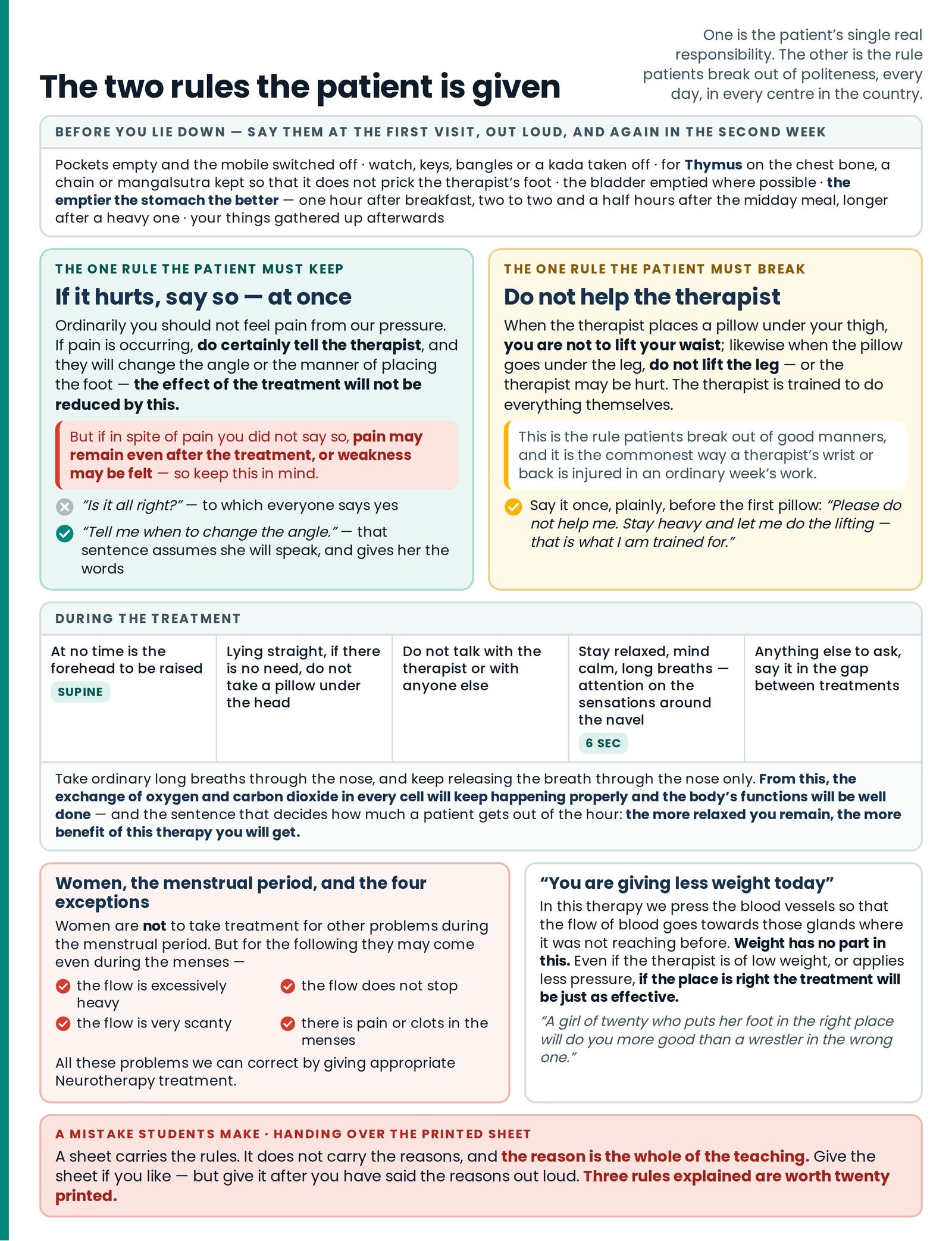
If it hurts, say so — at once
Ordinarily you should not feel pain from our pressure.
If pain is occurring, do certainly tell the therapist, and they will change the angle or the manner of placing the foot; the effect of the treatment will not be reduced by this. ▲ Take care
But if in spite of pain you did not say so, pain may remain even after the treatment, or weakness may be felt — so keep this in mind.
Say the last sentence to the patient in exactly that spirit. It is not a threat and it is not a disclaimer. It is a description of what will happen tomorrow if she is polite today.
That is the rule the patient must keep, and it is harder than it sounds. A woman raised to be a good guest does not interrupt a man who is helping her for nothing to tell him he is hurting her. So you must ask — during the treatment, not after it — and you must ask in a form that makes saying yes easy. Not "Is it all right?", to which everyone says yes. "Tell me when to change the angle." That sentence assumes she will speak and gives her the words. (Figure 38.1)
Do not help the therapist
When the therapist places a pillow under your thigh, you are not to lift your waist; likewise when the pillow goes under the leg, do not lift the leg — or the therapist may be hurt. The therapist is trained to do everything themselves.
This is the rule patients break out of good manners, and it is the commonest way a therapist's wrist or back is injured in an ordinary week's work. A patient who lifts her waist as a hand goes under it has put the therapist's forearm between a moving pelvis and the floor.
Say it once, plainly, before the first pillow: "Please do not help me. Stay heavy and let me do the lifting — that is what I am trained for."
During the treatment
At no time during treatment is the forehead to be raised. Supine ▲ Take care
Lying straight, if there is no need, do not take a pillow under the head.
Do not talk with the therapist or with anyone else.
Staying relaxed with a calm mind, taking long breaths, keep giving attention to the sensations around the navel.
If you have to say or ask the therapist something else, say it during the gap between treatments. Otherwise, during the treatment and in that intervening time, take ordinary long breaths through the nose, and keep releasing the breath through the nose only.
The reason for the breathing: from this, the exchange of oxygen and carbon dioxide in every cell will keep happening properly and the body's functions will be well done. And the sentence that decides how much a patient gets out of the hour: the more relaxed you remain, the more benefit of this therapy you will get.
Attention on the sensations around the navel is not a piety. It is the most useful instruction in the list, because it gives a patient something to do with a mind that would otherwise spend thirty minutes composing questions. It also, week by week, teaches her to notice her own abdomen — which is the region you will be asking her about for the next three months.
"You are giving less weight today"
Not a rule but a complaint, and the answer has to be ready
This one is not a rule at all. It is a complaint, it arrives in every practice, and the answer has to be ready.
Weight has no part in this
Sometimes patients say the therapist is giving less weight.
In this therapy we press the blood vessels so that the flow of blood goes towards those glands where it was not reaching before. Weight has no part in this. Even if the therapist is of low weight, or applies less pressure, if the place is right the treatment will be just as effective.
Across the mat, in the patient's own language: "You are thinking of it as a massage, where harder means more. It is not. I am moving blood into a place it was not reaching. What decides that is where my foot is and for how long — not how much of me comes down on you. A girl of twenty who puts her foot in the right place will do you more good than a wrestler in the wrong one."
The therapist's side of the same question — the student who presses harder because effort feels like care — is taught in The Hand That Heals, and the reason the two chairs exist at all is taught there too. The patient's side is simply this: never let a patient talk you into more weight, and never let her leave believing she got less treatment. She got the same treatment.
The rules of the night are the most valuable thing in this article, and the most neglected. A patient spends a third of her life doing this, unsupervised, in the dark, out of habits formed in childhood. Change one of them and you have changed something that happens three thousand times a year.
Begin with the one that applies not only to sleep but to every bed, sofa and mat the patient will ever get on or off.