Your muscular system is every muscle in your body: more than 600 muscles that move your bones, the smooth muscle that squeezes your gut, bladder and blood vessels, and the heart muscle that never rests. Muscle makes up about a third of your body weight. It keeps you upright, keeps you warm, and soaks up most of the sugar from every meal.
Overview
What is the muscular system?
Muscle is the body's only tissue that can shorten on command and pull. Your muscular system is all of that tissue together. It comes in three kinds: skeletal muscle, which moves your bones; smooth muscle, which lines the walls of hollow organs such as the gut, bladder and blood vessels; and cardiac muscle, which is found only in the heart.
Every movement you make is muscle at work: a step, a smile, a word, a swallow, a breath and every heartbeat. You choose some of these movements yourself. Most of them — the heartbeat, the squeeze of the gut, the narrowing and widening of blood vessels — happen without you ever thinking about them.
Muscle problems are some of the most common reasons people see a doctor or therapist. Back and neck pain are among the leading causes of disability worldwide. Muscle also weakens with age and with sitting still — yet it keeps answering to use at any age, even in the nineties.
🖼Illustration coming soonA see-through mannequin with the main body muscles in red, the heart in deep red and the gut in pink, showing the three kinds of muscle
One system, three kinds of muscle: skeletal muscle moves the bones, cardiac muscle pumps the blood, and smooth muscle works quietly inside the organs.
Function
What does the muscular system do?
A muscle can do only one thing: shorten and pull. It can never push. So skeletal muscles work in pairs across a joint — one pulls to bend it, its partner pulls to straighten it. Inside the organs, rings and sheets of smooth muscle squeeze in waves to move things along.
Moves the body: walking, lifting, gripping, speaking, chewing and every facial expression.
Holds you upright and steadies the joints, even when you are standing still.
Breathes for you: the diaphragm and the muscles between the ribs move air in and out.
Pumps and pushes: the heart pumps blood, the gut moves food, the bladder empties, and the calf muscles squeeze blood back up the leg veins.
Opens and closes the body's gates — the rings of muscle (sphincters) that hold urine and stool, and the muscle of the iris that sizes the pupil.
Makes heat: working muscle warms the body, and shivering is muscle making extra heat on purpose.
Stores and burns fuel: muscle keeps sugar in the form of glycogen and takes up most of the sugar from the blood after a meal.
The order
The brain decides to move and sends a signal down the spinal cord and along a motor nerve.
The handover
Where the nerve meets the muscle, it releases a chemical messenger called acetylcholine.
The spark inside
An electrical wave spreads over the muscle fibre and releases calcium stored inside it.
The pull
Calcium lets tiny protein threads (myosin) grab their neighbours (actin) and pull them inward, so the fibre shortens. Each pull spends energy (ATP).
Letting go
When the nerve stops firing, calcium is pumped back into storage and the threads release. Letting go also needs energy.
The report back
Stretch sensors inside the muscle and tendon report its length and tension to the spinal cord and brain, so the next order is adjusted.
How does the muscular system work with other systems?
Skeletal system (bones and joints) — Bones are the levers and joints the hinges; muscles, fixed by tendons, pull on them to make movement.
Nervous system and brain — Every skeletal muscle waits for a nerve's order; nerves also set the tone of smooth muscle in the gut and vessels.
Heart, blood and circulation — Blood brings oxygen and fuel to working muscle; in return, the heart muscle and the calf-muscle pump keep the blood moving.
Lungs and breathing — The diaphragm and rib muscles do the work of breathing; smooth muscle in the airways widens or narrows them.
Digestive system — Smooth muscle pushes food along the gut in waves; digestion supplies the protein and sugar that muscle is built and run on.
Glands and hormones — Hormones such as insulin and thyroid hormone set how muscle uses fuel; working muscle releases its own messengers too.
The system is made of three kinds of muscle tissue, the tendons that fix skeletal muscle to bone, and the thin wrapping sheets (fascia) that hold every muscle in place.
Skeletal muscle
The muscle you can see and control. It is fixed to bones and looks striped under a microscope.
Muscle fibres — Each fibre is one long cell with many nuclei, packed with protein threads that slide over each other to shorten it.
Bundles and wrappings — Fibres are grouped into bundles, and bundles into a whole muscle, each layer wrapped in its own thin sheet.
Tendons — Tough white cords that join muscle to bone. The Achilles tendon at the back of the heel is the thickest and strongest.
Slow and fast fibres — Slow fibres are red, rich in oxygen and tire slowly — good for posture and walking. Fast fibres are paler and powerful but tire quickly — good for sprints and lifting.
Motor nerves — Each skeletal muscle has its own nerve supply. Without it, the muscle cannot move and slowly wastes.
🖼Illustration coming soonA muscle attached to bone by a tendon, zoomed in from the whole muscle to a bundle, one fibre and the protein threads inside
A muscle is built like a rope: bundles of long fibres, and inside each fibre, threads that slide to shorten it.
Smooth muscle
The quiet muscle inside the organs. It works on its own, without your choosing, and can stay squeezed for a long time without tiring.
Gut wall — Two layers — one in rings, one running lengthwise — squeeze in waves (peristalsis) from the food pipe to the rectum.
Blood vessel walls — A coat of muscle around every artery of any size narrows or widens it, deciding how much blood each part receives.
Bladder and uterus — Thick smooth-muscle walls that stretch to hold, then squeeze to empty or, in childbirth, to push.
Airways — Bands of smooth muscle around the breathing tubes; when they tighten too much, as in asthma, breathing becomes hard.
Eye and skin — Tiny smooth muscles size the pupil, focus the lens and raise the hairs on your skin as goosebumps.
Cardiac muscle
Found only in the heart. It is striped like skeletal muscle but works on its own, like smooth muscle.
Branched, joined cells — Its cells branch and lock together at special junctions, so an electrical signal passes through the whole heart and it squeezes as one.
Its own pacemaker — A small patch of special cells sets the beat. Nerves only speed it up or slow it down.
Built not to tire — Packed with energy-making units (mitochondria) and a rich blood supply, it works every second of life.
🖼Illustration coming soonThree microscope views comparing striped skeletal muscle, smooth muscle without stripes, and branched cardiac muscle
The three kinds side by side: striped and willed, smooth and automatic, and the heart's own branched kind.
The main muscle groups
Skeletal muscles are usually learned by region.
Head and face — Muscles of chewing, and more than 20 small muscles of expression that pull on the skin itself.
Neck and shoulders — Hold up and turn the head, lift the shoulder blades and steady the arm.
Trunk — The belly wall, the long muscles beside the spine and the deep muscles of the low back form a living corset around the spine.
Diaphragm — The dome-shaped muscle under the lungs; it does most of the work of quiet breathing.
Pelvic floor — A hammock of muscle across the bottom of the pelvis that supports the bladder, bowel and uterus and helps control the openings.
Arms and legs — The largest muscles of the body are in the hips and thighs; the calf muscles also act as a pump for the leg veins.
The journey
The decisionA fraction of a second
You decide to lift a cup. The movement areas of the brain plan which muscles to use and in what order.
The message travelsHundredths of a second
The signal races down the spinal cord and along the nerve to the arm. The fastest nerve fibres carry it at about 70 to 120 metres a second.
The muscle pullsMilliseconds
At the nerve-muscle junction the message becomes a chemical, then an electrical wave, and the fibres shorten. The muscle at the front of the arm bends the elbow.
The partner lets goAt the same moment
The muscle at the back of the arm relaxes so that the elbow can bend smoothly.
The sensors reportContinuously
Stretch sensors in the muscle and tendon report back, and the brain fine-tunes the grip so the tea does not spill.
RecoverySeconds to days
Fuel is refilled within seconds to minutes. After unusually hard work, the fibres repair small strains over the next few days — and grow a little stronger.
Where is the muscular system located?
Everywhere. Skeletal muscle lies just under the skin and fat, in layers over the bones, from the scalp to the soles. Smooth muscle lies inside the walls of the hollow organs and of the blood vessels that run through every part of the body. Cardiac muscle sits in the middle of the chest, as the heart.
Muscles work in layers. In the thigh, for example, you pass through skin, a layer of fat, a tough wrapping sheet, and then thick muscle before reaching the bone. Nerves and blood vessels run between the muscles — which is why a muscle held tight for a long time can press on the vessels that pass through it.
🖼Illustration coming soonA slice through a thigh showing skin, fat, the wrapping sheet, muscle groups, the vessels and nerve between them, and the bone in the centre
A slice through the thigh: muscle fills most of it, and the vessels and nerve run between the muscles.
Skeletal muscle is deep red, because its fibres hold myoglobin, a red protein that stores oxygen. Muscles that work all day, such as the ones that hold your posture, are darker; muscles built for short bursts are paler. Tendons at the ends are white and shiny, like wet rope.
Smooth muscle is paler and forms thin sheets inside organ walls. Heart muscle is a firm reddish-brown. Under a microscope, skeletal and heart muscle show fine stripes; smooth muscle has none — which is how it got its name.
How big is the muscular system?
You have more than 600 skeletal muscles. In a large study of adults, skeletal muscle made up on average about 38% of body weight in men and about 31% in women — so in a 60 kg adult, roughly 18 to 23 kg is muscle.
The biggest single muscle is the buttock muscle (gluteus maximus). The longest is the sartorius, a strap that runs from the hip across the front of the thigh to below the knee. The smallest, the stapedius in the middle ear, is only a few millimetres long.
🖼Illustration coming soonA mannequin with the biggest muscle in the buttock, the longest muscle across the thigh and a magnified tiny muscle in the ear highlighted
Biggest, longest and smallest: from the buttock to a muscle in the ear only a few millimetres long.
Conditions and disorders
What conditions and disorders affect the muscular system?
Muscle trouble can start in the nerve that gives the order, in the muscle itself, in the places where muscles work hardest, or in the smooth muscle inside the organs. Some problems are short-lived strains; others are long-term diseases that need a specialist.
When the nerve's message does not reach the muscle
Paralysis and strokeDamage in the brain cuts the orders to muscles on one side of the body.
Motor neuron diseaseThe nerve cells that drive the muscles slowly fail, so muscles weaken and waste.
Myasthenia gravisThe nerve-muscle junction tires, so muscles weaken with use — often the eyelids first.
Guillain-Barré syndromeThe body's defences attack the nerves, and weakness can climb from the feet upward over days.
Polio and its after-effectsA virus damages the nerve cells that move the muscles, often leaving a weak limb.
Multiple sclerosis (MS)Patches of damage in the brain and spinal cord disturb the signals to muscles.
Cerebral palsy (CP)A brain injury around birth affects movement, tone and posture for life.
Weakness — trouble climbing stairs, rising from a chair, lifting the arms or gripping
Pain, soreness or tenderness in a muscle
Cramps or spasms — sudden, hard tightening
Stiffness, or a muscle that will not relax
Twitching, or a muscle that is visibly thinner than on the other side
Weakness that gets worse with use — drooping eyelids, double vision or trouble swallowing
Very dark, cola-coloured urine after severe muscle pain or extreme exercise
What tests check the muscles?
Examination and strength testing — A doctor or physiotherapist checks each muscle group against resistance, looks for wasting and tests the reflexes.
CK (creatine kinase) blood test — A muscle enzyme that leaks into the blood when muscle fibres are damaged.
Other blood tests — Potassium, calcium, magnesium, vitamin D, thyroid and sugar — any of these can cause weakness or cramps.
EMG and nerve conduction studies — Fine needles and skin sensors record the electrical activity of muscles and nerves, to tell a nerve problem from a muscle problem.
Ultrasound and MRI — Show tears, swelling, bleeding or wasting inside a muscle.
Muscle biopsy and genetic tests — A tiny piece of muscle, or a blood sample for genes, confirms some long-term muscle diseases.
How are muscle conditions treated?
Relative rest, then a steady return — A strained muscle is rested briefly, then used again gradually; long bed rest usually makes muscle weaker.
Physiotherapy and exercise — Guided stretching and strengthening — the main treatment for most muscle pain and weakness.
Medicines — Pain relief, anti-inflammatory medicines or muscle relaxants for a short time; specific medicines for conditions such as myasthenia gravis.
Treating the cause — Correcting low thyroid, low vitamin D, low potassium or a medicine side effect often brings the strength back.
Surgery — For a fully torn muscle or tendon, a hernia, or a prolapse that does not settle.
Aids and long-term support — Braces, walking aids and specialist teams for long-term conditions such as muscular dystrophy or motor neuron disease.
Neurotherapy (LMNT)
LMNT teaching gives muscle a central place, because it sees muscle as the tap that decides where blood goes. Every artery of any size wears a coat of muscle: tighten it and the pipe narrows, relax it and the pipe widens — and that muscle takes its orders down a nerve. A vessel running through a hard, contracted muscle is also squeezed by it, so relaxing the muscle opens the vessel. That is why a therapy of pressure and release, given to muscle, is taught as a therapy of circulation. The teaching adds a chain: a poor blood or nerve supply changes the body's fluids, which changes how tight the muscles around the glands and organs are held, which changes what those glands make. A gland in tight muscle is like a sponge in a closed fist. Posture feeds the same chain — most people lean to one side for hours a day — and pressure on the arms and legs is taught to give a tight muscle the stretch a yogāsana would, for people who cannot do yoga themselves. Each press is held for six seconds, in step with the natural rhythm of a muscle and its partner. Guruji's teaching also links loose 'flesh-muscles' with hernia, prolapse, varicose veins and low blood pressure, and gives a formula for the lactic acid of tired legs. This is support alongside medical care, never instead of it.
Points
Stretch — Pressing the fingertips and pulling them outward relaxes the muscles of the neck. The teaching reports great relief in breathing troubles, so it is used in asthma, bronchitis and the Oxygen formula.
Electrical Waves — Relaxes the muscles of the neck; found excellent for asthma and breathing difficulty.
Giriraj — Fingers gathered together roll the thigh muscles upward, from near the knee to the groin, along three or four lines — to loosen the muscles above and below the knee.
Fracture Point — Its second half, 1-2-3, loosens the muscles at the back of the thigh. A relative raises the legs to 45°; if the patient lifts them himself, the muscles go stiff and the benefit is less.
Neck Ghisai — Relaxes the muscles all round the neck in four stages, the first with light hands; for neck, head, shoulder and arm pain.
Triangle for Piles — Given across the sacrum with pressure towards the head. The teaching says it strengthens the pelvic muscles and tightens the sphincters of the bladder, uterus and anus.
(2) S4 – S5 — The exact opposite on the same bone: the muscles are drawn downward, which relaxes and opens those same sphincters — used to increase a scanty flow of urine.
(10) Medulla — The teaching credits it with the muscles of the voice-box and throat, and with the smooth muscle of the windpipe and bronchi, for bronchitis.
(6) Rt. Ov. (6) Lt. Ov. (8) Pan (12) Liv (6) Adr. Built from one of Guruji's patients who could not lift his knees after many stairs. The teaching gives it for calf pain on the second day after a climb or the gym after a long gap, for knee pain with pain at both Liv° and Mu°, and reports benefit in rheumatoid and osteoarthritis. That it helps convert lactic acid is called an inference in the teaching's own words.
“Whenever there is an obstruction or blockage in the blood circulation of any part of the body, then pain or numbness is felt in that part.”
— Dr. Lajpatrai Mehra
“In this therapy we do not treat the disease; rather, we improve the body.”
— Dr. Lajpatrai Mehra
“Every person, from a one-day-old infant up to the age of a hundred years, can take this treatment.”
— Dr. Lajpatrai Mehra
Never do this
Emergency: sudden weakness, numbness or drooping of the face, arm or leg on one side, or slurred speech — call 108/112 at once. This is a stroke until proved otherwise, not a muscle problem. Paralysis and stroke
Weakness that climbs from the feet upward over hours or days, or weakness with drooping eyelids, double vision, or trouble swallowing or breathing, needs a hospital the same day. Guillain-Barré syndrome
Severe muscle pain with very dark, cola-coloured urine after extreme exercise, a crush injury or heat stroke is a doctor's question the same day — muscle breakdown can harm the kidneys. How to say it
One calf or thigh that is hot, swollen and tender — especially after surgery, a long illness, a long journey or pregnancy — may hide a blood clot. It is not rubbed, pressed or walked on; it is sent to a doctor. Thrombosis (blood clots)
Six seconds, never longer. The teaching explains that pressure held past six seconds uses up the oxygen and sugar in the trapped blood and lets lactic acid build up in the muscle. Six Seconds
When a leg must be raised for a treatment, somebody else lifts it — never the patient. A muscle holding itself up is working, and the teaching warns that pain may even increase. Fracture Point
The Lactic Acid Conversion formula carries the bars of its points: Rt. Ov. and Lt. Ov. not in cancer, nor in children treated to increase height; Pan not in fits or convulsions, never in schizophrenia; Liv not in liver cancer; Adr not in septicaemia, HIV/AIDS, cancer or high blood pressure. Lactic Acid Conversion
Cancer: if the person has cancer, (10) Pan, Thymus, Pit, Lu + Sh, Rt. Ov / Lt. Ov and (30) Medulla are never given — the therapist changes the plan.
Keep taking the medicines your doctor prescribed. If a medicine seems to be causing muscle aches, tell the doctor — never stop it on your own. Neurotherapy (LMNT) works alongside your medical care, never instead of it.
Care
How can I keep my muscles healthy?
Muscle follows the rule 'use it or lose it' — and it answers to good use at any age.
Move every day, and strengthen twice a week
The WHO advises adults to get 150 to 300 minutes a week of moderate activity such as brisk walking, plus muscle-strengthening work on at least two days a week. Older adults should add balance training.
Break up long sitting
Stand up and move for a minute or two every half hour. Muscles that never work stop helping to pump the blood.
Build up slowly after a long gap
The second-day ache after an unaccustomed climb, a long walk or the gym after months off is common. Start light and add a little each week.
Eat enough protein — and digest it
Dal, milk, curd, paneer, eggs, pulses and nuts supply the building blocks. Guruji's teaching adds that eating protein is not enough; what matters is that it is digested.
Drink enough water
Muscle is about three-quarters water, and a dry body cramps more easily. Guruji's most frequent advice was that no other drink can take the place of water.
Mind your posture
Change the shoulder you carry a bag on, the hip you carry a child on, and the way you lean at work. A body always bent to one side keeps one side's muscles squeezed all day.
Common questions
How many muscles do I have?
More than 600 skeletal muscles, the ones you can control. On top of these there is smooth muscle in the walls of your organs and vessels, and the heart muscle — these are tissues rather than separately counted muscles.
Is it too late to build muscle when I am old?
No. Muscle answers to strength training at any age. In a well-known study, frail people around 90 years old nearly tripled their leg strength in eight weeks of supervised training. Start gently and ask your doctor what is safe for you.
Why do I shiver when I am cold?
Shivering is your muscles tightening and relaxing very fast on purpose. Most of the energy a muscle uses turns into heat, so shivering can raise the body's heat output several times over.
Is the heart a muscle like my arm?
It is muscle, but a different kind. Heart muscle is striped like arm muscle, but its cells branch and lock together, it has its own pacemaker, and it never needs your permission — or a rest.
Are muscle cramps always a sign of low calcium?
No. Most cramps come from a tired or over-stretched muscle, too little water, or long sitting or standing. Low calcium, magnesium or potassium, thyroid problems, diabetes and some medicines can also cause them. Frequent cramps are worth a blood test.
Why does a Neurotherapist press my thigh when my problem is elsewhere?
In LMNT teaching the place of the complaint is not always the address of the treatment. The points are chosen from the pain points found on examination, and pressure on muscle is taught to open the blood supply that runs through it. Your therapist should explain which points are given and why.
What should I ask my doctor or therapist?
Is my weakness coming from the muscle itself or from the nerve?
Should I have my CK, vitamin D, thyroid, sugar or salts checked?
Could any of my medicines be causing muscle aches or cramps?
Which exercises are safe for me, how often, and how hard?
Which warning signs mean I should come back at once?
(To the therapist) Which points and formulas are you giving, which are blocked for me, and how will we know it is helping?
Surprising facts
1Muscles can only pull, never push
A muscle works only by shortening. To straighten a bent elbow, the front muscle cannot push it back — a different muscle at the back of the arm has to pull. That is why skeletal muscles are arranged in opposing pairs around every joint.
🖼Illustration coming soonTwo arms showing the front muscle pulling to bend the elbow and the back muscle pulling to straighten it
A working pair: one pulls while its partner lets go, then they swap.
Source: Gray's Anatomy (42nd ed.) — muscle action, agonists and antagonists; Guyton & Hall, Medical Physiology — skeletal muscle contraction.
2About a third of you is muscle
When researchers measured the whole-body muscle of 468 adults with MRI, skeletal muscle made up about 38% of body weight in men and 31% in women. It is the largest tissue in most healthy bodies.
Source: Janssen I et al., J Appl Physiol 2000;89(1):81–88.
3Your muscles are the body's biggest sugar sponge
After a meal, insulin opens the doors of cells to sugar. Under insulin, about four-fifths of the sugar cleared from the blood goes into skeletal muscle. That is one reason why active muscles help keep blood sugar in check, and why muscle matters in diabetes.
Source: DeFronzo RA et al., Diabetes 1981;30(12):1000–1007; DeFronzo RA, Tripathy D, Diabetes Care 2009;32(Suppl 2):S157–S163.
4Muscle is also a gland
Working muscle sends out its own chemical messengers, called myokines, into the blood. They carry signals to the liver, fat, bones and brain. Scientists now describe skeletal muscle as a hormone-making organ — a new reason why exercise helps so many body systems at once.
Source: Pedersen BK, Febbraio MA, Nat Rev Endocrinol 2012;8(8):457–465.
5Most of a muscle's energy becomes heat
Even at its best, a muscle turns less than a quarter of its fuel into movement; the rest comes off as heat. That is why exercise warms you — and why, in the cold, the body shivers. Hard shivering can raise the body's heat output to several times its resting level.
Source: Guyton & Hall, Medical Physiology — efficiency of muscle contraction (under 25%) and shivering (heat production up to about 4–5 times normal).
6Your calf is a second heart for your veins
Blood in the leg veins has to climb back up against gravity. Every time the calf muscles tighten, they squeeze the deep veins, and one-way valves let the blood move only upward. Standing still for hours stops this pump — which is why ankles swell on long journeys.
🖼Illustration coming soonA calf muscle squeezing a deep vein so that blood moves upward through one-way valves
Each step squeezes the veins and pushes blood back towards the heart.
Source: Guyton & Hall, Medical Physiology — the venous (muscle) pump and venous valves.
7Letting go also costs energy
It sounds backwards, but a muscle needs energy (ATP) to release as well as to pull: the protein threads cannot unhook without it. After death, when ATP runs out, the threads stay locked and the muscles stiffen. Doctors call this rigor mortis.
Source: Guyton & Hall, Medical Physiology — the role of ATP in the cross-bridge cycle and rigor.
8Lactic acid is a fuel, not only waste
For years lactic acid was blamed as muscle 'waste'. Science now shows that lactate moves between cells as a fuel: the heart, the liver and slow muscle fibres take it up and burn it or rebuild sugar from it. Guruji's teaching tells a similar story of the heart turning lactic acid into energy while the legs rest on a staircase landing.
~15,000blinks by the eyelid muscles while you are awake
~1/3of your body weight is skeletal muscle
<25%of muscle fuel becomes movement — the rest keeps you warm
Yoga
Tāḍāsana — standing tall Tāḍāsana
🖼Illustration coming soonA grey mannequin seen from the side, standing tall with arms stretched overhead and weight even on both feet
Tāḍāsana: stand evenly on both feet and grow tall.
Benefits
Teaches you to stand evenly — useful for the many people who lean to one side all day.
Gently stretches the muscles of the trunk, shoulders and arms.
Wakes up the small muscles of the feet and legs that keep your balance.
How to do it
Stand with your feet together or hip-width apart, weight spread evenly over both feet.
Lengthen your back and let your shoulders drop away from your ears.
Breathing in, raise both arms overhead, palms facing each other.
Reach up gently for 3 to 5 easy breaths, keeping the heels down.
Breathing out, lower the arms slowly. Repeat 3 times.
Take care
Keep the heels on the floor if your balance is unsteady, and stand near a wall. If you have a shoulder problem or high blood pressure, raise the arms only to shoulder level.
Setu Bandhāsana — the bridge Setu Bandhāsana
🖼Illustration coming soonA grey mannequin seen from the side, lying on its back with knees bent and hips lifted into a gentle bridge
Setu Bandhāsana: lift the hips a little and hold for a few breaths.
Benefits
Strengthens the buttock and back-of-thigh muscles, the biggest muscles in the body.
Works the long back muscles gently, without any weight on the spine.
Opens the front of the hips after long sitting.
How to do it
Lie on your back, knees bent, feet flat and hip-width apart, arms by your sides.
Breathing out, press the feet down and lift the hips a little off the mat.
Hold for 3 to 5 easy breaths. Do not hold the breath.
Lower the back slowly to the mat, one part at a time.
Rest, and repeat 3 to 5 times.
Take care
Lift only as high as is comfortable. Skip it if you have a recent neck or back injury, and avoid it in late pregnancy. Never turn the head while the hips are up.
Śavāsana — letting every muscle go Śavāsana
🖼Illustration coming soonA grey mannequin seen from the side, lying relaxed on its back with a towel under the knees
Śavāsana: lie still and relax the body part by part.
Benefits
Trains you to notice and release muscles that stay tight without your knowing.
Calms the breath and the stress response, which keeps muscles tense.
A towel under the knees lets the low back rest flat.
How to do it
Lie on your back with a thin pillow under the head and a rolled towel under the knees.
Place the arms a little away from the body, palms up.
Close your eyes and breathe slowly.
Tighten the feet for a moment, then let them go; move up the body the same way — calves, thighs, hands, shoulders, face.
Rest for 5 to 10 minutes, then roll onto your right side and get up slowly.
Take care
If lying flat makes you breathless, or you are in late pregnancy, lie on your side or with the head and shoulders raised on pillows. Get up slowly if you feel dizzy.
Watch
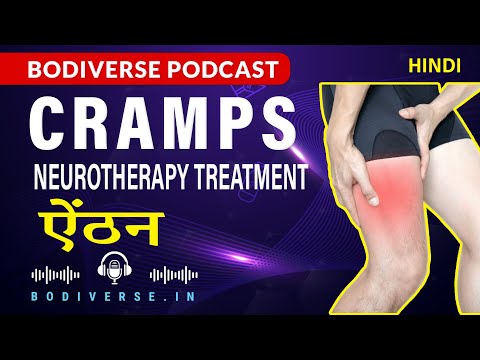
Get Rid of Muscle Cramps: Simple Causes and Effective Prevention मांसपेशियों की ऐंठन से पाएं छुटकारा
A short talk on the common causes of muscle cramps and simple ways to prevent them.
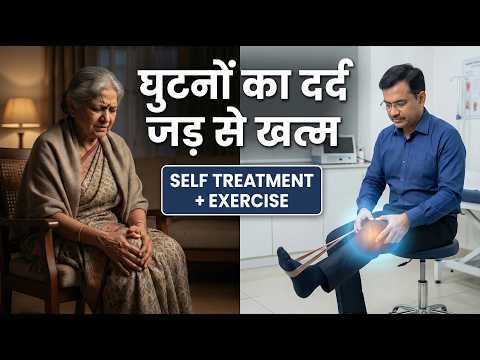
घुटने के दर्द का 100% पक्का इलाज |Treatment & Exercises | Knee Pain Permanent Relief Without Surgery
A home routine for the knees: thumb pressure along the thigh and shin, zig-zag massage above and below the knee, easing the kneecap, and massage behind the knee, then simple exercises such as tapping, a towel roll under the knee and pressing a fist between the knees. It is shared for relief and to strengthen the muscles around the knee.
Test yourself
Research
Strong evidence
Whole-body MRI in 468 adults aged 18 to 88 showed that skeletal muscle is about 38% of body weight in men and 31% in women. Muscle mass began to fall slowly from the third decade and more clearly after about 50, especially in the legs.
Frail nursing-home residents with an average age of 90 did eight weeks of supervised high-intensity leg training. Their strength rose on average by about 174% — nearly tripling — and their thigh muscle grew, showing that muscle answers to training even in extreme old age.
This review describes skeletal muscle as an organ that releases hundreds of messenger molecules (myokines) when it works. These signals reach fat, liver, bone and brain, and may explain part of why exercise protects against diabetes, heart disease and more.
This page explains how the body works; it does not diagnose. Neurotherapy (LMNT) works alongside your medical care — keep taking the medicines your doctor prescribed, and see a doctor for any new or severe symptom.
Ready to begin?
Send COURSE for course details, or your name, age and health issue for a consultation.