Watch


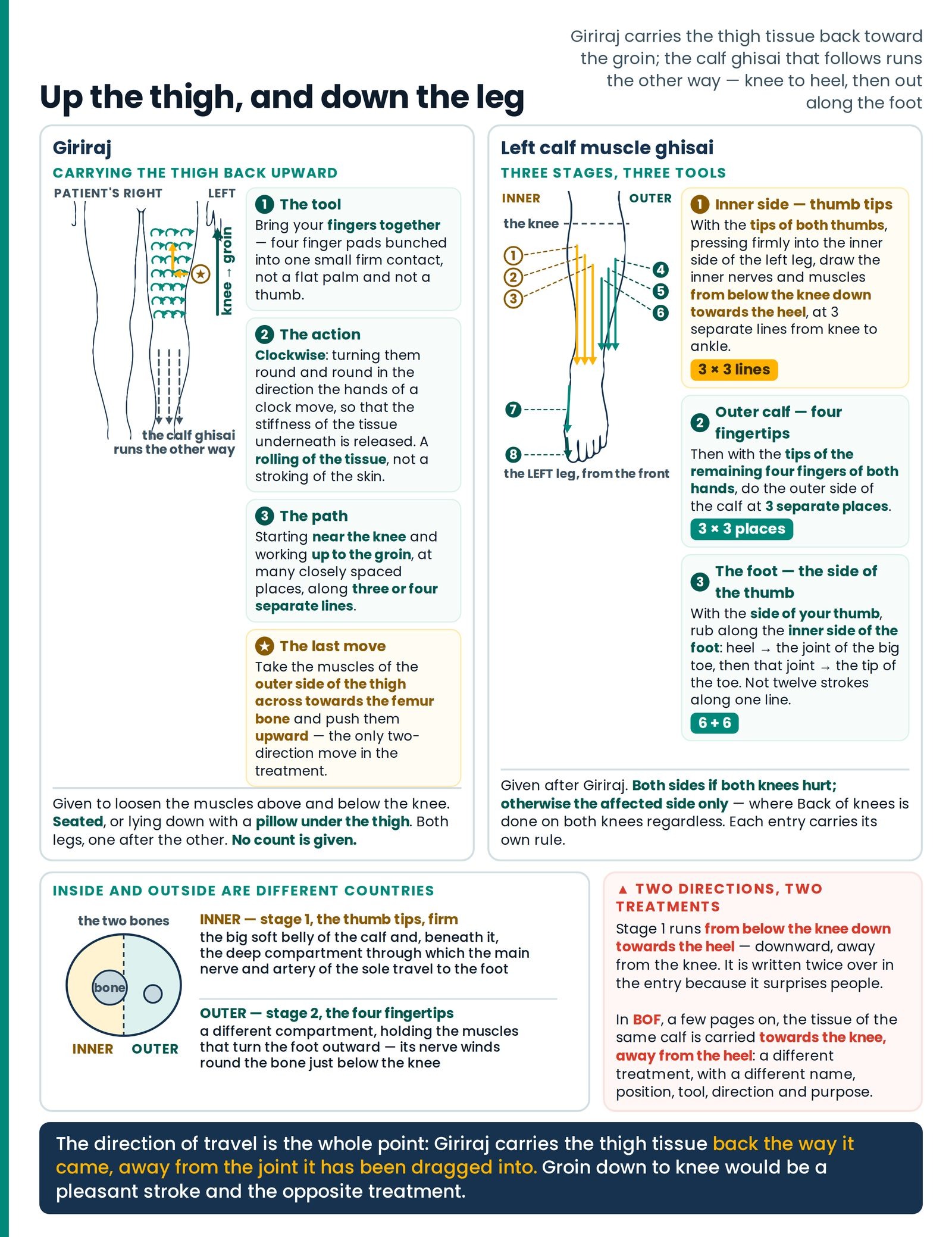
GIRIRAJ — carrying the thigh back upward
Fingers together, clockwise, knee → groin, along three or four lines
Several treatments in this atlas carry a person's name rather than a place — Giriraj and Pradeep here, and elsewhere Loveleen, Raman, Shivaji, Mauneesh. The convention is that a technique is named for the student or patient in connection with whom it was found: the method and the story of its finding travel together, and the name is the index entry. The cost is that the name tells a newcomer nothing, which makes these the entries a student must actually learn rather than half-recall.
This is given to loosen the muscles above and below the knee. It can also be given with the patient seated. If treating them lying down, put a pillow under the thigh. Seated Supine Both sides
Bring your fingers together and, starting near the knee and working up to the groin, at many closely spaced places, carry the muscles upward with a clockwise action. Do the same along three or four separate lines. Finally, take the muscles of the outer side of the thigh across towards the femur bone and push them upward. Do both legs, one after the other.
After this, calf muscle ghisai is to be done. If both knees hurt, do both sides; otherwise do the affected side only.
| Patient's position | Seated, or lying down with a pillow under the thigh Seated Supine |
|---|---|
| Where the hands are placed | The fingers brought together, starting near the knee and working up to the groin, at many closely spaced places, carrying the muscles upward with a clockwise action, along three or four separate lines; finally the muscles of the outer side of the thigh taken across towards the femur bone and pushed upward |
| Duration and repetitions | Many closely spaced places along each of three or four lines; no count is given; both legs, one after the other Both sides |
| What it is for | Loosening the muscles above and below the knee |
| What follows it | Calf muscle ghisai — both sides if both knees hurt; otherwise the affected side only |
Clockwise is defined for you — "clockwise" means bringing the fingers together and turning them round and round in the direction the hands of a clock move, so that the stiffness of the tissue underneath is released. It is a rolling of the tissue, not a stroking of the skin: the bunched finger pads take the muscle with them as they turn, and each turn carries it upward before the hand lifts off and moves on to the next closely spaced place.
The direction of travel is the whole point. Giriraj runs from near the knee up to the groin — carrying the thigh tissue back the way it came, away from the joint it has been dragged into. Working from groin down to knee would be a pleasant stroke and the opposite treatment. "Bring your fingers together" gives the tool: four finger pads bunched into one small firm contact, not a flat palm and not a thumb. "At many closely spaced places" gives the spacing: you stop, roll, lift, move up a little, roll again, all the way to the groin. "Three or four separate lines" gives the coverage — inner thigh, middle, outer, and a fourth if the thigh is broad. (Figure 23.2)
The final move is a different action and is easy to lose. The muscles of the outer side of the thigh are taken across towards the femur bone and then pushed upward. Across, then up — the only two-direction move in the treatment, over the long tough band that so many painful knees complain from.
And the closing sentence is a prescription, not a note. If both knees hurt, do both sides; otherwise do the affected side only. Compare Back of knees, where both knees are done regardless. Different rules attached to different treatments, each complete where it stands.
LEFT CALF MUSCLE GHISAI — three stages, three tools
Thumb tips inside, fingertips outside, thumb edge along the foot
On the left leg, done in three stages. Supine Seated Left
- 1. With the tips of both thumbs, pressing firmly into the inner side of the left leg, draw the inner nerves and muscles from below the knee down to the ankle — that is, the heel — towards the heel. Do this 3 times. In the same way, at 3 separate lines from knee to ankle, as in the figure — see 1, 2, 3 in the picture.
- 2. Then with the tips of the remaining four fingers of both hands, do the outer side of the calf at three separate places, three times each — see 4, 5, 6 in the picture.
- 3. Then with the side of your thumb, rub along the inner side of the foot from the heel to the joint of the big toe, 6 times, and from that joint to the tip of the toe, 6 times — see 7, 8 in the picture.
| Patient's position | Follows Giriraj; the left leg as named — the affected side, or both if both knees hurt Left Right |
|---|---|
| Where the hands are placed | 1 — tips of both thumbs, pressing firmly into the inner side of the leg, along 3 separate lines from knee to ankle. 2 — tips of the remaining four fingers of both hands, on the outer side of the calf, at 3 separate places. 3 — the side of the thumb, along the inner side of the foot |
| Direction | 1 — from below the knee down towards the heel. 3 — heel → big-toe joint, then that joint → tip of the toe |
| Duration and repetitions | 3 times on each of the 3 inner lines; 3 times each at the 3 outer places; 6 times heel to the joint of the big toe, and 6 times that joint to the tip of the toe |
| What it is for | Given after Giriraj, as part of the knee sequence |
Two hands, three tools, named separately for a reason. Stage 1 is the tips of both thumbs, pressing firmly. Stage 2 is the tips of the remaining four fingers of both hands — the same two hands turned so that fingers rather than thumbs are the working surface. Stage 3 is the side of your thumb, the flat of its edge, not its tip. Thumb tips inward, fingertips outward, thumb edge along the foot.
The direction in stage 1 is written twice over, because it surprises people. From below the knee down to the ankle — that is, the heel — towards the heel. Downward, away from the knee. Note it, because in a few pages you meet BOF, where the tissue of the same calf is carried towards the knee, away from the heel — a different treatment, with a different name, position, tool, direction and purpose. Each is given as it is written; keep them apart and you will never give either by accident.
The three inner lines and three outer places are stations, not one long sweep — line 1, three strokes; line 2, three; line 3, three; then place 4, place 5, place 6, three each. And stage 3 leaves the calf for the foot, along the inner border, in two separate segments with separate counts: heel to the joint of the big toe, six; that joint to the tip of the toe, six. Not twelve strokes along one line.