Watch
खाँसी से स्थायी छुटकारा पाने का बेहतरीन उपाय
knee and muscle pain
How to Stimulate Pancreas Naturally? | LMNT Pan Point | Diabetes और Indigestion का जादुई इलाज
Fingers, posture and the rhythm of one examining press
THE METHOD, STEP BY STEP The examining hand, and where you put yourself Nails short and hands warm. Short enough that when you press your fingertip pad flat against your own forearm no white edge touches skin — a patient scratched once braces for the rest of the examination. And a cold hand makes the wall tighten under it, a tightness that reads as hardness and will be gone by the time your hand has warmed.
Two fingers, or three, side by side — index and middle, or index, middle and ring. Never a thumb: strong, blunt, badly informed, and it presses harder than you intend. Never one finger boring in. Never a knuckle.
Held so the fingers move as one board. The bend comes at the big knuckles where the fingers join the palm; the small joints beyond stay almost straight, firm enough not to buckle. If the fingertips collapse backwards as you press, you are pressing with the ends of the nails and feeling nothing.
Contact through the pads — the fleshy pulp just behind the tip. Laid flat, two pads give a contact about the size of a small coin: broad enough not to sting, narrow enough to sit inside one point. Wrist straight; a bent wrist tires within four patients and its angle drifts without your noticing.
Kneel at the patient's side, level with her hip, sitting back on your heels, so your forearm comes in parallel to the mat — if you are looking down at the back of your own hand you are too high. Elbow softly bent, shoulder down.
The force comes from leaning your weight a little forward through a soft arm — never from squeezing with the fingers. A finger working hard cannot feel; a finger merely carrying weight stays sensitive. It is the principle of the two chairs at one-hundredth of the scale.
The other hand rests on the patient, on the far hip, so your landings do not startle and you can feel whether the whole wall is tightening. And change sides rather than reach across: eight seconds spent moving keeps every press on the left at the same angle as every press on the right, which is the whole basis of comparing the two.
TAKE CARE Whose belly is examined with the hand, and only the hand Small children, very weak persons, and any patient with osteoporosis are to be treated with the hand only. The same restraint governs the examination, and more strictly, because the abdomen has no bone to spread a load.
Frail elders and thin bones: the softest press that reaches the second layer at all, and stay off the rib margins and hip crest — the last rib is a floating rib and gives way more readily than any other. Small children: one or two fingers, feather-light, learning as much from the face as from depth.
Long-standing diabetes : the report you rely on may never arrive, because sensation can be blunted and a patient who cannot feel what you are doing cannot warn you. Reduce the pressure, not the attention.
THE METHOD, STEP BY STEP One examining press, from first contact to release {{6s}} Say what you are going to do, then do it. "I am going to press here, gently. Tell me anything you feel." A belly that has been warned does not guard; a belly that is surprised does.
Land flat and wait for an out-breath. Rest the pads on the point a moment with no pressure at all, letting the wall accept the hand; as she breathes out the wall slackens and the same press finds a truer answer. Never press into a held breath — a held breath is a braced wall.
Sink slowly, straight in — about two unhurried seconds from surface to whatever stops you. Pressed slowly, tissue yields and reports; pressed quickly it resists, and the patient jumps at the speed rather than the depth. Straight in means at right angles to the skin at that place, not down towards the floor: on the flat of the belly the two are the same, but over the curve of a rib margin, the slope of a flank or the rim of a hip they are quite different, and that is where beginners go wrong.
Stop where you are stopped. You are not descending to a depth decided beforehand; you descend until something meets you. That is the finding.
Hold only long enough to be sure — a second or two, no more. 6 sec The six-second unit belongs to treatment; an examining press held on and on stops telling you anything and starts creating something.
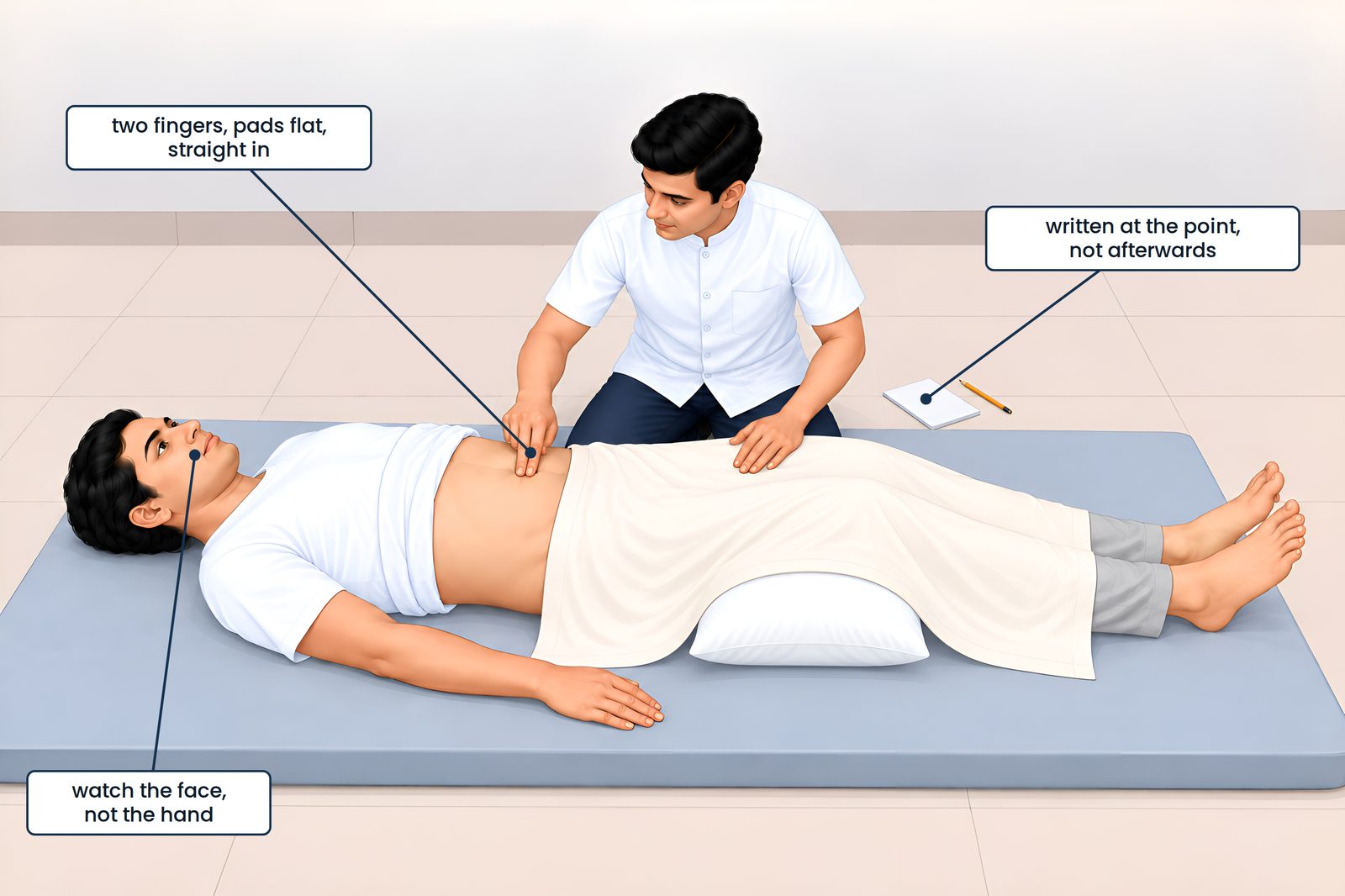
Watch the face, not your hand. The face reports about half a second before the mouth , and honestly in patients who will not complain aloud.
Release as slowly as you pressed, then lift clear before you move. A press snatched away hurts on the way out; and sliding from point to point is a different act altogether — ghisāī — which is a treatment.
Keep one tempo everywhere. The moment your rhythm changes, the patient learns which spot you care about.
That is about eight seconds a point — four or five minutes for the eighteen, the cheapest four minutes in this therapy. (Figure 7.1)
THE WORDS WE USE Guarding — the wall that argues back Voluntary guarding is a person bracing — cold hands, ticklishness, anxiety, a sudden press. It melts if you warm the hand, talk about something else and press on the out-breath. It is not a finding.
Involuntary guarding is a wall that stays hard whatever you do, usually over a wide area. With a rigid board-like belly, exquisite tenderness, vomiting or distension it is a reason to stop and send for a doctor the same hour — not a grade to write on a card. ▲ Take care
The examining hand, and the card beside the knee. Kneeling level with the patient's hip, two finger pads rest flat a little to the patient's left of the navel and sink straight in; the other hand stays still on the patient; the card and pencil lie beside the knee; the eyes are on the patient's face, not on the hand. DID YOU KNOW? A steady press stops being felt — by you as much as by the patient Hold a finger still against your own arm and notice how fast the sensation fades. The nerve endings that report touch and pressure fire hard when something changes and go quiet when nothing does.
So holding a press longer feels as though it should reveal more and in fact reveals less: your own instrument goes deaf while you wait. The information arrives in the first moment of contact and the first moment of release.