Heart Attack (Myocardial Infarction)
A heart attack happens when blood flow to part of the heart muscle is suddenly blocked, usually by a clot, and that muscle starts to die within minutes. With chest pain or pressure, call 108/112 now — every minute counts.
- Heart attack and stroke cause 85% of all deaths from heart and blood-vessel disease — about 19.8 million such deaths worldwide in 2022
- Heart attack chest discomfort usually lasts at least 10 minutes
- Treatment within 6 hours of the first symptoms greatly improves the outlook
Source: World Health Organization; Cleveland Clinic; StatPearls (Mechanic et al.)
What is Heart Attack (Myocardial Infarction)?
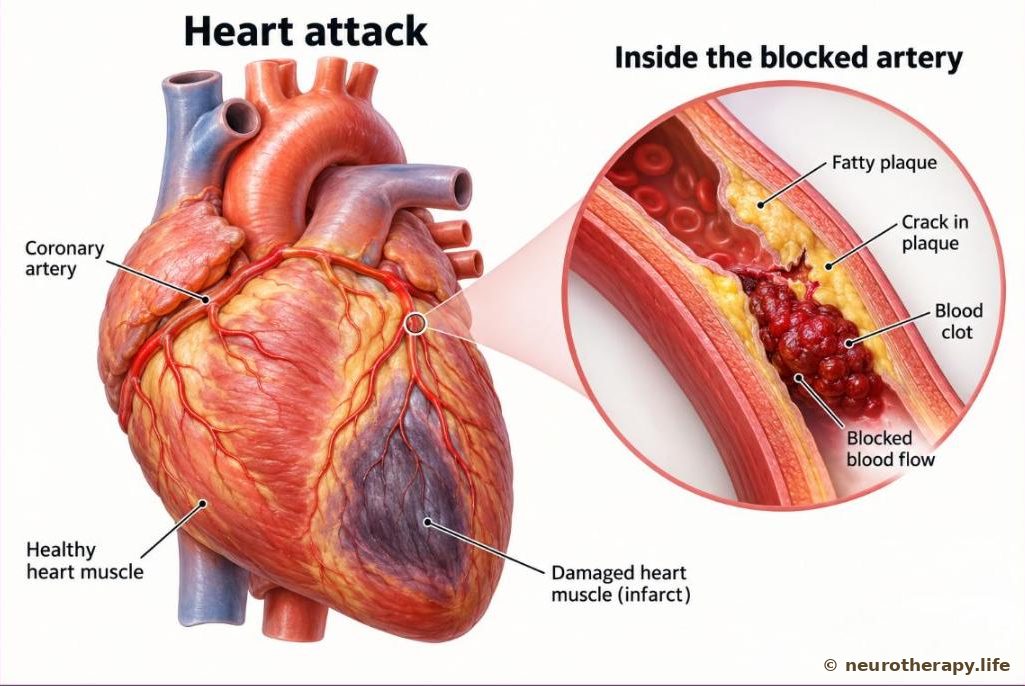
The heart muscle gets its own blood through small arteries on its surface, the coronary arteries. Over years, fatty plaque can build up in their walls.
If a plaque cracks, a blood clot forms on it and can block the artery. The muscle beyond it gets no oxygen and begins to die. Doctors call this a myocardial infarction — heart muscle that has died because its blood stopped. The sooner the artery is opened, the more muscle is saved.
What are the symptoms?
- Chest pain, pressure or squeezing, usually lasting more than a few minutes
- Pain spreading to the arm, jaw, neck, shoulder or back
- Shortness of breath
- Cold sweat, nausea, vomiting, or a feeling like indigestion
- Dizziness, light-headedness or fainting
- Unusual tiredness — more common in women; some heart attacks are silent
What causes it, and who is more likely to get it?
What blocks the artery
Risks you can change
- Smoking
- High blood pressure
- High cholesterol
- Diabetes
- Little activity, excess weight and stress
Risks you cannot change
- Age — men over 45, women over 50 or after menopause
- Heart disease in the family
How is it found?
A heart attack is diagnosed in hospital, fast — the tests run while treatment begins.
ECG
A tracing of the heart's electrical signals — it often shows a heart attack within minutes.
Troponin blood test
Troponin is a protein that leaks into the blood when heart muscle is damaged.
Echocardiogram
An ultrasound of the heart. It shows which part is not moving well and gives the ejection fraction — how much blood the main chamber pumps out with each beat.
Coronary angiogram
Dye and X-rays show exactly where an artery is blocked.
A neurotherapist never treats chest pain on the mat. After the hospital has treated the heart attack, the therapist asks for the discharge summary, the echo report with its ejection fraction, and every medicine — especially blood thinners — and checks whether any wound is still open.
How Neurotherapy sees Heart Attack (Myocardial Infarction)
LMNT reads an infarct as a problem of clots. Its teaching gives two words to keep apart: ischaemia is hunger — the part is alive but underfed; an infarct is a death in the tissue — the part died because the blood stopped. Blood is safe while it moves; slow it or stop it inside a vessel and it begins to set. The body has its own answer: it makes heparin to stop unwanted clots, and plasmin to dissolve clots already formed.
How the body opens a clot
- Clotalready holds a waiting chemical, plasminogen
- Vessel lininghours after an injury, releases tPA
- PlasmintPA slowly turns plasminogen into plasmin — in about 24 hours
- Fibrinplasmin digests the fibrin threads that hold the clot together
- Flowthe clot opens; if this fails, LMNT teaches, clots keep growing
P. Heparin — (8) Pan (7) Liv (8) Ch. Only — was built in 1994 with two aims: that unwanted clots should not form, and that old clots should be dissolved. LMNT says it can be given to all patients and lists the heart among its targets. The therapy reports the ejection fraction rising over several months of P. Heparin — a clinical observation measured on the cardiologist's scan, not a trial result.
Whenever there is an obstruction or blockage in the blood circulation of any part of the body, then pain or numbness is felt in that part.
Neurotherapy treatment for Heart Attack (Myocardial Infarction), step by step
Emergency first
Chest pain or pressure: call 108/112 and do not drive yourself. LMNT is never first aid for a heart attack; it comes only in recovery, after the hospital's treatment.
Examine first
The therapist checks Liv° and Mu°, reads the discharge summary and echo report, notes every medicine, and asks whether any wound — such as an angiography or surgery site — is still open.
P. Heparin
The pancreas point first, to help digest the fibrin of old clots; then the liver and chest points, to help the body make its own heparin. Clear first, then prevent.
Let the reports speak
Progress is judged by the cardiologist's repeat tests, such as the echo, not by a hand. The heart team decides every change in medicines.
Points and formulas used
P. Heparin (plasmin)
The parent Heparin formula — built to help the body keep blood from clotting where it should not, and to open old clots; LMNT says it can be given to all patients.
Works through
Open →Never do this
- A heart attack is an emergency. Call emergency services (108/112) immediately. LMNT works best alongside your existing medical care — always call emergency services first. Chest pain or pressure lasting more than a few minutes, spreading to the arm, jaw, neck or back, or coming with sweating, breathlessness, nausea or faintness: do not wait, and do not drive yourself.
- LMNT is given only in recovery, after hospital treatment, with the heart doctor aware — never as first aid and never in place of it.
- Never in heart disease: G. Heparin and (30) Medulla. The Th + Ch bars include the heart, so the Heparin forms that carry Th + Ch are not given. In X. Heparin, heart patients get (10) Left Medulla only. G. Heparin ('glandins)
- No Heparin treatment at all while a wound is open — including a fresh angiography or surgery site. P. Heparin (plasmin)
- Cancer: if the person has cancer, (10) Pan, Thymus, Pit, Lu + Sh, Rt. Ov / Lt. Ov and (30) Medulla are never given — the therapist changes the plan.
- Keep taking the medicines your doctor prescribed, and never stop or cut down a heart medicine or blood thinner on your own. Neurotherapy works alongside your medical care, never instead of it.
Watch

Shows the P. Heparin formula: (8) Pan at the top of the thighs, (7) Liv on the thigh and forearm, and (8) Chest Only with the palms on the chest. In the video it is given as the last part of the Angina treatment, to support circulation.
The P. Heparin formula — for recovery after hospital treatment, never as first aid for chest pain.
From Ayurveda and the kitchen
Test yourself
What research says
- Strong evidence
A heart attack is death of heart muscle from a long shortage of oxygen, usually after a plaque cracks and a clot forms. Damage starts within 10–15 minutes, and treatment within 6 hours of the first symptoms greatly improves the outlook.
Mechanic OJ, Gavin M, Shams P, Grossman SA. Acute Myocardial Infarction. StatPearls. 2023.
- Strong evidence
The body dissolves clots by turning plasminogen into plasmin with tPA, which works far better once bound to the clot's fibrin; plasmin then breaks the fibrin apart — the chain LMNT's P. Heparin is named for.
Chapin JC, Hajjar KA. Fibrinolysis and the control of blood coagulation. Blood Rev. 2015.
No clinical trial of Neurotherapy after a heart attack has been published yet. Improvements reported by neurotherapists are clinical observations.
For you
Women
A heart attack may not feel like chest pain — it can show as unusual tiredness, breathlessness or an upset stomach. Take these seriously and call for help.
People with diabetes, high BP or high cholesterol
These raise the risk the most among the things you can change. Keep your check-ups, stay active and do not smoke.
After a heart attack
Recovery can take weeks to months. Keep every medicine and follow-up, join the rehabilitation your heart team offers, and show your therapist your reports before LMNT support begins.
This page explains; it does not diagnose. Neurotherapy works alongside your medical care — keep taking the medicines your doctor prescribed, and see a doctor for any new or severe symptom.