Parkinson's disease
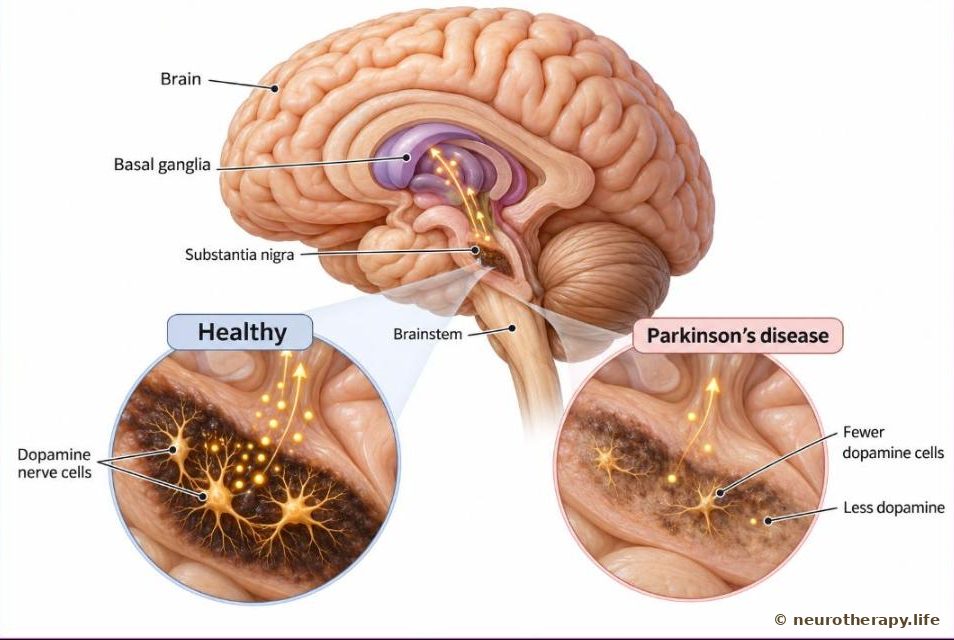
Parkinson's disease is a slow, lifelong condition of the brain. It causes shaking, stiff muscles and slow movement, because the brain makes too little of a messenger chemical called dopamine.
- More than 8.5 million people worldwide were living with Parkinson's in 2019
- It usually begins around the age of 60, and is more common in men
- By the time it is diagnosed, more than half — up to 80% — of the brain's dopamine cells have already been lost
Source: WHO; MedlinePlus; Cleveland Clinic; StatPearls (NCBI Bookshelf)
What is Parkinson's disease?
Deep in the brain, a small dark area called the substantia nigra makes dopamine. Dopamine is a messenger: it helps the brain send smooth, well-timed signals to the muscles, so that you can start, stop and control a movement.
In Parkinson's disease these cells slowly stop working and die. As dopamine falls, movements become shaky, stiff and slow. The change starts years before the first signs, and it keeps going slowly — so the aim of care is to keep a person moving, comfortable and independent for as long as possible.
What are the symptoms?
- Shaking (tremor), often in one hand, while it is resting
- Stiff arms, legs or trunk
- Slow movement, small shuffling steps, poor balance
- A face that shows less expression, and a softer voice
- Loss of smell, constipation and poor sleep — often years before the shaking
- Later: trouble swallowing or chewing, low mood, memory problems
What causes it, and who is more likely to get it?
Loss of dopamine cells
- The cells of the substantia nigra slowly stop working — why this starts is usually not known
Age and sex
- Being over 60
- Being male
Genes
- A family history — though most cases are not inherited
Surroundings
- Contact with pesticides, or long exposure to metals such as manganese
How is it found?
There is no single test for Parkinson's. A neurologist makes the diagnosis from your story and a careful examination of how you move. Tests are mainly used to rule out other causes.
Neurological examination
The doctor watches you walk, checks tremor, stiffness, balance and the speed of small movements.
MRI of the brain
Pictures of the brain, to look for other causes such as a stroke or a tumour.
DaTscan
A special scan that shows how well the brain's dopamine system is working, when the picture is unclear.
Blood tests
To rule out other conditions that can cause similar signs.
A neurotherapist does not diagnose Parkinson's — that is the neurologist's work. What the therapist looks for is the picture under the fingers: Liv° and Mu°, tenderness at the Gas 'I' point on the calves, the stools — hard, or loose — and whether the person coughs or splutters when drinking.
How Neurotherapy sees Parkinson's disease
LMNT teaching starts from the same fact as medicine: Parkinson's comes from too little dopamine. It knows two roads to ask the body for it — (20) Medulla at the back of the neck, and (12) Gas 'I' on the calves. The second works because the nerve cells in the wall of the intestine make, in smaller amounts, the very same chemicals the brain makes. Parkinson's is also named among the long-standing diseases in which undigested food (UDF) is often found, so digestion and constipation are looked after too.
Neurotherapy does not reverse Parkinson's disease. It aims to support comfort, movement and daily life — tremor, stiffness, facial expression, constipation — alongside the neurologist's care and medicines, never in place of them.
Wherever there is a question mark, it is an indication that this is my own thinking, on which other people can now do research.
Neurotherapy treatment for Parkinson's disease, step by step
Examine first
The therapist checks Liv° and Mu° and presses the Gas 'I' point down the calves, asks about the stools, and asks the family whether the person coughs on liquids, sounds wet after drinking, or has had chest infections.
(20) Medulla at the neck
Given at both sides of the neck below the ears, usually seated, for dopamine. LMNT teaching speaks of great benefit from it in Parkinson's. A person too weak or unsteady to sit can have it lying down.
(12) Gas 'I', where it is tender
Where there is pain at Gas 'I', (12) Gas 'I' is given down the calves, lying on the back — it works like (20) Medulla. Exactly six seconds at every place: the count is the treatment.
Face and speech
(7) Medulla is given for the expressions of the face, and LMNT teaching says it should be used in Parkinson's. (2) Medulla is also named for Parkinson's.
Digestion and constipation
If undigested food comes in the stool, the UDF treatment is given. For the hard constipation of Parkinson's, the Const point is used — chosen by tenderness above and to the left of the navel.
Points and formulas used
(20) Medulla
The first road to dopamine — at the back of the neck, both sides below the ears; LMNT teaching speaks of great benefit in Parkinson's.
Open →(12) Gas 'I'
The second road to dopamine — down the calves, by way of the nerve cells of the intestine; given where Gas 'I' is tender, six seconds at every place.
Open →Never do this
- Gas 'I' is not given if there are loose motions — it speeds up the small intestine. Then (20) Medulla is given instead: a bar on one road does not close the other. Gas 'I'
- In (12) Gas 'I', six seconds only at every place. Holding longer turns it into a different treatment on the Gas 'I' ladder. Gas 'I' ladder
- A person who coughs or splutters on liquids, whose voice sounds wet after drinking, or who has repeated chest infections, is sent for a proper swallowing assessment — food may be going into the airway. Meals are eaten sitting up, in small mouthfuls, with a glass of water close by and someone within earshot. Swallowing, difficulty in
- Parkinson's medicines are never stopped or reduced because a tremor is better on the mat. Only the doctor who prescribed them changes them.
- Get emergency help first for choking, sudden weakness or numbness of one side or the face, sudden trouble speaking, or a fall with a head injury.
- Cancer: if the person has cancer, (10) Pan, Thymus, Pit, Lu + Sh, Rt. Ov / Lt. Ov and (30) Medulla are never given — the therapist changes the plan.
- Keep taking the medicines your doctor prescribed. Neurotherapy works alongside your medical care, never instead of it.
Watch

A practical demonstration of where the Gas 'I' point lies down the calves, how the patient is positioned, and how the six-second presses are given.
The video shows the (1) Gas 'I' count. In Parkinson's the count is (12) Gas 'I' — still exactly six seconds at every place, and never with loose motions.

A step-by-step demo of the full UDF (undigested food) treatment: 15 Medulla, Parkhoo at both hips, Half Kundli, 10 Medulla with 1 Gas Only and 1 Gas 'I', then the Gal, Spleen, Liver and Mucus points and Ajay Normal on the thighs and forearms. It is given to support digestion when food passes through undigested.
Where the Gas 'I' point lies on the calves and how it is pressed, and the UDF treatment for undigested food.
From practice
The patient whose hand trembled less
Recorded in the therapy's own account — a case from Guruji's practice; the patient's name was not recorded
An adult · Parkinson's disease, with marked tenderness at the Gas 'I' point on the calves
- What was found
- The pain at Gas 'I' was not aimed at his disease — it was simply the finding, and in LMNT the finding is what is treated.
- What was done
- (12) Gas 'I' was given because of that tenderness, and the trembling of his hand was seen to become much less. Only afterwards came the question: since Parkinson's comes from too little dopamine, could this point be helping the body make it? That question grew into the Gas 'I' ladder — one point, different counts, different treatments.
- What it teaches
- The point was chosen by what the fingers found, not by the name of the disease. An unexpected result is a question, not a conclusion. And a calmer hand on the mat is never a reason to touch the Parkinson's medicines — only the prescribing doctor changes them.
From Ayurveda and the kitchen
Test yourself
What research says
- Strong evidence
Parkinson's comes from the loss of dopamine cells in the substantia nigra. By diagnosis, 50–80% of them are gone. The disease process starts a decade or more earlier — including in the nerve cells of the gut — which is why constipation and loss of smell often come first.
Zafar S, Lui F, Yaddanapudi SS. Parkinson Disease. StatPearls. 2025.
- Emerging evidence
This study measured how much dopamine the digestive organs make, and found it to be close to half of the body's total. The enzyme that builds dopamine was found in the lining of the stomach and duodenum. It shows the gut is a real dopamine maker — the idea behind (12) Gas 'I'. It does not show that pressing a point raises dopamine.
No clinical trial of Neurotherapy in Parkinson's disease has been published yet. Improvements reported by neurotherapists are clinical observations.
For you
Family and carers
Watch the meals. Coughing on water, a wet-sounding voice after drinking, or chest infections that keep coming back need a swallowing check. Keep food soft if needed, and never feed someone lying flat.
Older adults living alone
Eat within earshot of somebody, with a glass of water beside you. A person who is choking cannot call out.
Everyone with Parkinson's
Keep moving every day — walking, stretching and balance work help. Tell your therapist every medicine you take, and keep your neurologist's visits.
This page explains; it does not diagnose. Neurotherapy works alongside your medical care — keep taking the medicines your doctor prescribed, and see a doctor for any new or severe symptom.