Shoulder Blade Pain
Pain in or around the shoulder blade is usually a pain in the muscles that hold the blade on the back of the ribs. Sometimes, though, it is a message from the neck, the heart, the lungs or an organ in the belly.
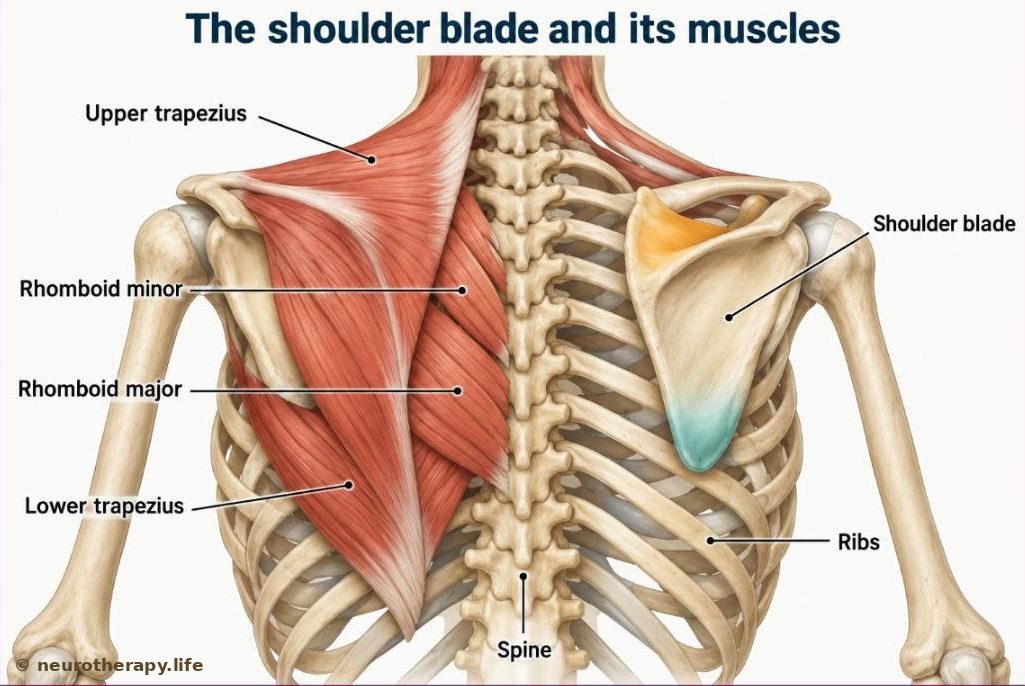
- Pain between the shoulder blades can be referred pain — felt there, but coming from the heart, lungs, gallbladder or pancreas
- The rhomboid muscles run from the spine (C7 to T5) to the inner edge of the shoulder blade
- Shoulder pain that does not ease within 2 weeks should be checked by a doctor
Source: Cleveland Clinic (referred pain; upper back pain); StatPearls (rhomboid muscles); NHS; MedlinePlus
What is Shoulder Blade Pain?
The shoulder blade (scapula) is a flat triangle of bone on the upper back. Unlike most bones it does not sit in a joint socket. It floats on the back of the rib cage, held there by muscle alone — and those muscles run on from the spine, over the blade, into the arm.
So most shoulder blade pain comes from these muscles — from strain, overuse or sitting hunched for hours. It can also come from the neck, where the nerves to the arm begin. And some pain felt here comes from organs deep inside, which is why it must never be ignored when it comes with chest pressure or breathlessness.
What are the symptoms?
- A dull ache or burning in, under or between the shoulder blades
- Pain that is worse after long sitting at a desk, driving or looking down at a phone
- Stiffness when turning the neck or raising the arm
- Tender, tight spots in the muscles over the blade
- Pain that spreads down the arm with tingling or numbness in the fingers
What causes it, and who is more likely to get it?
Muscles and posture
- Sitting hunched for long hours
- Muscle strain from lifting, sport or sleeping awkwardly
- Overuse of the arm in the same movement again and again
Neck and spine
How is it found?
A doctor first asks where the pain is, what brings it on, and whether anything else comes with it — chest pain, breathlessness, fever or pain after meals.
Physical examination
The doctor presses on the muscles, moves the neck and the arm, and checks strength and feeling in the hands.
X-ray or MRI of the neck and upper back
Shows wear in the spinal bones, a slipped disc, or a crack in a bone.
ECG and blood tests
Used at once when the pain could be coming from the heart.
Ultrasound of the belly
Looks at the gallbladder and nearby organs when the pain comes after meals.
Before touching the back, a neurotherapist asks three questions: is there chest pressure, breathlessness, sweating or pain into the jaw or arm; is the pain constant, worse at night, or in someone who has had cancer; and is there new neck pain with headache or trouble with vision or balance. Then the therapist finds which part of the blade hurts — upper or lower.
How Neurotherapy sees Shoulder Blade Pain
LMNT teaching says a pain in the blade is rarely a pain in the blade. It is a pain in a sheet of tissue that starts at the spine and ends at the fingers. That is why both shoulder blade treatments begin beside the spine and finish at the hand — and why they are told apart by which part of the blade hurts, and by what the arm is doing while the therapist works.
One sheet of tissue, from the spine to the fingers
- Spinethe muscles start beside the spinal bones of the neck and upper back
- Upper bladeupper trapezius and the small rhomboid, over ribs two to four
- Lower bladelarge rhomboid and lower trapezius, over ribs six to eight, with the base of the lung beneath
- Armthe same muscles pull on the arm and move with it
- Fingersthe treatment ends at the hand
Turning the palm over changes which part of the blade faces the therapist. With the palm up, the lower half of the blade and its muscles come into the open; with the arm raised and the palm down, the upper corner swings into reach. So the two treatments are not one technique given twice.
Only they know the pain; you do not.
Neurotherapy treatment for Shoulder Blade Pain, step by step
Listen and examine first
The therapist asks the three safety questions — heart, night pain or cancer, new neck pain with headache or dizziness — and asks about thin bones and steroid tablets. Then the pain is found: upper part of the blade, or lower.
Lower shoulder blade pain
For pain in the lower part of the blade. Lying face down, arms down, elbows bent and palms facing the sky — the therapist works with the palms, from beside the spine toward the hand.
Upper shoulder blade pain
For pain in the upper part of the blade, between the shoulder and the neck. Face down, arms raised, elbows bent and palms facing the ground — this one is given with the feet.
BAFA, when the neck is involved
After these two treatments, BAFA — both arms and both forearms — is given; LMNT teaching says it brings great benefit in cervical (neck) problems.
Check again and write it down
After the treatment the pain points are checked again and the change is written on the card — ++++ before, ++ or + after, or a minus when the pain has gone. The card, not memory, decides the next day's treatment.
Points and formulas used
Lower Shoulder Blade Pain
For pain in the lower part of the shoulder blade — palms up, elbows bent, given with the palms.
Open →Upper Shoulder Blade Pain
For pain in the upper part of the shoulder blade — arms raised, palms down, given with the feet.
Open →Never do this
- Emergency: pain between the shoulder blades with chest pressure or tightness, breathlessness, sweating, nausea, or pain into the jaw or down an arm is not a muscular back. Stop, sit the person up and call emergency help (108/112) at once. Angina
- Pain that is constant, worse at night, or in someone who has had cancer is checked by a doctor before it is treated.
- New or unusual neck pain with headache, or any trouble with vision or balance: nothing is pressed on the neck at all until a doctor has looked.
- Thin bones, long use of steroids, an earlier fracture from a small injury, frailty, or cancer that may have reached bone: light contact only over the ribs and spine, and none where bone is known to be involved. Osteoporosis
- Never repeat 'yesterday's treatment' from memory. If the card is missing, the pain points are checked again first — a wrong treatment can increase the trouble.
- Cancer: if the person has cancer, (10) Pan, Thymus, Pit, Lu + Sh, Rt. Ov / Lt. Ov and (30) Medulla are never given — the therapist changes the plan.
- Keep taking the medicines your doctor prescribed. Neurotherapy works alongside your medical care, never instead of it.
From Ayurveda and the kitchen
Test yourself
What research says
- Strong evidence
The rhomboid muscles run from the lower neck and upper back bones (C7 to T5) to the inner edge of the shoulder blade. They pull the blade back, lift it, turn it and hold it against the ribs, so trouble in them brings pain along the inner edge of the blade and in the neck, back and shoulder — the same sheet of tissue LMNT works from the spine outward.
No clinical trial of Neurotherapy in shoulder blade pain has been published yet. Improvements reported by neurotherapists are clinical observations.
For you
Desk and phone workers
Sit tall, keep the screen at eye level, and get up to move your shoulders every half hour.
People with heart risk
Diabetes, high blood pressure, smoking or heart disease in the family: new pain between the shoulder blades is checked by a doctor first — never rubbed away.
Older adults
New sharp pain in the upper back can be a spinal bone cracked by thin bones. Ask for a check before any pressure on the back.
This page explains; it does not diagnose. Neurotherapy works alongside your medical care — keep taking the medicines your doctor prescribed, and see a doctor for any new or severe symptom.