Bell's palsy
Bell's palsy is a sudden weakness of one side of the face. The nerve that moves the face swells and stops working for a while. Most people get better over weeks to months — but a face that droops must always be checked for a stroke first.
- About 1 in 60 people get Bell's palsy at some time in their life
- Most common between 15 and 60 years; the average age is about 40
- Up to 8 in 10 people recover fully within three months
Source: Cleveland Clinic; MedlinePlus; NHS; StatPearls (Hohman, Warner & Varacallo, 2024)
What is Bell's palsy?
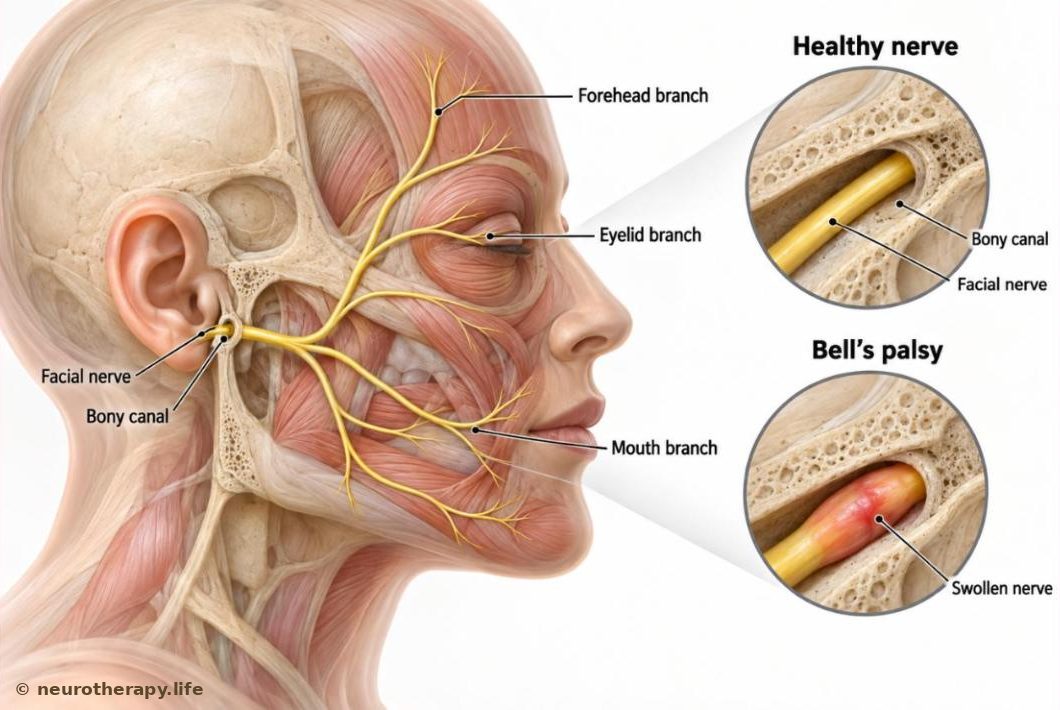
The facial nerve — the seventh of the twelve nerves that leave the brain — works the muscles of one side of the face. On its way out it passes through a very narrow canal of bone behind the ear.
In Bell's palsy this nerve swells, often after a virus such as the cold-sore virus. Inside the tight canal the swelling squeezes the nerve and its blood supply, and its messages stop. So the whole side of the face goes weak — the forehead, the eyelid and the mouth together. It usually comes on over a few hours to two or three days.
What are the symptoms?
- One side of the face droops — the eyebrow, the eyelid and the corner of the mouth
- The eye on that side cannot close fully, and may be dry or keep watering
- Drooling, and food or drink escaping from one corner of the mouth
- Cannot smile, whistle or wrinkle the forehead on that side
- Pain behind the ear, often a day or two before the weakness
- Loss of taste, or ringing in the ear, in some people
What causes it, and who is more likely to get it?
Viruses
- The cold-sore virus (herpes simplex) — the most likely trigger
- The chickenpox and shingles virus, and other viral infections
Who is at higher risk
- Diabetes
- Pregnancy, and high blood pressure in pregnancy
- High blood pressure and being very overweight
- Having had Bell's palsy before
Other causes the doctor rules out
- A stroke — the most important one to rule out
- A middle-ear infection, Lyme disease, or, rarely, a growth pressing on the nerve
How is it found?
Bell's palsy is usually recognised from an examination of the face — but only after the doctor has ruled out a stroke and other causes. There is no single test that proves it.
Face and nerve examination
Raising the eyebrows, shutting the eyes, smiling and puffing the cheeks show which muscles are weak. Arms, legs and speech are checked too.
Blood tests
To look for a cause such as diabetes or an infection.
Nerve tests (EMG, nerve conduction)
Show how badly the nerve is affected and help predict recovery.
CT or MRI scan
Used when a stroke, a growth or another cause is suspected, or when the face does not start to improve.
A neurotherapist does not start with the face. First come twenty seconds of screening: raise both eyebrows, shut both eyes tight, hold both arms out with the eyes closed and count to ten. When did it start, has a doctor seen it, can the eye close, are the drops or ointment being used? Only then are Liv°, Mu° and the points around the navel examined.
How Neurotherapy sees Bell's palsy
LMNT has a treatment named after this very problem: the Bell's Palsy point, also called the Facial point. Guruji's teaching describes it for the person whose mouth has turned to one side, who cannot smile properly or close the eye fully, and says such patients benefit greatly from it. Beside it, LMNT gives (7) Medulla — in its system each of the twelve nerves of the head is reached by the Medulla count of the same number, and the seventh is the nerve of the face.
LMNT is honest about what the hands reach. The face is the one place where muscles are anchored into the skin, so drawing the skin works real muscle. Whether it reaches a nerve swollen inside a canal of bone has not been shown. That is why it is offered alongside the doctor's treatment, never in place of it.
Whether or not the patient gets immediate benefit from our treatment, let no harm reach him through our carelessness — attend to this.
Neurotherapy treatment for Bell's palsy, step by step
Screen first, then examine
Forehead, eyes, arms and speech are tested before any hand goes near the face, and the hour the face changed is written on the card. Then Liv°, Mu° and the navel points — the digestive work they ask for goes along with the face work.
(15) Medulla, then (7) Medulla
(15) Medulla always comes first, before any Medulla given for a nerve of the head. Then (7) Medulla — soft thumb strokes down the side of the neck behind the ears — three times, with a minute and a half between rounds.
The Facial point — from the working side
Seated. The soft pads of both thumbs, one behind the other, press the tissue gently inward and draw it along without scratching, leaving no place empty — starting from the side that opens properly, across to the weak side, and finally up to the side, behind the hair. The direction is written on the card as a symbol, so every therapist works the same way.
M. Heparin
The Heparin formula headed by (6) Medulla. LMNT lists Bell's palsy — the mouth turned crooked to one side — among its chief uses.
Thymus — only when it is allowed
Thymus is given to raise the body's own resistance, and LMNT names it for Bell's palsy. But it has the longest list of people who must not have it — so it is checked against that list first (see Safety).
Points and formulas used
Bell's Palsy
The Facial point — a slow, even drawing of the facial tissue from the working side across to the weak side, finishing behind the hair; helps the muscles of the face.
Open →Medulla
(7) Medulla — the Medulla count that LMNT gives for the seventh nerve, the nerve of the face; always after (15) Medulla, three times.
Open →M. Heparin (medulla)
The Heparin formula headed by Medulla — LMNT lists Bell's palsy among its uses.
Works through
Open →Never do this
- A face that droops is a stroke until proved otherwise. If it comes with weakness of an arm or leg, slurred speech, sudden confusion or loss of vision — FAST: call 108 / 112 at once. Nothing is given. Stroke, or a passing weakness, numbness or loss of vision, within three months
- Every new weakness of the face is seen by a doctor the same day, before any Neurotherapy — early medical treatment works best. Also go at once for severe pain in or behind the ear, blisters in the ear or mouth, or fever.
- An eye that will not close dries out, and a dry eye can get ulcers and scars. Use the drops, ointment and night-time tape or patch your doctor advises. A red, painful eye or blurred vision needs a doctor the same day. Eyes
- Thymus is never given in pregnancy, polio, inflammatory disease, heart disease, diabetes, rheumatoid arthritis, autoimmune disorders or kidney disease. M. Heparin's (6) Medulla is not given to 13–20-year-olds being treated for height; with a shunt, less pressure on the neck; never the front of the neck. Th. Only
- Cancer: if the person has cancer, (10) Pan, Thymus, Pit, Lu + Sh, Rt. Ov / Lt. Ov and (30) Medulla are never given — the therapist changes the plan.
- Keep taking the medicines your doctor prescribed. Neurotherapy works alongside your medical care, never instead of it.
Watch

A demo of the M. Heparin formula — the Heparin formula headed by Medulla ((6) Medulla, (8) Pan, (7) Liv, (8) Chest Only) — used for neck and shoulder pain and for headache that keeps coming back.
How M. Heparin is given — one of the formulas LMNT lists for Bell's palsy.
From practice
The schoolteacher whose face fell, and what she did not say
A teaching case — a composite from practice, not one patient's file
52 years · the right side of her face had fallen eleven weeks earlier; her doctor had given two weeks of tablets
- What was found
- On the right she could not wrinkle her forehead, close her eye, smile evenly or whistle — yet a light touch on the cheek felt perfectly normal. The face was moving badly, not feeling badly: the seventh nerve. Her scan said the trouble was in the nerve, not the brain. Gal, Pan, Liv° and Mu° were tender, and the ring fingers of both hands hurt.
- What was done
- (15) Medulla, then (7) Medulla three times, with the digestive work her navel findings asked for. In the first week the eye began to close in sleep and the night tape came off. By week three a faint crease came back on the forehead; in week four, a thin whistle. Then progress stopped.
- What it teaches
- A longer formula was added, and its immunity parts made her fingers and wrists worse within two days. Asked to bring every strip and bottle from home, she brought an old strip of sugar tablets — she had never thought of her borderline diabetes as an illness. Those parts were removed, as LMNT requires in diabetes, and she went to her own doctor. The face moved again; at four months she was back at work. One eyebrow never came fully level, and she was told so honestly.
From Ayurveda and the kitchen
Test yourself
What research says
- Strong evidence
The facial nerve swells where its bony canal is narrowest — about 0.7 mm wide — and the swelling cuts its blood flow. The cold-sore virus has been found in many patients. A stroke usually spares the forehead, while Bell's palsy weakens it too. About 80% recover fully even without treatment, and about 40% get damage to the surface of the eye, so eye care matters.
Hohman MH, Warner MJ, Varacallo MA. Bell Palsy. StatPearls. 2024.
No clinical trial of Neurotherapy in Bell's palsy has been published yet. Improvements reported by neurotherapists are clinical observations.
For you
Pregnant women
Bell's palsy is more common in pregnancy. See your doctor the same day. In LMNT, Thymus is never given during pregnancy.
People with diabetes or high sugar
Tell your therapist, even if you were only told your sugar is "borderline". It changes which points may be given.
Anyone whose eye does not close
Protect the eye every night and day as your doctor advises, and check that it closes at each session. A red or painful eye needs a doctor the same day.
This page explains; it does not diagnose. Neurotherapy works alongside your medical care — keep taking the medicines your doctor prescribed, and see a doctor for any new or severe symptom.