Paralysis and stroke
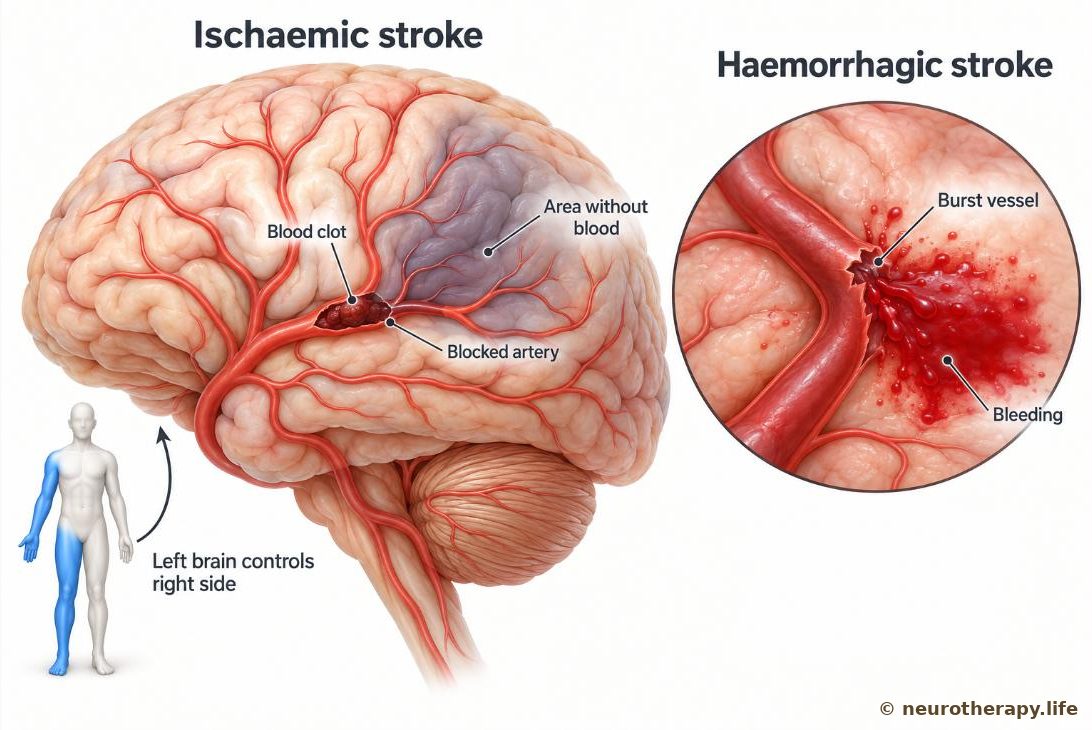
A stroke happens when blood stops reaching part of the brain — a clot blocks a vessel, or a vessel bursts. It can leave one side of the body weak or paralysed. A stroke is an emergency; Neurotherapy comes later, to support recovery alongside the stroke team.
- About 11.9 million people worldwide have a new stroke every year (2021)
- About 80% of strokes are caused by a clot; the rest by bleeding
- 1 in 4 adults is expected to have a stroke in their lifetime; high blood pressure nearly triples the risk
- In an untreated stroke, about 1.9 million brain cells are lost every minute
Source: World Health Organization (Stroke fact sheet); MedlinePlus (Stroke); Saver, Stroke 2006
What is Paralysis and stroke?
Your brain needs a steady supply of blood to bring it oxygen and food. In a stroke that supply is cut off to one part of the brain — most often by a clot, sometimes by a burst vessel. Within minutes the brain cells there begin to die.
Each side of the brain moves the opposite side of the body, so a stroke on the left can paralyse the right arm and leg and often affects speech. A “mini-stroke” (TIA) passes within minutes or hours but is a warning that a bigger stroke may follow. Paralysis can also come from a head injury, a bleed after a blow, or disease of the nerves.
What are the symptoms?
- Sudden drooping or numbness of one side of the face
- Sudden weakness or numbness of an arm or leg, usually on one side
- Slurred speech, trouble finding words or understanding
- Sudden loss or blurring of vision
- Sudden loss of balance, dizziness or a very severe headache
- Later: a weak, stiff or curled arm or leg on one side
What causes it, and who is more likely to get it?
A clot (ischaemic stroke)
Bleeding (haemorrhagic stroke)
- High blood pressure bursting a weak vessel
- A bleed inside the head after a blow
Habits and age
- Smoking, too much salt, alcohol and too little activity
- Older age and a family history of stroke
Other causes of paralysis
How is it found?
A stroke is diagnosed in hospital, fast. Scans show whether it is a clot or a bleed — and that decides the emergency treatment.
CT or MRI scan of the head
Shows a clot or a bleed and which part of the brain is affected.
Heart tests (ECG, echo)
Look for a heart rhythm problem or a clot source in the heart.
Blood pressure and blood tests
Check sugar, cholesterol and clotting — the risks that must be controlled to prevent another stroke.
When a person comes to a neurotherapist after a stroke, the first questions are: when did it happen, and is there a neurologist's letter? The letter says which side of the brain was hit and whether blood-thinning medicine is being taken — that alone rules some points out. Before any paralysis treatment, both calves are compared for temperature and size.
How Neurotherapy sees Paralysis and stroke
LMNT teaching sees paralysis after a clot as a problem of blood that has stopped moving. Its Heparin family of formulas is built to provoke the body's own chemistry that keeps blood from clotting and opens old clots — heparin and plasmin. The explanation is offered, in LMNT's own words, with a “perhaps”; what is recorded is what patients reported.
Alongside the chemistry comes the physical work: Paralysis Clockwise along the limbs, Shukla at the wrist and ankle, and Hammering on the head for speech. LMNT teaching also gives families an honest forecast before the first session: recent paralysis may respond sooner; old paralysis can take a good deal of time. And it is clear that this work sits alongside proper rehabilitation — physiotherapy and speech therapy — never instead of it.
Whether or not the patient gets immediate benefit from our treatment, let no harm reach him through our carelessness — attend to this.
Neurotherapy treatment for Paralysis and stroke, step by step
Hospital first, then examine
A new stroke goes to hospital at once. Later, the therapist asks when the stroke happened, reads the neurologist's letter — which side, and whether blood thinners are taken — and compares both calves before any paralysis treatment.
The first three months: gentle, and nothing on the neck
Within three months of a stroke, no neck work of any kind is given. In the first days, once the hospital team has the patient stable, Feather Touch — the lightest fingertip stroking — is the one treatment that stays open.
The Heparin family, chosen by the picture
P. Heparin for paralysis of every kind. PT. Heparin where an infarct (a clot-damaged area) comes with pain. F. and Anti F. Heparin where paralysis after an infarct is many years old. TT. Heparin where paralysis follows a bleed after a blow.
Moving the weak limbs
Paralysis Clockwise: down the inner side of the limb, up the outer side, ending with its lifts. Shukla at the wrist and ankle — families can be taught it for twice a day at home. Lt. Parkhoo where the leg cannot be lifted, and Const for the constipation that often comes with paralysis.
Speech, and the later work
Hammering on the left side of the forehead where speech is affected, and the Speech Point. Only in paralysis of long standing — never within three months of a stroke — does LMNT add Necklace and Medulla at the neck.
Points and formulas used
P. Heparin (plasmin)
The parent Heparin formula — built to help the body keep blood from clotting and open old clots; LMNT gives it in paralysis of every kind.
Works through
Open →F. Heparin (fibrinolysin)
For paralysis after an infarct that is many years old; given with Anti F. Heparin.
Works through
Open →Never do this
- Stroke signs — FAST: Face drooping, Arm weakness, Speech difficulty → Time to call 108 / 112 immediately. Sudden loss of vision, loss of balance or the worst headache of one's life count too. Every minute matters. LMNT is never first aid for a stroke.
- Within three months of a stroke, or of a passing weakness, numbness or loss of vision: no neck work at all. For these patients there is no version of neck pressure that is acceptable. Neck
- On blood-thinning medicine: no forceful points — Katka and Motor Neuron Point are not used. Never stop a blood thinner on your own. Katka
- Do not use a weak arm as a handle — support it from beneath, and never lift the patient by the arms. Shukla is not given in osteoporosis; Multivitamin 2 not to those paralysed because of high BP; G. Heparin never in heart disease. Shukla
- This work sits alongside proper rehabilitation — physiotherapy, speech therapy and the stroke team's follow-up — never instead of it.
- Cancer: if the person has cancer, (10) Pan, Thymus, Pit, Lu + Sh, Rt. Ov / Lt. Ov and (30) Medulla are never given — the therapist changes the plan.
- Keep taking the medicines your doctor prescribed. Neurotherapy works alongside your medical care, never instead of it.
Watch

Shows the P. Heparin formula: (8) Pan at the top of the thighs, (7) Liv on the thigh and forearm, and (8) Chest Only with the palms on the chest. In the video it is given as the last part of the Angina treatment, to support circulation.
How the P. Heparin formula is given — the parent formula LMNT uses in paralysis.
From practice
The hand that had been closed for three years
A teaching case — a composite from practice, not one patient's file
64 years · retired storekeeper · three years after a stroke, right hand curled shut, right leg swung to walk
- What was found
- Physiotherapy had stopped after a year. The neurologist's letter showed he was on blood-thinning medicine, which ruled out every forceful point. Both calves matched. His right shoulder was loose in its socket and tender when others moved the arm.
- What was done
- Paralysis Clockwise on the arm and leg with its lifts, Shukla at the wrist and ankle, and Feather Touch at the end of each session. By week four the ankle moved further but the fingers had barely opened — so his daughter was taught Shukla for morning and evening. The gains in the hand came from her, not from the clinic.
- What it teaches
- In week six his shoulder began to hurt. Asked to show how they got him up from the chair, the family lifted him under both arms — nobody had mentioned it, because it was not “treatment”. It was changed that day. Read the letters, teach the family, and ask how the patient is lifted and washed.
From Ayurveda and the kitchen
Āsana done for another
Yoga defines an āsana simply as a posture that is steady and comfortable, and it keeps muscles and nerves supple. A person with paralysis cannot make her own stretch. LMNT teaching puts it this way: when the therapist's pressure stretches muscles that have gone tight, what yoga does for oneself, this therapy does for another.
Test yourself
What research says
- Strong evidence
This study worked out how fast the brain is damaged in a typical untreated stroke: about 1.9 million brain cells are lost every minute. It is the reason stroke is an emergency — every minute before treatment counts.
- Strong evidence
A review of stroke rehabilitation found good evidence that recovery is helped by well-organised teams — in stroke units, or through early supported discharge home. It is the reason Neurotherapy is given alongside this care, never instead of it.
Langhorne P, Bernhardt J, Kwakkel G. Stroke rehabilitation. Lancet. 2011.
No clinical trial of Neurotherapy in stroke or paralysis has been published yet. Improvements reported by neurotherapists are clinical observations.
For you
Families and carers
Support a weak arm from below and never lift the person by the arms. Learn the home exercises the therapists give — daily practice matters more than any single session.
Anyone who had a warning “mini-stroke”
Weakness, numbness or loss of vision that passed on its own still needs a doctor the same day — it can come before a bigger stroke.
People with high BP or diabetes
These are the biggest risks you can control. Keep your blood pressure and sugar checked, and take the medicines prescribed.
This page explains; it does not diagnose. Neurotherapy works alongside your medical care — keep taking the medicines your doctor prescribed, and see a doctor for any new or severe symptom.