Watch


The six-step chain from a shortage of blood to a named disease
Now put the three together, because separating them is a convenience of textbooks and a trap for a therapist. Learn this chain in order; you will use it in front of patients for the rest of your working life.
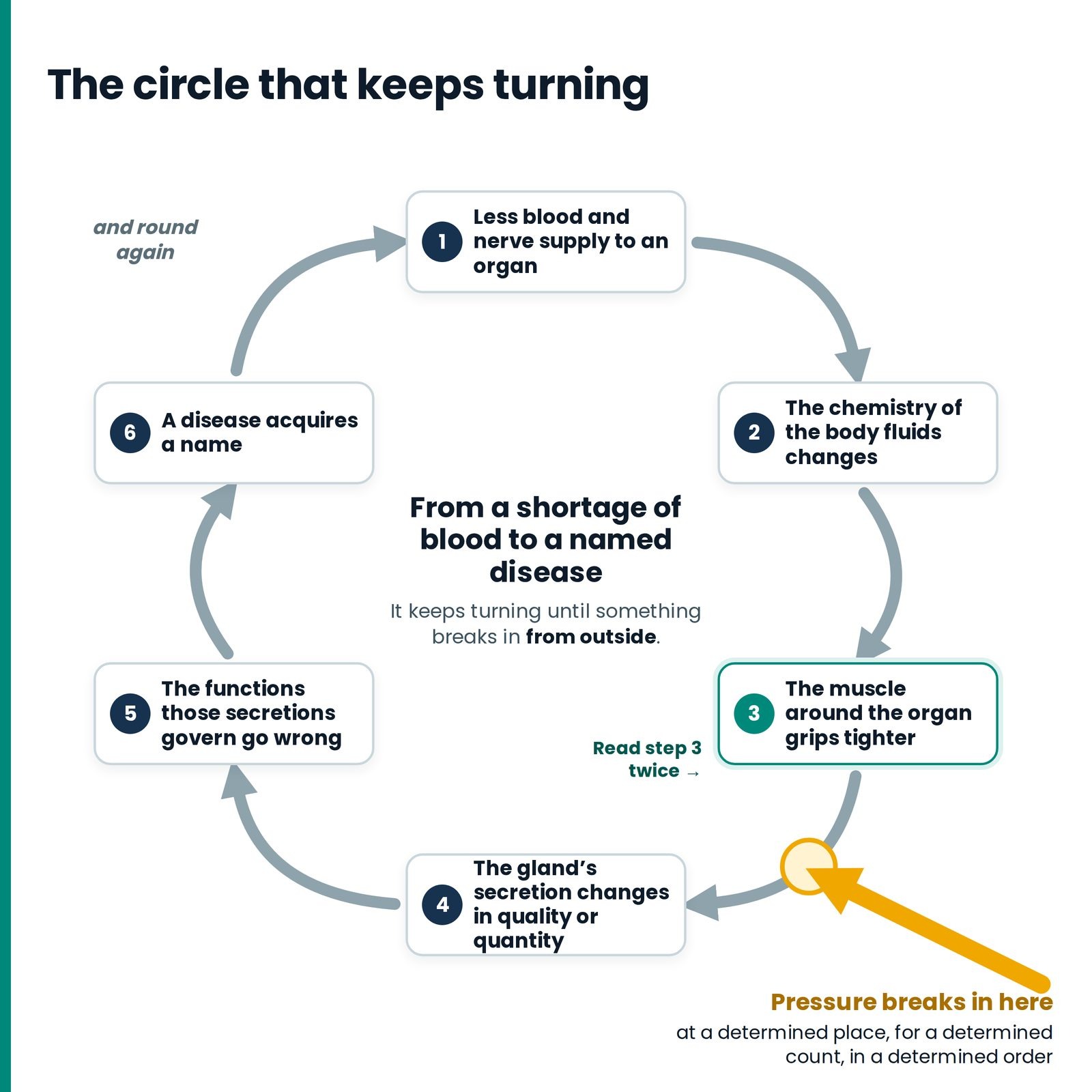
The chain from a shortage of blood to a named disease
1. Improper blood or nerve supply to one or more organs — 2. — causes an alteration in the chemical composition of the body's fluids; 3. — this alters the tonicity of the muscles surrounding the glands and organs — that is, how tight or how slack they are held; 4. — which in turn affects the behaviour of those glands and organs, causing a variation in the quality or the quantity of their secretions; 5. — and since all the body's functions are constantly monitored and governed by the secretions of the glands, any variation in any of them must cause the body to malfunction; 6. — which lays the foundation of disease.
And therefore: treatment consists primarily in restoring the flow of blood, lymph and nervous signals to the organs concerned, and thereby stimulating the glands and organs back to normalcy.
Read step 3 twice. It is the step students skip, and it is the one that makes the therapy make sense.
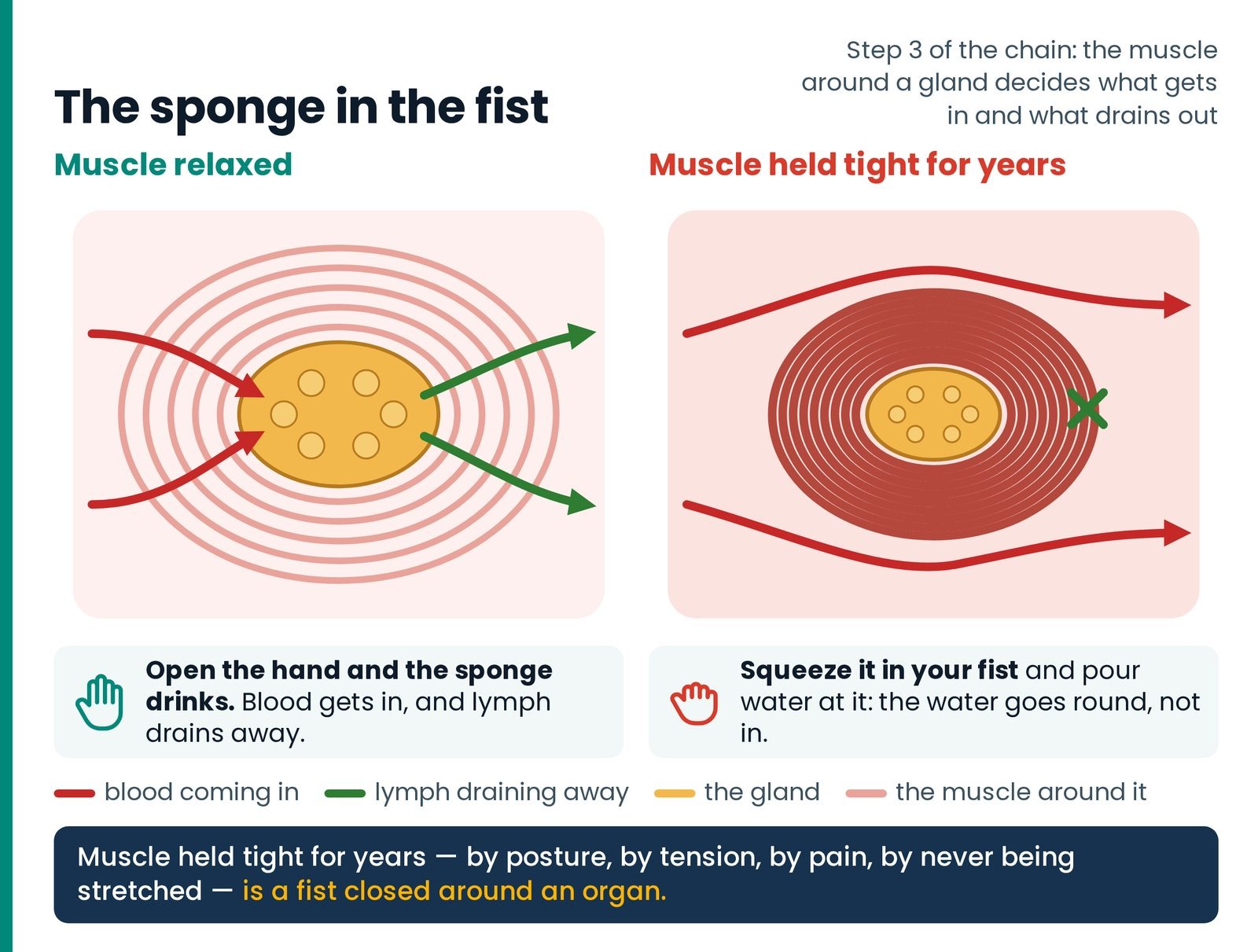
A gland is not a bag hanging in space. It sits in a bed of muscle, wrapped in tissue that is either supple or tight, and the tightness of what surrounds an organ decides how freely blood can enter it and how freely lymph can leave it. Squeeze a sponge in your fist and pour water at it: the water goes round, not in. Open the hand and the sponge drinks. Muscle held tight for years — by posture, by tension, by pain, by never being stretched — is a fist closed around an organ. (Figure 3.10)
And the tightness of the muscle is itself decided by the chemistry of the fluid it sits in. That is step 2 feeding step 3: get the fluid wrong and the muscle grips; get the muscle gripping and the supply falls; get the supply falling and the fluid goes further wrong. It is a circle, and it keeps turning until something breaks into it from outside. Doing that, with a hand or a foot, at a determined place for a determined count, is the whole of this therapy's technique. (Figure 3.11)