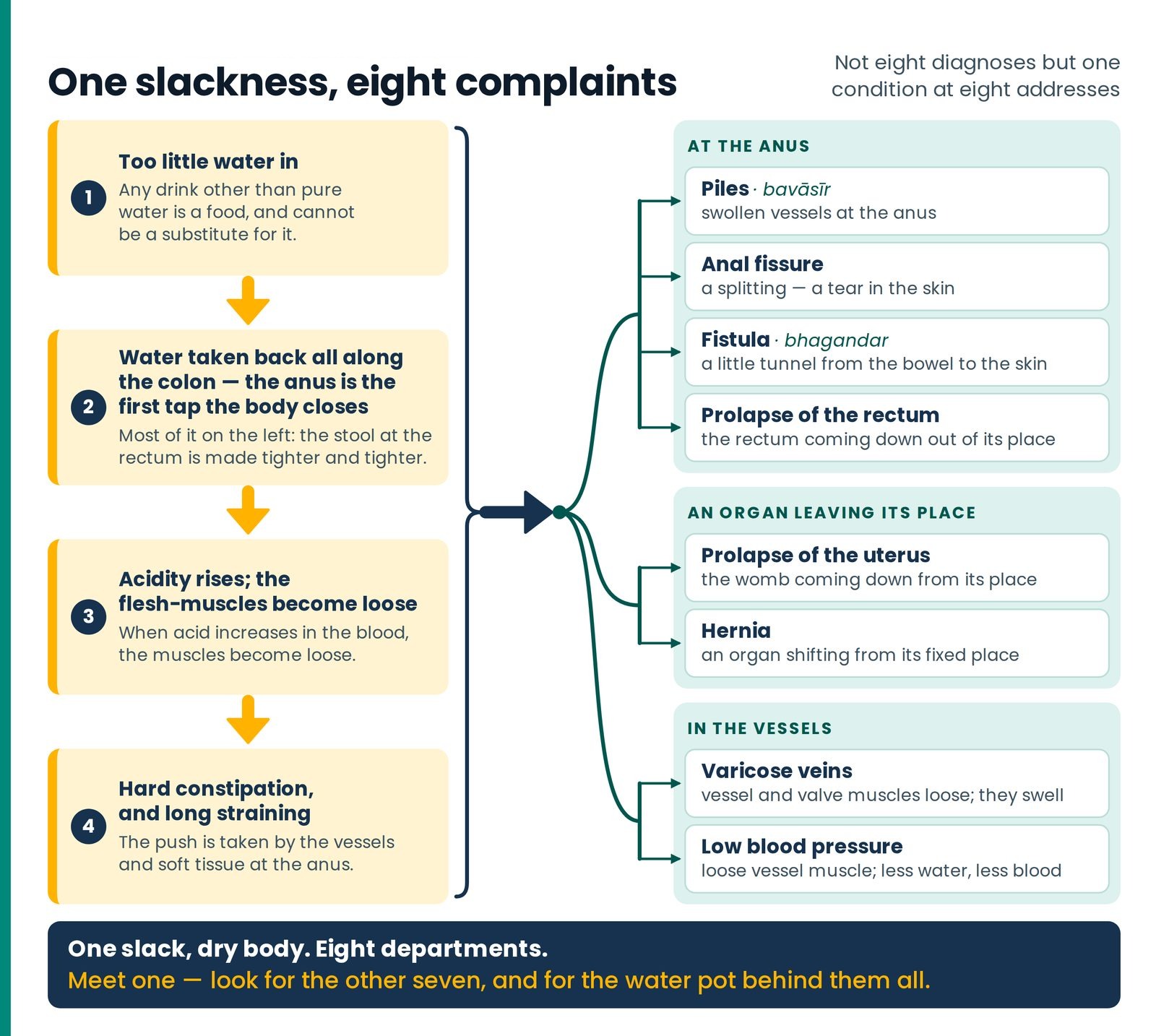
They appear together on the acidic side of the chart under one heading — hard constipation and the diseases connected with it — in the same list as blocked nose, dry cough, burning yellow urine, dry itchy eyes, pimples, dandruff, hair falling or greying early, dry skin, warts and psoriasis. One chief aspect of acidity is deficiency of water in the body, and these are the symptoms that appear on the organs that get rid of things.
So when a patient shows you one member of this family, do not treat the member. Look for the constipation standing behind it, and for the water pot standing behind that.
Three conditions carry pain at Mu° with them: prolapse of the rectum — the rectum coming down from its place; prolapse of the uterus — the womb coming down from its place; and hernia — an organ shifting from its fixed place and entering inside some other organ or part.
Key teaching
The family is larger than the anus
These are three different diseases. But there is one thing common among all three: they all occur because the flesh-muscles have become loose.
And two more, in the blood vessels, which have also come only because the flesh-muscles became loose — one chief cause of that being acidity:
Varicose veins, the blue veins. Varicose means to swell up. Because the muscles of the vessels and of their valves become loose, a fault comes into them and they swell easily.
Low blood pressure. When the muscle of the vessels becomes loose the pressure will be less; and because of the deficiency of water the volume of the blood will be less. From both these causes together the blood pressure goes down.
Now read your patient again. Piles, a hernia repaired at forty, blue veins on both calves, a pressure always called "on the low side", a bowel that opens every third day with force — not five diagnoses, but one slack, dry body described five times by five departments. (Figure 10.2)
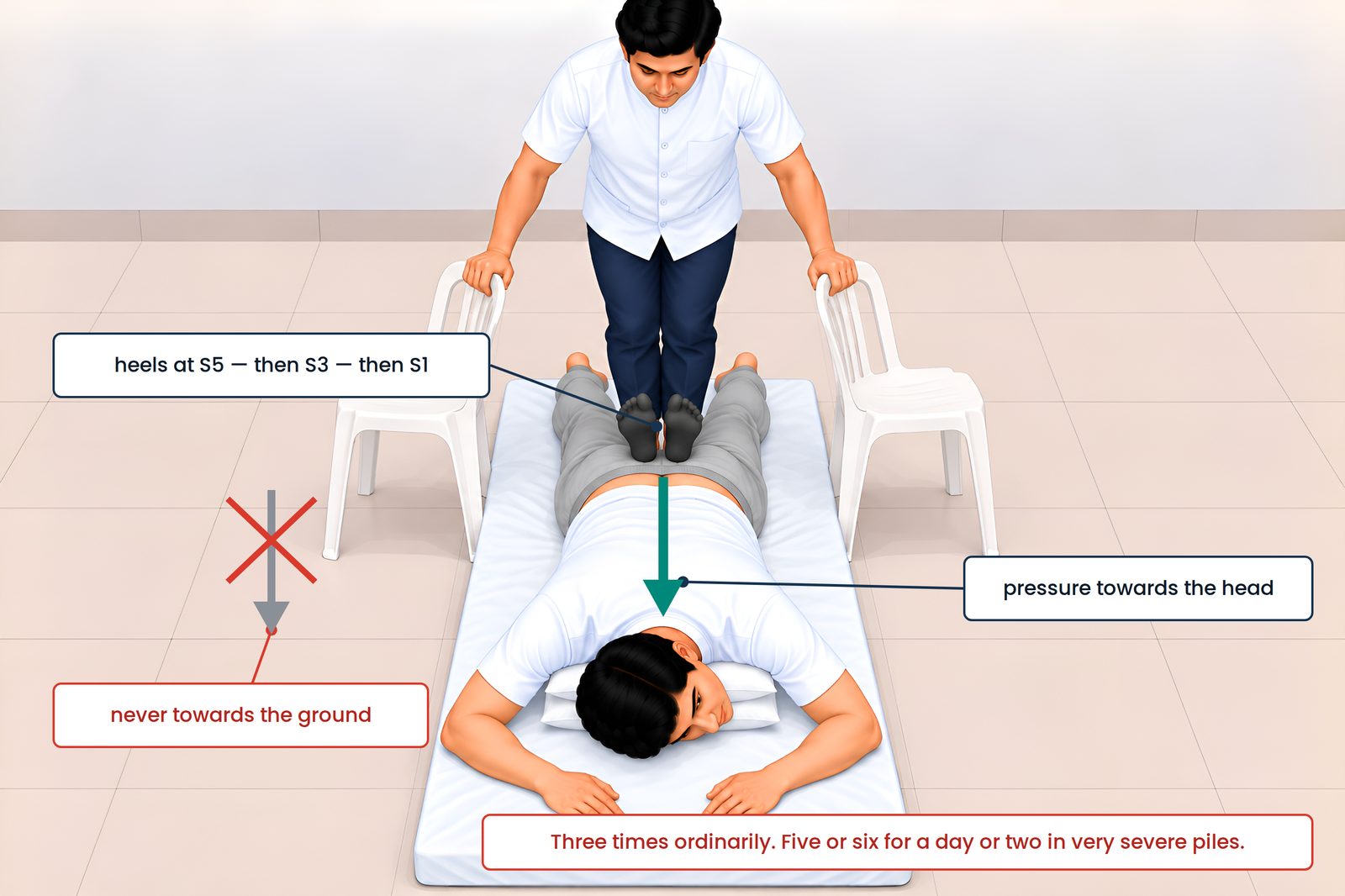
The treatment named for this family is the Triangle for Piles — so named because it is given for piles, and given across the triangle of the sacrum. It strengthens the muscles of the pelvis, and tightens the sphincters — of the urinary bladder, of the uterus, of the anal opening and so on.
Therefore, besides piles, it gives benefit in: anal fissure · fistula · prolapse of the rectum. It is also beneficial for control of urine in children and in the elderly — give it to children who wet the bed — and in women for prolapse of the uterus and for controlling excessive bleeding in the menses.
Two details of its giving are the instruction itself and must never be dropped: the pressure is in the direction of the head, and never in the direction of the ground — the chairs are placed so that this is what happens — and for an ordinary person three times is enough, but for very severe piles one may give five or six times for a day or two at first. Prone (Figure 10.3)
Key teaching
What is given, and what it strengthens
▲ Take care Do not give it to those who pass little urine.
Its neighbour on the same sacrum, S4–S5, is the exact opposite of the Triangle treatment: the heels draw and press the muscles inward and downward instead of jerking them upward, and it is given ordinarily twice — for obstructed urine, for high blood pressure, and to increase a scanty flow in the menses. Two treatments, one square of bone, opposite directions, opposite indications. The direction is not a detail of technique. It is the treatment. Both are taught in Face Down, "Face Down".
One slackness, eight complaints. Too little water in, water taken back along the colon, acidity and loose flesh-muscles, hard constipation and straining — and the eight complaints that come from one slack, dry body: four at the anus, two where an organ leaves its place, two in the vessels.The Triangle for Piles: pressure towards the head. The patient lies face down with the chest raised on one and a half pillows and the arms forward beside the head. Standing between two upright chairs and carrying his weight on his arms, the therapist rests both heels on the sacral triangle and jerks the muscles upward — the three paired stations, S5 then S3 then S1, the pressure always travelling towards the head and never towards the ground.
Read next
Face Down Face Down — the Triangle for Piles and S4–S5
The Fire and the Ash The Fire and the Ash — the bleeding and stool findings that go to a doctor
When the Hand Must Stop When the Hand Must Stop — rectal bleeding is never put down to piles unchecked
Straining, posture, and the act of passing stool
The seat, the squat, straining, and the urges that must not be held
Key teaching
The seat itself is a cause
The use of Western-type toilets does not aid easy defecation; it puts a strain on the bowels and on the bladder.
It belongs to a longer list of modern arrangements, each trivial alone and serious together:
Sitting for long hours in chairs with the legs hanging downwards is a major contributor to digestive disorders, because it interferes with proper blood flow to the abdominal organs.
Regular use of lifts and vehicles even for short distances robs the feet of much-needed exercise.
Setting out to work immediately after breakfast, lunch or dinner hampers digestion — and children who rush to school munching something on the way pay for it.
Eating standing up, as one must at a fast-food counter, leads to poor blood supply to the organs of digestion.
And behind all of them, tension and stress, which take their toll by frequently arousing the sympathetic nervous system and inhibiting normal parasympathetic activity — on which almost all the functions of the digestive system depend.
Each answers a question you will ask a constipated patient: what do you do all day, and where do you eat it?
Key teaching
What straining does, and what it becomes
A patient who strains is not merely uncomfortable. He is manufacturing the next disease. The pressure of a long forced push is taken by the vessels and the soft tissue at the anus — the mechanical half of how piles arise, how a tear becomes a fissure, and how the rectum is pushed down out of its place.
And it works the other way too. An uncontrollable urge on waking — sometimes so great that a patient cannot even wait to close the door — is often due to semi-solid stools; and behind it may lie a weak anal sphincter, probably an acquired habit of straining while passing stools, or else a congenital deficiency of folic acid. ▲ Take care
The man who strains at hard stools today is the man whose sphincter will not hold soft ones in ten years. The tightening treatment across the sacrum addresses the second half; only the patient's own habit addresses the first.
The questions to ask, and how to ask them
The second layer of the bowel interview, asked in the same voice
The Fire and the Ash gave you the five questions of the general stool interview and the elicitation script for undigested food. What follows is the second layer, asked in the same visit and in the same voice.
Three devices carry the interview. Show, do not ask — the chart turns a description into a pointing. Ask about yesterday, not about usually — usually returns the patient's self-image, yesterday returns an event. And ask the same thing twice, differently: "how often daily?" and, later, "once, or more than once?" are the same question, and the second gets a more accurate answer and makes the patient more responsive besides. A patient who insists irritably that everything is fine is met with no reaction and no irritation of your own — ignore the answer, just smile, and go politely on to the rest of the questions. (Figure 10.4)
Recording it, so that improvement can be shown
What goes on the card, and the order in which improvement arrives
Two bodies, read as this article teaches
A tailor operated twice for piles, and a boy who had stopped going
Ready to begin?
Send COURSE for course details, or your name, age and health issue for a consultation.