Difficulty in swallowing (dysphagia)
Difficulty in swallowing means food, drink or even saliva does not go down easily — it may stick, hurt, or make you cough. It is more common in older people and after illnesses of the brain and nerves.
- About 1 in 3 older adults living at home has trouble swallowing
- Almost half of older patients in hospital have it
- Food going into the airway can lead to pneumonia
Source: Doan et al., J Clin Med 2022 (systematic review); MedlinePlus; Mayo Clinic
What is Difficulty in swallowing (dysphagia)?
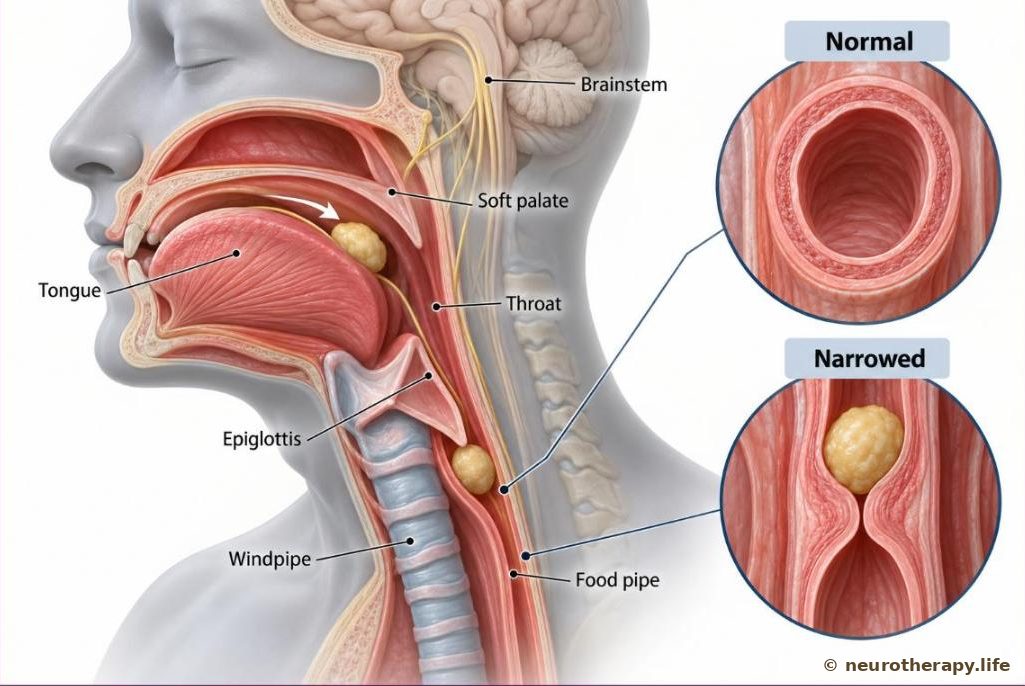
Swallowing looks simple, but it is one of the most finely timed things the body does. The tongue pushes the food back. Then, in less than a second, the throat squeezes, a small lid called the epiglottis closes over the windpipe, and the food pipe (oesophagus) opens to carry the food down to the stomach.
Difficulty can come at either stage. In the mouth and throat, it is usually the nerves and muscles that are weak — after a stroke, or in Parkinson's disease. Lower down, the food pipe itself may be narrowed, tight or in spasm, so food feels stuck in the chest.
What are the symptoms?
- Coughing or choking while eating or drinking
- A feeling that food is stuck in the throat or chest
- Pain while swallowing
- A wet, gurgly voice after drinking
- Food coming back up, sometimes through the nose; drooling
- Weight loss or repeated chest infections over time
What causes it, and who is more likely to get it?
Brain and nerves
- Stroke
- Parkinson's disease, multiple sclerosis, dementia
- Head or spinal cord injury; cerebral palsy
The food pipe
- Narrowing or scarring, often from long-standing acid reflux
- A tight lower ring or spasm of the food pipe muscles
- A growth in the throat or food pipe
Other
- Older age
- Some medicines, and treatment for head and neck cancer
- A sore, inflamed throat
How is it found?
A doctor asks exactly where the food sticks and whether solids, liquids or both are hard to swallow, then may arrange tests to see the swallow in action.
Bedside swallow check
A speech and language therapist watches you swallow small amounts of water and food, looking for coughing or a wet voice.
Barium swallow / video X-ray
You swallow a chalky liquid that shows up on X-ray, so the doctor can watch it pass through the throat and food pipe.
Endoscopy
A thin tube with a camera looks inside the food pipe for narrowing, inflammation or a growth.
A neurotherapist asks two quick questions — “How is your taste? How is your voice?” — because the answer decides the treatment. They also ask about diabetes and heart disease, and send anyone who coughs on liquids for a proper swallowing assessment.
How Neurotherapy sees Difficulty in swallowing (dysphagia)
In LMNT, swallowing is read as the work of the cranial nerves — the twelve nerves that come straight from the brain. Guruji's teaching gives each step of the swallow to the nerve that performs it, and treats that nerve through the Medulla points at the back of the neck, below the ears.
One swallow, several nerves
- 5th nerveTakes the mouthful backward — (5) Medulla.
- 12th nerveMoves the muscles of the tongue — (12) Medulla.
- 9th nerveThe throat, the closing of the epiglottis and taste at the back of the tongue — (9) Medulla.
- 10th nerve (vagus)The voice box and the food pipe itself — (10) Medulla.
That is why the therapist asks about taste and voice. If, with difficulty in swallowing, taste has gone, LMNT teaching gives (9) Medulla. If the voice has become heavy, it gives (10) Medulla. And where the food pipe itself is narrowed or tight, the rule is that a narrowed passage is opened from the left side.
This is exactly how it should be. And this itself is the secret of Neurotherapy's success.
Neurotherapy treatment for Difficulty in swallowing (dysphagia), step by step
Examine first
The therapist asks about taste and voice, watches you drink a little water, asks about diabetes and heart disease, and checks the diagnostic points Liv° and Mu°.
(15) Medulla first
Before any cranial-nerve Medulla, (15) Medulla is given. Every Medulla treatment is given three times, a minute and a half apart.
Taste gone: (9) Medulla. Voice heavy: (10) Medulla
The answer to the two questions decides the nerve. For a heart patient, (10) Medulla is always given on the left side only.
A narrowed food pipe: the left side opens
Where the food pipe is narrowed or contracted, (15) Left Medulla with (6) Left Swt is given, three times; (10) Left Medulla may be added. Left only.
Pain on swallowing: (12) Armpits
LMNT teaching gives (12) Armpits where swallowing hurts.
Points and formulas used
(10) Medulla
For difficulty in swallowing with a heavy voice; Left only for a narrowed food pipe and for heart patients.
Open →(6) Left Swt
With (15) Left Medulla, three times — the left pair that, in LMNT, opens a tight food pipe. Not in diabetes.
Open →Never do this
- Food stuck so that you cannot swallow even your saliva, choking, or difficulty breathing is an emergency — go to hospital at once. Swallowing trouble that starts suddenly with a drooping face, slurred speech or a weak arm may be a stroke: call an ambulance (108/112).
- Coughing or spluttering on liquids, a wet voice after drinking, or repeated chest infections mean food may be entering the airway. Get a proper swallowing assessment — the texture of food and drink may need to change. A sore throat with high fever, drooling, a muffled voice or a mouth that will not open needs a doctor the same day.
- (6) Left Swt is never given to a person with diabetes. The therapist checks the diabetes list of barred points before choosing any other point. (6) Left Swt
- Heart patients get (10) Left Medulla only. The rows for a narrowed food pipe are Left only, for everyone. Nothing presses the front of the throat. (10) Medulla
- Cancer: if the person has cancer, (10) Pan, Thymus, Pit, Lu + Sh, Rt. Ov / Lt. Ov and (30) Medulla are never given — the therapist changes the plan.
- Keep taking the medicines your doctor prescribed, exactly as told. Neurotherapy works alongside your medical care, never instead of it.
From practice
Four years without an easy swallow
Recorded in the therapy's own account — a camp case taught in Guruji's teaching; the patient's name is not used here
A man at a camp in Mysore · a narrowed food pipe (oesophageal stenosis) for four years
- What was found
- Even a single sip of water took him a long time. He swallowed in stages, lifting his chin a little each time, and had stopped eating with other people. His report named the problem: a narrowing — a passage that would not open.
- What was done
- Following the rule that a narrowed passage is opened from the left, he was given (15) Left Medulla with (6) Left Swt, three times. Right after, he drank water and said he was comfortable, and was comfortable at dinner too. On the second day (10) Left Medulla — the nerve of the food pipe itself — was added in between.
- What it teaches
- Relief after one session does not undo four years of narrowing, so the treatment was deepened on the second day rather than simply repeated. And the choice came from the mechanism in the report — a passage that will not open — not from the name of the disease.
From Ayurveda and the kitchen
Test yourself
What research says
- Strong evidence
Swallowing has three stages — mouth, throat and food pipe — and the throat stage cannot be stopped once it starts. It is run from the brainstem, with cranial nerves V, IX, X and XII working the chewing muscles, throat, palate and tongue — the same nerves LMNT reaches through its Medulla points.
Panara K, Ramezanpour Ahangar E, Padalia D. Physiology, Swallowing. StatPearls. 2023.
- Strong evidence
Pooling many studies, this review found swallowing difficulty in about one in three older people living at home and almost half of older hospital patients. Simple screening tools missed many cases that proper assessments found.
No clinical trial of Neurotherapy in swallowing difficulty has been published yet. Improvements reported by neurotherapists are clinical observations.
For you
Older adults
Sit upright to eat, take small mouthfuls, eat slowly and stay upright for a while after meals.
After a stroke or with Parkinson's
Ask for a swallowing assessment, and follow the food and drink textures the swallowing therapist advises.
People with diabetes or heart disease
Tell the therapist first — some points used for swallowing are changed or left out for you.
This page explains; it does not diagnose. Neurotherapy works alongside your medical care — keep taking the medicines your doctor prescribed, and see a doctor for any new or severe symptom.