Sprain and Injury
A twist, a fall or a blow can stretch or tear a ligament (a sprain), bruise the flesh, or leave a pocket of blood under the skin. Most heal in weeks — but a broken bone or a head injury must be seen by a doctor first.
- Ankles and wrists are the joints sprained most often
- Most sprains and strains feel better within 2 weeks
- Hard exercise such as running is best avoided for up to 8 weeks, as the joint can be hurt again
Source: MedlinePlus (sprains and strains); NHS (sprains and strains); Cleveland Clinic (sprains)
What is Sprain and Injury?
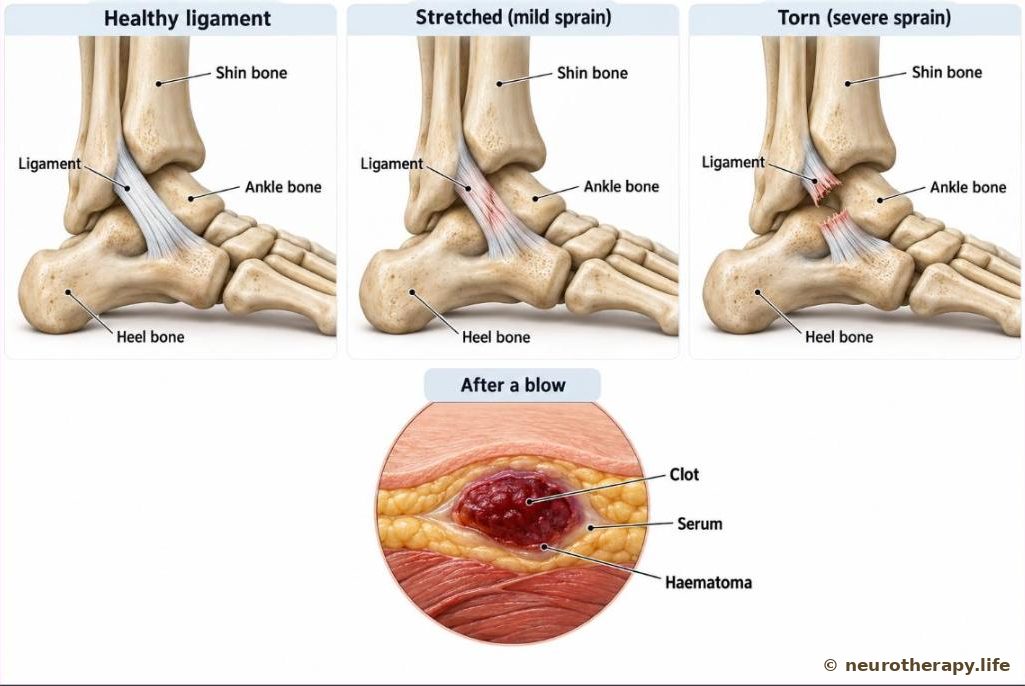
Ligaments are strong bands that hold bone to bone at a joint. A sprain is a ligament that has been stretched or torn, usually by a twist or a fall. A strain is the same kind of damage to a muscle or tendon.
A blow can also break small blood vessels. If the skin does not tear, the blood collects underneath as a bruise, or as a firm lump called a haematoma. The blood clots, and a pale, watery liquid — serum — separates out.
What are the symptoms?
- Pain and tenderness around the joint
- Swelling and bruising
- A pop or tearing feeling at the moment of injury
- Trouble moving the joint or putting weight on it
- A firm, boggy lump under a bruise that does not go down
What causes it, and who is more likely to get it?
Everyday accidents
- Twisting an ankle on uneven ground or stairs
- Falling on an outstretched hand
- A blow from a fall, a heavy object or a vehicle
Sport and work
- Sudden turns, jumps and landings
- Lifting and pulling heavy loads
Things that raise the risk
- A joint that was sprained before and did not fully heal
- Tired or weak muscles
- Thin, weak bones, which break more easily in a fall
How is it found?
The main question after an injury is: is a bone broken? A doctor examines the joint and, when needed, orders an X-ray before anything else.
Examination
The doctor checks tenderness, swelling, movement and whether you can bear weight. Checking the joint again after 4–5 days gives a clearer picture of the ligament.
X-ray
Shows or rules out a broken bone.
Ultrasound or MRI
Show torn ligaments, tendons and collected blood when the injury is severe or slow to heal.
How bad is the sprain? (grades)
Source: Cleveland Clinic — Sprains
A neurotherapist asks for the X-ray report before treating near an injury — a normal film is what makes the work allowed. You will be asked when it happened, whether any wound is still open, and about diabetes, heart disease, arthritis, pregnancy and every tablet you take, because these change the formula.
How Neurotherapy sees Sprain and Injury
LMNT teaching looks at what a blow leaves behind. The clot is the body's own repair. The watery serum that separates from it is what has to be cleared — so the course of treatment runs until the serum has dried up.
After a blow — what happens under the skin
- The blowbreaks small blood vessels under the skin
- Haematomathe blood cannot get out, so it collects in a pocket
- Clotforms — the scaffold on which healing is built
- Serumthe pale, watery liquid left over — this is what must be cleared
- The Injury formulafor 10–15 days, or until the serum dries
Gal and Liv open every part of the Injury formula, because bile — made by the liver and stored in the gall bladder — is, in LMNT teaching, the body's own antiseptic.
Whether or not the patient gets immediate benefit from our treatment, let no harm reach him through our carelessness — attend to this.
Neurotherapy treatment for Sprain and Injury, step by step
Rule out a fracture first
An X-ray, and the warning signs below, come before any treatment near an injury. The therapist also asks about diabetes, heart disease, arthritis and pregnancy, which change the formula.
A fresh wound: (4) Thrd first
For a fresh wound, (4) Thrd is given first — (2) Thrd in a heart patient. For a very old wound, nothing is added before the formula.
The Injury formula
Four parts, with a minute's gap between them: Toe-Finger work on Gal and Liv, three rounds; then Gal and Liv with Ch. Only; then Gal and Liv with Th + Ch, first at four and then at eight. Given for 10–15 days, or until the serum dries.
Once the wound has dried: the Heparin formulas
T. Heparin for an ordinary blow. TT. Heparin for a deeper or older blow, or a lump of collected blood, at 10–15 days once the serum has dried.
For the sprain and the pain
BOF on all four sides for a sprain; Th + Ch as a painkiller after a blow. For an arm that will not lift after a blow to the shoulder, neck or arm, the Rocket point — only after a doctor has ruled out a break or dislocation.
Points and formulas used
Injury treatment formula
For a blow, a bruise, a lump of collected blood, a sprain or a torn ligament — helps the body clear the serum left after an injury.
Works through
Open →T. Heparin (thymus)
For an ordinary blow, and after an accident or an operation — given only after the wound has dried.
Works through
Open →Never do this
- No Heparin formula while a wound is open — a clot is the scaffold healing is built on. The bar lifts when the wound has closed. No work over or right around an open wound, a fresh cut from surgery, a graft or a burn. open Wounds
- Thymus + Chest (inside the Injury formula and T. and TT. Heparin) is not given in pregnancy, inflammatory disease, polio, heart disease, diabetes, rheumatoid arthritis or other autoimmune disease, or kidney disease — and when it is given, the armpits always go with it. In diabetes, arthritis or autoimmune disease the Injury formula is given only in its own written changed form; for T., TT. and PT. Heparin no changed form exists, and none may be made up. Th + Ch
- No more than twelve rubs of Thymus on one side at one time — more can cause vomiting. Larger counts are divided, twelve and twelve, then the rest, without a pause. Th. Only
- No Heparin formula during a heavy menstrual flow, because it keeps blood from clotting.
- Go to a doctor or hospital first if you heard a crack; the part looks out of shape or points at an odd angle; you cannot move it or bear weight; there is numbness or tingling, or the skin is cold, pale, blue or grey; there was a blow to the head; there is heavy bleeding; a bruise is very large, tight and painful; or a wound turns red, swollen or pus-filled with fever. Never pull on an arm that will not lift after a blow.
- Cancer: if the person has cancer, (10) Pan, Thymus, Pit, Lu + Sh, Rt. Ov / Lt. Ov and (30) Medulla are never given — the therapist changes the plan.
- Keep taking the medicines your doctor prescribed. Neurotherapy works alongside your medical care, never instead of it.
Watch
A full Hindi demonstration of the Injury formula: 60 Toe-Finger twists on the third and fourth toes of the left foot, three rounds; then Gal, Liv and Chest Only; then Gal, Liv, Thymus and Chest with the armpits, at four and at eight — a minute's gap between parts, and only as much weight as the patient can bear.

A shorter Hindi demonstration of the same Injury formula: the toe work on the left foot three times, then Gal, Liv and Chest Only, then Gal, Liv with Thymus and Chest at four and at eight, with a minute's rest between parts.
In LMNT teaching the armpits are always given with Thymus + Chest; this video does not show them. Thymus + Chest is not given in diabetes, heart disease, pregnancy or autoimmune disease.
Two step-by-step demonstrations of the Injury formula, in Hindi.
From practice
The lorry cleaner who did not mention his sugar
A teaching case — a composite from practice, not one patient's file
38 years · lorry cleaner · a hard lump in the thigh ten days after a heavy crate fell on it
- What was found
- The skin was unbroken and the bruise had turned green and yellow at the edges; beneath it was a firm, boggy lump of collected blood. The hospital X-ray showed no fracture, which is what allowed work on the thigh at all. Gal and Liv were tender.
- What was done
- The Injury formula, set for 10–15 days or until the serum dried. By the fourth day the lump had a softer edge and the knee bent further; by the seventh it had lost its shape. On the ninth day he came in shaky and sweating — and only when asked what he swallowed morning and night did he say he had been on a sugar tablet for four years. The plan was rewritten for diabetes.
- What it teaches
- “Do you have any disease?” is the wrong question. Ask what the patient swallows every morning and every night — a “controlled” sugar is still diabetes, and it changes the formula.
From Ayurveda and the kitchen
Shotha — the old word for swelling
Classical Indian medicine divided swelling by its cause — a blow, a poison, or an upset of the doshas — before deciding what to do. A hot, red, angry swelling called for cooling and rest; an old, cold, boggy one for warmth and movement.
Marma — where a blow does more harm
The old surgical texts mapped 107 marma points — places where flesh, vessel, sinew, bone and joint meet, and where a blow does more harm than its size explains. The knee is one of them. At such a place the rule was not to press harder, but to be more exact.
Test yourself
What research says
- Strong evidence
A guideline on ankle sprains: examining the ankle again 4–5 days after the injury is most accurate; simple bedside rules tell who needs an X-ray; a brace or support for 4–6 weeks is better than a plaster; and exercise should follow to restore the joint.
- Strong evidence
Healing runs through four set phases — first clotting, then inflammation, then new tissue growth, then remodelling. Diabetes, poor blood and oxygen supply, infection and some medicines slow it down.
Guo S, DiPietro LA. Factors affecting wound healing. J Dent Res. 2010.
No clinical trial of Neurotherapy for sprains or injuries has been published yet. Improvements reported by neurotherapists are clinical observations.
For you
In the first two or three days
Protect and rest the joint, cool it with an ice pack wrapped in a cloth for up to 20 minutes every 2–3 hours, support it with a bandage, and keep it raised on a pillow.
People with diabetes
Wounds heal more slowly, and several injury points are barred for you. Always tell the therapist — and see a doctor for any foot wound that is not healing.
Older adults
A fall can break a thin bone even when the pain seems small. Get an X-ray after a fall, and ask for gentle, hands-only treatment.
This page explains; it does not diagnose. Neurotherapy works alongside your medical care — keep taking the medicines your doctor prescribed, and see a doctor for any new or severe symptom.