Rectal Prolapse
In rectal prolapse, the last part of the large bowel (the rectum) slips down from its place and comes out through the anus — often after passing stool.
- About 80 to 90 in every 100 adults with rectal prolapse are women
- It is seen most in women over 50 — and in young children, usually under 4
- Complete prolapse is diagnosed in about 2.5 in every 100,000 people each year
Source: NIDDK (US National Institutes of Health); MedlinePlus; Cleveland Clinic
What is Rectal Prolapse?
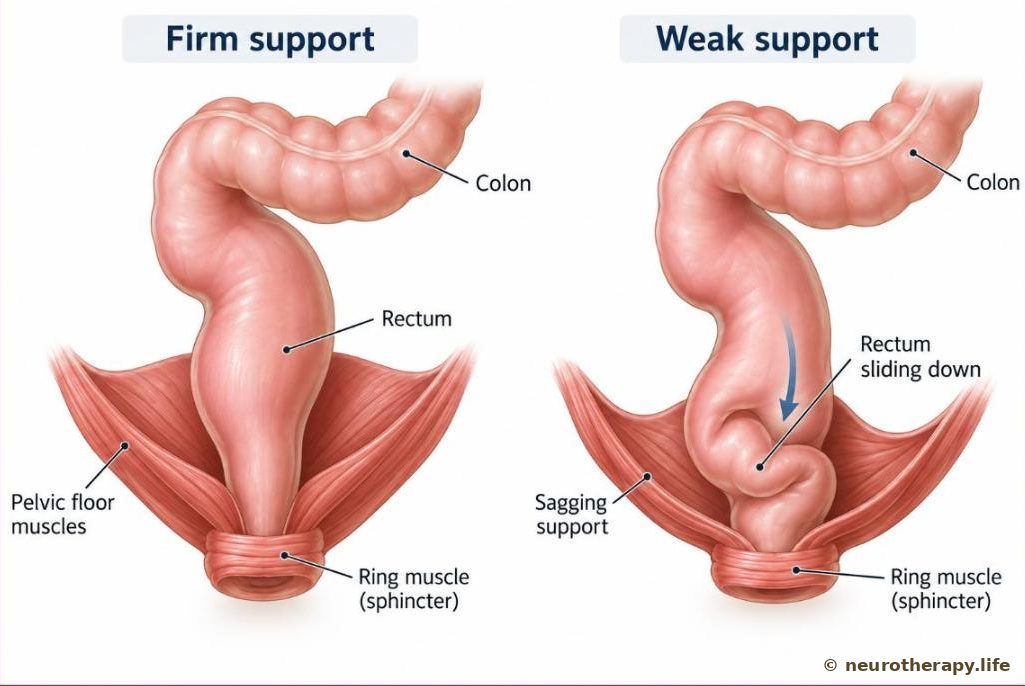
The rectum is the last few inches of the large bowel, where stool waits before it leaves the body. It is held in place by a hammock of muscles at the floor of the pelvis, and the anus is kept shut by a ring muscle called the sphincter.
When these muscles become weak or slack, the rectum can slide down. At first only its inner lining may bulge, and it slips back by itself. Later the whole wall can come out and may need to be pushed back by hand.
What are the symptoms?
- A red, fleshy lump coming out of the anus, especially after passing stool
- A feeling of pressure, or that the bowel has not fully emptied
- Mucus or a little blood from the back passage
- Leaking of stool or wind that you cannot hold
- Long-standing constipation and straining
What causes it, and who is more likely to get it?
Weak or slack muscles
Straining
Other causes
- Earlier surgery or injury in the pelvis
- Nerve or spinal cord damage
- In children: worms, long diarrhoea, or cystic fibrosis
How is it found?
A doctor can often see a prolapse during an examination. If it has slipped back inside, the doctor may ask you to bear down, as if passing stool.
Physical and rectal examination
The doctor looks at the area and gently checks inside with a gloved finger, to judge the muscle ring and to tell a prolapse from piles.
Defecography
An X-ray or MRI taken while you pass stool, to show how the rectum moves and where it slips.
Colonoscopy
A thin camera looks inside the bowel, to rule out other causes of bleeding or a lump.
Anorectal manometry
A small tube measures how strongly the muscles of the anus squeeze.
Blood test (haemoglobin)
Shows whether bleeding has made the blood thin.
A neurotherapist looks at the bowel and the body behind the prolapse. After Liv° and Mu° — pain at Mu° is found in prolapse of the rectum — the therapist feels the Const point, asks how long and how hard you strain, how much plain water you drink, and whether you pass little urine, because that decides whether the Triangle for Piles can be given.
How Neurotherapy sees Rectal Prolapse
LMNT teaching gives one simple definition: a prolapse is any organ shifting from its own place into another place — and if the muscles stay loose, any organ can shift. Prolapse of the rectum, prolapse of the womb and hernia are three different diseases with one thing in common: the flesh-muscles have become loose. All three show pain at Mu°, the sign of the acid side.
From the water pot to the prolapse
- Too little watershort of water, the body holds water back at every exit — the anus is one of them
- Acid sidethis shows as pain at Mu°, and the muscles become loose
- Hard stoolthe left bowel takes back more water; the stool turns hard
- Straininglong, forceful sitting pushes down on a slack pelvic floor
- Prolapsethe rectum slips from its place and comes out
So LMNT does not treat the prolapse alone. It belongs to one family with piles, fissure and fistula, and one chief cause of all of them is hard constipation. The acid work and the bowel come first; then the Triangle for Piles, which strengthens the pelvic muscles and tightens the ring muscles of the anus, the bladder and the womb.
No other drink can be a substitute for water.
Neurotherapy treatment for Rectal Prolapse, step by step
Examine first
The therapist checks Liv°, Mu° and Const, asks how long and how hard you strain, how much plain water you drink, whether you pass little urine, and about every powder or tablet you take. A prolapse, or any bleeding, is first seen by a doctor.
Acid work first
Where Mu° is tender, ATF and the (1) or (2) Acid point are given — and only then. No pain at Mu°, no acid treatment.
Move the bowel
Round Normal walks the whole large bowel in the direction its waves travel, and Round Arrow is given with it — so the stool comes without straining.
The Triangle for Piles
Face down, the therapist gives one upward lift with the heels at three places on the sacrum — near S5, S3 and S1 — with the weight carried on two chairs so the push goes toward the head, never toward the floor. It strengthens the pelvic muscles and tightens the ring muscle of the anus.
Water in decides water out
A glass of plain water half an hour after a meal, then one every hour. Tea or juice is food, not water.
Points and formulas used
Round Normal
Moves the whole large bowel, from start to end, in the direction its waves travel — so the stool comes without straining.
Works through
Open →ATF, form (a)
The Acid Treatment Formula — helps the body lower its acid side; given only when Mu° is clearly tender.
Works through
Open →Never do this
- Go to hospital the same day if the prolapse cannot be pushed back, turns dark red or purple, becomes very painful, or bleeds heavily — its blood supply may be cut off. Nothing is pressed on it.
- (10) Medulla, Gas Only and Dys are not given in prolapse of the rectum, piles, fissure or fistula — hard constipation is what made the trouble. If Gas Only must be given, Gas 'I' must follow it, or the constipation will increase. Gas Only
- The Triangle for Piles is not given to those who pass little urine — it tightens the bladder's ring muscle too. The push always goes toward the head, never toward the floor. Triangle for Piles
- ATF and the (1) or (2) Acid point are not given where there is no pain at Mu°. Acid
- Bleeding from the back passage is never assumed to be from the prolapse or piles — it is looked at once by a doctor who can see inside.
- Children get half the adult dose and light treatment only, given by a trained therapist.
- Cancer: if the person has cancer, (10) Pan, Thymus, Pit, Lu + Sh, Rt. Ov / Lt. Ov and (30) Medulla are never given — the therapist changes the plan.
- Keep taking the medicines your doctor prescribed. Neurotherapy works alongside your medical care, never instead of it.
Watch

Shows the Acid Treatment formula step by step: (8) Pan, (3) Gal, (5) Mu°, 3 Acid on the side of the right thigh, (4) Chest Only, and (6) Adr on the upper back, given without breaks. It is used to support the body's acid–alkali balance when acid is raised.
Note: the Acid Treatment formula is given only when the Mu° point is tender, and (6) Adr is not given in high BP, diabetes, cancer or HIV — the therapist checks first.
The Acid Treatment formula shown step by step — given only when Mu° is tender.
From Ayurveda and the kitchen
Test yourself
What research says
- Strong evidence
In adults, women have about six times the risk of men. In young children the rectum lies more upright, its lining is only loosely attached to the muscle beneath, and the pelvic floor muscle gives less support — the same picture of loose supporting tissue that LMNT describes as slack flesh-muscles.
Krishnaprasadh D, McKeown DG, Tavarez MM. Pediatric Rectal Prolapse. StatPearls. 2026.
No clinical trial of Neurotherapy in rectal prolapse has been published yet. Improvements reported by neurotherapists are clinical observations.
For you
Women after childbirth and after 50
Childbirth and the years after menopause weaken the pelvic floor. Do not strain on the toilet, drink enough plain water, and see a doctor early if you feel a bulge.
Children
A prolapse in a small child needs a doctor's check — for worms, long diarrhoea or cystic fibrosis. Any Neurotherapy is half dose and light, by a trained therapist.
Anyone with a long cough
Every hard cough pushes down on the pelvic floor. Get a cough that lasts for weeks checked and treated.
This page explains; it does not diagnose. Neurotherapy works alongside your medical care — keep taking the medicines your doctor prescribed, and see a doctor for any new or severe symptom.