Cervical spondylosis
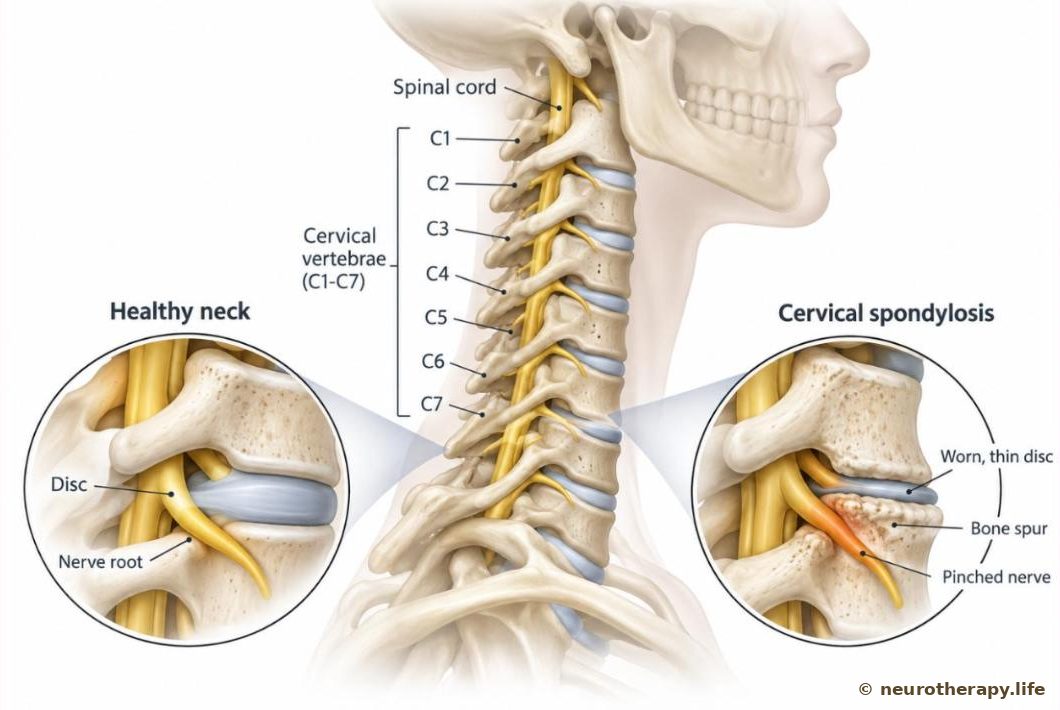
Cervical spondylosis is the wear of the bones and discs of the neck that comes with age. It can cause neck pain and stiffness, and sometimes pain or numbness that runs into the shoulder and arm.
- Wear in the neck usually begins in the 30s
- By age 60, about 9 in 10 people have it
- Neck and back pain are the world's leading cause of years lived with disability
Source: Cleveland Clinic; MedlinePlus; StatPearls (Margetis & Tadi, 2025)
What is Cervical spondylosis?
Your neck has seven small bones (vertebrae), with a soft disc between each pair acting as a cushion. With the years, the discs lose water and get thinner. The bones come closer, the small joints at the back take more load, and the body lays down extra bone at the edges — bone spurs.
Often this causes no trouble at all. When it does, it brings neck pain and stiffness. If a spur or a bulging disc crowds a nerve, pain or numbness can run into the arm. Rarely, it presses on the spinal cord itself. Many people in India call it “cervical spondylitis”, but “-itis” means inflammation; the wear-and-tear condition is spondylosis.
What are the symptoms?
- Neck pain, worse on moving the neck, coughing or sneezing
- A stiff neck that slowly gets worse
- Pain spreading to the shoulder blade, upper arm or fingers
- Numbness or tingling in the shoulders or arms
- Headache, especially at the back of the head
- Less often: loss of balance, weak or clumsy hands, trouble walking
What causes it, and who is more likely to get it?
Age and wear
- Getting older — the main cause
- Discs drying out and bone spurs forming
- Family history
Work and posture
- Looking down or up for long hours — screens, phones, sewing, desk work
- Jobs with heavy lifting, bending or twisting
Body and habits
Past injury
- An old neck injury, even years ago
- A slipped disc or earlier spine surgery
How is it found?
The doctor examines how far your neck moves, your arm strength, your reflexes, the feeling in your hands and the way you walk. Imaging then shows the bones and discs.
Neck X-ray
Shows narrowed disc spaces and bone spurs. But the same wear shows up in many people whose necks do not hurt, so the X-ray alone does not explain the pain.
MRI or CT scan
Shows the discs, the nerves and the spinal cord — used when there is arm pain, numbness or weakness.
Nerve tests (EMG and nerve conduction)
Check how well the nerves to the arms are working.
A neurotherapist asks for your neck reports and, in an older or thin person, the bone density report too. The warning questions come first: new headache, dizziness, change in vision, speech or walking, a recent stroke, a thyroid swelling. Then the pain points Liv° and Mu° are checked.
How Neurotherapy sees Cervical spondylosis
In the therapy's own table of the two directions, cervical spondylitis sits on the acid side — among the disorders in which calcium is laid down in the wrong places, such as a spur, and among the degenerative diseases that wear bone away. The acid side is recognised by pain at the Mu° point.
So the work is not only at the neck. The hands relax the muscles around the neck gently, in a fixed order; the acid formulas are given where Mu° says so; and digestion is set right where undigested food shows in the stools. Positioning is part of the treatment too: a pillow under the head is compulsory when lying on the side, and a thin one may be given lying on the back if the patient becomes giddy.
Whether or not the patient gets immediate benefit from our treatment, let no harm reach him through our carelessness — attend to this.
Neurotherapy treatment for Cervical spondylosis, step by step
Screen, then examine
The warning questions come first. Then the therapist checks Liv° and Mu°, looks at the neck reports, and asks for the bone density report where bones may be thin.
Neck ghisai — in order, with light hands
Four stages in a fixed order: the front and back muscles with light hands, then the two sides, then a necklace-like pass at the base of the skull, then the muscles of the shoulder blade. Only gliding strokes — no jerk, twist or pull.
Shoulders and back
Upper shoulder blade pain, then BAFA for the arms. For neck pain, Raman and Sudhakar relax the shoulder and back muscles; (11) Medulla and M. Heparin may be added, and (11) Left Medulla where the neck will not turn towards the good side.
The acid side — when Mu° says so
ATF is given for whatever has come from degeneration, and the Anil Sharma treatment for joint pain from acid — both chosen by pain at Mu° on the day.
Digestion and the navel
Where undigested food shows in the stools, the comprehensive UDF treatment. New Star Modified is also among the formulas LMNT teaching gives.
Points and formulas used
Anil Sharma treatment
A formula for joint pain from acid, including cervical spondylitis — given when Mu° is clearly painful.
Works through
Open →ATF, form (a)
The Acid Treatment Formula — helps the body lower excess acid; here, for what has come from degeneration.
Open →M. Heparin (medulla)
The Heparin formula headed by Medulla — used for face, neck and shoulder pain.
Works through
Open →Comprehensive UDF treatment
Clears undigested food and supports absorption — given where UDF shows in the stools.
Open →New Star Modified
The working formula of the Star family, beginning with the navel-setting stations.
Open →Never do this
- Never the front or sides of the neck, in any treatment, whatever a card says. Neck
- No neck work within three months of a stroke or a passing weakness, numbness or loss of vision; none with a goitre, a neck swelling or a thyroid running fast. Goitre
- Glide, never thrust: no jerk, no turning of the head, no traction. Thin bones or long steroid use: light hands only. Osteoporosis
- New or unusual neck pain with headache, dizziness, or a change in vision, speech or balance ends the session — see a doctor the same day. Headache
- Clumsy hands, an unsteady walk, new bladder urgency, or loss of bladder or bowel control can mean the spinal cord is squeezed — see a doctor urgently.
- Cancer: if the person has cancer, (10) Pan, Thymus, Pit, Lu + Sh, Rt. Ov / Lt. Ov and (30) Medulla are never given — the therapist changes the plan.
- Keep taking the medicines your doctor prescribed. Neurotherapy works alongside your medical care, never instead of it.
Watch

This video shows the right way to give (4) Medulla, Raman and the T1–T2 point for neck and shoulder pain and numbness.

A demo of the M. Heparin formula — the Heparin formula headed by Medulla ((6) Medulla, (8) Pan, (7) Liv, (8) Chest Only) — used for neck and shoulder pain and for headache that keeps coming back.
How M. Heparin is given — one of the formulas used for neck pain.
From practice
The tailor who was given a necklace and needed a scan
A teaching case — a composite from practice, not one patient's file
52 years · headache at the back of the head and a stiff neck for nine days
- What was found
- The pain began suddenly while he lifted his shop shutter — “like something tore”. He had never had headaches before. Asked directly, he said his left eyelid had looked a little droopy for a week.
- What was done
- Nothing — no Necklace, no Medulla, no contact with the head or neck at all. He was told calmly that a first-ever sudden headache with a changed eyelid must be seen by a doctor that same day, and was sent with a short written note.
- What it teaches
- The scan found a tear in the wall of an artery of the neck, treated by his doctors. Eleven weeks later, with his physician's agreement, he came back: the work began at the shoulders and with digestion, and the seated neck points came last and lightest. Refusing to treat was the treatment that day.
From Ayurveda and the kitchen
Test yourself
What research says
- Strong evidence
With age, the discs of the neck lose water and height. More load then falls on the small joints behind them, and bone spurs form. X-ray changes are seen in about 25% of people under 40, 50% over 40 and up to 85% over 60.
- Strong evidence
MRI scans of 497 people with no neck symptoms found disc wear in 86–89% of discs in people over 60. Wear on a scan, by itself, does not mean it is the cause of the pain.
No clinical trial of Neurotherapy in cervical spondylosis has been published yet. Improvements reported by neurotherapists are clinical observations.
For you
Desk, phone and craft workers
Hours of looking down load the neck. Raise the screen to eye level, and break every half hour to lift the head and roll the shoulders gently.
Older adults
Tell your therapist about thin bones, steroid tablets, blood thinners or a recent stroke — each changes how your neck is treated. Get up slowly, by rolling to the side.
Anyone with arm symptoms
Numbness, tingling or weakness in the arms or hands should be checked by a doctor, so that pressure on a nerve or the spinal cord is not missed.
This page explains; it does not diagnose. Neurotherapy works alongside your medical care — keep taking the medicines your doctor prescribed, and see a doctor for any new or severe symptom.