Watch


The pillows
The standing rule, pillow by treatment, and the patient in a hurry
A pillow here is not comfort but positioning: a treatment given without its pillow is not a gentler version of it but a different one, delivered into a body arranged wrongly.
The standing pillow rule
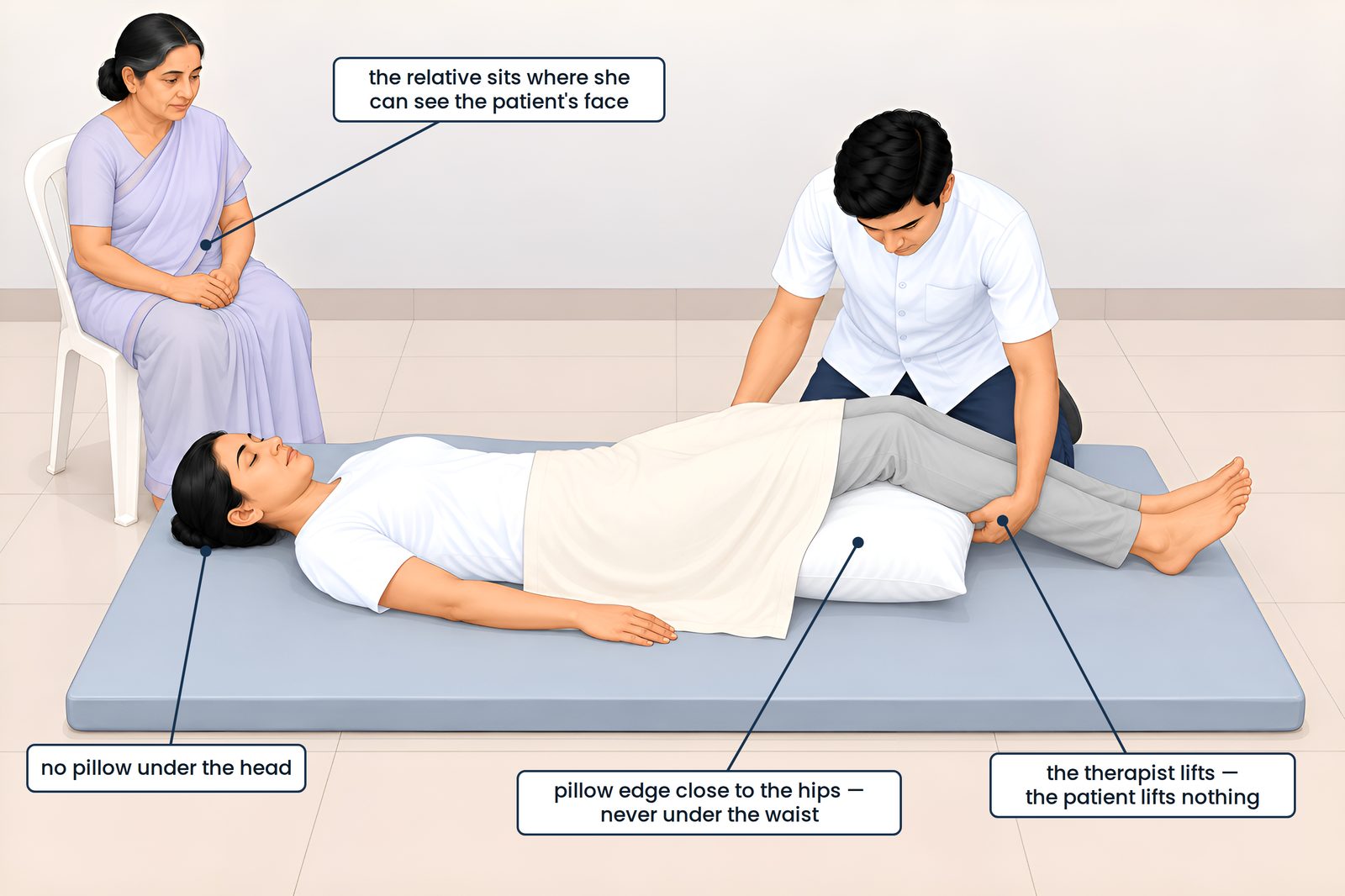
Under the part on which pressure is to be given, place pillows as required.
Even if the patient says they are in a hurry, do not give the treatment without placing the pillows properly.
And the rule printed along the foot of every page of the treatment atlas, applying to all of them:
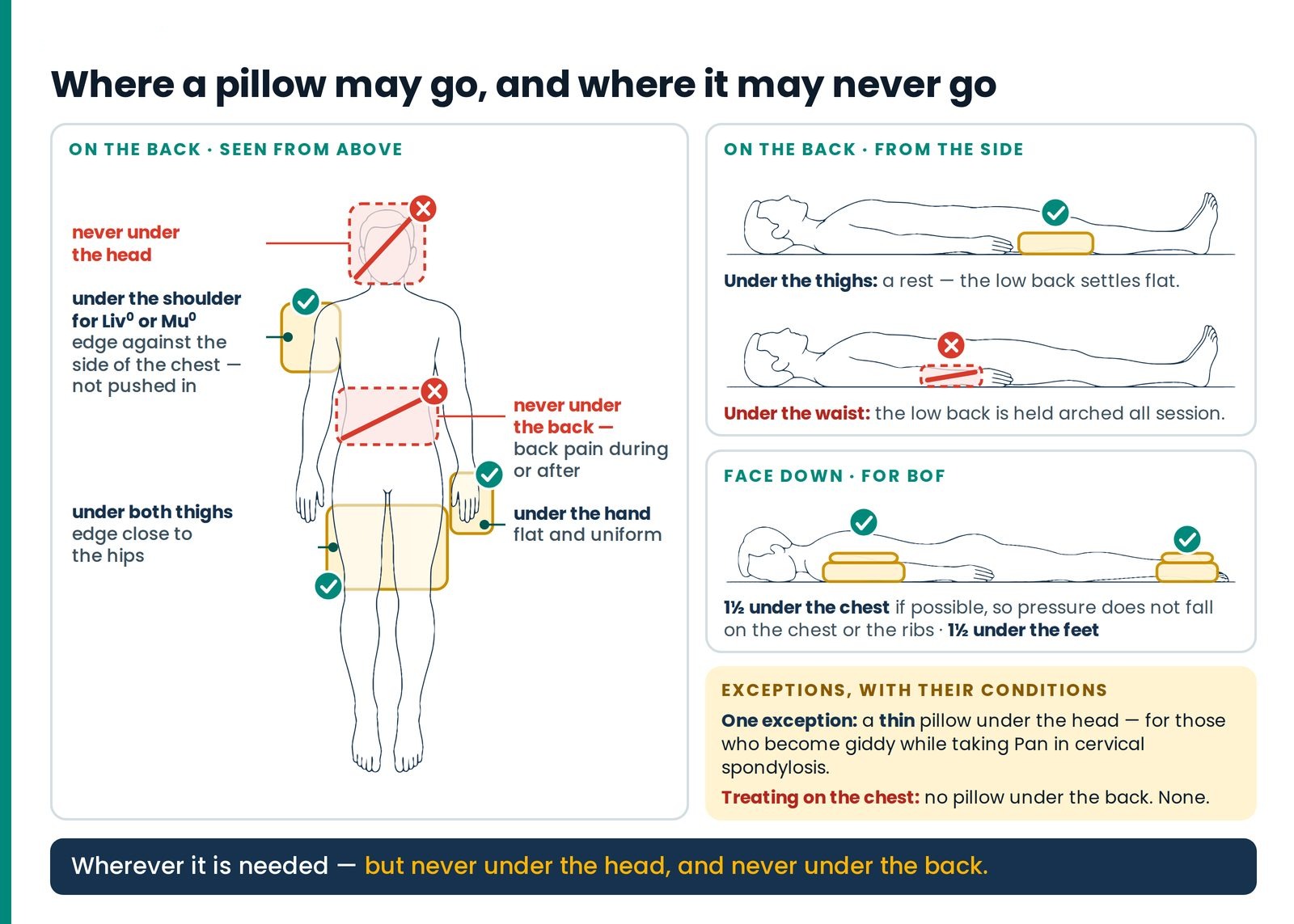
Place the pillow at the proper place as needed — but never under the head, and never under the back. Supine ▲ Take care
Both halves matter. Unless it is needed, no pillow should be placed under the head, so that the spine stays straight. And the pillow must not come under the patient's waist, or they may get back pain during or after the treatment — it arches the low back and holds it arched for the entire session. A pillow at the knees is a rest; a pillow at the waist is a strain held for half an hour. (Figure 5.3)
Table 1 — Where the pillows go, treatment by treatment
| Treatment | Pillows, and exactly where | Chips |
|---|---|---|
| Pan, Gal–Spl and the like | One pillow under both thighs, edge close to the hips. It must not come under the waist — back pain during or after the treatment follows if it does | Supine Both sides ▲ Take care |
| Liv⁰ or Mu⁰ | Two pillows. One under the thigh; the second under the shoulder, so the shoulder joint rests well upon it. Do not push it too far in under the back or the shoulder — only so far that the edge of the pillow stays pressed against the side of the chest | Supine Left Right |
| Liv, Mu and the arm treatments | A flat pillow under the hand; if it is not uniform the patient gets pain in the hand or fingers. Failing a good pillow, a thick book such as a telephone directory is better | Supine |
| The elbow that will not reach the floor — the carrying angle | Place the pillow at the edge of the elbow, so there is no gap between the wrist and the pillow and the whole hand comes properly onto it | Supine |
| WD | As a rule, no pillow. But if someone's muscles are very weak, one is used — and then it must be uniform, not soft in one place and hard in another. Best of all is a folded sheet | Supine Both sides |
| Pan in cervical spondylosis | A thin pillow under the head may be given, for those who become giddy while taking the Pan treatment | Supine ▲ Take care |
| BOF — bottom of the feet | 1½ pillows under the feet. And if possible 1½ pillows under the chest as well, so that pressure does not fall on the chest or the ribs | Prone |
| Any treatment on the chest | No pillow under the back. None | Supine ▲ Take care |
The shoulder pillow supports the joint so the head of the arm bone is not levered forward as you press; pushed deep it wedges the spine instead. The 1½ pillows under the chest for BOF lift breastbone and rib cartilages clear, so the load passes through pelvis and legs.
Before a hand is laid on anyone
One fixed check before every treatment, and four that stop a session
Learn this as one fixed order, run every time, so that on a day when you are behind you need not decide which items to keep.
When an old patient forgets
Sometimes even old patients, returning after a gap of some days, forget that they must lie down by rolling onto the side.
Do not ask them why they cannot remember.
Explain calmly, again, how to lie down and how to get up. What is ordinary for us is new for them, so forgetting is natural.
The irritation a busy therapist feels at the ninth repetition leaks into the voice, and a patient made to feel slow stops asking questions.
The patient's clothing mirrors yours: loose clothing that keeps the whole body covered — loose so nothing binds a thigh or arm you are about to work through, covered because dignity is not something a patient should have to negotiate for. Say it when the appointment is made, not when they arrive; and a chain or mangalsutra is tucked inside.
Precautions during the treatment
The naman, one foot at a time, the soft middle of the sole, silence
The salutation, and the first rule of pain
In most of our treatment points we have to touch the patient with our feet. Therefore, before beginning, touch the patient's feet with both hands in salutation (naman), so that they are made ready in mind to receive the treatment.
If the patient screws up their face, or tells you that it is hurting, then without arguing change the angle of your foot or reduce the weight.
Only they know the pain; you do not. So do not think, "I have seen many patients, nobody has ever said such a thing."
Sometimes, out of fear of this pain, the patient does not want to take treatment from that therapist — or they become so negative towards the therapy that they may stop coming to the centre altogether. Arguing in this way will damage both you and the therapy. ▲ Take care
No instrument can measure another person's pain, and a patient raised not to complain to somebody who is helping her will go quiet, leave sore, and be "too busy to come" next week.
The mind you bring, and the mouth you keep shut
Whatever reverence is in your mind, that same reverence will arise in the patient's mind towards this therapy. Your vibrations and your positive thinking play an important part in the success of the treatment.
As far as possible, give the treatment with the eyes closed, so that along with your good feelings the influence of alpha waves also helps the patient recover sooner. Bring this thought into your mind: that by this treatment the patient will gradually become well, because by Guruji's grace this therapy has given me this capacity.
If during the treatment or in the gap you do anything that lowers the dignity of the therapy, it will harm both you and the therapy.
So while giving the treatment, and in the gaps between, do not talk unnecessarily with the patient or with anyone else.
And the one time you must speak: ordinarily one does not talk to the patient during treatment, but when different formulas are given in one session, then in the gap after each formula one must certainly ask the patient how they are feeling. If their trouble increases after any point or formula, immediately take the opinion of the chief therapist as to whether the treatment should be changed. And write this clearly on the card, so that in future that point is not given again — or, if it must be given, so that proper caution is taken. ▲ Take care
Explain the silence before you begin: I am counting; between the formulas I will ask how you are. And write down any point that made a patient worse — it exists nowhere but in your memory, which loses it inside a month.
One foot at a time
For Pan, Liv, Mu, Liv⁰, Mu⁰, Gas Only and Gas 'I' — and the same caution when giving WD, Rt. Ov., Lt. Ov., Pit and Para — Guruji says emphatically that you must not put both feet onto the patient's body at once while holding the chairs.
1. First place one foot, without pressure, at the proper place on their body. 2. Then, taking your full weight on both hands upon the chairs, place the second foot at the right place, also without pressure. 3. Only after that, when you are standing well, quite straight and in full balance, put your full weight onto the patient — not before.
Two reasons are given. First: as soon as the patient feels the touch of one foot, they become alert and will then lie relaxed without moving. Second: conditions are not always the same — if for some reason your hand slips on a chair, or you turn an ankle, you will not be able to hold your balance. It is so that no harm comes to you or to the patient that Guruji repeats this again and again. 6 sec Both sides ▲ Take care
A body touched without warning startles, and a startled muscle grips. You are not putting your foot down; you are announcing it, and then putting it down.
The soft middle of the sole, and no empty space between joints
Always give pressure from the middle part of the sole only.
If you press with the toes, the patient will feel a pricking sensation on the thigh, and you yourself may get pain in your calves.
If you press with the heel, the patient will feel pain at that place for a long time after the treatment.
Place your heel or your palm so that the weight falls over a broad surface, not on a single point, and so that the muscles are drawn inward, not outward. When giving pressure with the foot or the heel, your body weight must be so directed that the muscles are drawn inward — otherwise the patient will have a great deal of pain, because it would be against the natural direction of the muscles. ▲ Take care
For very small children, use the soft part of the palms, so laid that the whole palm rests on their thigh and the pressure is not felt as pressure. If the palm is held crooked, or pressure is given with the edge of the palm or with the fingers, they will not bear it and will begin to cry.
How many places? For Gas, Gas I, Gal, Spl, Liv, Mu, Lt. Ov., Rt. Ov. and WD, three places is enough for an ordinary person — but this depends on the length of the patient's thigh and the width of the therapist's foot. The main issue is that no space should be left empty from one joint to the other joint. a. For a tall patient, four places may be enough for an ordinary therapist — but if the therapist is a young child, then even five places may be needed, and that too is correct. b. For a very small child, even two places may be enough. This is a matter of experience. c. While giving WD and Pit, keep equal weight on both soles → pay attention to this. Both sides
The edge of anything is never a tool, and the station count is a rule that is not a number: lay each contact where the last ended, and count afterwards.