Watch


Place, time and angle — the three things determined every time
What goes wrong when each one is wrong — and one foot at a time
The therapy's own description of itself names them in a row: pressure applied at particular places of the body, in a determined time, angle and order. Three of those are settled inside a single application; the fourth, order, belongs to the formula and gets its own section below.
The three things determined in every application
1. The place.
Not "the thigh" but this part of it — the middle, below the waist joint, at the station the point specifies. A point is a named site together with the way it is loaded; move the contact two inches and you are treating something else. Left Right Both sides
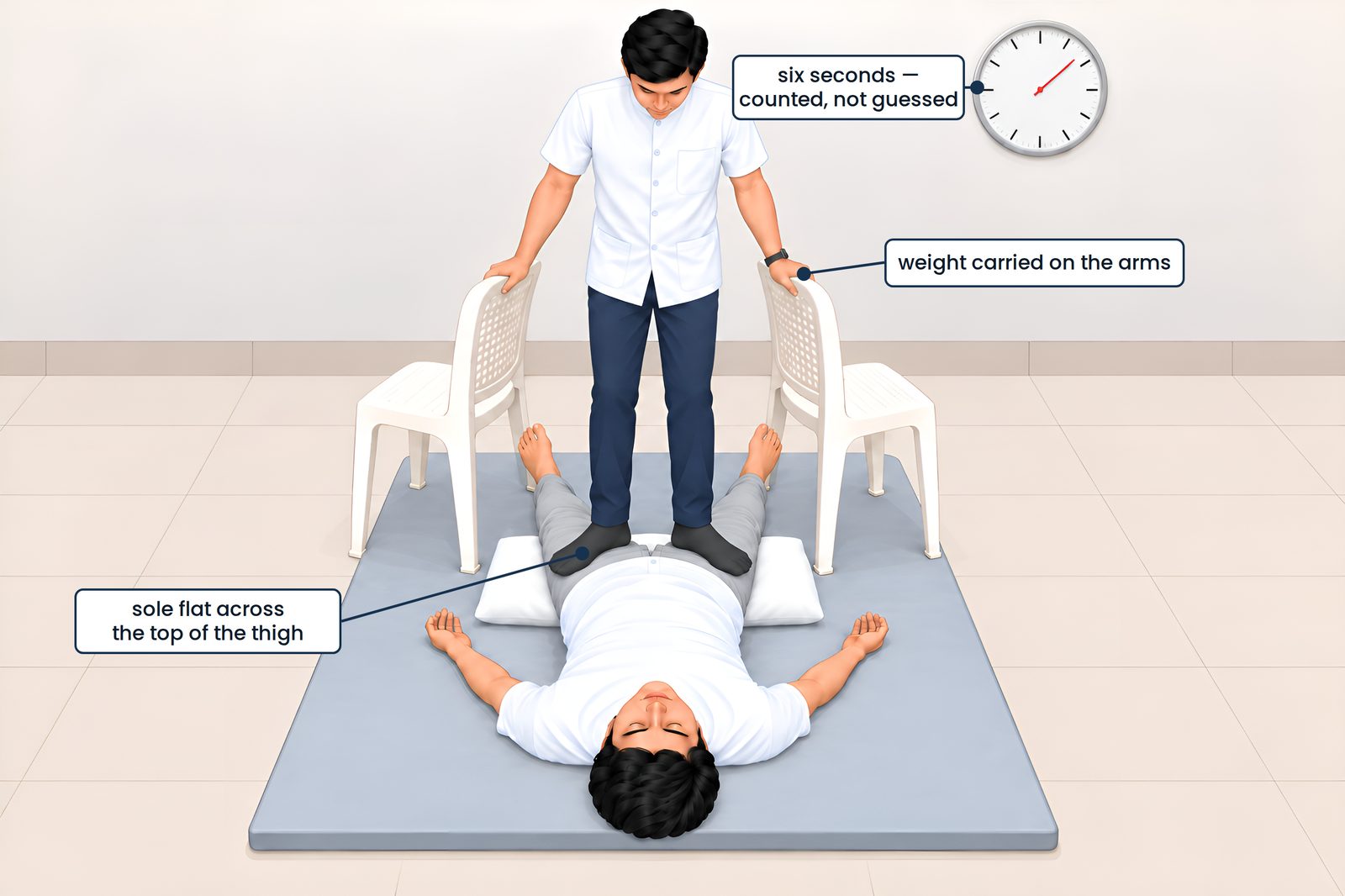
2. The time. Six seconds, held, then released.
3. The angle. The direction in which the pressure travels into the body. The standing rule: place your heel or your palm so that the weight falls over a broad surface, not on a single point, and so that the muscles are drawn inward, not outward. When giving pressure with the foot or the heel, your body weight must be so directed that the muscles are drawn inward — otherwise the patient will have a great deal of pain, because it would be against the natural direction of the muscles. ▲ Take care
What happens when each one is wrong?
Wrong place. Nothing happens, and that is the deceiving part. No pain, no complaint, no sign — just a treatment that quietly does not work while you conclude the case is difficult. Two feet two inches apart are two different treatments.
Wrong time. Short of six and the application is under-given. Past six and you work against the release you were relying on. The count is a separate matter again: at a chemical point a wrong number can produce a different chemical from the one intended — or, rarely, the opposite effect.
Wrong angle. The only one of the three that hurts, and the patient will tell you. Pressure driven across the natural line of the muscle, or delivered on an edge instead of a broad surface, produces real pain — a signal to be acted on at once, not endured.
Two further pieces of the angle belong here, because they are where beginners go wrong.
Steadiness is part of the angle. Keep the weight equal on both feet and exactly at the centre of your own body; do not shift it from one foot to the other in between. If your own balance does not feel right, the patient too will feel discomfort. And note the specific warning: if without realising it you stiffen your toes, or move them during the hold, the patient's muscles will be pulled the wrong way and they will have pain for a long time after the treatment. A six-second hold is six seconds of stillness.
One foot at a time. For Pan, Liv, Mu, Liv⁰, Mu⁰, Gas Only and Gas 'I' — and the same caution for WD, Rt. Ov, Lt. Ov, Pit and Para — you must not put both feet onto the patient at once while holding the chairs. First place one foot, without pressure; then, taking your full weight on both hands upon the chairs, place the second, also without pressure; only then, standing straight and in balance, let your weight down. Two reasons: at the touch of the first foot the patient becomes alert and then lies relaxed without moving; and if your hand slips or you turn an ankle, you will not hold your balance. (Figure 4.3)
The counting conventions of this wiki
The bracket, the stations, the “equal one” family, seconds and rounds
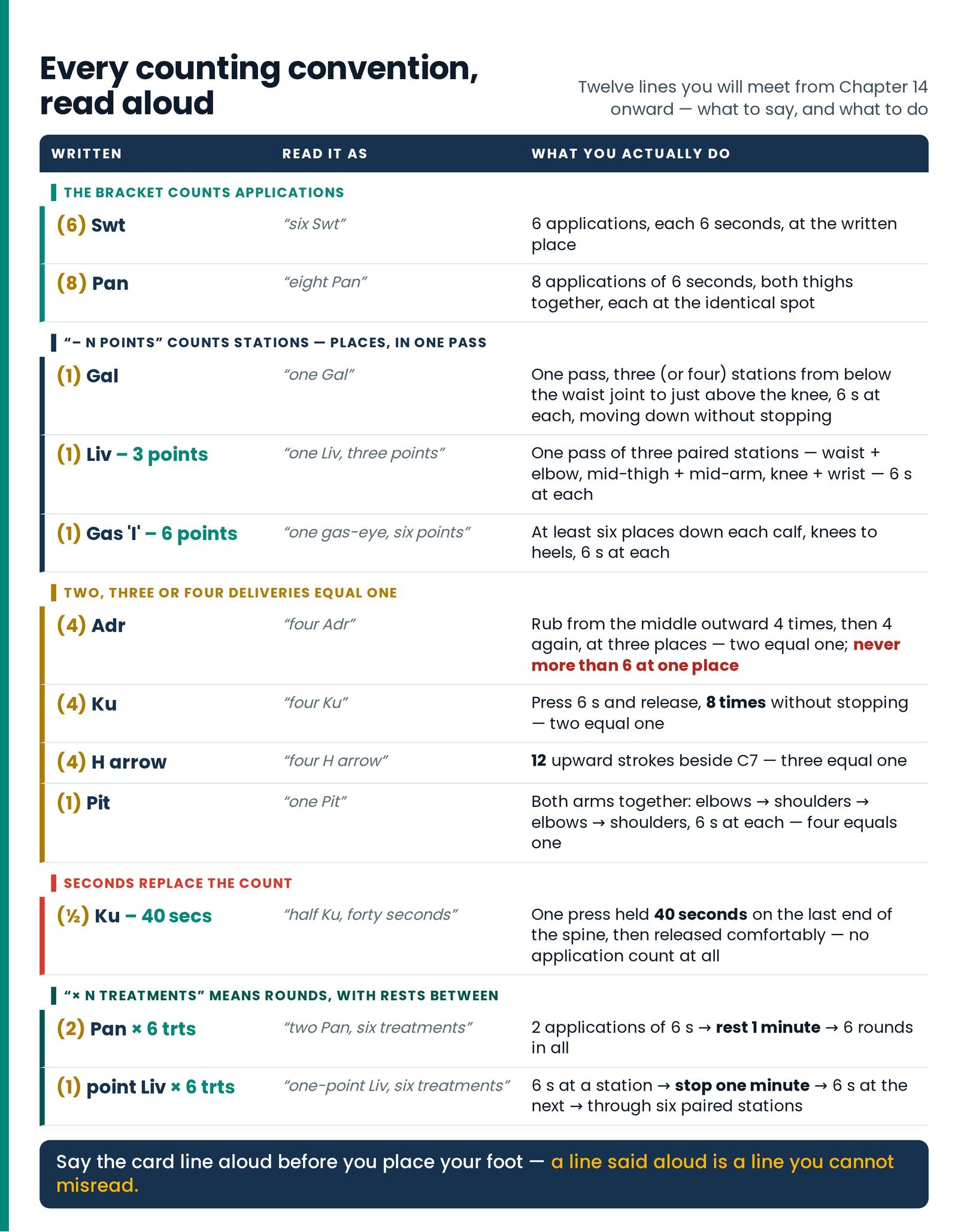
From The Shorthand onward you will meet formulas written in a compressed shorthand, and every element of that shorthand is a count. Learn the conventions now and they will never trouble you again. Every point also carries a written symbol — ↑o↑ is the H arrow, ↑|↓ the Round arrow — and the complete plate of symbols with their full names is given in The Shorthand, "The Shorthand". What concerns us here is not the glyphs but the numbers that travel with them. (Figure 4.5)
How a count is written, and what it means
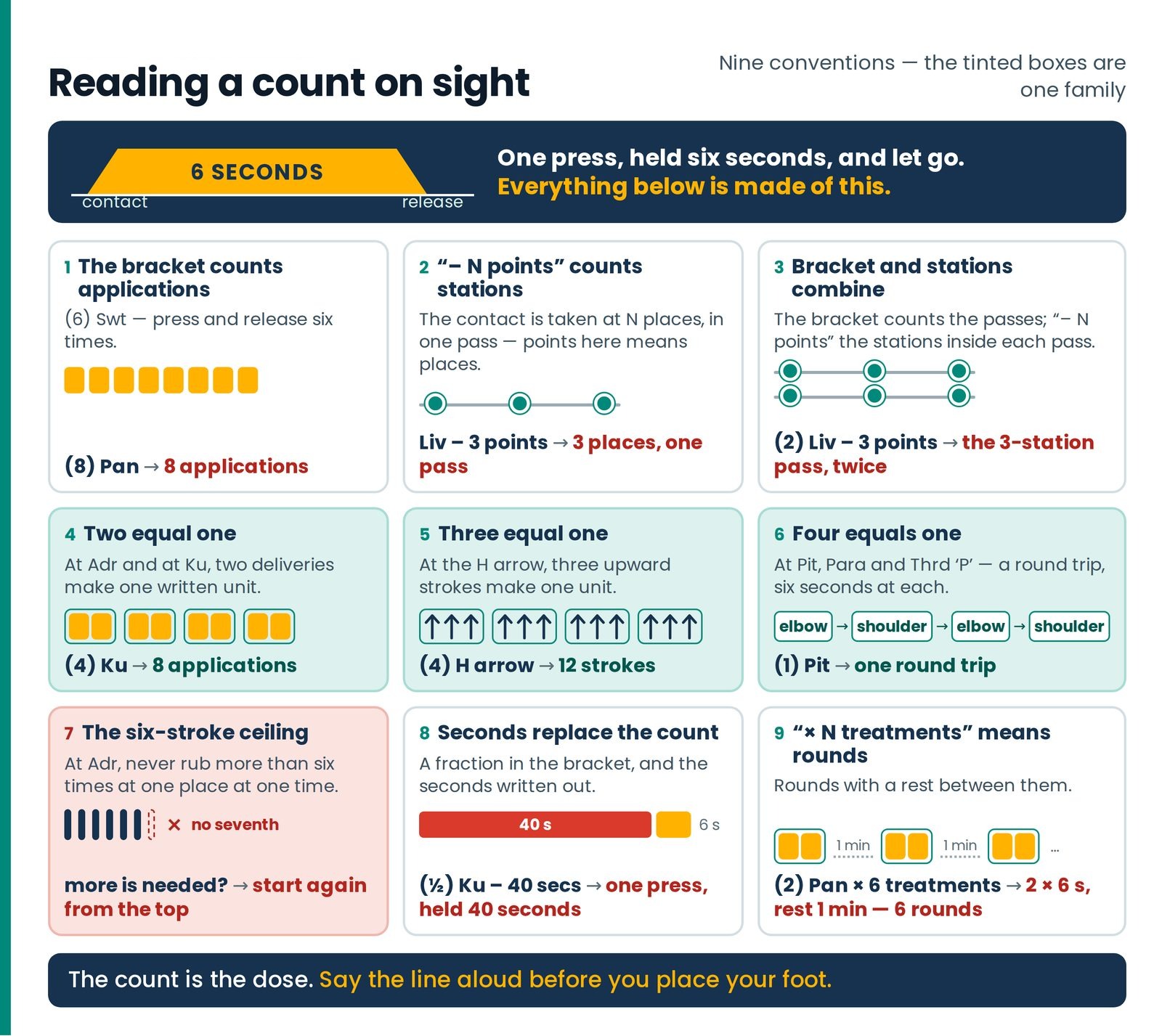
1. The bracketed integer is the number of applications.
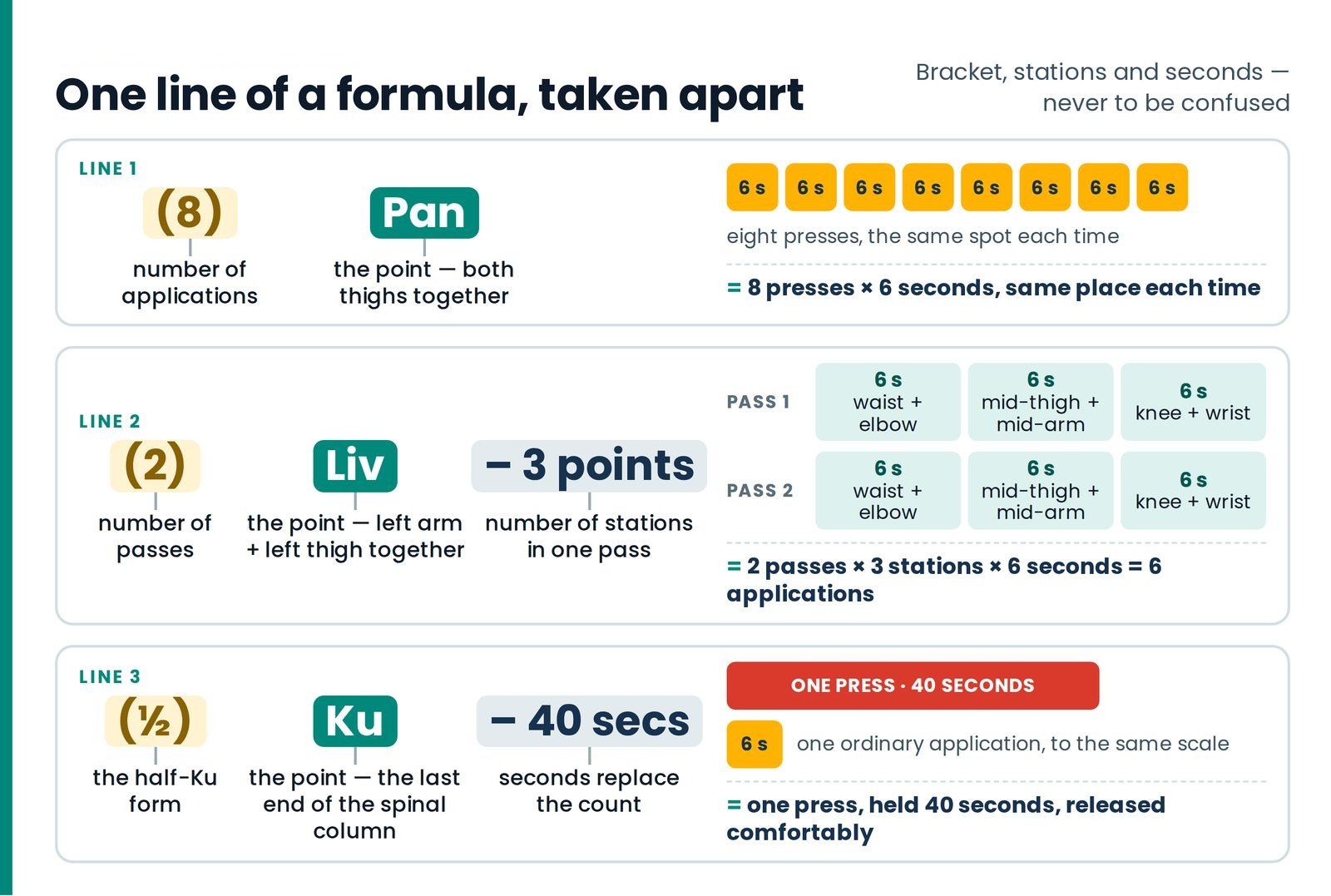
(6) Swt means press and release six times; (8) Pan, eight applications at the pancreas point. Unless a convention below says otherwise, the bracketed number is the number of six-second applications. (Figure 4.6)
2. "– N points" is the number of stations. Liv – 3 points means the contact is taken at three places, not three times in one place: waist and elbow; mid-arm and mid-thigh; wrist and knee. Gas 'I' – 6 points means at least six places down each calf. Points here means places.
3. The bracket and the stations combine. (2) Liv – 3 points is the whole three-station pass, done twice: the bracket counts the passes, the "– N points" the stations inside each pass. (Figure 4.4)
4. "Two equal one." At Adr the rub runs from the middle outward as many times as the number written, and the same again — at three places, two equal one. At Ku, the old Kundali, the time is six seconds and the count is two equal one: if (4) Ku is written, press for 6 seconds and release, and do this 8 times without stopping.
5. "Three equal one." At the H arrow — between both shoulders, on both sides of the C7 bone, rubbing from below upward — the count is three equal one, so (4) H arrow calls for twelve strokes.
6. "Four equals one." At Pit, Para and Thrd 'P' the unit is a round trip — elbow, shoulder, elbow, shoulder, six seconds at each — and the count of four equals one.
7. The six-stroke ceiling. At Adr: at one place, do not rub more than 6 times at one time. If more is to be given, start again from the top. ▲ Take care
- 8. Seconds may replace the count altogether. At ½ Ku the bracket carries a fraction and the seconds are written out: (½) Ku – 6 secs, (½) Ku – 20 secs, (½) Ku – 40 secs. You count no applications at all — one press, with normal pressure, on the last end of the spinal column, held for exactly as many seconds as is written, then released comfortably.
- 9. "× N treatments" means rounds with rests inside them. (2) Pan × 6 treatments: press on both thighs twice for six seconds and release; rest one minute; six such rounds.
Why the sequence matters
Right follows left, the reversed order, and how a formula is reasoned
Sooner or later a student asks: if I am giving all the right points the right number of times, does the order really matter? The answer is short.
Can we provoke any point at all, in any order at all?
Answer — no. We cannot provoke the organs in an order of our own choosing.
For that there are certain general rules, and it is necessary to follow them.
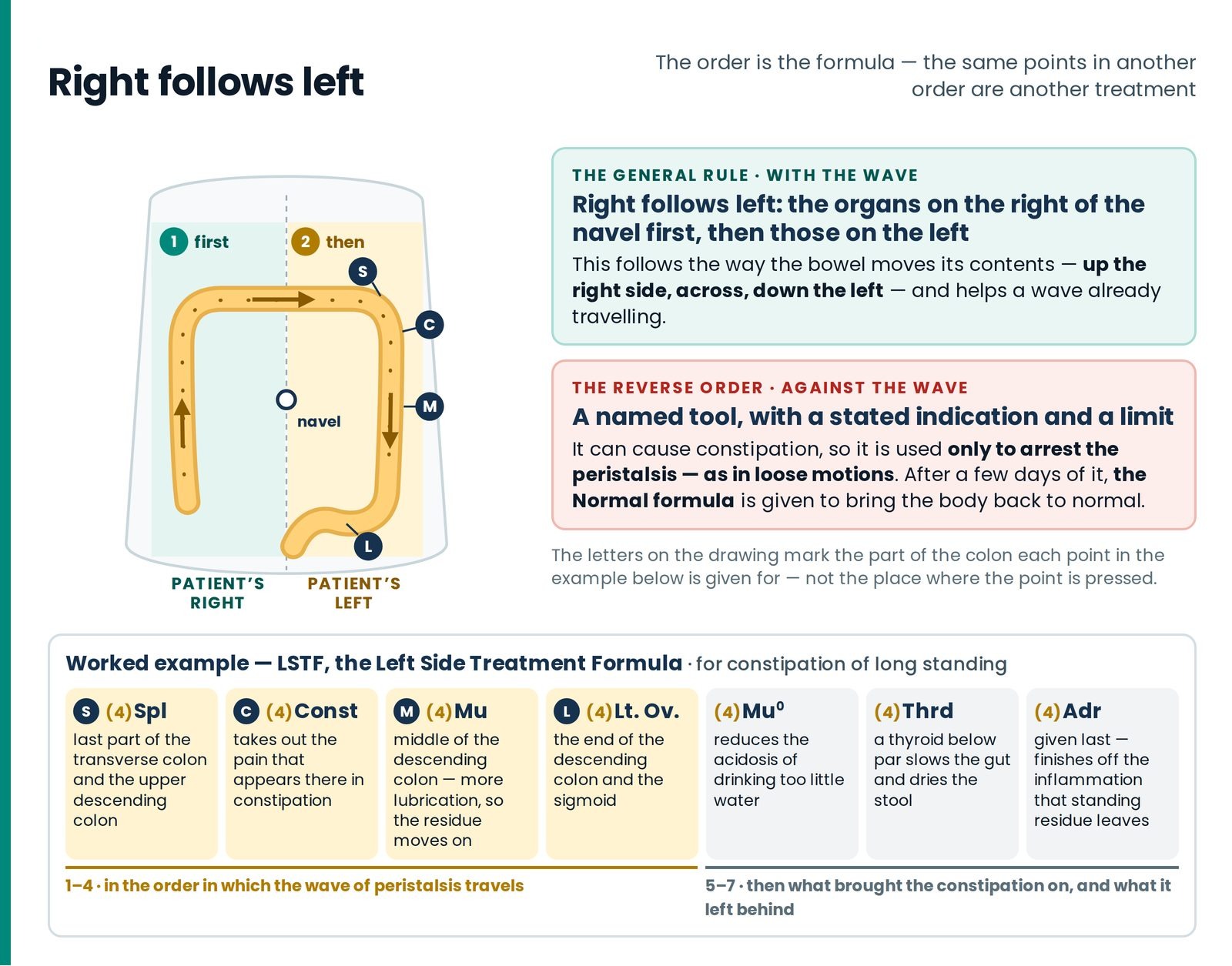
The general rule for proper peristaltic movement is: right follows left — that is, first stimulate the organs on the right side of the navel, and then stimulate the organs on the left side of the navel.
A reverse order can cause constipation; and it is to be resorted to only when we wish to arrest the peristalsis — as, for example, while treating loose motions.
Application of pressure cannot be done in any random sequence.
Read that carefully: it holds both the rule and its exception, and each is complete where it stands. The usual order follows the direction in which the bowel moves its contents — up the right side, across, down the left. Work with that direction and you help a wave already travelling; work against it and you slow the wave, which is a fault in constipation and exactly the treatment in loose motions. The reversed order is not a mistake that sometimes helps; it is a named tool with a stated indication, and it carries its own limit: after a few days of it, the Normal formula must be given, to bring the body back to normal again. (Figure 4.7)
Hence the definition of a formula: a number of organs must be stimulated continuously one after another, in a particular sequence, to cure a particular set of symptoms — and each such set of sequences is called a formula. The sequence is not the packaging round the formula. The sequence is the formula.
One example shows how a sequence is reasoned rather than decreed. The Left Side Treatment Formula, for constipation of long standing, is built by asking what the descending colon needs and in what order —
LSTF — (4) Spl (4) Const (4) Mu (4) Lt. Ov. (4) Mu⁰ (4) Thrd (4) Adr
— and every position has a reason. Spl, for the last part of the transverse colon and the upper descending colon. Const, to take out the pain that appears there whenever there is constipation. Mu, for the middle of the descending colon, and to increase lubrication so the residue moves on easily. Lt. Ov., for the terminal descending colon and the sigmoid — four points given in the same order in which the wave of peristalsis travels. Then Mu⁰, to reduce the acidosis that comes of drinking too little water and brings constipation with it. Then Thrd, because a thyroid working below par slows the gut and dries the stool. Then Adr last, because constipation of long standing leaves residue in the bowel; where rubbish stands infection follows, and a chronic infection turns into inflammation, which must be finished off or the patient will not get complete relief.
Shuffle those seven and you have not given LSTF. You have given seven points in an order nobody has studied.
To cure constipation, why stimulate Spl — the spleen — and Lt. Ov. — the left ovary? Both are outside the alimentary canal.
Why a point reaches more than the organ it is named for
By our points we increase the blood circulation in the various parts of the abdomen all around the navel. Each point's name has been given by keeping in mind the chief organ in that region. But when we give that point, it will increase blood flow not only in that organ, but in all the organs that are in that region.
A point is an address in a region, not a wire to a single organ.