Watch


The three lanes of the nape — Medulla, Mesencephalon, Dorsal
One counted thumb-glide, told apart by thumb placement alone
Three treatments open the seated group, and they are the same movement three times over: a counted thumb-glide downward at the back of the neck, the two thumbs alternating. What separates them is where the thumbs are, and nothing else — behind the ears for Medulla, in the soft gutters beside the bone for Mesencephalon, on the beads of the spine themselves for Dorsal. (Figure 18.2)
Medulla — मेडूला
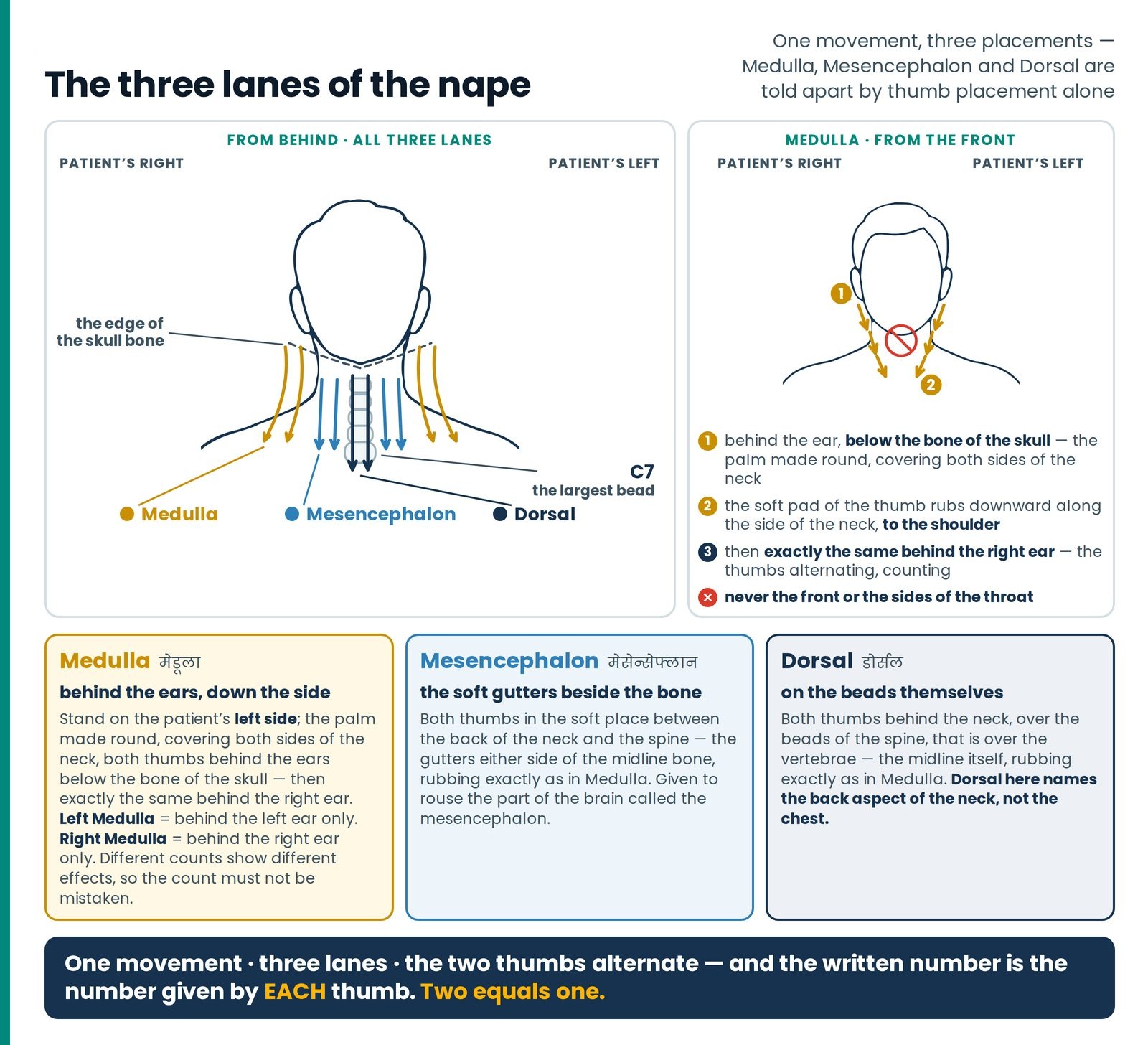
Stand on the patient's left side. Make your palm round and cover both sides of the patient's neck with it. Both your thumbs should be behind their ears, below the bone of the skull.
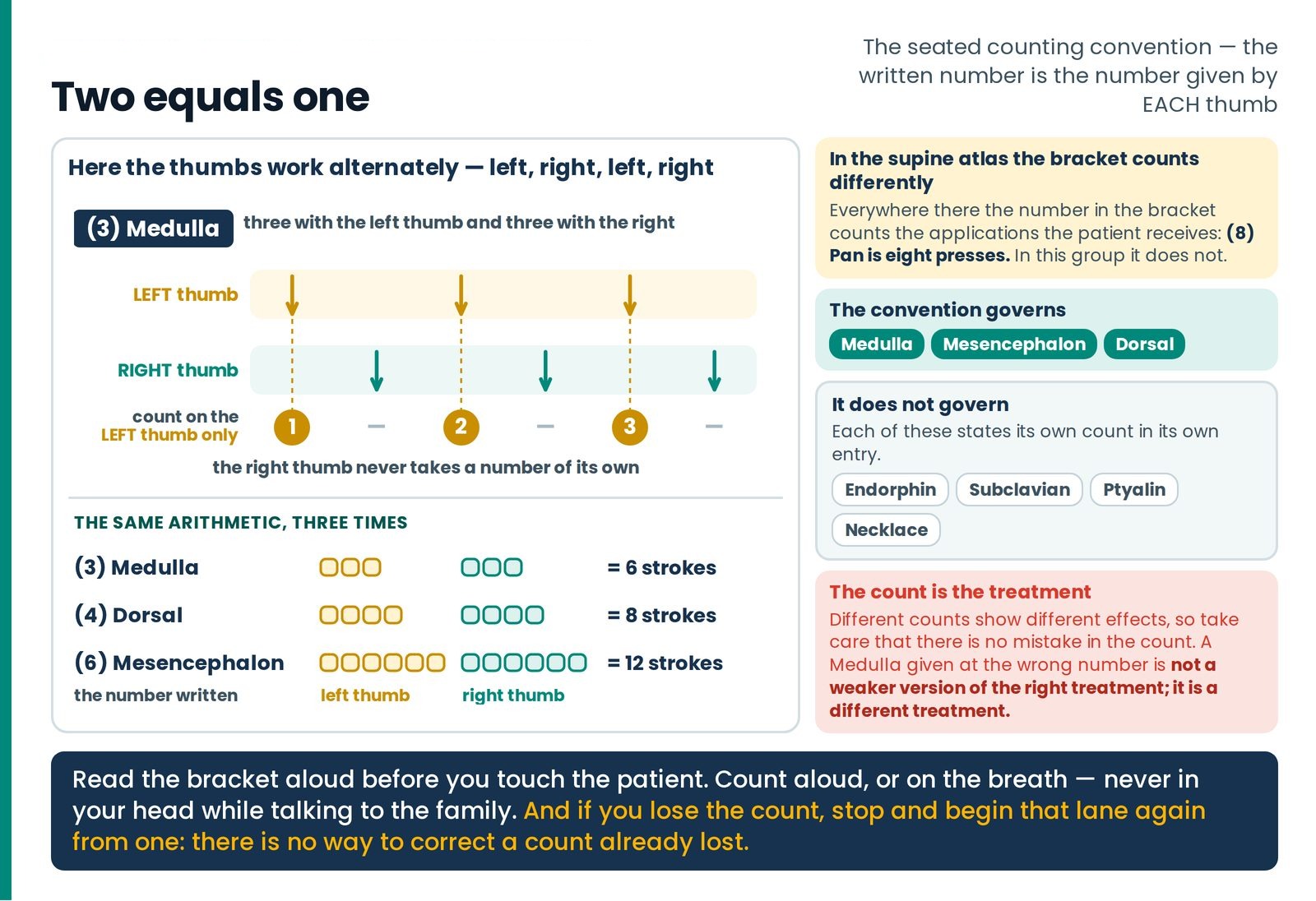
Then, with the soft pad of the thumbs, from behind the ear below the bone down to the shoulder, rub downward along the side of the neck, counting, alternately. Rub as many times as the number with each thumb — that is, two equals one. After this, do exactly the same behind the right ear.
If Left Medulla is written, do it only behind the left ear.
If Right Medulla is written, do it only behind the right ear.
Different counts show different effects, so take care that there is no mistake in the count.
| Patient's position | Seated on a chair — or lying down if the patient is very ill or very weak; the therapist standing on the patient's left side Seated Supine |
|---|---|
| Where the hands are placed | The palm made round, covering both sides of the neck; both thumbs behind the ears, below the bone of the skull; the soft pads of the thumbs rubbing downward along the side of the neck to the shoulder Both sides |
| Duration and repetitions | Downward rubs, thumbs alternating, counting; as many times as the number with each thumb — two equals one. Then exactly the same behind the right ear. Left Medulla = behind the left ear only; Right Medulla = behind the right ear only Left Right |
| What it is for | Named for the medulla; different counts show different effects, so the count must not be mistaken |
What lies beneath. The medulla itself is the stalk at the bottom of the brain where it becomes the spinal cord, and it sits inside the skull. No thumb reaches it; it is behind a wall of bone. What the name records is an intention, not an address.
What the thumb rests on is far from a consolation. Running up over the back of the head from the top of the neck is the large nerve that supplies the scalp, with a smaller one beside it to the skin behind the ear, and beneath both the four position-reporting muscles described above. And in the cord at that level, the nerves of the face and the nerves of the neck arrive on the same cells — which is why the neck refers pain to the head, and why a counted stroke at the nape can be felt behind an eye. It is the best reason in the whole atlas why a point at the back of the neck should influence anything at all in the head.
The graded series is named by its count — and is taught in The Medulla Family
A card in this therapy rarely says Medulla alone. It says (2) Medulla, (4) Medulla, (6) Medulla, (8) Medulla, (10) Medulla, (12) Medulla, (15) Medulla, (20) Medulla or (30) Medulla — and each of those is a named treatment in its own right, with its own work and its own place in a formula.
This article teaches you to give a Medulla. It does not yet teach you which one to give. The members of the series, what each is for, the clockwise form, the pairing with Thoracic T1/T2, and the rule about what is given before any of them, are set out together in The Medulla Family, "The Medulla Family — The Graded Series", where they can be learned as a family. Do not read this entry and think the series has been taught: it has been made giveable.
Mesencephalon — मेसेन्सेफ्लान
This is given to rouse the part of the brain called the mesencephalon.
In the soft place between the back of the neck and the spine, exactly as in the Medulla treatment, rub with both thumbs, alternately, counting. Rub with each thumb as many times as the number written.
| Patient's position | As for Medulla — seated, or lying down if the patient is very ill or very weak Seated Supine |
|---|---|
| Where the hands are placed | Both thumbs in the soft place between the back of the neck and the spine — the gutters either side of the midline bone Both sides |
| Duration and repetitions | Rubbing exactly as in Medulla, both thumbs alternately, counting — as many times as the number written with each thumb |
| What it is for | Rousing the part of the brain called the mesencephalon |
What lies beneath. The mesencephalon is the topmost segment of the brain stem, and like the medulla it is inside the skull and out of reach. But the name is better chosen than it looks: that segment holds the body's own pain-suppressing switchboard — the system that can turn a pain signal down before it reaches the place where pain is felt. Under the gutter thumbs lie the long straps running from the back of the skull down the neck, and beneath them the small joints of the neck bones with their nerves; a steady input there is exactly the kind that recruits that descending system. The point does not touch the midbrain. It plausibly speaks to it.
Dorsal — डोर्सल
Behind the neck, over the beads of the spine — that is, over the vertebrae — exactly as in the Medulla treatment, rub with both thumbs, alternately, counting.
As many times as the number written — rub that many times with each thumb.
| Patient's position | As for Medulla and Mesencephalon Seated Supine |
|---|---|
| Where the hands are placed | Both thumbs behind the neck, over the beads of the spine, that is over the vertebrae — the midline itself Both sides |
| Duration and repetitions | Rubbing exactly as in Medulla, both thumbs alternately, counting — that many times with each thumb |
| What it is for | Named for the dorsal, that is the back, aspect of the spine |
What lies beneath. The midline of the neck is bone and cord. The beads you feel are the backward-pointing spurs of the neck vertebrae, joined by a strong sheet of ligament running from the skull down to the shoulders, with almost no muscle padding. In a slim patient your thumb is very nearly on bare bone, and heavy pressure there is painful out of all proportion to any good it does. The therapy's own instruction — a light, counted glide, exactly as in Medulla — is the only sensible version of this point.
All three are glides, never thrusts; all three are governed by the six standing rules above and by the anterior-neck rule of The Front of the Body II; and in all three the thumbs alternate, so two equals one. (Figure 18.3)