Watch


The lift and the breath — Raman and Mukha Dhauti
Six held seconds three times — and a breath she takes home
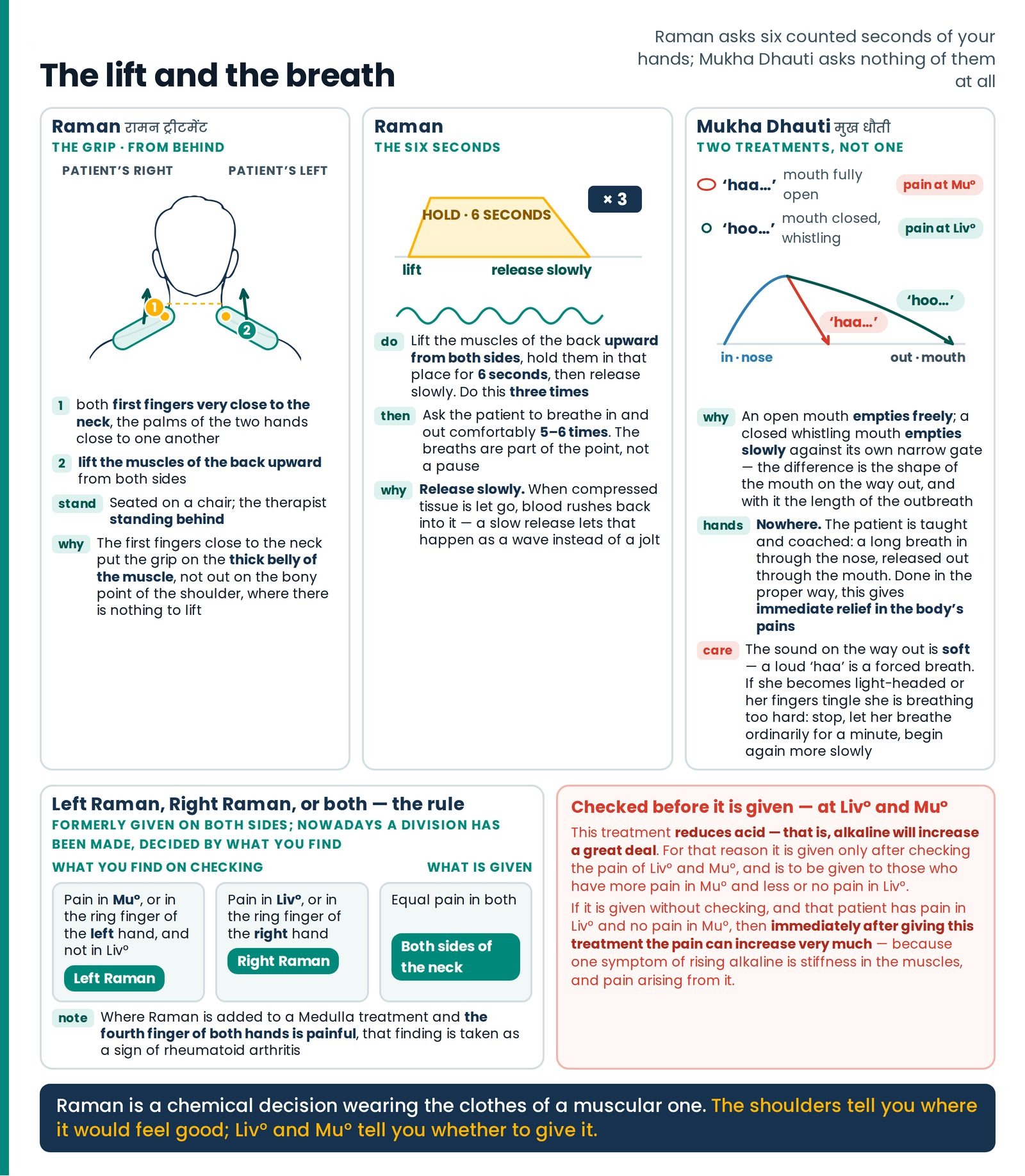
Two treatments follow that are not thumb-points at all. The first lifts a handful of muscle and holds it for a counted six seconds; the second asks nothing of the therapist's hands and everything of the patient's breath. (Figure 18.4)
Place both hands onto the shoulders from behind, in such a way that both first fingers are very close to the neck and the palms of the two hands are close to one another.
Then lift the muscles of the back upward from both sides, and hold them in that place for 6 seconds, then release slowly.
Do this three times.
After this, ask the patient to breathe in and out comfortably 5–6 times.
| Patient's position | Seated on a chair; the therapist standing behind Seated |
|---|---|
| Where the hands are placed | Both hands over the tops of the shoulders from behind, both first fingers very close to the neck, the palms of the two hands close to one another; the muscles of the back lifted upward from both sides Both sides |
| Duration and repetitions | Lift and hold for 6 seconds, then release slowly; three times. Then the patient breathes in and out comfortably 5–6 times 6 sec × 3 |
| What it is for | A treatment in its own right, closed by the 5–6 easy breaths |
What lies beneath. The handful is the great fan of muscle running from the base of the skull out to the point of the shoulder, with a deeper muscle under it that lifts the shoulder blade.
Three things in the instruction do real work. The first fingers close to the neck put the grip on the thick belly of the muscle rather than out on the bony point of the shoulder, where there is nothing to lift. And release slowly matters more than it looks: when compressed tissue is let go, blood rushes back into it, and a slow release lets that happen as a wave instead of a jolt. The breaths are part of the point, not a pause — five or six easy ones after the third lift are what turn a squeeze into a settling.
Raman — रामन ट्रीटमेंट
Formerly Raman was given on both sides of the neck. Nowadays a division has been made into Left Raman and Right Raman, decided by what you find:
What you find on checking · What is given
Pain in Mu°, or in the ring finger of the left hand, and not in Liv° · Left Raman Left
Pain in Liv°, or in the ring finger of the right hand · Right Raman Right
Equal pain in both · Given on both sides of the neck Both sides
Left Raman, Right Raman, or both — the rule
Further experience will make it understood.
The ring finger earns its place there. Where Raman is added to a Medulla treatment and the fourth finger of both hands is painful, that finding is taken as a sign of rheumatoid arthritis — and the pain of that finger used to go. The formula in which Raman sits with the Medulla work and Thoracic T1/T2 is in The Medulla Family, "The Medulla Family"; its place among the lymph and cranial-nerve formulas is in Cranial Nerve and Brain Formulas, "The Twelve Messengers".
Mukha Dhauti — मुख धौती
Take a long breath in through the nose and release it out through the mouth. Done in the proper way, this gives immediate relief in the body's pains.
If there is pain in Mu°, tell them to exhale with the mouth fully open, making a sound like 'haa…'.
If there is pain in Liv°, tell them to exhale with the mouth closed, making a whistling 'hoo…' breath.
| Patient's position | Seated; the therapist's hands do nothing — this is an instruction given to the patient Seated |
|---|---|
| Where the hands are placed | Nowhere. The patient is taught and coached |
| Duration and repetitions | A long breath in through the nose, released out through the mouth; no count is given. Mouth fully open, 'haa…' if there is pain in Mu°; mouth closed, whistling 'hoo…' if there is pain in Liv° |
| What it is for | Immediate relief in the body's pains |
The two forms are the instruction. This is not one breathing exercise with a decorative choice of sound. It is two treatments, and the finding at the navel selects which one the patient is taught: pain at Mu° → the mouth fully open, sounding 'haa…'; pain at Liv° → the mouth closed, a whistling 'hoo…'.
Both begin the same way — a long breath in through the nose — and both release through the mouth. The difference is the shape of the mouth on the way out, and with it the length and resistance of the outbreath: an open mouth empties freely, a closed whistling mouth empties slowly against its own narrow gate.
How to coach it, since this is the one point where your hands are idle. The breath in through the nose is long and unhurried; the sound on the way out is soft, because a loud 'haa' is a forced breath and forcing is the one thing this must not become. If she becomes light-headed or her fingers tingle she is breathing too hard — stop, let her breathe ordinarily for a minute, begin again more slowly. And give it to her to take home — a treatment she can give herself at four o'clock in her own office is worth more than one she can only have from you on a Tuesday.
Endorphin — एंडोर्फिन
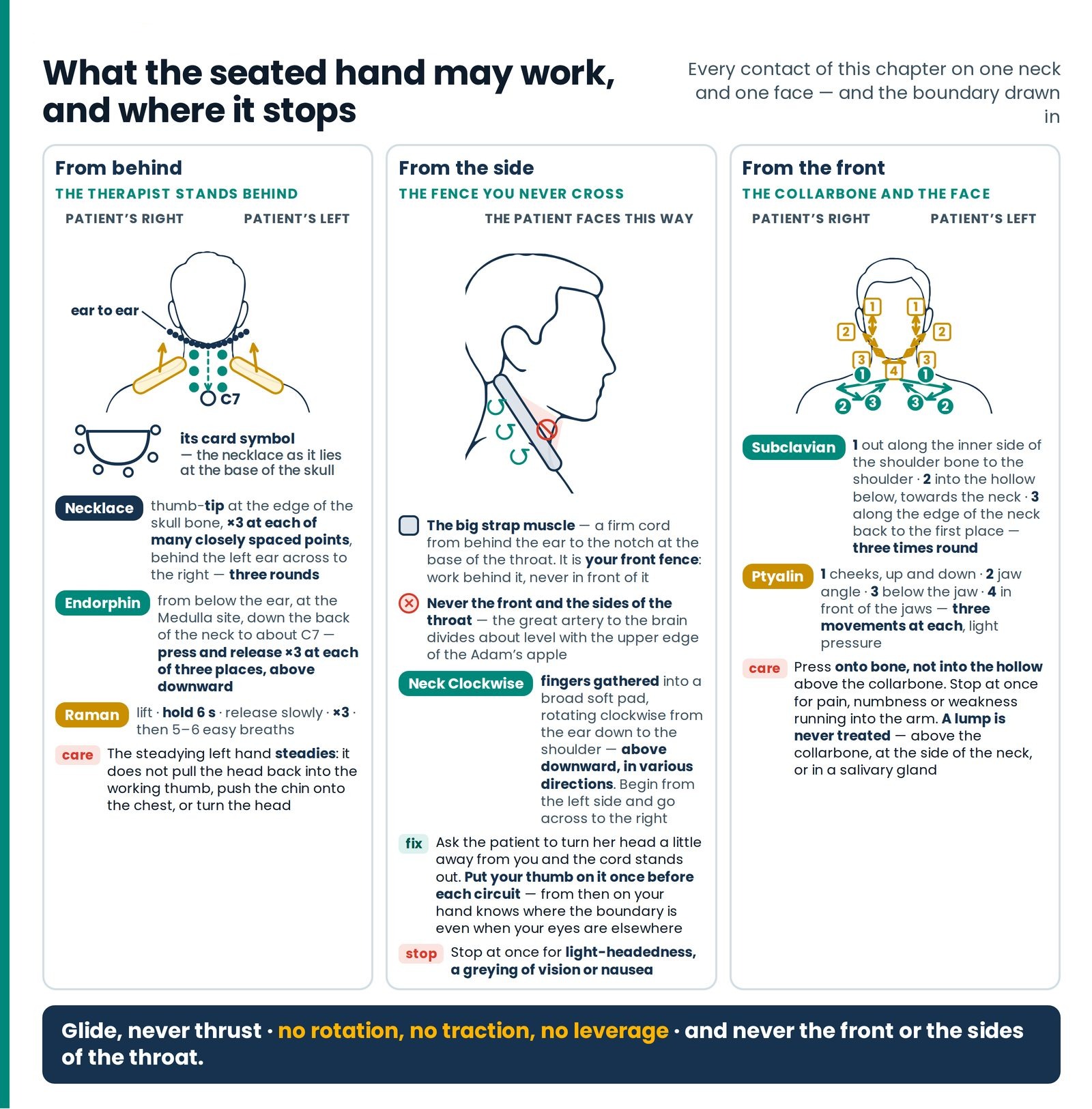
With the soft part of both your thumbs, starting from below the ear, where we give the Medulla treatment, press and release three times each at points running down the back part of the neck, to around the C7 bead.
Do this at three places below the ear, working from above downward.
This reduces the sensation of pains; it lessens the feeling of pain in the body.
| Patient's position | Seated — or lying down if the patient is very ill or very weak, by the rule at the head of this group Seated Supine |
|---|---|
| Where the hands are placed | The soft part of both thumbs, starting from below the ear, at the Medulla site, running down the back part of the neck to around the C7 bead Both sides |
| Duration and repetitions | Press and release three times each at three places below the ear, working from above downward × 3 |
| What it is for | Reducing the sensation of pains; it lessens the feeling of pain in the body |
Where the thumbs go, exactly — and how this differs from Medulla
The two points start in the same place and go different ways. Medulla starts behind the ear, under the edge of the skull bone, and travels down the side of the neck to the shoulder — a glide, counted by the convention two equals one. Endorphin starts at that same spot, below the ear at the Medulla site, and travels down the back of the neck to about the C7 bead — not a glide at all, but press and release, three times at each of three stations, worked from above downward, both thumbs, one each side.
Say it as a sentence before you begin: "Medulla runs down the side and rubs; Endorphin runs down the back and presses."
Finding C7. Ask the patient to let her head drop gently forward and run a finger down the midline of her nape: the last bead of the neck stands out further than the rest. To be certain, feel the two most prominent bumps and tip the head backwards — the upper one slides away, the lower one stays. The one that stays is C7, the bottom end of this point's run; do not go below it.
What lies beneath. The same territory as Medulla, worked downward — the strap muscle at the side, the great fan of the shoulder behind it, the scalp nerves at the top of the run, the prominent bead at the foot of it.
What the name records, and what it does not. The body genuinely makes its own pain-quietening chemicals, and it is also true that a strong sensation at one place can raise the threshold for pain felt at another. But naming a patch of skin "Endorphin" does not prove that pressing it releases one. The technique stands on its own feet; the name is a memory hook, not an address.
Subclavian — सब क्लेवियन ट्रीटमेंट
With the soft part of your thumb, pressing at many points on the inner side of the shoulder bone on both sides, go out as far as both shoulders.
Then from there, go into the hollow below, towards the neck, in the same way.
Finally, coming along the edge of the neck, return to the first place.
Repeat the whole process three times.
| Patient's position | Seated; the therapist in front Seated |
|---|---|
| Where the hands are placed | The soft part of the thumb, at many points on the inner side of the shoulder bone, out as far as both shoulders; then into the hollow below, towards the neck; then along the edge of the neck back to the first place Both sides |
| Duration and repetitions | Many closely spaced thumb-pressures; the whole process three times × 3 |
| What it is for | Named for the subclavian region; no separate indication is given here. Its place in the lymph formulas is in Cranial Nerve and Brain Formulas; its indications and precautions in Each Point in Use |
Read it as a circuit, not as three points: a closed loop from the inner end of the collarbone out to the shoulder, into the hollow beneath the bone and back inward towards the neck, then up the edge of the neck to where it began — both sides, three times round. (Figure 18.5)
What lies beneath. The name is literal, and that is the reason for the care. Under the collarbone the great vessels of the arm cross the first rib, and with them the cords of nerves on their way to the shoulder, the elbow and the hand; deeper and further in, the very top of the lung rises into the root of the neck, higher than most students expect.
The neck, the jaw and the base of the skull — Neck Clockwise, Ptyalin, Necklace
Circles, four salivary stations, and a string of beads ear to ear