Watch


Reading the stool
The chart of seven forms, colour, and whether it floats
The patient will not describe a stool accurately in words, because he has no words for it and would rather not try. Show him a picture and let him point. (Figure 10.1)
What the form tells you about the direction
The form tracks the speed of the journey better than the number of motions ever will, and the speed is what your work changes.
Form · The journey · Which kingdom
1 hard lumps · Very slow — squeezed nearly dry on the left · Acidic — expect tenderness at Mu° Left
2–3 lumpy or cracked sausage · Slow, but moving · Acidic, milder
4 smooth soft sausage · Right · Neither
5 soft blobs, easily passed · Faster than it should be — this is SSS · Alkaline — expect tenderness at Liv° Right , and undigested items
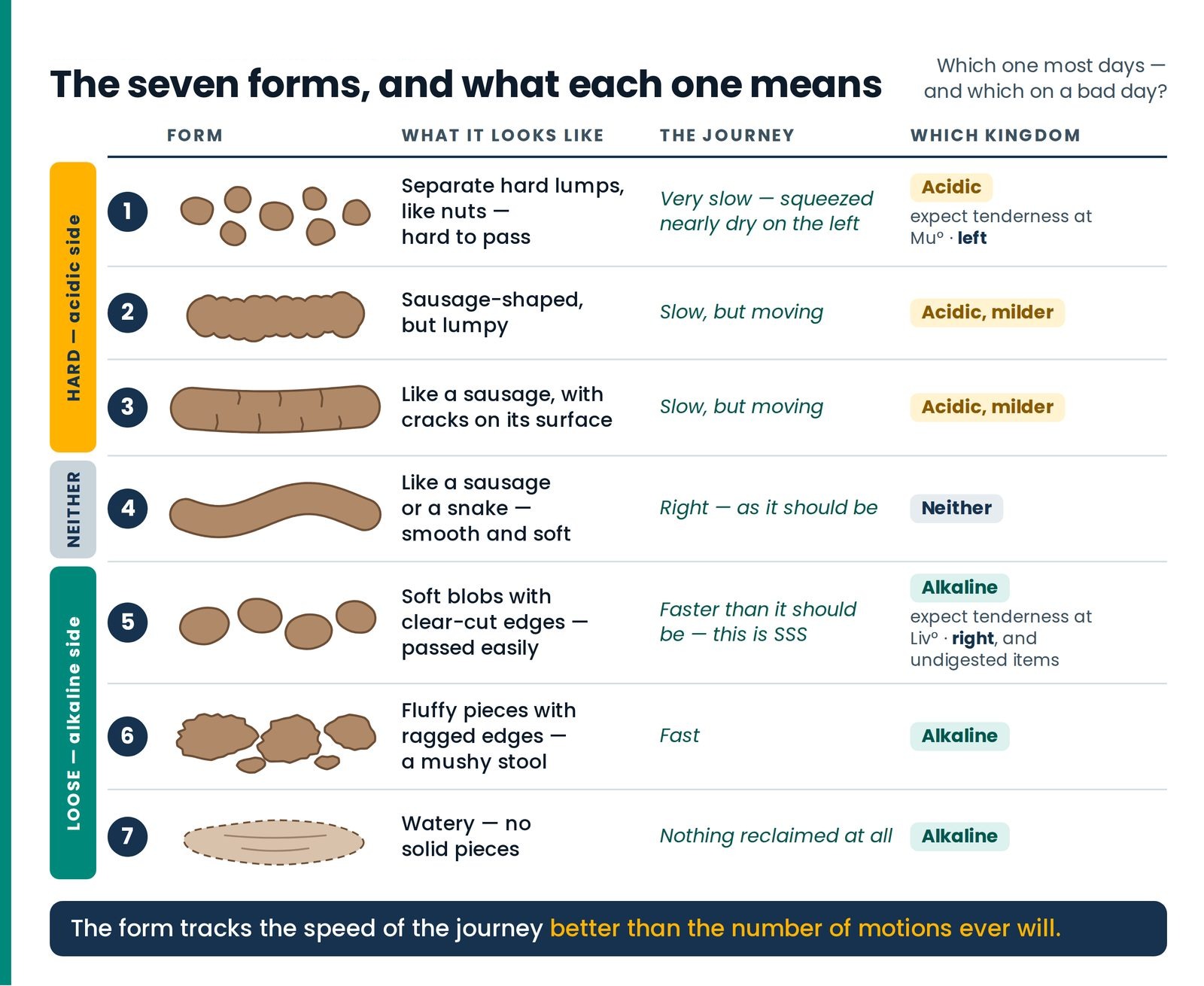
6 mushy, ragged · Fast · Alkaline
7 watery · Nothing reclaimed at all · Alkaline
And the two ends carry the two families of ordinary disease. On the hard end: constipation, piles, fissure at the anus, fistula, pimples, dandruff and scaling, hair falling or greying before its time, prolapse of the uterus or of the rectum. On the loose end: fits, epilepsy, cerebral palsy. Two rows of one chart, and a bowel finding that reaches all the way to a child's seizure.
Colour, and what to do about each
Ordinary brown.
The colour is not made by food but by the pigment in bile, altered on the way down: brown is a report that bile is arriving.
Pale, clay-coloured, putty. Bile is not arriving in normal quantity. With dark urine, or yellowness of the eyes, a doctor's matter today. ▲ Take care
Black and tarry. Never explain this away. There is a treatment in the formulary — Large Folic Black, given after the undigested-food work — after which the black colour of the face is said to be reduced by a quarter immediately, and the next morning the first inch of the stool will be black, meaning waste is coming out by way of the rectum. Learn that as it stands, with its boundary: it accounts for the first inch on the morning after that treatment, and for nothing else. Iron blackens a stool harmlessly; so does an ulcer bleeding higher up. ▲ Take care
The colours and consistencies that are not a matter for the mat at all — a bulky pale greasy floating stool with weight coming off, a black tarry stool, blood of any colour at any age — are listed with their instructions in The Fire and the Ash, "The Fire and the Ash", and are asked about of every patient, every time. Rectal bleeding is never put down to piles until a doctor has excluded what else it can be, and a patient genuinely having piles does not make the blood theirs.
Four readings are taken every time — form, frequency, effort and content — and none stands alone. Their information has to be correlated to arrive at a proper diagnosis, together with the pain points around the navel, the B₁₂ and folic acid points, and, in women, the menstrual history, which is an additional and very valuable tool. Content — the undigested items — is The Fire and the Ash's question, not this article's.
The causes of constipation, and the cure
Four causes, the acid treatment, and the left run in the wave's order
Having given a treatment for the acidity behind hard stools, the teaching turns round and says the treatment is not the whole answer, and lists everything else that may be wrong.
Constipation is a cumulative result
In actual practice, constipation is the cumulative result of a number of factors, each of which has to be set right.
The cause · The remedy
Not drinking enough water — hence the stools become hard · Advise the patient to drink water in small doses at specified intervals
Not having enough roughage — the reason for the poor motility of the faecal matter · Plenty of vegetables and fresh fruits, with their skins as far as possible
Sluggishness of the large intestine, due mainly to sedentary habits, or perhaps to age · Stimulate the descending colon
Insufficient quantity of secretions in the digestive tract · Stimulate the various organs of digestion
Two your hands correct and two only the patient can — and a therapist who forgets which is which will treat a man for eight weeks while he goes on drinking two glasses a day.
The primary treatment is to reduce the acidity, by the Acid Treatment Formula, given while there is pain at Mu° and repeated on subsequent days until that pain is removed. The formula and its two forms are taught in Correcting the Two Kingdoms, "Correcting the Two Kingdoms". Its standing warning is worth carrying from today: if there is no pain at Mu°, the Acid treatment is not to be given.
When the acid treatment is not enough
If the stools are hard even after the acid treatment, and he is drinking water in the right manner, then it means his descending colon is sluggish.
To rectify that, blood supply has to be increased to: the transverse colon, the descending colon, the sigmoid colon, the rectum and the anus.
Read the two conditions before the conclusion. The treatment was given and the water was corrected. A therapist who skips the second will diagnose a sluggish colon in a man whose only fault is a water pot.
The five points of the left run, and what each stimulates
Point · What it stimulates
Spl Left · The left end of the transverse colon and the beginning of the descending colon
Const Left · The area between the navel and the transverse colon, and parts of the small intestine
Mu Left · Mainly the middle part of the descending colon — and it increases lubrication in the intestines, so the residue moves forward easily
Mu° Left · The left kidney, which reduces acidity
Lt.Ov. Left · The lower descending colon, the sigmoid colon and the rectum
Between them, the whole left-hand run of the pipe from the bend under the spleen to the anus. It is not a scatter of useful places. It is the pipe itself, in order.
To cure constipation, why Spl, the spleen — and why Lt.Ov., the left ovary? Both are outside the alimentary canal.
Why a point named for one organ works on another
By these points we increase the blood circulation in the various parts of the abdomen all around the navel. Each point's name was given by keeping in mind the chief organ of that region. But when the point is given it increases blood flow not only in that organ, but in all the organs of that region.
Above and to the left of the navel the chief organ is the spleen — but the left terminal transverse colon and the upper descending colon lie there too, and all three receive the blood; and below and to the left, besides the ovary or testis, lie the terminal descending colon and sigmoid. In this work Spl is not given for the spleen at all, but for that part of the large intestine. Learn the names as addresses, not as claims.
The order is the peristalsis
The points are given in the same order in which the wave of peristalsis travels in the intestine — first the upper part of the transverse colon, then the middle, then the lower part, that is the sigmoid colon.
This is the deepest habit of thought in the therapy: study how the body does a thing, then stimulate the parts in that very order which sets right the body's own way of working. A hand that pushes downstream helps; a hand that pushes upstream is doing something else, whose effects nobody has taught you.
Two formulas rest on that principle and differ in reach. The Left Side Treatment Formula works the left run only and is the formula for chronic constipation — of very long standing. The Round Normal Formula is for ordinary constipation, and differs in that not only the descending colon but all the parts of the large intestine, from the ascending colon right through to the sigmoid, are stimulated in order. Both are taught in Water and Salt, "Water and Salt".
Its six points are anatomy you can carry to the mat tomorrow: Rt.Ov. the terminal ileum and the beginning of the ascending colon · Liv the middle of the ascending · Gal the upper ascending and the beginning of the transverse · Spl the terminal transverse and upper descending · Mu the middle descending · Lt.Ov. the terminal descending and sigmoid. Six points, and you have walked the whole large intestine in the direction the wave travels.
The third cause: the gland that sets the pace
The thyroid, the mistrī, and the low gland in children and women
Having covered the descending colon, the teaching asks a hard question of itself: does that cover ALL possible reasons for constipation? The answer given is: no, not completely.
Constipation is a cardinal symptom of the thyroid working too little
From physiology we know that constipation is one of the main symptoms associated with hypothyroidism. This means that, for curing constipation, we have to stimulate the thyroid gland also.
The thyroid's chief responsibility is metabolism, and for that it increases both the outflow of digestive secretions and the motility of the digestive tube. So:
The gland works less → digestive secretion comes out in smaller quantity → food is not properly digested and moves forward very slowly → stool and waste remain in the large intestine for a longer time → more fluid is absorbed from it → the stool becomes dry and hard, and that is the constipation.
And the line that makes the chain dangerous: the motility of the large intestine is already quite low. So even a small change in motility is enough to produce constipation.
That is why the thyroid is stimulated in this work, by the treatment called Thrd.
The same gland is called, in this therapy's own image, the chief craftsman — the mistrī — without whose order or supervision the other glands and organs will not work properly. All the functions of the digestive tract depend on the thyroid gland.
What the low thyroid shows, and in whom
When the gland works less, T₃ and T₄ do not come out in the right quantity, and two chief pictures are seen:
In children → very hard constipation; and mental dullness can also occur. In women → menses coming before the date, or more flow in the menses.
When that lasts for years, T₃ and T₄ become very much less than normal and it is called hypothyroidism; one chief indicator is that the TSH also rises.
And the loop closes. When acid increases in the blood the muscles become loose; for a gland's secretion to come out properly the muscles around it must contract properly; loose muscles mean poor contraction, and the gland runs hypo — and a hypo thyroid means a slow bowel, a dry stool, and more acidity still.
A child with very hard constipation and a school report saying he is slow is a child whose thyroid deserves a blood test. Say it plainly: "There is a simple blood test for the thyroid. Please have it done and bring me the paper." You are not treating a gland with a slip of paper; you are making sure a correctable cause is not sitting under your hands for six months.
The fourth cause: what long constipation does to the lining
Inflammation at Mu, Adr before Thrd, and the points blocked
Severe constipation and the mucous membrane
Severe constipation is certainly accompanied by inflammation of the mucous membrane of the gastro-intestinal tract, and this shows itself as severe pain at the pain point Mu.
Wherever rubbish accumulates, a favourable environment is created for germs to breed, which takes the form of infection. So if someone has had constipation for a very long time, there will certainly be some infection in the intestines — and a chronic infection, one that stays a long time, changes into inflammation.
Therefore: along with curing the constipation, the inflammation must also be finished, or the patient will not get complete relief. Inflammation is corrected here by stimulating the adrenal cortex to produce cortisol.
Recap, learnt as it stands: pain at Mu indicates inflammation in the digestive tract. The instant remedy is either (30) Medulla or Adr — the actual treatment being (6) Adr, repeated three times, with a gap of ninety seconds in between. × 3
A complete account of long-standing constipation therefore has four faults in it — the acidity, the sluggish left colon, the thyroid, and the inflammation the constipation itself produced — which is why the formula for it stimulates most of the organs of the left side of the body and is named for that side.
Adr before Thrd — and the compromise that reverses them
The physiology.
Whenever Adr is given it makes the thymus hypo, and with it the thyroid also becomes a little hypo. So if both are given one after the other, giving the thyroid first and Adr afterwards will not give a full hundred per cent result; it comes out a little less. For a full result, Adr should be given first and the thyroid afterwards.
The problem. The abdominal points up to Mu° are given face up Supine ; Adr requires face down Prone ; Thrd face up again. The ideal order turns the patient supine — prone — supine: two turns, troublesome for the elderly, and for patients with back pain or heart trouble.
The compromise actually taught. After Mu°, give Thrd first and Adr afterwards — one turn instead of two.
And the honesty that goes with it: always remember this compromise was made for the patient's convenience. There is no harm in it, but the patient may need the treatment to be given one or two days longer.
If, after all the above, the bowel movement is still not satisfactory enough, then it means the patient's intestines are not producing the correct quantity of secretions, and the organs of digestion themselves are set right — see also → Setting the Stomach, "Setting the Stomach". Separately: individual treatment points alone do not set right a disorder, but they can give instant relief from individually annoying symptoms and can be used as starters, chiefly for the bed-ridden and those with severe joint pains, who may not bear the pressure of the regular treatments even by hand. The points which reduce the symptoms of acidity are Mukha Dhauti · Raman treatment · Round Arrow · Adr · Left Chest Only.