Watch


The two directions, symptom by symptom
Table 1 row by row: slack and dry against tight and wet
What follows is the working heart of this wiki, and every article after it leans on it somewhere. It is the fruit of original and continuous observation over more than half a century and something close to a million patients. Read it as two columns of one page, row against matching row.
Table 1 — The complete picture of the two directions
| Typical picture of the ACIDIC patient Left | Typical picture of the ALKALINE patient Right | |
|---|---|---|
| The points | Pain at the Mu° pain point and at the Acid point · pain in the ring finger of the left hand Left | Pain at the Liv° pain point, at the Gas point and at the Fluid point · pain in the ring finger of the right hand Right |
| Water | Arises from a deficiency of water in the body and the blood; found in persons who drink less water | Arises from an increase of water in the blood or in some part of the body; swelling — that is, oedema |
| Stool | Very hard stools, with constipation; the bowel not clearing daily | Semi-soft or thin stools; frequent stools, coming again and again; loose motions; UDF — undigested food in the stool |
| Nose | Blocked nose | Pale watery fluid running from the nose |
| Cough | Dry cough, or cough with hard yellow mucus | Cough with watery, white or thin mucus |
| Urine | Yellow urine, often with a burning sensation | White, colourless urine |
| Skin and hair | Scaly skin; itchy dry rashes; dry hair | "Weeping" rashes with watery exudates |
| Menses | Heavy bleeding · menses longer than 4 days — typically 5 to 6 days or more | Scanty bleeding · menses shorter than 4 days — typically 2 to 3 days or less, sometimes coming for only a day or two and then stopping |
| Headache | Migraine · headache normally on either or both temples | Headache normally on the top of the skull, or in the upper or back part of the head — sometimes radiating over the whole head or the whole forehead |
| Muscles | Muscles become loose and slack | Muscles become hard and tight — this is called spasticity |
| Thyroid | Typically hypothyroidism — a gland running slow | Hyperthyroidism — a gland running fast |
| Blood pressure | Low BP — because the volume of blood is reduced | High BP — because the volume of blood is increased |
| Bone and joint, I | Disorders in which calcium is stored in the wrong places between the bones — spur; ankylosing spondylitis, that is bamboo spine; cervical spondylitis | Calcium deficiency disorders — cramps, bow legs, rickets |
| Bone and joint, II | Rheumatic pains — vāt pains — except rheumatic heart disease | Arthritic pains · osteoarthritis · rheumatic heart disease |
| Which side hurts | Pains predominantly in the organs of the left side of the body — for example dimness in the left eye, stiffness in the left shoulder, a frozen left shoulder Left | Pains predominantly in the organs of the right side of the body — for example dimness in the right eye, stiffness in the right shoulder, a frozen right shoulder Right |
| Common ailments | Constipation; piles, that is haemorrhoids; anal fissure; fistula, that is bhagandar; premature greying of the hair; dandruff and scaling; pimples; alopecia and falling of the hair; prolapse of the uterus or of the rectum; hernia; varicose veins; and degenerative diseases — those that eat away bone or tissue — such as spondylosis | Fits and convulsions; epilepsy, that is mirgī; spasticity with or without cerebral palsy (CP); stammering or lisping; tumour, fibroid, cyst; and proliferative diseases — those with a tendency to grow — such as tumours and cancer |
| Which ages | Predominant up to about 30 to 35 years, when most people are found to have pain at Mu° and to get the diseases of acidity | With increasing age the diseases of alkali begin to come. But it is not always so: a chief cause of fits and CP in children is an increase of alkali |
| How readily corrected | Many diseases and symptoms may appear from it — but they are easy to set right | Fewer in number — but they do not get right easily; to correct them takes considerable effort and time |
| The matched treatments | Treatments that reduce acidity Left : the Acid Formula (ATF) · the Raman treatment, the left Raman · ADR · Round arrow · Left Chest only · Left vitamin formation · "Ha" Mukha Dhauti | Treatments that reduce alkalinity Right : the UDF treatment · the Alkali Formula (ALTF) · the right Raman treatment · Ku — the (½) Ku at 40, 60 or 80 seconds · Right Chest only · Right vitamin formation · "Whooo" Mukha Dhauti · and in some people alkali is also reduced by Th+Ch, thymus with chest |
What the table's own footnotes carry
Four notes travel with that table and each is a teaching in itself. They are set out here in full, because a note that is skipped is a note that gets a patient treated wrongly.
UDF stands for UnDigested Food in stools. It sits in the alkaline column and means literally what it says: the patient can see in the pan the very food she ate — the seeds of tomato or of bhindī, okra, coming through whole; the leaves of spinach, methī, dhaniyā, curry leaves, recognisable; groundnut, gram, peas, corn passing out exactly as they went in. The Fire and the Ash teaches it completely — the questionnaire that draws it out, the three levels of it, the tongue and the curd tests.
Why a gland runs slow on the acidic side. Muscle tone affects the effective working of any gland — so poor muscle tone, which travels with the acid direction, will automatically cause a gland to become hypo, that is, to work less. The thyroid is where you notice it first. This is not a separate phenomenon needing a separate explanation; it is the same slackness at a different door.
Why prolapse and hernia sit in the acidic column. Prolapse means any organ shifting from its designated place and entering into some other organ or place. If the muscles remain loose, an organ will shift from its own place. Slackness automatically sets the stage for herniation, for prolapse of the uterus, for prolapse of the rectum — again, the same slackness at different doors.
The treatments in the last row are names only, for now. Each is a complete formula with its own points, counts, order and cautions, taught in its own place. What you need from that row today is the shape of the thing: once the direction is known, a matched family of treatment is waiting for it — the left-sided work belonging to one direction and the right-sided to the other.
Two rules that govern the whole table
What makes a reading, and what makes a guess
All the symptoms will not be found in each and every patient.
Nobody arrives with a whole column: four of the sixteen rows is an ordinary patient, eleven is rare enough to be worth remembering.
But it has been found that in a majority of patients, in addition to having pain at the Mu° or Liv° pain point, they will have a combination of two or more of the symptoms listed.
So: one tender point plus two or more matching symptoms is a reading. One symptom alone is a hint. And the anchor is always the point — the symptoms are the company that finding keeps, not the finding itself.
One pair of rows deserves saying out loud, because it is the observation from which the whole classification grew. Pains on either side of the navel are accompanied by opposing symptoms. In patients with high BP, pain is felt above the right hip, just in front of the right kidney, often with whitish watery urine. In patients with low BP it is felt on the opposite side, often with yellow concentrated urine that may produce a burning sensation. Two sides, two pressures, two colours of urine — which corroborates that high BP is predominantly a condition of the alkaline direction and low BP one of the acid.
Carrying the table in your head as two temperaments
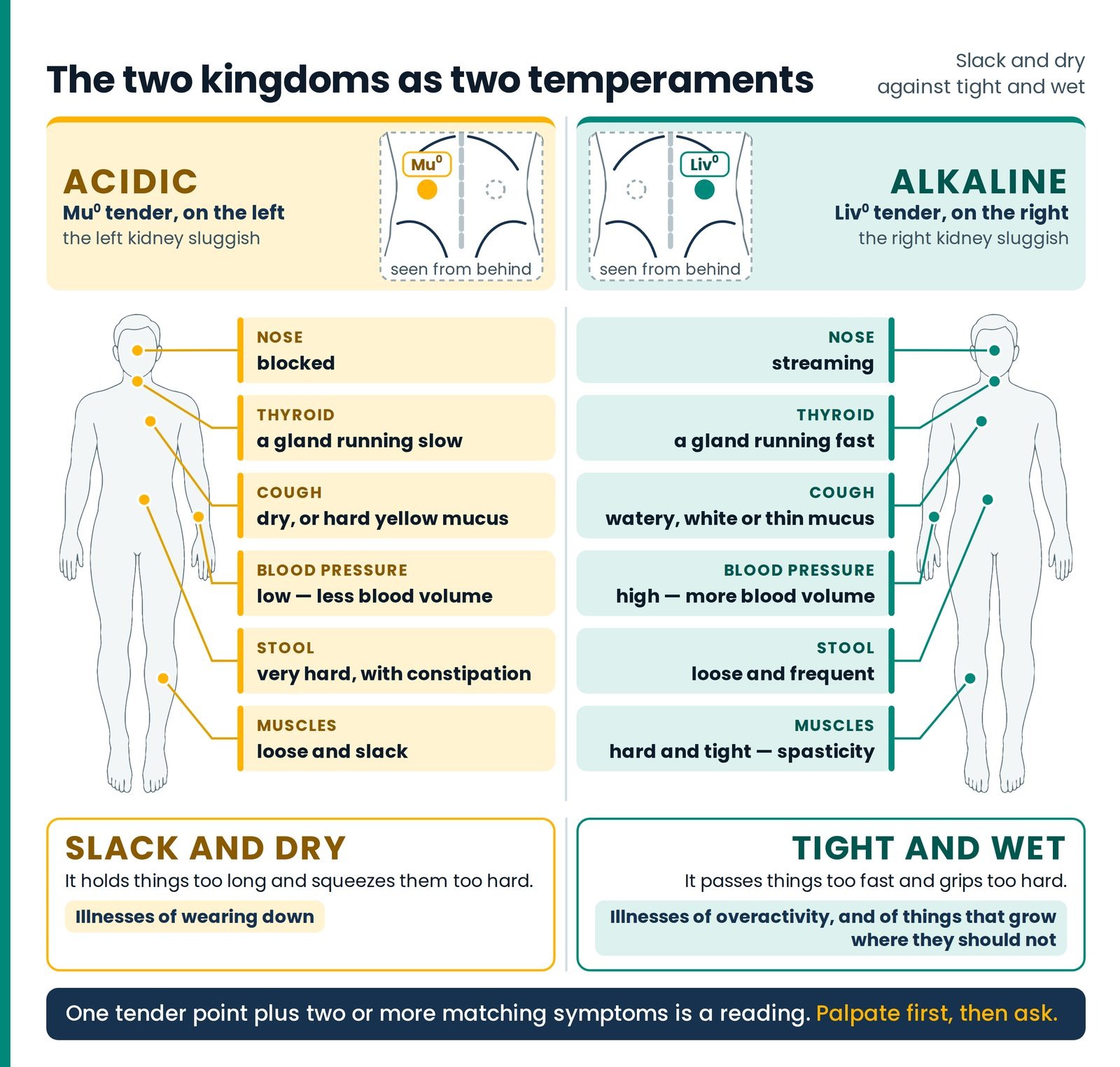
Sixteen rows is more than anybody memorises by repetition. Learn the table as two temperaments and the rows can be reconstructed rather than recalled. (Figure 8.2)
The acidic body has gone slack and dry. It holds things too long and squeezes them too hard: the stool sits and is wrung until it is stone; the nose is blocked rather than running; the cough has nothing in it, or brings up something hard and yellow; the urine is dark and stings; the skin scales and the hair goes white early; the period runs past four days because nothing closes properly; the muscles have no spring, so glands under-perform and organs drop from their places. Its illnesses are those of wearing down — and where calcium moves it moves into the wrong places and sits there like scale in a pipe.
The alkaline body has gone tight and wet. It passes things too fast and grips too hard: loose frequent stools with food unfinished; a streaming nose; a wet white cough; urine pale as water; a period over in two days; muscles that cramp and clench; a gland running fast. Its illnesses are those of overactivity and of things that grow where they should not.
Slack and dry against tight and wet: that is the whole table in six words.