Watch


The rule of dilution
Add water and an acid weakens; the colon takes water away
Now the single idea on which the rest of this article stands. It can be demonstrated on a kitchen shelf and it takes one sentence.
The rule of dilution
Take a beaker of any strong acid and slowly add water to it. It becomes diluted and progressively less acidic — that is, it is moving in the alkaline direction.
Conversely, any fluid from which water is removed becomes less alkaline — that is, more acidic.
Add water and the acid weakens. Take water away and it strengthens. Everything that follows in this article rests on that rule.
Every kitchen in India already knows it. A spoon of tamarind pulp stirred into a whole vessel of water is barely sour; the same spoon in a small cup makes your eyes water. Nothing was added to the tamarind and nothing taken from it — only the water changed. The strength of a thing dissolved in water is a property of the thing and how much water is with it.
Now carry the rule of dilution into the belly, and follow it the whole way along.
The journey along the large intestine
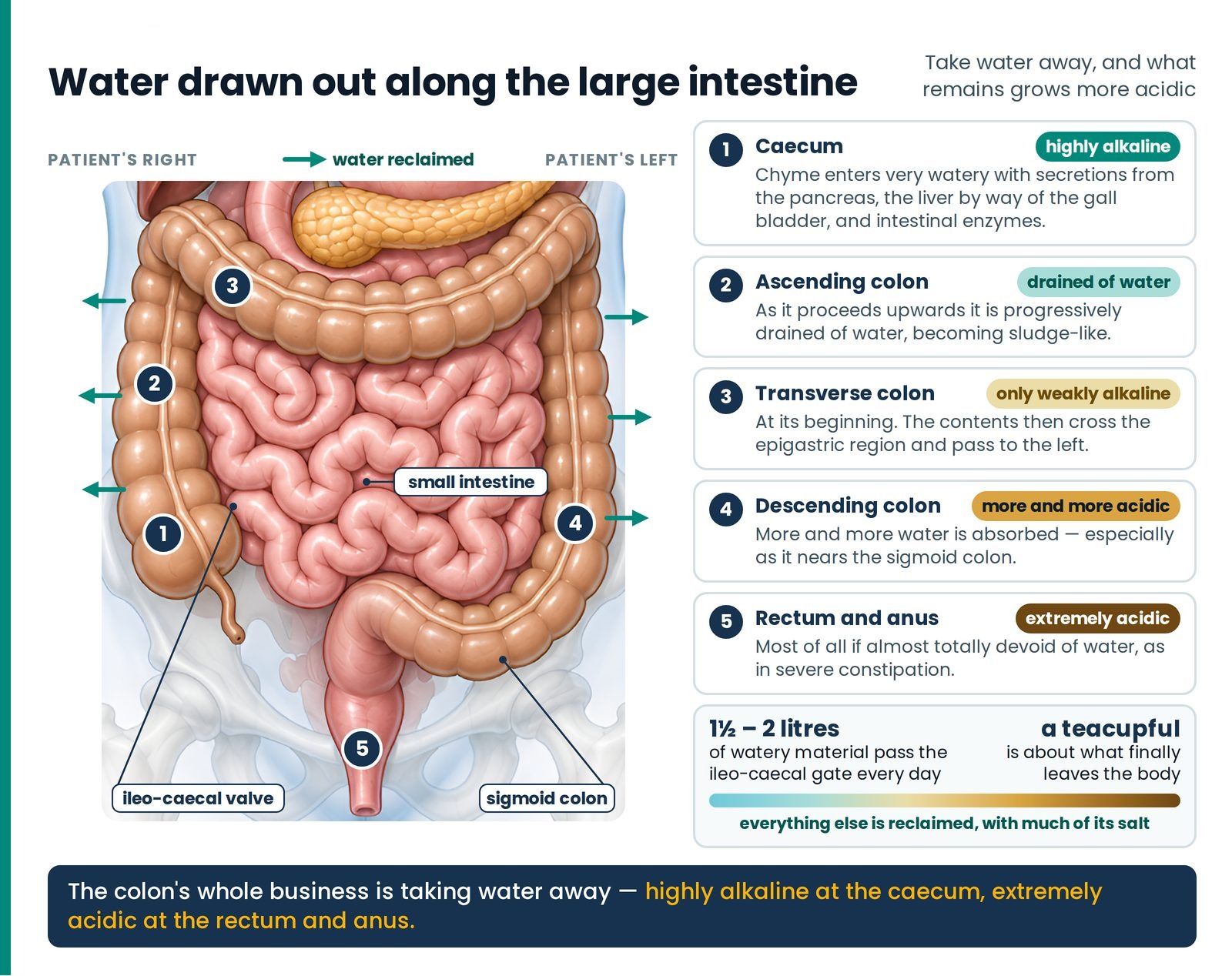
When chyme enters the beginning of the ascending colon it is a very watery fluid, on account of the various secretions poured onto it — from the pancreas, from the liver by way of the gall bladder, and from the intestinal enzymes besides.
By the rule of dilution it follows that the contents of the caecum, the beginning of the ascending colon, are highly alkaline.
As the chyme proceeds upwards it is progressively drained of water, becoming sludge-like in the process — so that the contents at the beginning of the transverse colon are only weakly alkaline.
As it crosses the epigastric region and passes to the left of the transverse colon, more and more water is absorbed by the colon, making the contents of the descending colon progressively more and more acidic — especially as it nears the sigmoid colon.
Finally, at the rectum and the anus, the faecal matter is extremely acidic — most of all if it is almost totally devoid of water, as is the case in severe constipation.
Picture the cloth at the ghat. It goes into the river soaked and heavy and comes out streaming. Wrung once, the water runs off it in a rope; wrung again, it only drips; spread on the hot stone, by evening it is stiff enough to stand up on its own. Nothing was added to the cloth; water was taken away, four times over, and at each stage it became a different object. The colon does exactly that along its length — which raises the only question that matters for a therapist: what decides how hard the wringing is? (Figure 8.1)
Water in decides water out
Two litres lost a day; drink too little and the exits shut
Water in decides water out
An average person loses almost two litres of water a day — through sweat, through urine, and in expired air, the breath you can see on a cold morning. This quantity must be replenished on a daily basis, for which he must consume at least an equal amount of pure water.
If one does not consume enough water, the body reacts by first stopping water excretion from all the exit points it has — one of which is the anus. The others fall away with it: poor secretion of sweat, of urine, and of saliva.
The consequence is unavoidable. Shutting the exit at the anus tends to make the faecal matter more and more tight — that is, more acidic — around the rectum and anus, these being the exit points.
Thus, if an individual consumes very little water — even though he may be consuming other types of liquid — he is more likely to suffer from constipation. And it is inevitable that this will be accompanied by acidity in the large intestine, especially the descending colon and the rectum.
No other drink can be a substitute for water.
From all of which follows the rule you will use for the rest of your practice: by reducing acidity and by stimulating the descending colon, constipation can be cured. And conversely, by reducing acidity, many of the symptoms accompanying a disorder can be relieved — especially if the disorder is accompanied by constipation.
That last sentence is the hinge of the whole article. It is why a therapist may treat a stiff neck by working on a bowel, why a patient who came about one thing finds three things better, and why the acid direction, once identified, gives you a lever long enough to move complaints that look unrelated.
Ask before you advise. How many glasses of plain water, honestly, on a working day? — then, because everybody overestimates, tell me what you drank yesterday, from waking. Then: what colour is the urine first thing? And be exact about what counts. Tea is not water. Coffee is not water. Buttermilk is not water. A cold drink is emphatically not water; it is sugar carried in water. The instruction is pure water, in the quantity lost, every day.