The sole only, two pillows, and the hand left where Liv and Mu put it
Liv° and Mu° are given in the same place and the same manner as Liv and Mu, with two changes that the small ring records — the hand contact moves up to the shoulder, and is taken at a single station.
Each is doing a different job. The first is the contact rule of the whole atlas restated where it is easiest to break: a shoulder is rounder and less forgiving than a thigh, and a foot that tips onto heel or toes there has become an edge. The second is positioning, not comfort — the pillow's work is to bring the shoulder joint up to meet your sole rather than let the head of the arm bone be levered forward, and its limit is stated as precisely as its purpose. The third is craft: the hand stays where Liv and Mu put it, so the arm is not re-arranged between points; the powder is practical sense, and a therapist thinking about his own foot is not thinking about the count; and parallel means parallel — turn the big toe in and the load runs onto the inner edge of your sole, turn the heel in and onto the outer.
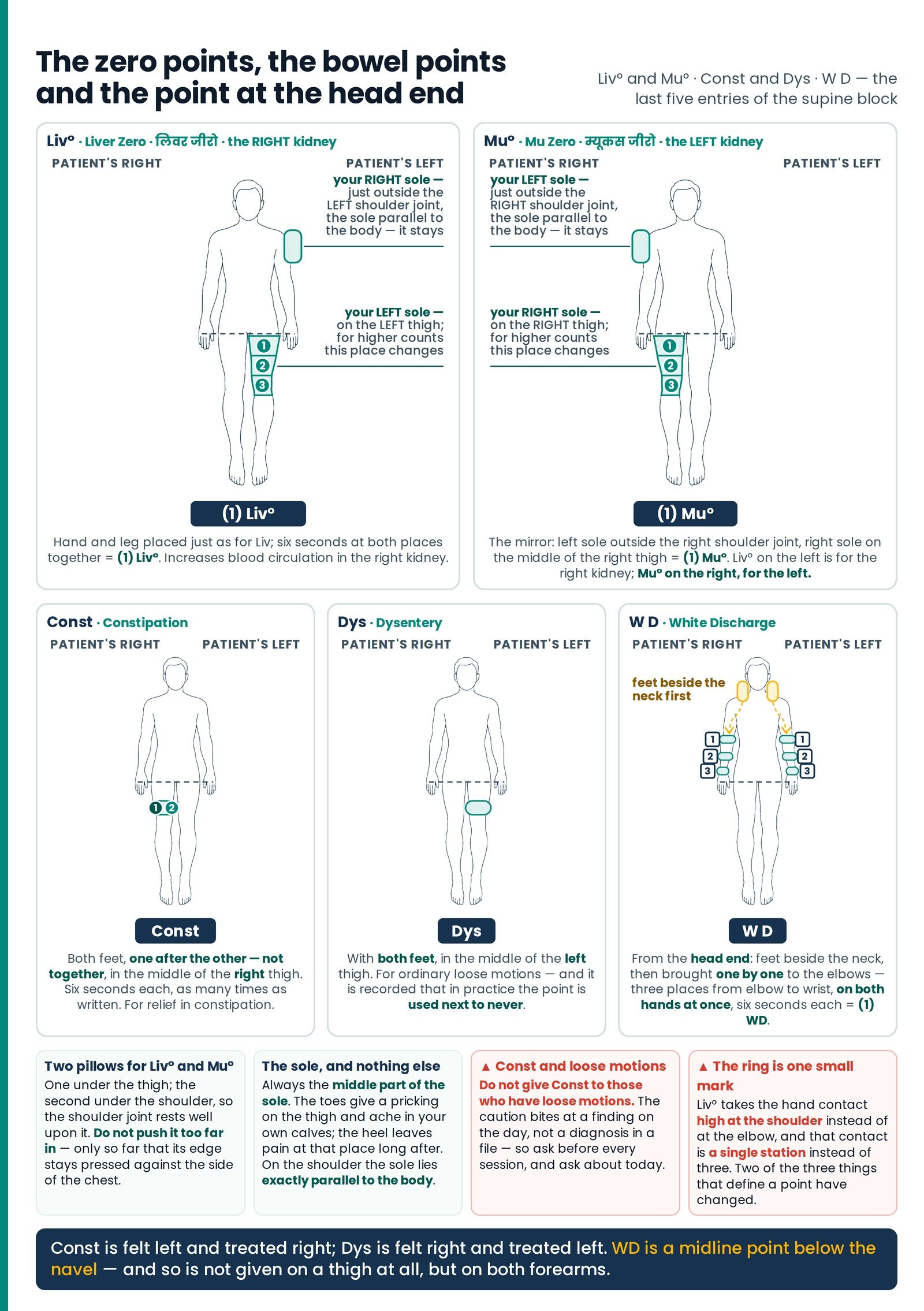
The zero points, the bowel points and the point at the head end. The last five entries of the supine block on one plate — Liv° and Mu° with the shoulder contact that stays and the thigh place that changes, Const and Dys on opposite thighs, and WD given from above the patient's head.
Liv° — Liver Zero (लिवर जीरो)
Tell the patient to keep the hand and the leg placed just as for Liv. Place your right sole just outside their left shoulder joint, and your left sole on their left thigh, and, standing straight, press at both places together for six seconds and release. This is called (1) Liv°.
If a greater number is to be given, then change the place on the thigh turn by turn, but on the shoulder it stays near the joint.
Patient's position
Supine; two pillows — one under the thigh, one under the shoulder with its edge pressed against the side of the chest — and the flat pillow under the hand, the hand at the same distance as for Liv Supine
Where the feet are placed
Right sole just outside the left shoulder joint, the sole exactly parallel to the body; left sole on the left thigh. One foot placed without pressure, then the other, then the weight let down Left Both sides
Duration and repetitions
6 seconds at both places together, released = (1) Liv°; for higher counts the thigh place changes turn by turn, the shoulder place stays near the joint 6 sec
What lies beneath. The cap of muscle over the point of the shoulder, and under it the knob at the top of the arm bone with the small cuff tendons fastening onto it, a lubricating sac between the two. Further in, under the fold of the armpit, run the great vessels and nerve cords on their way into the arm — one more reason the contact is just outside the joint and laid flat. The right kidney lies at the back of the body, behind and below the last rib, packed in fat.
Mu° — Mu Zero, Mucus Zero (म्यूकस जीरो)
Press your left sole just outside their right shoulder joint and your right sole on the middle of the right thigh, together, for six seconds, and release. This is called (1) Mu°.
If a greater number is to be given, then change the place on the thigh; on the shoulder it stays near the joint.
Patient's position
Supine; two pillows, as for Liv° Supine
Where the feet are placed
Left sole just outside the right shoulder joint, parallel to the body; right sole on the middle of the right thigh Right Both sides
Duration and repetitions
6 seconds at both places together = (1) Mu°; the thigh place changes, the shoulder place does not 6 sec
What it is for
Increases blood circulation in the left kidney
Read the crossing carefully, because in a hurry it is easy to reverse: Liv° is given on the left and is for the right kidney; Mu° is given on the right and is for the left. The Liv pain point lies right of the navel with the right kidney immediately behind it — so the right kidney is Liv°, answered from the left limbs. (Figure 16.6)
The two thigh points for the bowel
Const on the right, one foot then the other; Dys on the left, and rarely
Const — Constipation (कोंस्टीपेशन — read aloud as constipation)
Placing both feet one by one in the middle of their right thigh, press for six seconds and release. Do it as many times as the number written.
Patient's position
Supine, one pillow under both thighs Supine
Where the feet are placed
Both feet, one after the other — not together — in the middle of the right thigh Right
Duration and repetitions
6 seconds each, as many times as the number written 6 sec
What it is for
Relief in constipation
Dys — Dysentery (डिसेंट्री — read aloud as dysentery)
With both feet, press in the middle of the left thigh for six seconds and release. Do it as many times as the number written. This gives relief in ordinary loose motions.
This is given for information only. In practice this point is used next to never.
Patient's position
Supine, one pillow under both thighs Supine
Where the feet are placed
Both feet, in the middle of the left thigh Left Both sides
Duration and repetitions
6 seconds, as many times as the number written 6 sec
What it is for
Ordinary loose motions — though it is recorded that in practice the point is used next to never
Two differences between this pair are the substance of the instruction. Const is given one foot after the other, Dys with both feet; Const goes on the right thigh, Dys on the left. They are a matched pair on opposite thighs answering opposite quadrants of the belly. And notice that the point is set down here together with the plain statement that it is scarcely ever used: learn Dys so that you can read a card that carries it, and do not go looking for reasons to give it.
Key teaching
The pillow line printed beneath these entries
निम्न उपचारों के लिए जरूरत न हो तो सिर के नीचे तकिया न दें।
For the treatments that follow, if there is no need for it, do not place a pillow under the head. Supine ▲ Take care
The standing supine rule said once more where the therapist moves to the head end, and a pillow up there is in his way rather than under his eye.