Watch

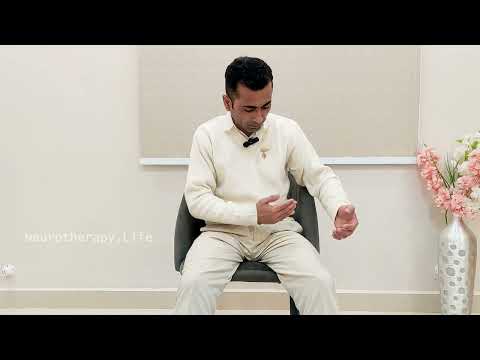

Pan — the pancreas point
Stand astride the patient at the joint of thigh and waist, so placed that the soft middle part of your sole lies right in the middle of their thigh, and so that the patient feels comfortable. Press on both thighs together for six seconds and release. Do it as many times as the number written — but take care that each time the pressure falls for six seconds at the same place, and that the weight is equal on both feet.
That last sentence is the whole difficulty of Pan. Every other thigh point travels down the limb; Pan does not move at all. (8) Pan is eight presses at one and the same spot, and a foot that creeps an inch lower each time has given something else. (Figure 16.2)
| Patient's position | Supine; one pillow under both thighs, its edge close to the hips; nothing under the head, nothing under the back Supine |
|---|---|
| Where the feet are placed | Both soles at once, soft mid-sole in the middle of each thigh, close to the hip–waist crease — one foot placed without pressure, then the other, then the weight let down Both sides |
| Duration and repetitions | 6 seconds, released; repeated as many times as the number written, each time at the same place, weight equal on both feet 6 sec |
| What it is for | The pain of the region just below the sternum, which is found in all diseases of the pancreas |
The variant. If (2) Pan × 6 treatments is to be given, then press on both thighs twice for six seconds and release; then rest one minute; and do six such rounds. × 3 Read that exactly as it stands: not twelve presses run together, but two, rest, two, rest, two, rest — six rounds of two with a full minute between them, the minutes as much part of the treatment as the seconds.
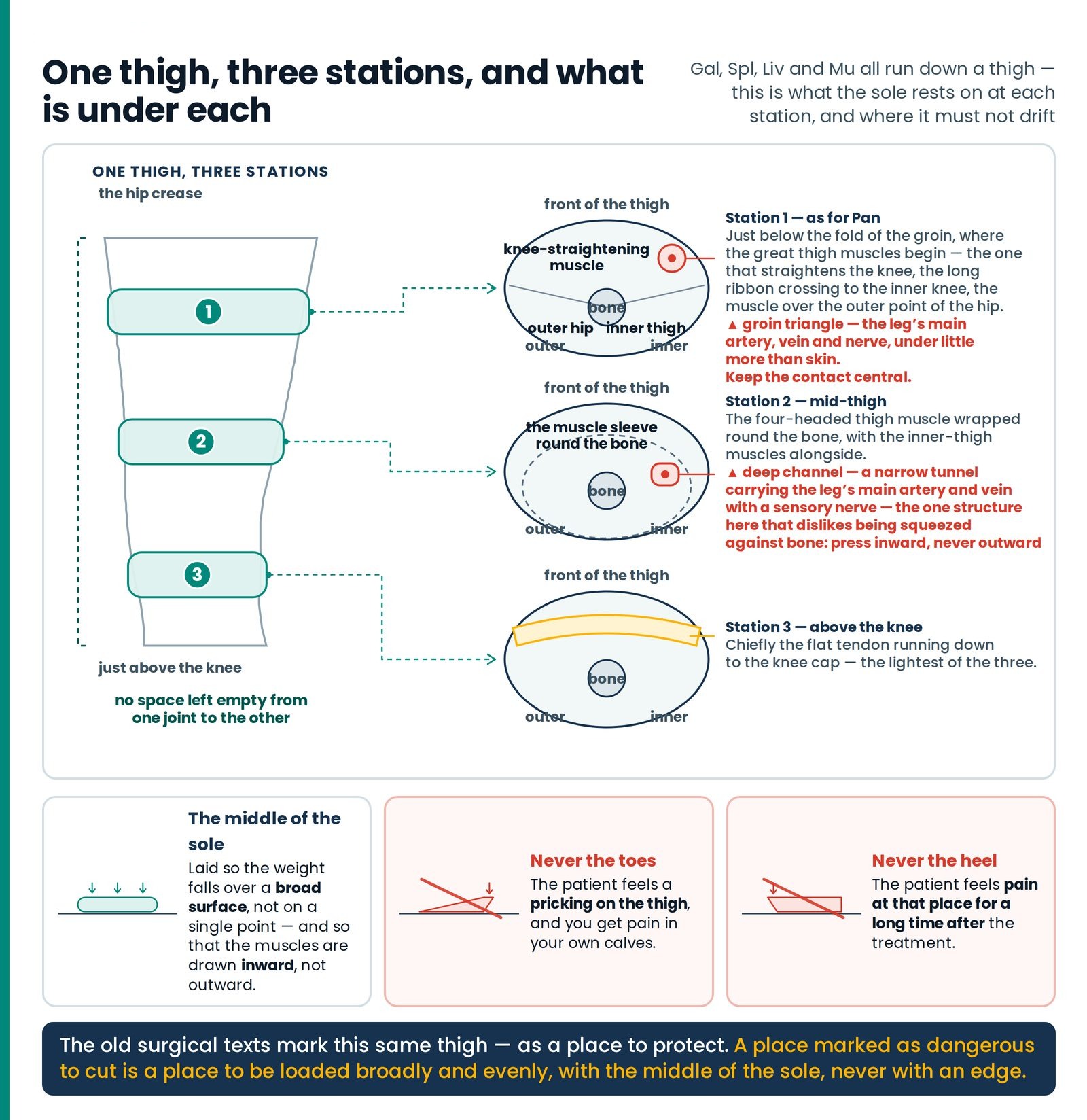
What lies beneath. Just below the fold of the groin, where the great thigh muscles begin — the one that straightens the knee, the long ribbon crossing to the inner knee, the muscle over the outer point of the hip — with the hip-flexor tendon passing under them to the thigh bone and the hip joint deep beneath. Drift inward from the middle and you are over the groin triangle, where the leg's main artery, vein and nerve lie under little more than skin: which is why the instruction says the middle of the thigh. The pancreas itself lies far off at the back wall of the belly, behind the stomach; nothing in a thigh reaches it. What the point is named for is the sore place under the breastbone by which pancreatic trouble announces itself.
Gal — the gall bladder point
Standing straight, with your right foot on the patient's left thigh, using the soft middle part of the sole, give pressure without stopping at three (or four) places, running from below the waist joint down to just before the knee joint. At each place press for six seconds and release. Doing this from the waist down to the knee is called (1) Gal.
If more than (1) Gal is to be given, then without stopping repeat from waist to knee as many times as the number written.
| Patient's position | Supine, one pillow under both thighs; the therapist standing straight, the other foot lifted clear of the ground, knee not bent Supine |
|---|---|
| Where the feet are placed | Therapist's right sole on the patient's left thigh; three (or four) stations from just below the hip joint to just above the knee Left |
| Duration and repetitions | 6 seconds at each station, moving down without stopping; one hip-to-knee pass = (1) Gal; the pass repeated as many times as the number written 6 sec |
| What it is for | The pain below the ribs on the right side of the chest, which is found in gall bladder disease and in all bile-related diseases |
Choosing the station from the ring. The entry carries its own note — the ring rule in working clothes: if there is pain at the number one place in Gal, it will be relieved by the treatment near the waist on the left thigh; whereas to relieve pain at the number three place of Gal, one must treat near the knee of the same thigh.
What lies beneath. Station one is as for Pan. Station two, mid-thigh, is the four-headed thigh muscle wrapped round the bone with the inner-thigh muscles alongside; deep and inward runs a narrow tunnel carrying the leg's main artery and vein with a sensory nerve — the one structure here that genuinely dislikes being squeezed against bone, and the reason the contact is broad, flat and central. Station three, above the knee, is chiefly the flat tendon running to the knee cap. The gall bladder itself is a small pear tucked under the liver on the right, where the rib margin crosses. (Figure 16.3)
(1) point Gal × 6 treatments
As in the left-hand picture, press on the number one point of the thigh for six seconds and release; then, after stopping for one minute, press on the number two point in the middle of the thigh for six seconds and release; then, after one minute, press on the number three point of the thigh for six seconds and release; then, after one minute, repeat this whole process again. That is, altogether it is to be done six times.
| Patient's position | As for Gal Supine |
|---|---|
| Where the feet are placed | The same three stations on the patient's left thigh, taken one at a time Left |
| Duration and repetitions | 6 s at station 1 → 1 minute → 6 s at station 2 → 1 minute → 6 s at station 3 → 1 minute → the whole process once more. Six times in all 6 sec × 3 |
| What it is for | As for Gal |
Set the two side by side and you have the clearest illustration of what the word point does as a modifier. Gal is a continuous descent counting as one; (1) point Gal × 6 treatments is the same three stations given as six separate events a minute apart. (2) Gal would deliver those same six applications too — and run them straight through without a pause. The spacing is the treatment, which is why the minute cannot be spent tidying the sheet or answering a question.
Spl — the spleen point
Do exactly as for Gal above, but give the pressure with the sole of your left foot on their right thigh. At every place press for six seconds and release. Completing this from the waist down to the right knee is called (1) Spl. Repeat from waist to knee as many times as the number written, pressing six seconds and releasing at each place.
| Patient's position | Supine, one pillow under both thighs; therapist standing straight, other foot lifted clear, knee not bent Supine |
|---|---|
| Where the feet are placed | Therapist's left sole on the patient's right thigh; three (or four) stations from below the hip to just above the knee Right |
| Duration and repetitions | 6 seconds at each station; a full hip-to-knee pass = (1) Spl; repeated as written 6 sec |
| What it is for | The pain below the ribs on the left side of the chest, which is found in blood disorders and in diseases of the spleen |
The stance for both. Gal and Spl share a stance of their own — the one place in the supine atlas where the therapist deliberately puts all of himself onto the patient: do not bend your knee; give the pressure with the middle part of your sole; lift the other foot clear of the ground and stand straight, so that your full weight comes onto the patient. And: if the patient's legs stay straight, better results come — but if the patient straightens their own legs the muscles stay tight and they will be uncomfortable, so place a pillow on the outer side of the legs for support to stop them rolling outward.
What lies beneath. The mirror of Gal — thigh muscle front and inner, the deep tunnel with the leg's main vessels at mid-thigh, the flat tendon above the knee. The spleen itself sits high on the left, behind the ninth to eleventh ribs and under the dome of the diaphragm, and in health cannot be felt at all: a spleen you can feel below the ribs is an enlarged one.
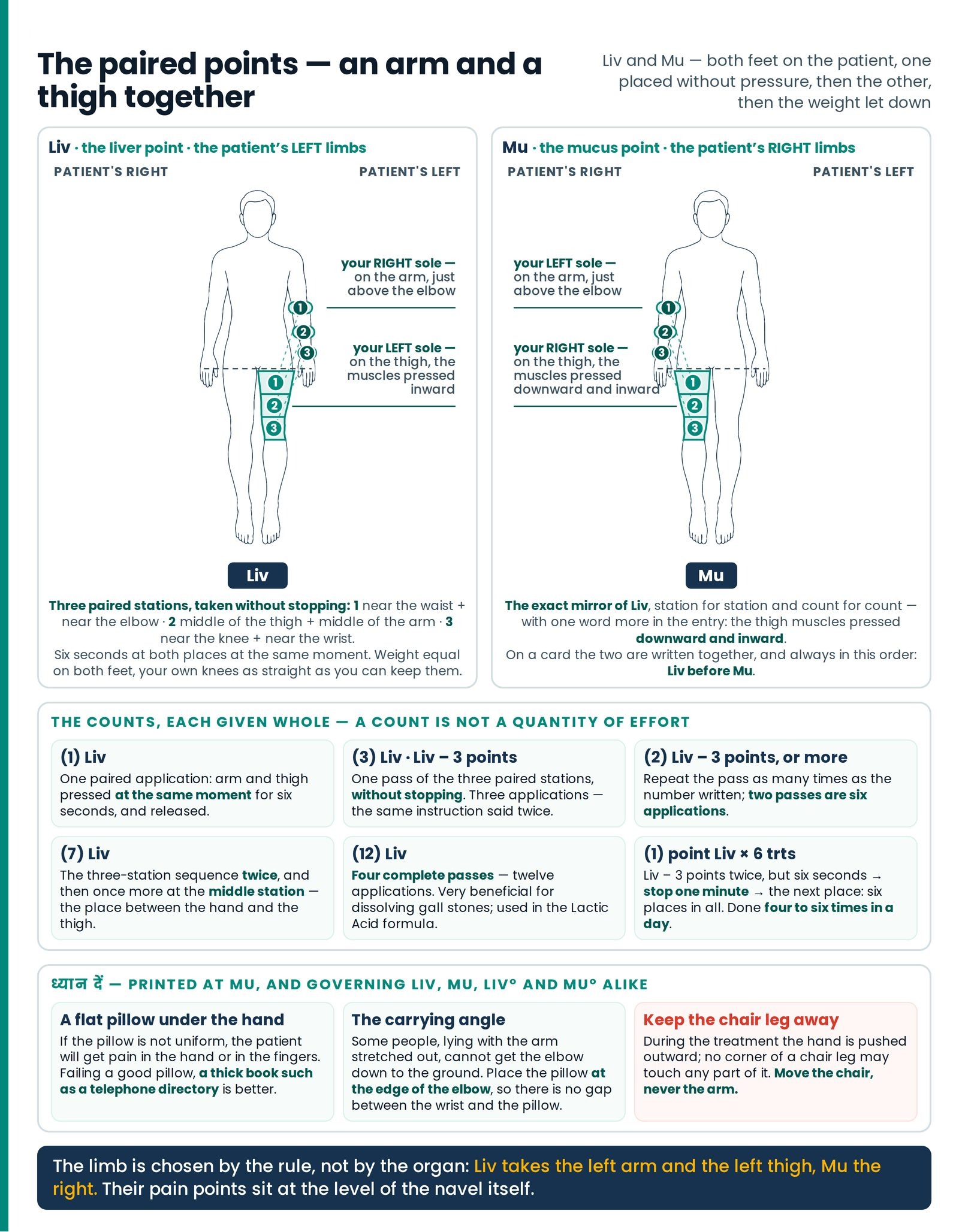
The paired points — an arm and a thigh together
Liv on the left limbs, Mu on the right — both places at the same moment
Liv — the liver point
Taking the support of the chairs, place the sole of your right foot on their left hand near the elbow, and the sole of your left foot on their left thigh, so laid that the thigh muscles are pressed inward. Press and release at both places together for six seconds. This is (1) Liv. If a greater number is written, then keep changing the place according to the stations set out below.
Keep the weight equal on both feet, and as far as possible try to keep your own knees straight, so that you will not tire.
| Patient's position | Supine; a pillow under both thighs and a flat pillow under the treated hand; the therapist astride at hip level, supported on both chairs, weight divided between two treating feet Supine |
|---|---|
| Where the feet are placed | Right sole on the patient's left arm just above the elbow; left sole on the patient's left thigh, the muscles pressed inward — one foot placed without pressure, then the other, then the weight let down Left Both sides |
| Duration and repetitions | 6 seconds at both sites at the same moment, released = (1) Liv; for higher counts, move through the stations below 6 sec |
| What it is for | The liver — the stated indication is given under (1) point Liv × 6 treatments below |
What lies beneath — the arm contact. The most nerve-dense square inch in this article, and it decides how the foot is laid. At the front of the elbow is a shallow hollow, and under the skin lie the tendon of the big arm muscle, the main artery of the arm and the median nerve, barely covered; behind the inner knob — the "funny bone" — the ulnar nerve runs in a bony groove with almost nothing over it. At mid-arm the big muscle lies in front and the triceps behind, artery and nerves together down the inner side. At the wrist it is nearly all tendon, the pulse artery on the thumb side and the median nerve dipping into its tunnel. (Figure 16.4)
The thigh contact is as for Gal and Spl, and for the same reason the instruction says pressed inward: a muscle belly sits in a tough sleeve that already packs it toward the bone, so press along that packing and it takes the load as it is built to. The liver itself fills the right upper belly under the dome of the diaphragm, behind the seventh to eleventh ribs; when its covering is stretched it gives a dull heavy ache under the right ribs, felt at the tip of the right shoulder if the diaphragm above is irritated.
Liv – 3 points — that is, (3) Liv — (1) Liv-3 वाला
In this, without stopping, it is to be done at three places: first near the waist and near the elbow; then on the middle of the arm and the middle of the thigh; and finally near the wrist and near the knee. At each place press for six seconds and release.
| Patient's position | As for Liv Supine |
|---|---|
| Where the feet are placed | Three paired stations, upper limb and lower limb together: (1) near the waist + near the elbow · (2) middle of the arm + middle of the thigh · (3) near the wrist + near the knee Left Both sides |
| Duration and repetitions | 6 seconds at each paired station, taken without stopping; one pass = (1) Liv – 3 points = (3) Liv 6 sec |
| What it is for | As for Liv |
Each application counts as one Liv, which is why one pass of three stations is written both ways: (1) Liv – 3 points and (3) Liv are the same instruction said twice. Reading Liv – 3 points as "give Liv three times in one place" is named in The Shorthand, "The Shorthand" as the commonest misreading in the wiki.
The higher counts, each given whole:
(2) Liv – 3 points, or more. Repeat the pass as many times as the number written; two passes are six applications.
(7) Liv. Give the Liv – 3 points sequence twice, and at the end give once more at the place between the hand and the thigh — that is, the middle station. Six applications, then a seventh at station two. Not "seven presses anywhere"; the entry names where the odd one goes.
(12) Liv. Four complete passes of Liv – 3 points — twelve applications. It is the highest single count the atlas gives for this point, and it has a use of its own: it is very beneficial for dissolving gall stones, of which the therapy's own note says, with the hedge left standing, perhaps it works something like cholic acid; and it is used in the Lactic Acid formula. The full account of what each count is for belongs to Each Point in Use, "Each Point in Use"; the formula belongs to Water and Salt, "Water and Salt".
Why a count is not a quantity of effort
At a chemical point the number in brackets is a dose, and different numbers of the same point have been found to produce different effects — from which it is understood that they make different chemicals. So take care that the pressure is exactly six seconds and is given exactly as many times as is written; let there be no mistake in the count. Otherwise either the effect we want will not occur, or, in some rare cases, the opposite effect may occur. 6 sec ▲ Take care
(3) Liv, (7) Liv and (12) Liv are three treatments, not three sizes of one — and a therapist who gives ten because he lost count at seven has not given a slightly stronger (7) Liv.
(1) point Liv × 6 treatments
It is to be done like (1) Liv – 3 points, twice. But at each place give the pressure for six seconds, then stop for one minute, and then give the pressure at the next place. Two such rounds — that is, altogether at six places.
Doing this four to six times in a day is useful in everything from malaria and typhoid to every major illness.
| Patient's position | As for Liv Supine |
|---|---|
| Where the feet are placed | The same six paired stations of two three-station rounds Left Both sides |
| Duration and repetitions | 6 s at a place → stop for one minute → 6 s at the next → through six places. Done four to six times in a day 6 sec × 3 |
| What it is for | "Everything from malaria and typhoid to every major illness" |
Two things deserve saying out loud. The frequency: four to six times in a day is far the highest dose in this article, and the clearest case in the supine atlas of a treatment meant to be taught to the household and given at home between visits.
Mu — the mucus point
Mu is the code for mucus — the membrane lining the whole digestive tract.
Place the sole of your left foot on their right hand near the elbow, and the sole of your right foot on their right thigh, in such a way that the thigh muscles are pressed downward and inward. Now press at both places together for six seconds and release. This is (1) Mu. If a greater number is written, then go on changing the place according to the stations below.
| Patient's position | Supine; pillow under both thighs, flat pillow under the treated hand Supine |
|---|---|
| Where the feet are placed | Left sole on the patient's right hand near the elbow; right sole on the patient's right thigh, the muscles pressed downward and inward Right Both sides |
| Duration and repetitions | 6 seconds at both places together, released = (1) Mu; higher counts move through the stations below 6 sec |
| What it is for | The Mu point — mucus, the membrane of the digestive tract |
Mu is the exact mirror of Liv: Liv takes the left arm and the left thigh, Mu the right arm and the right thigh. Stance and count are the same, with one word more in the Mu instruction — downward and inward — which is kept because it is what the entry says. The two are almost always written next to one another on a card, and always in that order: Liv before Mu. That is not habit but the rule of order — right follows left, the organs on the right of the navel before those on the left, because that is the direction the intestine's own wave travels. Reverse it and you have given a different formula.
Mu – 3 points — that is, (3) Mu — (1) Mu-3 वाला
It is to be given simultaneously on the right hand and the right thigh at three places. First on the thigh near the waist and on the arm near the elbow; then on the middle of the arm and the middle of the thigh; and last near the wrist and near the knee. At each place press for six seconds and release.
| Patient's position | As for Mu Supine |
|---|---|
| Where the feet are placed | Three paired stations: (1) thigh near the waist + arm near the elbow · (2) middle of the arm + middle of the thigh · (3) near the wrist + near the knee Right Both sides |
| Duration and repetitions | 6 seconds at each, in order; one pass = (1) Mu – 3 points = (3) Mu 6 sec |
| What it is for | As for Mu |
The higher counts. If (2) Mu – 3 points or more is to be given, repeat as many times as the number written. If (7) Mu is to be given, then give (1) Mu – 3 points twice, and at the end give once at the place between the hand and the thigh — that is, the middle station.
What lies beneath. Identical to Liv, on the other side. The kidneys, which Mu° will be named for shortly, lie at the back, tucked behind the last ribs in a packing of fat; nothing on the front of an arm or a thigh comes near them.
The two gas points
Gas Only on both thighs, Gas 'I' on both calves — six places at least
(1) Gas Only – 6 points — (1) Gas only – 6 वाला
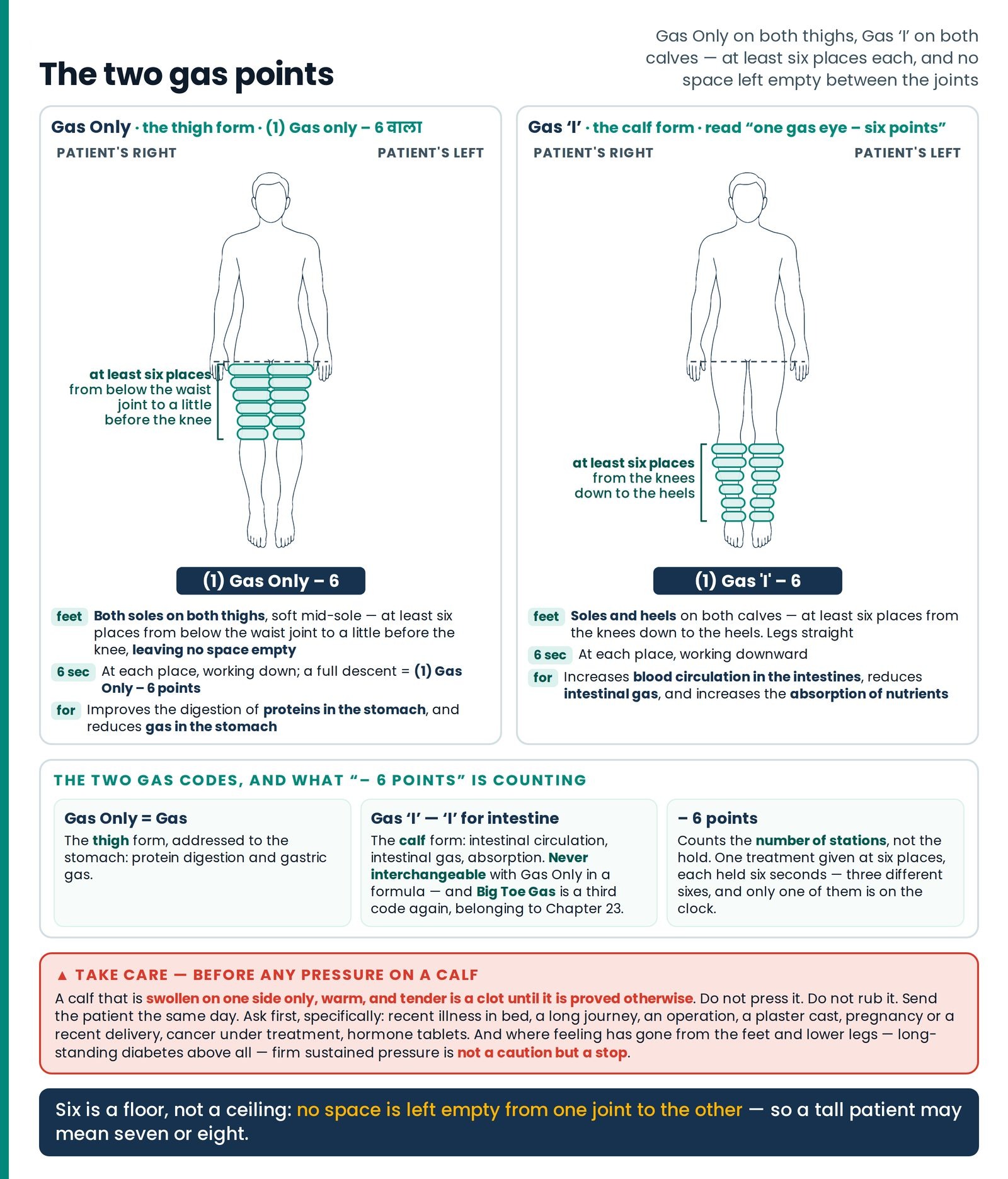
With the soft middle part of the sole, press and release on both thighs, from below the joint at the waist down to a little before the knee. Pressure is to be given at at least six places; at each place press for six seconds and release.
| Patient's position | Supine, one pillow under both thighs Supine |
|---|---|
| Where the feet are placed | Both soles on both thighs, soft mid-sole; at least six places from below the waist joint to a little before the knee, leaving no space empty Both sides |
| Duration and repetitions | 6 seconds at each place, working down; a full descent = (1) Gas Only – 6 points 6 sec |
| What it is for | Improves the digestion of proteins in the stomach, and reduces gas in the stomach |
Notice what has changed from Gal and Spl: both thighs together, not one, and at least six stations, not three. Six is a floor, not a ceiling — no space is left empty between the joints, so a tall patient may mean seven or eight. (Figure 16.5)
(1) Gas 'I' – 6 points — (1) Gas 'I' – 6 वाला
Read this aloud as "one gas eye – six points". The 'I' indicates the intestine.
With your soles and heels, on both the patient's calves, from the knees down to the heels, give pressure at at least six places. At each place press for six seconds and release.
| Patient's position | Supine, legs straight Supine |
|---|---|
| Where the feet are placed | Soles and heels on both calves, at least six places from the knees down to the heels Both sides |
| Duration and repetitions | 6 seconds at each place, working downward 6 sec |
| What it is for | Increases blood circulation in the intestines, reduces intestinal gas, and increases the absorption of nutrients |
This is one of the few entries in the supine atlas that names the heel as part of the contact — soles and heels. That is no licence to substitute the heel for the mid-sole elsewhere; and where a treatment does name it, the general rule still governs how it is laid: weight over a broad surface, not on a single point.
What lies beneath. The thigh you already know. The calf is the two-headed muscle that bulges when you rise on your toes, over a flatter, deeper muscle beneath; a vein and a nerve run just under the skin down the middle. Deepest of all are the wide, slow-flowing veins inside the calf muscle itself — and those are why this point, alone in the article, needs a look before it is touched.