- Part ofइसका हिस्सा
- Digestive systemपाचन तंत्र
Watchवीडियो देखिए


Fromस्रोत Reading the Reportsथायरॉइड, हीमोग्लोबिन, कैल्शियम, क्रिएटिनिन — कौन-सी रिपोर्ट ट्रीटमेंट बदलती है
Liver values, cholesterol, uric acid and the white cells
The liver reports are read because the liver decides three of the file's other values. If the liver does not work properly, accumulation of cholesterol begins and it settles on the inner walls of the arteries, from which the arteries slowly become narrow and disorders in the heart and kidneys are born — by correcting the function of the liver, this therapy keeps the level of cholesterol correct. And the chief responsibility for the metabolism of uric acid belongs to the liver: if the liver does not work properly, uric acid rises above normal — a chief cause of gout, or of pain in the joints, which makes the sour parhez a thing you will not compromise on (Food as Medicine).
That line is also a reading list: of the whole folder, the pages that most often earn their place speak about those three.
लीवर की वैल्यू, कोलेस्ट्रॉल, यूरिक एसिड और सफ़ेद कण
लीवर की रिपोर्टें इसलिए पढ़ी जाती हैं कि फ़ाइल की तीन और वैल्यू लीवर ही तय करता है। लीवर ठीक से काम न करे तो कोलेस्ट्रॉल जमा होना शुरू हो जाता है और वह खून की नलियों की भीतरी दीवारों पर बैठ जाता है, जिससे नलियाँ धीरे-धीरे सँकरी होती जाती हैं और दिल और किडनी की खराबियाँ जन्म ले लेती हैं — लीवर का काम ठीक करके यह थेरेपी कोलेस्ट्रॉल का लेवल सही रखती है। और यूरिक एसिड के मेटाबोलिज़्म (metabolism) की मुख्य ज़िम्मेदारी भी लीवर की ही है: लीवर ठीक से काम न करे तो यूरिक एसिड नॉर्मल से ऊपर चला जाता है — गाउट का, या जोड़ों के दर्द का एक मुख्य कारण। इसीलिए खट्टे का परहेज़ वह चीज़ है जिस पर आप समझौता नहीं करेंगे (खाना और पानी — क्या, कब और कितना)।
यह वाक्य पढ़ने की सूची भी है: पूरी फ़ाइल में जो पन्ने सबसे ज़्यादा बार अपनी जगह बनाते हैं, वे इन्हीं तीन की बात करते हैं।
इस विकी में यह भी देखिए
Fromस्रोत Each Point in Useहर पॉइंट: किस बीमारी में देना है और किसमें रोकना है
The liver and the spleen
Table 5 — LIV and SPL
| Point and variant | What it is used for | When it must not be used | Notes |
|---|---|---|---|
| (1) Liv – 3 points / (2) Liv – 3 points | Pain to the right of the navel. To stimulate the liver and the middle part of the ascending colon. To reduce fever and fight infection through the Kupffer cells — excellent for fevers of every kind. To increase appetite and improve fat metabolism. To lower blood cholesterol. To improve circulation and keep blood sugar correct. To clear the scars of burns — from fire or from chemicals — and wounds from a blow. In kidney failure and other chronic diseases, to stimulate erythropoietin so that the red cell count does not fall too low. It may be given in any disease | But if there is cancer in the liver, do not give it ▲ Take care | The widest indication in the atlas and a single hard bar, printed in adjacent lines. |
| (7) Liv | Used in the Heparin, 1,25 DCC and angiotensin #2 formulas | (the liver-cancer bar stands) | |
| (12) Liv | Very beneficial for dissolving gallstones. Perhaps it works something like cholic acid. Also used in the Lactic acid formula | (the liver-cancer bar stands) | The hedge — perhaps — is the therapy's own and is kept. |
| (1) point liver × 6 treatments | Given all day, at one-hour intervals. Beneficial in liver diseases — hepatitis, jaundice, cirrhosis, or fatty infiltration of the liver, fat accumulating in the liver tissue and obstructing its function. In all serious or long-standing diseases — kidney disease, enlarged spleen, enlarged heart. In angina, HIV, AIDS, cancer. In blood clot in the brain. In circulation problems. To increase lung capacity, digestion, weight or immunity. For erythropoietin, for B₁₂ deficiency, and to raise red cells or haemoglobin — especially in pregnant women. Where white cells are raised, where ammonia is raised, where potassium is high or low, or to reduce abnormal protein | (the liver-cancer bar stands) | Six treatments through one day, an hour apart — the count is a timetable, not a number of presses |
| Spl — TF 'Spl', (1) point Spl, (1) Spl, (3) Spl | To stimulate the upper part of the descending colon — for those who have constipation, or pain in the left front part of the chest. To make white cells and antibodies by means of the spleen. To be given in viral fever, septicaemia, HIV and the like. Nowadays also given in inflammation. To be tried on polio patients, to see whether they benefit from it? | In cold, allergy, asthma and the like this does harm — so do not give it to asthma patients. Nowadays it is not given in cancer. It is not given in diabetes or in other autoimmune disorders ▲ Take care | But one myasthenia gravis patient obtained much relief from Spl after a single treatment. One patient, recorded as one patient — and the word nowadays, twice, marking a rule that changed |
Notice the word nowadays. It appears twice in the Spl box — nowadays it is also given in inflammation, nowadays it is not given in cancer — and it is doing something a therapist should respect. It marks a rule that was different before and was changed on evidence. A teaching that prints its own revisions rather than quietly rewriting them is telling you that the atlas is a living record, and that your own careful observations have somewhere to go.
लीवर (liver) और तिल्ली (spleen)
तालिका 5 — LIV और SPL
| पॉइंट और उसका रूप | यह किसलिए है | कब नहीं दिया जाएगा | नोट |
|---|---|---|---|
| (1) Liv – 3 points / (2) Liv – 3 points | नाभि के दाईं तरफ़ का दर्द। लीवर और चढ़ती हुई बड़ी आँत के बीच वाले हिस्से को जगाने के लिए। बुख़ार उतारने के लिए, और कुफ़्फ़र कोशिकाओं (Kupffer cells) के रास्ते इन्फ़ेक्शन से लड़ने के लिए — हर तरह के बुख़ार में बहुत अच्छा। भूख बढ़ाने के लिए और चर्बी के पाचन को सुधारने के लिए। ख़ून का कोलेस्ट्रॉल घटाने के लिए। ख़ून के बहाव को सुधारने और ख़ून की शुगर ठीक रखने के लिए। जलने के निशान मिटाने के लिए — आग से जले हों या रसायन से — और मार से बने घाव भी। किडनी फ़ेल होने और दूसरी पुरानी बीमारियों में, एरिथ्रोपोइटिन (erythropoietin) को जगाने के लिए, ताकि लाल कोशिकाओं की गिनती बहुत नीचे न गिर जाए। यह किसी भी बीमारी में दिया जा सकता है | पर लीवर में कैंसर हो, तो मत दीजिए ▲ सावधानी | पूरे एटलस का सबसे चौड़ा इस्तेमाल, और एक सख़्त रोक — दोनों अगल-बग़ल की लाइनों में छपे हैं। |
| (7) Liv | Heparin, 1,25 DCC और angiotensin #2 फ़ॉर्मूलों में इस्तेमाल होता है | (लीवर के कैंसर वाली रोक लागू है) | |
| (12) Liv | पित्ताशय की पथरी गलाने में बहुत फ़ायदेमंद। शायद यह कुछ-कुछ कोलिक एसिड (cholic acid) की तरह काम करता है। Lactic acid फ़ॉर्मूले में भी इस्तेमाल होता है | (लीवर के कैंसर वाली रोक लागू है) | यह जो शायद लगा है, वह थेरेपी का अपना है और वैसा ही रखा गया है। |
| (1) point liver × 6 treatments | पूरे दिन, एक-एक घंटे के फ़ासले पर दिया जाता है। लीवर की बीमारियों में फ़ायदेमंद — हेपेटाइटिस (hepatitis), पीलिया (jaundice), सिरोसिस (cirrhosis), या लीवर में चर्बी का भर जाना (fatty infiltration), जिसमें चर्बी लीवर के ऊतकों में जमकर उसका काम रोक देती है। हर गंभीर या बरसों पुरानी बीमारी में — किडनी की बीमारी, तिल्ली का बढ़ जाना, दिल का बढ़ जाना। एंजाइना (angina), HIV, AIDS, कैंसर में। दिमाग़ में ख़ून का थक्का जमने पर। ख़ून के बहाव की गड़बड़ी में। फेफड़ों (lungs) की ताक़त, पाचन, वज़न या इम्यूनिटी बढ़ाने के लिए। एरिथ्रोपोइटिन के लिए, B₁₂ की कमी में, और लाल कोशिकाएँ या हीमोग्लोबिन (haemoglobin) बढ़ाने के लिए — ख़ास तौर पर गर्भवती महिलाओं में। जहाँ सफ़ेद कोशिकाएँ बढ़ी हुई हों, जहाँ अमोनिया (ammonia) बढ़ा हुआ हो, जहाँ पोटैशियम (potassium) ज़्यादा या कम हो, या असामान्य प्रोटीन घटाने के लिए | (लीवर के कैंसर वाली रोक लागू है) | एक ही दिन में छह ट्रीटमेंट, एक-एक घंटे के फ़ासले पर — यह गिनती समय-सारणी है, प्रेशर की संख्या नहीं |
| Spl — TF 'Spl', (1) point Spl, (1) Spl, (3) Spl | उतरती बड़ी आँत के ऊपरी हिस्से को जगाने के लिए — उनके लिए जिन्हें कब्ज़ है, या छाती के बाएँ अगले हिस्से में दर्द है। तिल्ली के रास्ते सफ़ेद कोशिकाएँ और एंटीबॉडी (antibodies) बनवाने के लिए। वायरल बुख़ार, सेप्टिसीमिया, HIV वग़ैरह में दिया जाना है। आजकल सूजन-जलन में भी दिया जाता है। पोलियो के रोगियों पर आज़माकर देखना है कि उन्हें इससे फ़ायदा होता है या नहीं? | ज़ुकाम, एलर्जी, अस्थमा वग़ैरह में यह नुक़सान करता है — इसलिए अस्थमा के रोगियों को मत दीजिए। आजकल यह कैंसर में नहीं दिया जाता। डायबिटीज़ में और दूसरी ऑटो-इम्यून बीमारियों में यह नहीं दिया जाता ▲ सावधानी | पर मायस्थीनिया ग्रेविस (myasthenia gravis) के एक रोगी को एक ही ट्रीटमेंट के बाद Spl से बहुत आराम मिला। एक रोगी, और लिखा भी एक रोगी की तरह ही गया — और वह शब्द आजकल, दो बार, जो बताता है कि एक नियम बदला था |
उस शब्द पर ध्यान दीजिए — आजकल। Spl के ख़ाने में यह दो बार आता है — आजकल यह सूजन-जलन में भी दिया जाता है, आजकल यह कैंसर में नहीं दिया जाता — और यह वह काम कर रहा है, जिसकी क़द्र हर थेरेपिस्ट को करनी चाहिए। यह उस नियम पर लगा निशान है, जो पहले कुछ और था और सबूत देखकर बदला गया। जो पढ़ाई अपने सुधार चुपचाप दोबारा लिखने के बजाय छाप देती है, वह आपसे यही कह रही है कि यह एटलस ज़िंदा रिकॉर्ड है — और आपने ध्यान से जो देखा है, उसके जाने की जगह भी यहीं है।
Fromस्रोत Water and Saltब्लड प्रेशर, किडनी, पथरी, निमोनिया — LSTF, Round Normal, Lactic Acid, Angiotensin
Liver, kidney and lung — how the formula was built
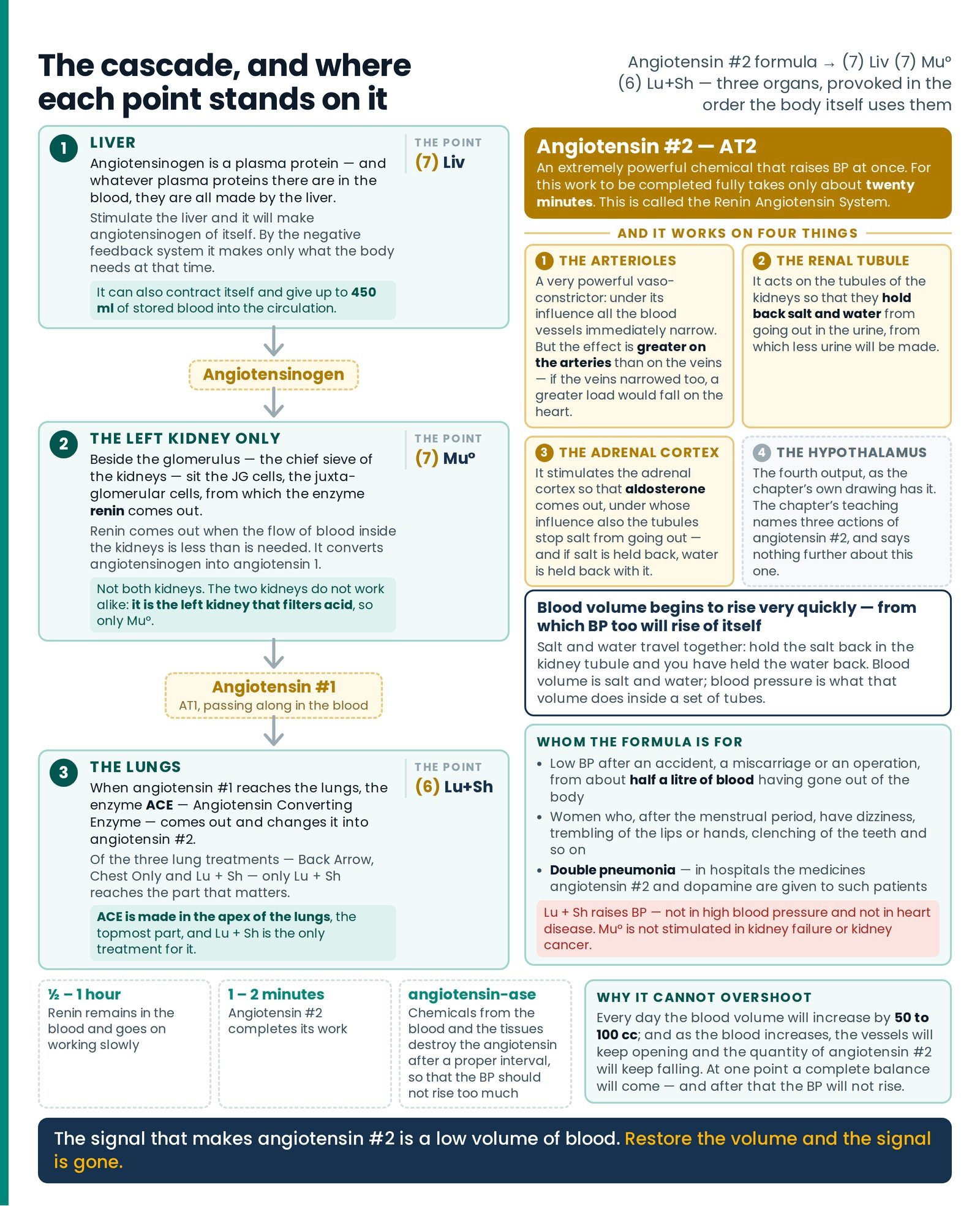
Four questions, four answers, and a formula: (7) Liv (7) Mu° (6) Lu+Sh
If we somehow make angiotensin #2 in the body, the BP will become normal. First we have to make angiotensinogen. Then the kidney and lungs will change it. So how is all this to be done?
Here comes the originality, and it is worth following one bullet at a time, because each answers a question a good student would have raised.
Four questions, four answers, and a formula
Where does angiotensinogen come from? It is written that angiotensinogen is a plasma protein. And whatever plasma proteins there are in the blood, they are all made by the liver. That is: if any plasma protein at all is to be made, we have only to stimulate the liver. It will make angiotensinogen of itself! And after that, the kidney and the lungs have to be stimulated. If we succeed in stimulating these three properly and in order, then we can solve this problem. Not only that — the lungs and the liver have one further quality, that some blood remains stored within them, which both of them can bring into the circulation when there is need. The liver can contract itself and give up to 450 ml of blood to the circulation.
But the liver makes a great many things — when we stimulate it, will it not make all of them? Answer — No, it is not so. In our body there is a negative feedback system, by which every organ of the body comes to know which thing or chemical the body needs at that time, and which it does not. So when we stimulate the liver, it will make only those things which the body needs at that time — among which one will be angiotensinogen. It will not make those things which are already present in the body in sufficient quantity.
Are we to stimulate both kidneys? Answer — No. We are not to stimulate both kidneys. Note that acidosis occurs because of a rise of acid in the body. And in this therapy it has been found that the two kidneys do not work alike. It is the left kidney that filters acid. That is, acidosis diseases come only when the left kidney is not working properly. So we have to stimulate only the left kidney, that is Mu°.
And which lung treatment? For stimulating the lungs there are three treatments — \°/, that is Back Arrow, Chest Only, and Lu + Sh. Which of the three? Answer — ACE is made in the apex of the lungs — that is, the topmost part — and to stimulate this part we have only one treatment: it is Lu + Sh.
Read the second of those four again, because it disposes of the objection most often raised against this whole therapy. The worry is: if you stimulate an organ, will you not get everything that organ makes, wanted or not? The answer offered is the negative feedback system — the body's own arrangement for knowing what it is short of. On that account a stimulation is not an order to manufacture; it is an invitation to a factory that already knows its own order book.
An everyday version: you do not tell the kitchen what to cook. You tell the kitchen the family is home. What comes out is what the family was short of.
Table 11 — Card: the Angiotensin No. 2 formula Supine 6 sec Left Both sides ▲ Take care
| Written | Angiotensin #2 formula → (7) Liv (7) Mu° (6) Lu+Sh |
|---|---|
| What it is for | To raise a suddenly-fallen blood pressure at once and bring it to normal, in the patient from whose body about half a litre of blood or more has gone out |
| Position | Supine throughout Supine |
| Step 1 — (7) Liv | Supine; the therapist's right sole on the patient's left arm above the elbow and the left sole on the left thigh, together — the Liv – 3 points pass given twice and then once more at the middle station, six applications and then a seventh. To make the liver produce angiotensinogen, and to bring as much as 450 ml of stored blood into the circulation 6 sec |
| Step 2 — (7) Mu° | Supine; the left kidney code, single station, hand contact high at the shoulder Left . To provoke the left kidney, so that by renin it makes angiotensin #1. Only the left — it is the left kidney that filters acid |
| Step 3 — (6) Lu+Sh | Supine, from the head end. Station 1: the flats of both palms, very light pressure, on both sides at the collar bone, the place below the shoulder bone — this is for rousing the lungs. Station 2: with the middle part of the palm or the sole, press a little firmly above the shoulder joint and release at once, so that the shoulder is pulled outward — this is for opening the muscles of the chest. These two together make (1) Lu + Sh; repeat them alternately six times. Ordinarily no pillow is needed; if the therapist's foot does not reach the ground, a thin pillow may be placed under the patient's forehead, so that pressure does not fall on the shoulder bone Both sides |
| Why the lung, and why this lung treatment | To provoke the lungs to make ACE, which will convert AT1 into AT2. ACE is made in the apex of the lungs, and Lu + Sh is the only treatment that reaches that part |
| What it inherits | Liv — not in liver cancer. Mu° — do not stimulate it in kidney failure or kidney cancer; those who have pain only at Liv° — do not give it to them. Lu + Sh — this raises BP, so do not give in high blood pressure and in heart disease ▲ Take care |
| Points taught in | Liv and Mu° — The Front of the Body I, "The Front of the Body — I"; Lu + Sh — The Front of the Body II, "The Front of the Body — II"; indications and bars — Each Point in Use |
Table 12 — The three points read against the cascade
| Step | Point | Organ | The step of the cascade it is aimed at |
|---|---|---|---|
| 1 | (7) Liv | Liver | Angiotensinogen — and 450 ml of stored blood into the circulation |
| 2 | (7) Mu° | Left kidney | Renin, which makes angiotensin #1 |
| 3 | (6) Lu+Sh | Lungs | ACE, which converts AT1 into AT2 |
It was seen that immediately after this treatment the shivering of those women stopped and the blood pressure began to rise. Since the formula is based on the facts of the physiology of angiotensin #2 production, its name was fixed as the Angiotensin #2 formula. (Figure 35.4)
लीवर, किडनी और फेफड़ा — फ़ॉर्मूला कैसे बना
चार सवाल, चार जवाब, और एक फ़ॉर्मूला: (7) Liv (7) Mu° (6) Lu+Sh
किसी तरह हम शरीर में एंजियोटेंसिन #2 बनवा दें, तो BP नॉर्मल हो जाएगा। इसके लिए पहले एंजियोटेंसिनोजन बनवाना होगा। फिर किडनी और फेफड़े उसे बदलेंगे। तो यह सब किया कैसे जाए?
यहीं से अपनी सूझ शुरू होती है, और इसे एक-एक बिंदु करके पढ़ना ठीक है, क्योंकि हर बिंदु उस सवाल का जवाब है, जो कोई भी अच्छा विद्यार्थी उठाता।
चार सवाल, चार जवाब, और एक फ़ॉर्मूला
एंजियोटेंसिनोजन आता कहाँ से है? लिखा है कि एंजियोटेंसिनोजन एक प्लाज़्मा प्रोटीन है। और खून में जितने भी प्लाज़्मा प्रोटीन हैं, वे सब लीवर ही बनाता है। यानी कोई भी प्लाज़्मा प्रोटीन बनवाना हो, तो हमें बस लीवर को उकसाना है। एंजियोटेंसिनोजन वह अपने आप बना देगा! उसके बाद किडनी और फेफड़ों को उकसाना है। इन तीनों को ठीक से और क्रम से उकसाने में हम कामयाब हो गए, तो यह मसला हल हो सकता है। इतना ही नहीं — फेफड़ों और लीवर में एक ख़ूबी और है: उनके भीतर कुछ खून जमा रहता है, जिसे ज़रूरत पड़ने पर दोनों खून के दौरे में ला सकते हैं। लीवर ख़ुद को सिकोड़कर 450 ml तक खून दौरे में दे सकता है।
पर लीवर तो बहुत सारी चीज़ें बनाता है — हम उसे उकसाएँगे, तो क्या वह सब की सब नहीं बना देगा? जवाब — नहीं, ऐसा नहीं है। हमारे शरीर में एक नेगेटिव फ़ीडबैक सिस्टम (negative feedback system) है, जिससे शरीर के हर अंग को पता रहता है कि उस वक़्त शरीर को कौन-सी चीज़ या कौन-सा केमिकल चाहिए, और कौन-सा नहीं। सो जब हम लीवर को उकसाते हैं, तो वह सिर्फ़ वही चीज़ें बनाएगा, जिनकी शरीर को उस वक़्त ज़रूरत है — और उनमें एक एंजियोटेंसिनोजन भी होगा। जो चीज़ें शरीर में पहले से काफ़ी मात्रा में मौजूद हैं, उन्हें वह नहीं बनाएगा।
क्या दोनों किडनियों को उकसाना है? जवाब — नहीं। दोनों किडनियों को नहीं उकसाना है। ध्यान रखिए कि एसिडोसिस शरीर में एसिड बढ़ जाने से होता है। और इस थेरेपी में यह पाया गया है कि दोनों किडनियाँ एक जैसा काम नहीं करतीं। एसिड को छानने वाली बाईं किडनी है। यानी एसिडोसिस की बीमारियाँ तभी आती हैं, जब बाईं किडनी ठीक से काम नहीं कर रही होती। इसलिए हमें सिर्फ़ बाईं किडनी, यानी Mu° को उकसाना है।
और फेफड़ों का कौन-सा ट्रीटमेंट? फेफड़ों को उकसाने के लिए तीन ट्रीटमेंट हैं — \°/, यानी Back Arrow, Chest Only, और Lu + Sh। तीनों में से कौन-सा? जवाब — ACE फेफड़ों के एपेक्स (apex) में, यानी सबसे ऊपर वाले हिस्से में बनता है, और इस हिस्से को उकसाने के लिए हमारे पास एक ही ट्रीटमेंट है: वह है Lu + Sh।
उन चार में से दूसरे बिंदु को एक बार फिर पढ़िए, क्योंकि इस पूरी थेरेपी पर जो एतराज़ सबसे ज़्यादा उठता है, उसका निपटारा वही कर देता है। डर यह है: किसी अंग को उकसाएँगे, तो वह अंग जो कुछ बनाता है, वह सब नहीं बनने लगेगा — चाहिए हो या न हो? जवाब में जो रखा गया है, वह है नेगेटिव फ़ीडबैक सिस्टम — शरीर का अपना इंतज़ाम, जिससे उसे पता रहता है कि किस चीज़ की कमी है। इस हिसाब से उकसाना कुछ बनाने का हुक्म नहीं है; यह उस कारख़ाने को बुलावा है, जिसे अपने ऑर्डर की बही पहले से मालूम है।
रोज़ की ज़िंदगी से एक मिसाल: आप रसोई को यह नहीं बताते कि क्या पकाना है। आप रसोई को बस इतना बताते हैं कि घरवाले घर आ गए हैं। जो बनकर निकलता है, वह वही होता है, जिसकी घरवालों को कमी थी।
तालिका 11 — कार्ड: Angiotensin No. 2 फ़ॉर्मूला पीठ के बल 6 सेकंड बायाँ दोनों तरफ़ ▲ सावधानी
| लिखी हुई लाइन | Angiotensin #2 formula → (7) Liv (7) Mu° (6) Lu+Sh |
|---|---|
| यह किसलिए है | जिस रोगी के शरीर से लगभग आधा लीटर या उससे ज़्यादा खून निकल गया हो, उसमें अचानक गिरे हुए ब्लड प्रेशर को फ़ौरन उठाकर नॉर्मल पर लाने के लिए |
| रोगी की स्थिति | पीठ के बल शुरू से आख़िर तक पीठ के बल |
| चरण 1 — (7) Liv | पीठ के बल; थेरेपिस्ट का दायाँ तलवा रोगी की बाईं बाँह पर, कोहनी के ऊपर, और बायाँ तलवा बाईं जाँघ पर, दोनों साथ-साथ — Liv – 3 पॉइंट वाला चक्कर दो बार, और फिर बीच वाले ठिकाने पर एक बार और, छह बार लगाना और फिर सातवाँ। लीवर से एंजियोटेंसिनोजन बनवाने के लिए, और जमा हुआ 450 ml तक खून दौरे में लाने के लिए 6 सेकंड |
| चरण 2 — (7) Mu° | पीठ के बल; बाईं किडनी का कोड, इकलौता ठिकाना, हाथ का छुआव कंधे के पास ऊपर बायाँ । बाईं किडनी को उकसाने के लिए, ताकि वह रेनिन के ज़रिए एंजियोटेंसिन #1 बनाए। सिर्फ़ बायाँ — एसिड को छानने वाली बाईं किडनी ही है |
| चरण 3 — (6) Lu+Sh | पीठ के बल, सिर की तरफ़ से। ठिकाना 1: दोनों हथेलियों का चपटा हिस्सा, बहुत हल्का प्रेशर, दोनों तरफ़ हँसली (collar bone) पर, यानी कंधे की हड्डी के नीचे वाली जगह पर — यह फेफड़ों को जगाने के लिए है। ठिकाना 2: हथेली या तलवे के बीच वाले हिस्से से कंधे के जोड़ के ऊपर ज़रा मज़बूती से प्रेशर देकर तुरंत छोड़िए, इस तरह कि कंधा बाहर की तरफ़ खिंच जाए — यह छाती की मांसपेशियाँ खोलने के लिए है। ये दोनों मिलकर (1) Lu + Sh बनाते हैं; इन्हें बारी-बारी से छह बार दोहराइए। आम तौर पर पिलो की ज़रूरत नहीं पड़ती; थेरेपिस्ट का पैर ज़मीन तक न पहुँचे, तो रोगी के माथे के नीचे एक पतला पिलो लगाया जा सकता है, ताकि प्रेशर कंधे की हड्डी पर न पड़े दोनों तरफ़ |
| फेफड़ा क्यों, और फेफड़ों का यही ट्रीटमेंट क्यों | फेफड़ों को उकसाने के लिए, ताकि वे ACE बनाएँ, जो AT1 को AT2 में बदल देगा। ACE फेफड़ों के एपेक्स में बनता है, और उस हिस्से तक पहुँचने वाला इकलौता ट्रीटमेंट Lu + Sh है |
| इसे विरासत में क्या मिलता है | Liv — लीवर के कैंसर में नहीं। Mu° — किडनी फ़ेल होने या किडनी के कैंसर में इसे मत उकसाइए; जिन्हें सिर्फ़ Liv° पर दर्द है, उन्हें यह मत दीजिए। Lu + Sh — यह BP चढ़ाता है, इसलिए हाई ब्लड प्रेशर में और दिल की बीमारी में मत दीजिए ▲ सावधानी |
| पॉइंट कहाँ सिखाए गए हैं | Liv और Mu° — पीठ के बल — 1: Pan, Gal, Spl, Liv, Mu, Gas, Const, Dys, WD, Liv°, Mu°, "पीठ के बल — 1: Pan, Gal, Spl, Liv, Mu, Gas, Const, Dys, WD, Liv°, Mu°"; Lu + Sh — पीठ के बल — 2: Thrd, Pit, Para, ONS, NNS, CNNS, Lymph और ओवरी पॉइंट, "पीठ के बल — 2: Thrd, Pit, Para, ONS, NNS, CNNS, Lymph और ओवरी पॉइंट"; कौन-सा इस्तेमाल और कौन-सी रोक — हर पॉइंट: किस बीमारी में देना है और किसमें रोकना है |
तालिका 12 — तीनों पॉइंट, लड़ी के सामने रखकर पढ़े हुए
| चरण | पॉइंट | अंग | लड़ी का वह चरण, जिस पर इसका निशाना है |
|---|---|---|---|
| 1 | (7) Liv | लीवर | एंजियोटेंसिनोजन — और जमा हुआ 450 ml खून दौरे में |
| 2 | (7) Mu° | बाईं किडनी | रेनिन, जो बनाता है एंजियोटेंसिन #1 |
| 3 | (6) Lu+Sh | फेफड़े | ACE, जो AT1 को AT2 में बदलता है |
देखा गया कि इस ट्रीटमेंट के फ़ौरन बाद उन महिलाओं की कँपकँपी रुक गई और ब्लड प्रेशर चढ़ने लगा। यह फ़ॉर्मूला एंजियोटेंसिन #2 बनने के शरीर-विज्ञान की सच्चाइयों पर टिका है, इसलिए इसका नाम Angiotensin #2 फ़ॉर्मूला रखा गया। (चित्र 35.4)
Also explained inयहाँ भी समझाया गया है
- Why is heparin made in such large quantity in the lungs and the liver?हेपरिन इतनी बड़ी मात्रा में फेफड़ों और लीवर में ही क्यों बनता है? The River — Heparinलकवा, हार्ट अटैक, ख़ून के थक्के — P. Heparin, A. Heparin, G. Heparin
The liver.
- Liv — the liver pointLiv — लीवर का पॉइंट The Navel Speaks Firstनाभि के दर्द वाले पॉइंट — Pan, Gal, Spl, Liv, Mu, Gas, Const, Dys, WD
The straight belly muscle in its sheath; behind it, in a thin patient, the lower edge of the right lobe of the liver; below and behind, the ascending colon, with small-bowel loops between.
- Liv — the liver pointLiv — लीवर वाला पॉइंट The Front of the Body Iपीठ के बल — 1: Pan, Gal, Spl, Liv, Mu, Gas, Const, Dys, WD, Liv°, Mu°
Patient's position Supine; a pillow under both thighs and a flat pillow under the treated hand; the therapist astride at hip level, supported on both chairs, weight divided between two treating feet Supine Where the fee
- The Vitamin B₁₂ formulaविटामिन B₁₂ फ़ॉर्मूला Vitamin and Gene Formulasख़ून की कमी, थैलेसीमिया, सफ़ेद पानी — Folic acid और Genes फ़ॉर्मूले
And then the last piece, which decided the other two steps of the formula: in the body, in the liver, there remains a stock of Vitamin B₁₂ of only five to six years, and the gall bladder is the godown of the liver where
- The organs of digestion — the key to healthपाचन के अंग — सेहत की चाबी The Body's Own Pharmacyशरीर की अपनी दवा की दुकान — हॉर्मोन, एंज़ाइम और ग्रंथियाँ
Cholesterol and the liver.
- What you are actually pressing overआपका हाथ असल में किस चीज़ के ऊपर प्रेशर दे रहा है The Navel Speaks Firstनाभि के दर्द वाले पॉइंट — Pan, Gal, Spl, Liv, Mu, Gas, Const, Dys, WD
Four fields hold the whole map: the upper field, rib margins to navel — liver, gall bladder, stomach, duodenum, pancreas behind them, spleen far back on the left; the middle field around the navel — small intestine, twen
- Why blood must keep movingखून का चलते रहना क्यों ज़रूरी है The River — Heparinलकवा, हार्ट अटैक, ख़ून के थक्के — P. Heparin, A. Heparin, G. Heparin
Of the heparin made in the body: About 85 per cent is made in cells named mast cells, of the liver and the lungs.
- Where this leadsयह आगे कहाँ ले जाता है The River — Heparinलकवा, हार्ट अटैक, ख़ून के थक्के — P. Heparin, A. Heparin, G. Heparin
Every formula here works by asking an organ to make something — heparin from the mast cells of liver and lung, something plasmin-like from the pancreas, prostaglandins, acetylcholine, calcium out of the bone.
- From a tomato skin to a diseaseटमाटर के छिलके से बीमारी तक The Fire and the Ashगठिया, सोरायसिस, थकान — बिना पचा खाना (UDF) जड़ कैसे बनता है
And the raw material is the same in either case — carbohydrates, proteins and fats, none of which enters the blood as it is, each broken down by the secretions of the mouth, stomach, pancreas, liver and small intestine a
- The investigations that change what you doवे जाँचें जो आपका काम बदल देती हैं Reading the Reportsथायरॉइड, हीमोग्लोबिन, कैल्शियम, क्रिएटिनिन — कौन-सी रिपोर्ट ट्रीटमेंट बदलती है
hyroid, haemoglobin, sugar, calcium, B₁₂, kidney and liver reports Learn the right-hand column; the rest of this section is explanation.
- Opening the door the bile comes through — the Vater treatmentपित्त जिस दरवाज़े से आता है, उसे खोलना — Vater ट्रीटमेंट Setting the Stomachअपच, गैस, एसिडिटी — Normal, Fast, Ajay, NAN, FAN और Ulta Normal
So, after much thought, an inference was drawn: if there is some blockage in the road by which the bile comes — in the ampoulla of Vater — then the bile will begin to congeal in the gall bladder itself, and its effect wi
- How 1,25 DCC is made in the bodyशरीर में 1,25 DCC बनता कैसे है Correcting the Two Kingdomsडायबिटीज़, ऑस्टियोपोरोसिस, थायरॉइड, पार्किंसन — ATF, ALTF और 1,25 DCC
The pathway walked in the order the body runs it — sun on the skin, liver, parathyroid, the two kidneys — with the point of the formula aimed at each step printed beneath it, then the two organs the finished hormone acts
- Snakebiteसाँप का काटा Fire and Swellingसूजन, इन्फ़ेक्शन, चोट और पोलियो — Adr, ITF और थायरॉइड ऐस्टरिस्क
Our own body has a chemical that does an antiseptic's work: bile — which the liver makes and the gall bladder stores.
- The body is a factory, and the factory has a pharmacyशरीर एक कारख़ाना है, और इस कारख़ाने की अपनी दवा की दुकान भी है The Body's Own Pharmacyशरीर की अपनी दवा की दुकान — हॉर्मोन, एंज़ाइम और ग्रंथियाँ
DID YOU KNOW? The chemical works that sits under your right ribs The liver is not one factory but several hundred.