Watch



The schoolchild and the bus
Move breakfast fifteen minutes and the rest of the rule keeps itself
Children who run for the bus, and adults who run for the office
School and college children often have to run immediately after breakfast to catch a bus.
If from a young age they are trained to eat breakfast a little earlier, to do after breakfast whatever small tasks can be done sitting, and after sitting a while to set out comfortably for school, they can be saved from many diseases of childhood.
Likewise, if this instruction is kept in mind while going to the office, health will not deteriorate quickly.
This is the only rule in the article addressed to a household rather than to a person, and it is the one that changes most lives per minute of your time. A family that moves breakfast fifteen minutes earlier has, without a single further instruction, kept the twenty-minute rule, kept the schoolbag from being packed over a plate, and handed a child a habit that will outlive everybody in the room.
Ask the question that gets the answer: not "does he eat breakfast?" — he does — but "what happens between the last mouthful and the front door?" The reply is always the same shape and always useful: he eats at 7.35, the shoes are being tied at 7.38, and he runs the last hundred metres to the stop. Fifteen minutes earlier is a negotiation with a kitchen and a mother, not with a child, and it is usually winnable.
Note what the rule asks for in the middle — whatever small tasks can be done sitting. Even in a hurried morning the instruction is not to sit doing nothing for twenty minutes, which no schoolboy alive will do; it is to put the sitting tasks after the meal and the standing ones before it. Shoes and bag first, then eat, then the sitting things — that is a household rearranging itself rather than obeying a rule.
Chew well, and what chewing is held to do
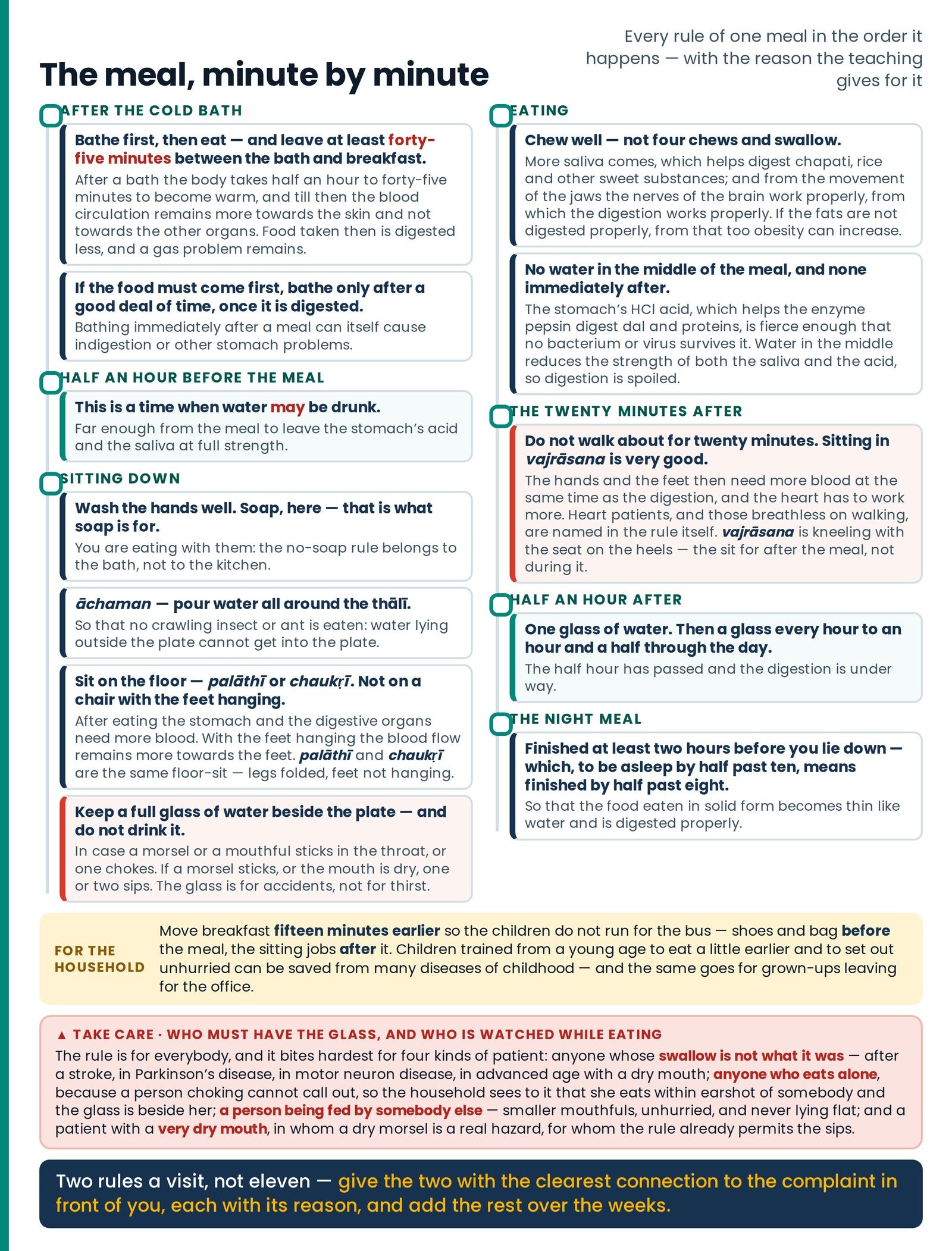
Food should be eaten chewing it well, so that saliva comes out in greater quantity — which helps in digesting chapati, rice and other sweet substances.
And from the movement of the jaws the nerves of the brain will work properly, from which the digestive system will work properly and the food will be digested properly.
If the fats in the food are not digested properly, from that too obesity can increase.
Three separate claims sit in that rule, and each has its own use across the mat.
Saliva on the starches. The first is the one a patient can prove on herself before the week is out, and you should tell her how. Take a plain piece of chapati with nothing on it and chew it thirty times without swallowing. It turns sweet in your mouth. That is the work being described — something in the saliva going to work on the starch of the wheat while it is still in the mouth. A rule a person has verified with her own tongue is a rule she keeps.
The jaws and the nerves. The second claim links the working of the jaw to the working of the nerves of the brain and so back to the digestive system. Give it as it is given. It is the reason the rule asks for chewing well rather than merely eating slowly — the movement itself is part of what is being asked for, not just the time it takes.
The fats and the weight. The third is stated as it stands: if the fats in the food are not digested properly, from that too obesity can increase. Note the word too — it is one contributor named among others, not a complete account of why a person is heavy, and it should not be given to a patient as though it were. A great many heavy patients have been told a great many simple things about why they are heavy, most of them unkind.
More of this article is about water than about food, and that is not an accident of arrangement. Water is the one thing in the household that costs nothing, that everybody already has, and that most people take far too little of without ever once suspecting it of anything.
Teach it in four parts, and in this order: when it may not be drunk · how much is asked for · how it is drunk · and the waters that are refused.
When water may not be drunk
Half an hour before, half an hour after — the acid does the work
Not in the middle of the meal, and not immediately after
Do not drink water in the middle of a meal or immediately after it. It is better to drink half an hour before eating, or only half an hour after.
The reason. In the stomach, HCl acid is formed, which helps the enzyme named pepsin to digest dal, proteins and so on properly. This acid should be so strong that no bacterium or virus can remain alive in that fierce acid.
From drinking water in the middle of the meal, the strength of both the saliva and the acid will be reduced — so digestion will be spoiled.
But a glass of water should certainly be kept near at the time of food, because it may be of use whenever a morsel or a mouthful sticks in the throat, or one chokes. If a morsel sticks, or if the mouth is dry, one or two sips of water may be drunk.
Two windows, then, on either side of the meal: half an hour before, and half an hour after. In between, the glass stands there and is not drunk except for the accident it is there for.
The reason given has two limbs and they should be given separately, because they land on different patients. The first limb is about strength — the acid and the saliva are working substances, and the rule holds that watering them down weakens the work. The second limb is the one patients find more striking and remember longer: the acid of a healthy stomach is fierce enough that nothing living gets through it. That is a real and under-appreciated fact about the human body, and it is why the stomach is as much a gate as a bag. A patient who grasps that her stomach acid is part of her defences stops thinking of "acidity" as a purely wicked thing to be neutralised at every opportunity.
How much water in a day
Ten to twelve glasses, given as a rhythm rather than as a total
The day's water, and the diseases of drinking too little
Nature has given man everything, of which water is one, and it is free. But many people drink very little water in the day.
Half an hour after taking food, one glass of water may be drunk; and after that, a glass of water every hour to hour and a half.
Every person should drink at least ten to twelve glasses of water in a day — that is, two or two and a half litres must certainly be drunk.
The reason. From our body a good deal of water goes out through urine, sweat and the breath, which it is necessary to balance.
Because of drinking less water many diseases come — such as constipation, rheumatism, low BP, acidity and so on, which we call the acid diseases. Once the disease has come, less benefit is obtained from drinking more water.
Tea, cold drinks and so on are all made from water only, but the body regards them as food. No other drink can take the place of water.
So an ordinary person should certainly drink one and a half to two litres a day in the form of pure water.
Four things in that teaching are habitually lost, and each of them is a part that does work. (Figure 39.3)
The rhythm, not just the total. The instruction is not drink two litres somehow. It is a pattern through the day: one glass half an hour after the meal, then a glass every hour to an hour and a half. That is what makes the total reachable without anybody gulping, and it is the form to give a patient — a glass on the hour is an instruction a person can actually follow; two and a half litres is a number she will fail at by three in the afternoon.
The figures as they stand. The teaching gives ten to twelve glasses, that is two or two and a half litres, and then closes by asking of an ordinary person one and a half to two litres in the form of pure water. Both figures are the teaching's own and both are given here as they are given. Do not average them into a single tidy number for the patient's benefit. What the two together plainly convey is a range — considerably more than most people drink, and drunk as water and not as something else.
The stated list of diseases. Constipation, rheumatism, low BP, acidity and so on — and the name given them, the acid diseases. This is the point at which the water rule joins the rest of the wiki, because those are the conditions the acid-direction work addresses.
The sentence students skip. Once the disease has come, less benefit is obtained from drinking more water. That is an unusually honest line and it must not be dropped, because it sets the rule's scope. Water is given here chiefly as prevention. A woman with ten years of constipation who is told to drink more water and expects it to fix her has been set up to be disappointed, and her disappointment will be aimed at you. Tell her what the teaching itself says: the water is part of the ground you are standing on, the treatment is what changes the condition.
And the last limb — tea, cold drinks and so on are all made from water only, but the body regards them as food — is the single most useful sentence to carry into an argument, because the argument comes daily. "I drink eight cups of tea, I am drinking plenty." No: the body files that under food. No other drink can take the place of water.