Lemon in a fast, kokum for acidity, and the instruction to test it yourself
The setting is part of the rule — and the patient tries it and sees
Key teaching
The qualification the rule carries with it
In naturopathy they say to drink lemon sharbat during a fast, as a treatment. If you do not fast, but take lemon along with food, then perhaps the pain will increase.
Likewise it is said that kokum is excellent for acidity. But the patient has to try for himself and see whether eating kokum causes joint pain or not.
Every single thing will not have the same effect on every person — this too is not so. This is a matter of experience.
This passage is the most valuable thing here and the most frequently trimmed. Do not trim it.
It says four things in order. One: the same lemon is given as a treatment in one setting — in a fast — and warned against in another, taken along with food. The setting is part of the instruction, exactly as the angle and the order are part of a treatment in of this wiki. Two: the word perhaps is used, and it is used deliberately. Three: for kokum, where the tradition says one thing and this teaching's own principle would say another, the answer given is not an adjudication. It is an instruction to the patient: try for himself and see.Four: the whole is closed with the honest label — this is a matter of experience.
That label has a precise meaning in this teaching and it was established in Between Two Sessions: it marks a rule that rests on observation rather than on a named mechanism. Preserve it wherever it appears. A therapist who can say "this one is a matter of experience, and this one is about the acid in your stomach" is a therapist who is believed about the second, because he has shown he can tell the two apart.
And note what the instruction to test actually gives you clinically: a method. Take one item. Remove it for two weeks. Put it back for a week. Ask the patient — not did it help? but what were your mornings like in the second week compared with the fourth? Then move to the next item. That is slower than handing over a list, and it is the only version of this rule that survives contact with a real household. It also respects the last sentence, which says in plain words that people differ.
The last rule of the day's eating is a rule about a clock, and the clock half of it was given in Between Two Sessions among the rules of the bed, where it decides whether a household can be asleep by half past ten at all. What belongs here is the other half: what the two hours are for, and how a kitchen is actually moved.
Key teaching
Two hours between the night meal and lying down
The night meal should be taken by such a time that there is a gap of at least two hours between eating and the time of sleeping — so that the food which has been eaten in solid form becomes thin like water and is digested properly.
The reason is worth giving to a patient in exactly its own words, because it is a picture rather than an abstraction: the food goes in solid and has to become thin like water. That takes a definite stretch of time, and it happens whether you are awake or not, but it happens best in a body that is upright and quiet rather than one that is lying down.
The rule is easy to state and very hard to keep, and the reason it is hard is never medical. It is that the meal waits for whoever comes home last. In a house where the husband reaches home at nine, dinner is at half past nine and the whole family's night is built around that; the woman of the house eats last of all, at ten, and is asked by her therapist to be asleep by half past. That cannot be done, and telling her again will not make it possible.
So the negotiation is with the kitchen, and it is a negotiation, not an instruction. Three moves work more often than any others:
Ask for four nights, not seven. A household will give you four. Seven it will refuse, and having refused it will stop discussing the matter.
Separate the meals. In many houses the children and the elders can eat at eight without waiting, and often already want to. The person who most needs the early meal is frequently the person who is serving it.
Move what is served, not only when. A lighter night meal is digested in the time that is available, and a household that cannot move the hour can sometimes move the weight.
And say the two rules together, because together they are convincing and separately they are nagging: finish two hours before you lie down, and be asleep by half past ten. Those two produce one arithmetic — the night meal is finished by half past eight — and a patient given one number will go and solve her own household better than any instruction of yours could.
Most of what this wiki has to say about the sick-room table belongs to the two articles that follow this one, because it is about a particular kind of body rather than about eating in general. What belongs here is the general instruction, the one emergency, and a clear statement of where the rest lives.
Diarrhoea
Not plain water: lemon, salt and sugar, sipped slowly — and the dose
This is the single most consequential instruction in the article. It is also the one where the detail does all the work.
Key teaching
In diarrhoea, plain water is not what is given
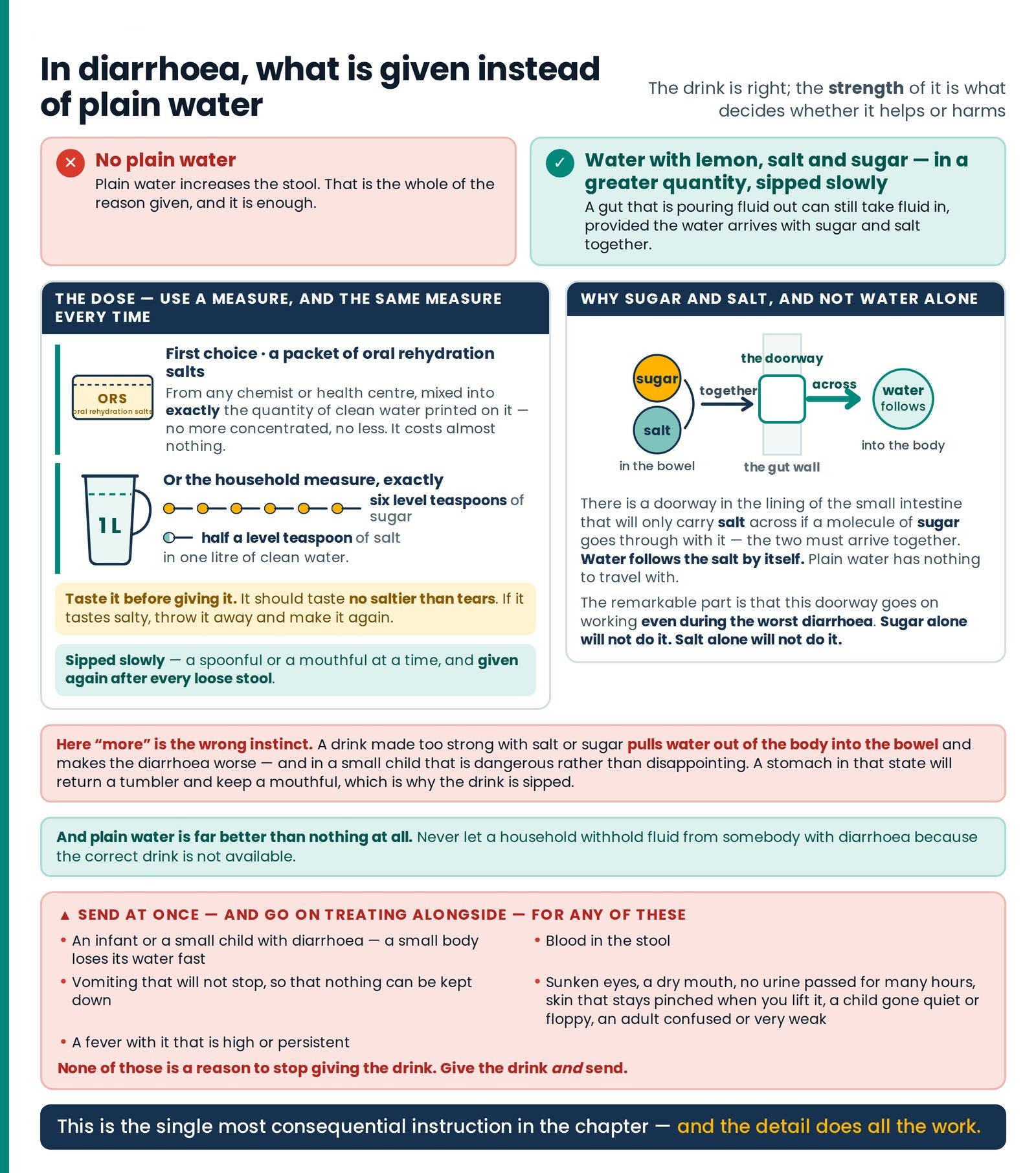
In diarrhoea, no plain water. Water with lemon, salt and sugar in a greater quantity, sipped slowly.
The reason: plain water increases the stool.
The principle here is completely sound and is one of the great discoveries about the human gut: a gut that is pouring fluid out can still take fluid in, provided the water arrives with sugar and salt together. The sugar and the salt are carried across the wall of the intestine hand in hand, and the water follows them. Plain water has nothing to travel with. That is why the drink is made the way it is made, and why it is sipped slowly rather than swallowed — a stomach in that state will return a tumbler and keep a mouthful. (Figure 39.5)
In diarrhoea, what is given instead of plain water. The drink, drawn to its measure — the rehydration packet mixed to the volume printed on it, or six level teaspoons of sugar and half a level teaspoon of salt in one litre — with the doorway sugar and salt go through together, the danger of making it too strong, and the findings that turn a rule into a referral.
What is said about food and the organs during a fever
The liver and the gall bladder are spoiled; no diet rule is attached
One further statement about illness belongs on these pages, and it is a statement about the organs of digestion rather than about the plate.
Key teaching
The liver and the gall bladder in fever
In fever, or for some days after the fever comes, the liver and the gall bladder remain spoiled, or cannot work properly.
That is the whole of what is said. No rule of diet is attached to it here, and none is to be invented and put into the patient's mouth as though it had been.
What is attached to it in the teaching is a rule about conduct during and after a fever, which belongs with the subjects of the next article and is taught there whole.
A student will want to extend it, because the extension is obvious and every grandmother in India has already made it. Resist the temptation to put words into the teaching. What you may honestly do is two things. You may say the statement itself to the patient, because it explains, better than anything else you could offer, why appetite disappears in a fever and why it takes a few days to come back after the temperature has gone: the organs that deal with food are not yet back at work. And you may ask about food in convalescence rather than instructing about it — what has he been able to eat since Tuesday, and what has he kept down? — which is a clinical question with a clinical answer.
Read next
The Body's Own Pharmacy The Body's Own Pharmacy — the liver and the gall bladder, and what they do with a meal
Treating Women Treating Women — the rule of conduct during and after a fever, taught there whole
The sick-room table that belongs to the articles ahead
Three instructions named here, and taught whole in Chapters 40 and 41
Three instructions in this material are about food or drink given for a specific condition, and every one of them belongs to the article that owns the body it concerns. They are named here so that no student goes looking for them in the wrong place, and they are not taught here.
The instruction
Where it is taught
Milk for a woman whose menstrual bleeding is heavy — the quantity, the temperature, and the khārak soaked overnight
One rule of drinking sits in that same stretch of the material and is a rule of the glass rather than a rule of the sickbed, so it is given here in the form a therapist needs — and its whole context, the care of a woman after childbirth, is Treating Women's.
Key teaching
The nursing mother's water
Such women should drink water little by little many times in the day, instead of drinking a great deal of water at one time — otherwise the child can get loose motions or pain in the stomach.
For calcium they should drink milk too.
Notice that this is the general water rule of this article, sharpened: everyone is asked for a glass every hour to an hour and a half rather than a jug at a sitting, and for a woman who is feeding a child that pattern is not a preference but an instruction with a stated consequence.
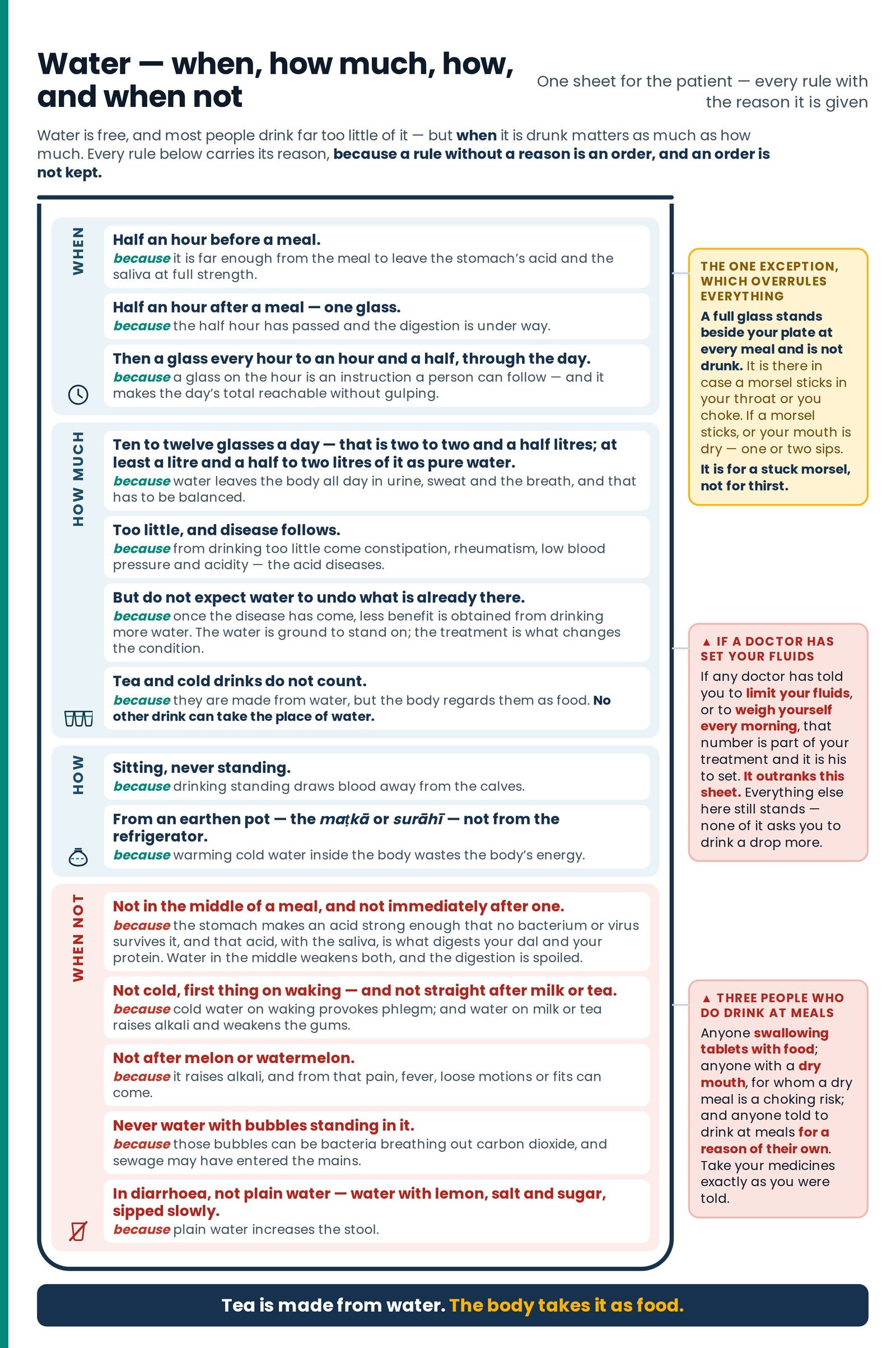
The rules of the plate, like the rules of the day, are a article when they are scattered and a usable thing when they are laid out in the order in which they happen. What follows is the whole of the eating and drinking half of the patient's day, with the reason beside every line, written to be read aloud across the mat — and handed over afterwards, not instead. (Figure 39.6)
Two rules a visit. The sheet is what the patient takes home at the end, when she already knows why.
Table 3 — Your plate and your glass, in the order of a day
When
What to do
Why
On waking
No cold water first thing. Room temperature, or warm.
Cold water on waking provokes phlegm.
Before breakfast
Bathe first, then eat — and leave at least forty-five minutes between a cold bath and breakfast. If you must eat first, then bathe only after a good long while, once the food is digested.
After a bath the body takes half an hour to forty-five minutes to get warm, and until it does, the blood is at the skin and not at the stomach. Food eaten in that time is digested less and leaves gas. And bathing straight after a meal can itself cause indigestion.
Half an hour before the meal
This is a time when water may be drunk.
It is far enough from the meal to leave the stomach's acid at full strength.
Sitting down
Wash the hands well. Soap, here — that is what soap is for.
You are eating with them.
Sit on the floor to eat — palāthī or chaukṛī. Not on a chair with the feet hanging.
After eating, the stomach and the digestive organs need more blood. Sitting with the feet hanging, the blood is pulled down towards the feet and the digestion does not get what it needs.
Keep a full glass of water beside the plate — and do not drink it.
It is there in case a morsel sticks or you choke. If something sticks, or the mouth is dry, one or two sips. That is what it is for.
Eating
Chew well — properly, not four chews and swallow.
More saliva comes, which helps digest chapati and rice. The working of the jaws keeps the nerves of the brain working properly, and from that the digestion works properly.
No water in the middle of the meal, and none immediately after.
The stomach makes an acid strong enough that nothing living survives it, and that acid, with the saliva, is what digests your dal and your protein. Water in the middle weakens both, and the digestion is spoiled.
If there is pain in your body or your joints: no sour things — curd, tamarind, tomato, lemon. And no fruit that is sour before it ripens — orange, sweet lime, apple, mango.
In this therapy we say joint pain often comes from acid increasing in the blood; and in Ayurveda too they say that sour food increases pain.
You may eat with relish the fruits that are bitter or bland before they ripen — banana, chīkū, papaya, custard apple, guava, fig, and *āmlā*.
The test is how the fruit tastes unripe, not how sour it is when ripe. That is why āmlā is allowed.
Eat what is in season and grown near you.
The liver's chemicals change with the season and with the place.
After the meal
Do not walk about for twenty minutes. Sitting in vajrāsana is very good. Heart patients, and anyone who gets breathless walking, must keep this.
Walking or heavy work straight after eating means the hands and feet want blood at the same time as the digestion — and the heart has to do more work to supply both.
Half an hour after the meal
One glass of water. Then a glass every hour to an hour and a half through the day.
The half hour has passed and the digestion is under way.
Through the day
Ten to twelve glasses in the day — two to two and a half litres. At least a litre and a half to two litres of it as plain water.
Water leaves you all day through urine, sweat and the breath, and it has to be balanced. From drinking too little come constipation, rheumatism, low blood pressure and acidity — the acid diseases.
Tea and cold drinks do not count.
They are made from water, but the body takes them as food. No other drink can take the place of water.
Sit down to drink.
Drinking standing draws the blood away from the calves.
Water from an earthen pot, not from the fridge.
Warming cold water inside you wastes the body's own energy.
No water straight after milk or tea.
It raises alkali, and it makes the gums weak.
No water after melon or watermelon.
It raises alkali, and from that can come pain, fever, loose motions or fits.
Never drink water with bubbles standing in it. Boil it, filter it, or leave it.
Those bubbles can be bacteria breathing out their gas, and sewage may have got into the mains.
If there is diarrhoea
Not plain water. Water with lemon, salt and sugar, sipped slowly — a mouthful at a time, and again after every loose motion.
Plain water increases the stool. Sugar and salt together carry the water across into the body. Use a rehydration packet, or six level teaspoons of sugar and half a level teaspoon of salt in one litre — it should taste no saltier than tears.
The evening meal
Finish it at least two hours before you lie down — which, if you are to be asleep by half past ten, means finished by half past eight.
So that food eaten in solid form has time to become thin like water and be digested properly.
For the household
Move breakfast fifteen minutes earlier so the children do not run for the bus. Shoes and bag before the meal; the sitting jobs after it.
Children trained to eat a little earlier, to do the sitting tasks afterwards and to set out unhurried are saved from many of the illnesses of childhood — and the same goes for grown-ups leaving for the office.
Water — when, how much, how, and when not. The patient's sheet: the whole water rule set inside a drinking glass in four zones — when, how much, how, and when not — every line carrying its because, with the glass beside the plate, the doctor's fluid limit and the three people who do drink at meals set outside the glass as exceptions.
Ready to begin?
Send COURSE for course details, or your name, age and health issue for a consultation.