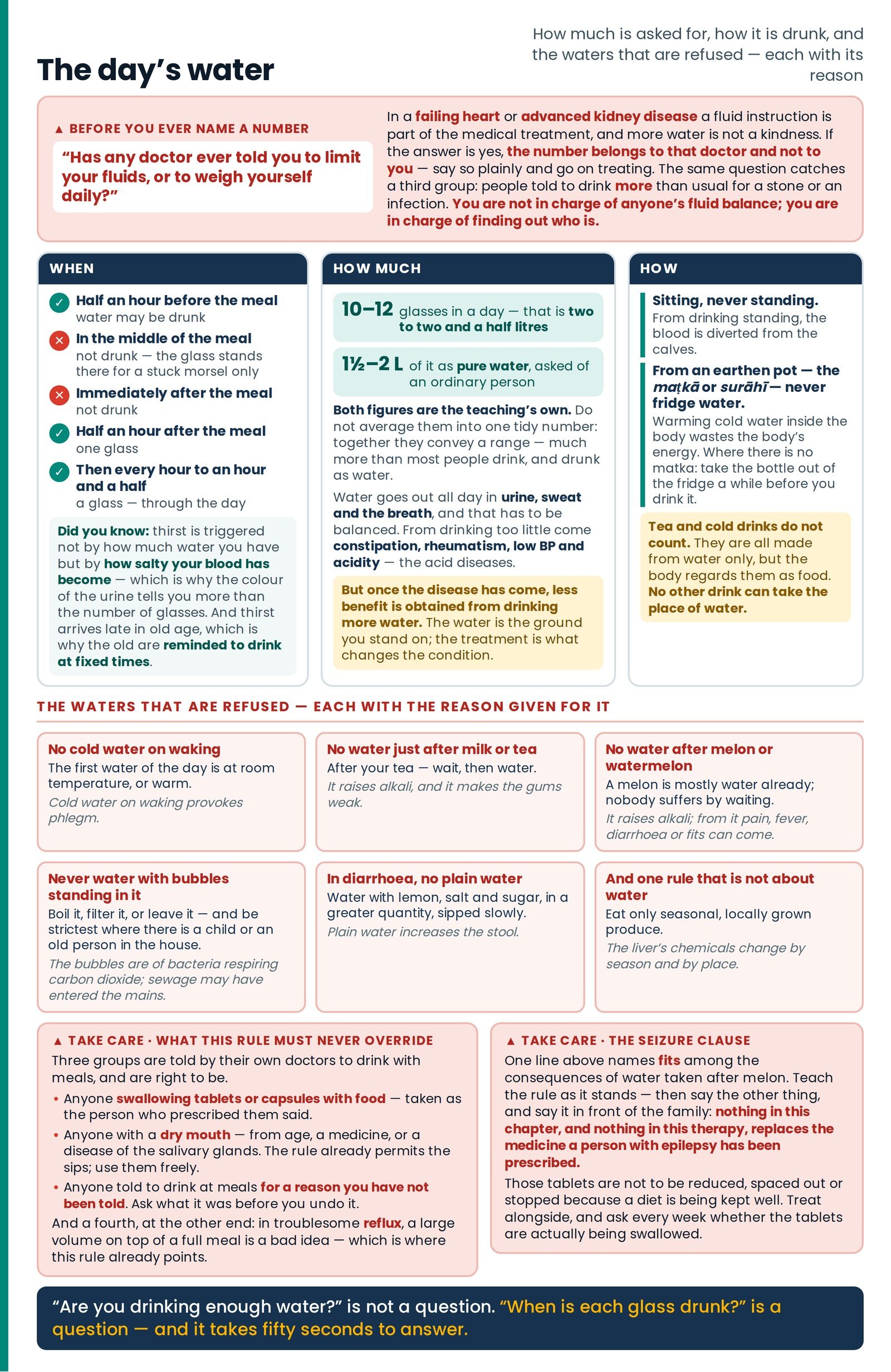
The bubbles are of bacteria respiring carbon dioxide; sewage may have entered the mains.
Seven rules, and they are not of one kind. Two carry a mechanism you can draw on a piece of paper. Three are stated flatly, with their reason inside the sentence and nothing further offered. One is a public-health warning wearing the clothes of a drinking rule. And one — the diarrhoea rule — is the most consequential instruction in this entire article and gets a section of its own below. Take them in turn.
Eat only seasonal, locally grown produce, because the liver's chemicals change by season and by place. This is the same rule that appears at the very start of this wiki from another direction — that even the locale and the diet followed by the people of an area help decide the treatment to be given, and that a knee treatment suited to a patient in Ludhiana may not suit one in Chennai.
No water after melon or watermelon, because it raises alkali; from it pain, fever, diarrhoea or fits can come. Give the rule as it stands. It belongs to the same family of thought as the rule about water after milk or tea — a combination held to be harmful together though each is harmless alone — and it costs a household nothing whatever to keep. A melon is mostly water already; nobody suffers by waiting.
Drink water only sitting, because from drinking standing, the blood is diverted from the calves. Sitting to drink is the same instruction as sitting to eat, arriving in a smaller form, and it has one practical consequence worth naming to an old patient: a person who sits to drink does not swallow a glass of water in four seconds on his way through the kitchen, and a person who sits does not fall.
Water from an earthen pot, never fridge water, because warming cold water inside the body wastes the body's energy. This is a rule with a household solution older than any refrigerator: the matka or surahi keeps water cool without making it cold, by letting a little of it evaporate through the clay. A patient who keeps a matka filled has kept the rule and given herself pleasanter water than the fridge would have. Where there is no matka, the practical form is simply: take the bottle out of the fridge a while before you drink it.
No cold water on waking; no water just after milk or tea, because cold water on waking provokes phlegm; water on milk or tea raises alkali and makes the gums weak. Two rules with two reasons in one line, and both cost nothing. The first is easy to make positive rather than negative, which is always better: the first water of the day is at room temperature or warm. The second is easy to attach to something the patient already does: after your tea, wait — then water.
Do not drink water that has bubbles in it, because the bubbles are of bacteria respiring carbon dioxide; sewage may have entered the mains. The warning underneath this is entirely real and every therapist should carry it: in a great many Indian towns the drinking water pipe and the sewer run in the same trench, and when the supply pressure drops, what is outside the pipe can be drawn into it. That is how cholera and typhoid travel. Teach the warning with the full force it deserves — cloudy water, water that smells, water that arrives after a supply failure, water from a line being dug up in the street — and teach the household what to do about it, which is to boil it, filter it, or treat it, and to be more careful, not less, when there is a child or an old person in the house.
The day’s water. The therapist's plate for the water rule: the question asked before any number is named, the two windows and the day's rhythm, both of the teaching's own figures, the manner of drinking, and the six waters that are refused with the reason given for each.
Now the rule that decides more courses of treatment than any other in this article, and the one that patients argue with hardest. It is also, by some distance, the most carefully constructed teaching on these pages — because it states a law, names its grounds, gives its lists, and then tells the patient to test it on himself.
Key teaching
Sour things, and pain
In Neurotherapy we say that pain in the joints often comes because of acid increasing in the blood. So such people should not eat sour things.
The reason. In Ayurveda too they say that from eating sour things pain increases.
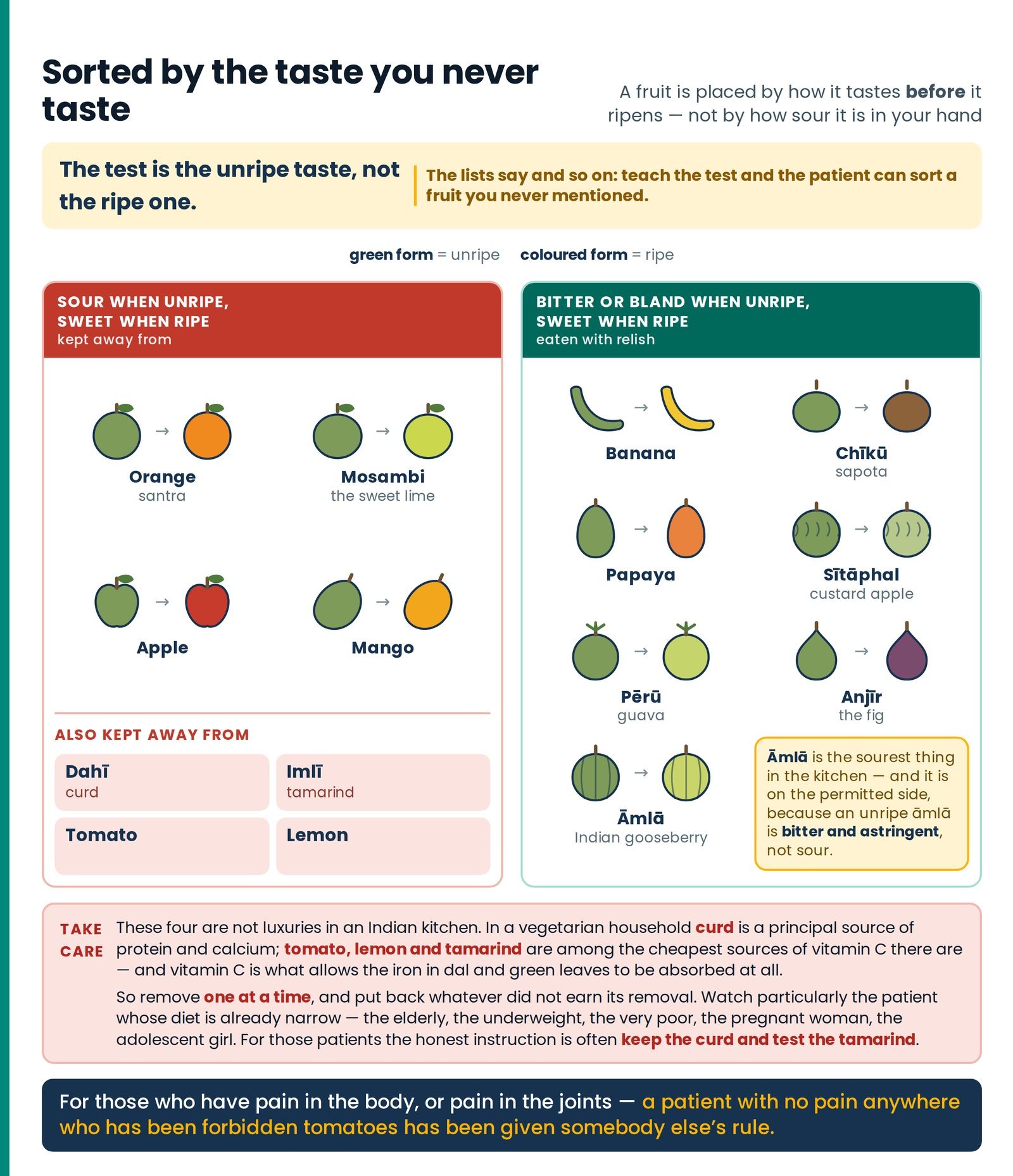
So those who have pain in the body, or joint pains — such people should not eat sour things: such as dahi (curd), tamarind, tomato, lemon and so on.
In the same way, fruits which are sour when unripe and sweet when ripe — such as orange (santra), mosambi or sweet lime, apple, mango and so on — those too should not be eaten.
Fruits which are bitter or bland when unripe but sweet when ripe — such as banana, chīkū, papaya, sītāphal (custard apple), pērū (guava), anjīr (fig), āmlā and so on — those may be eaten with relish.
Read the two fruit sentences again, because the sorting principle in them is not the one anybody expects and every student gets it wrong the first time.
The fruits are not sorted by how sour they taste when you eat them. They are sorted by how they taste before they ripen. (Figure 39.4)
An orange is sweet in the hand in December — and it goes on the forbidden side, because an unripe orange is sour. An apple is not a sour fruit by any ordinary reckoning — and it goes on the forbidden side by the same test. A ripe mango is one of the sweetest things in the world — forbidden, because a raw mango is the sourest thing in an Indian kitchen. And the āmlā, which will make a grown man's eyes water and which every household in India knows as the definition of sour, sits on the permitted side and may be eaten with relish, because an unripe āmlā is bitter and astringent rather than sour.
That is the rule. It is unexpected, it is consistent, it is easy to state, and it is the reason the grandmother in the story at the head of this article gave up the one fruit she was allowed. Teach the test, not the list, and the patient can sort a fruit you have never mentioned.
Note the words and so on in both columns. The lists are examples, not a complete inventory, and the test is what extends them. Note also, and say it out loud to every patient, who the rule is addressed to: those who have pain in the body, or joint pains. It is not given as a universal law of eating for every human being alive. A patient with no pain anywhere who has been forbidden tomatoes has been given somebody else's rule.
Sorted by the taste you never taste. The two columns of the sour rule drawn as fruit pairs — the unripe form beside the ripe one — so that the sorting principle is visible: orange, mosambi, apple and mango on the kept-away side, banana, chīkū, papaya, sītāphal, pērū, anjīr and āmlā on the permitted side, with curd, tamarind, tomato and lemon, and what removing them costs.
Ready to begin?
Send COURSE for course details, or your name, age and health issue for a consultation.