The Man Who Would Not Accept 'Incurable' — The Life of Dr. Lajpatrai Mehra
What the therapy is, how it differs from acupressure, the ailments it addresses and the mission behind it are taught in The Hand That Heals, "The Hand That Heals". This article is the life that produced them. See also → The Hand That Heals for the mission, the objectives and the ailments list, which are not repeated here.
Watch


Amritsar, 23 August 1932
Birth, family, and the city that shaped him
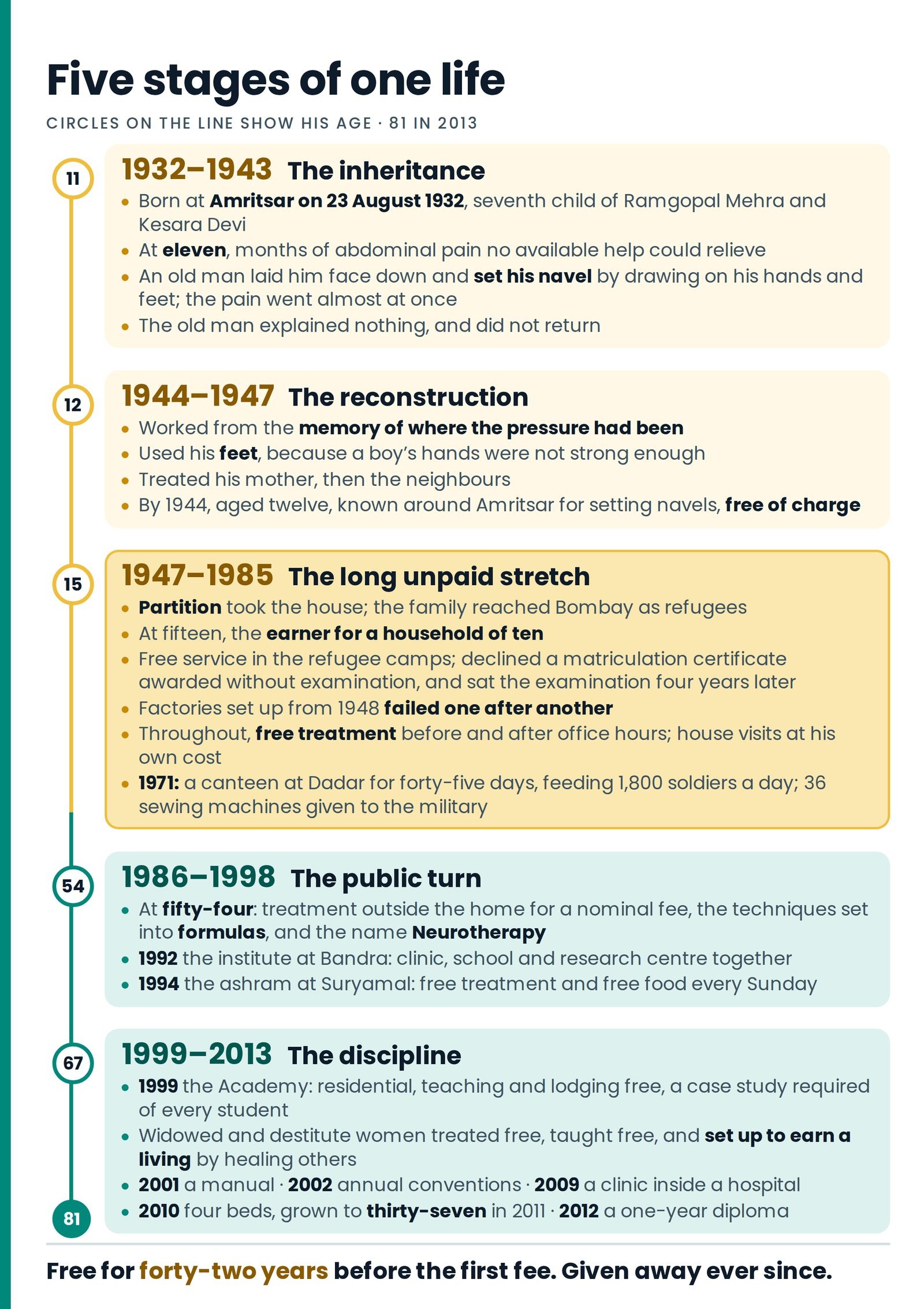
He was born into a highly respected family of Amritsar on 23 August 1932, the seventh child of Shri Ramgopal Mehra and Shrimati Kesara Devi.
The setting is half the explanation. Amritsar in the 1930s was a busy, prosperous, tightly woven city of trade and faith, where a household of standing kept an open door, and where medicine came in several kinds at once: an allopathic dispensary in the bazaar, a vaidya for a hot stomach, a hakim for a chronic cough, a dāī for a birth, a wrestler-masseur for a wrenched back — and, in a hundred thousand ordinary houses, an aunt or a grandfather who could set a slipped navel. None of it was exotic. It was simply what a family did.
He was the only son among nine children — six elder sisters and two younger, as the life is set down in one place; the only brother among eight sisters, as it is set down in another. Either way, he would be the one the household leaned on, and he knew it early.
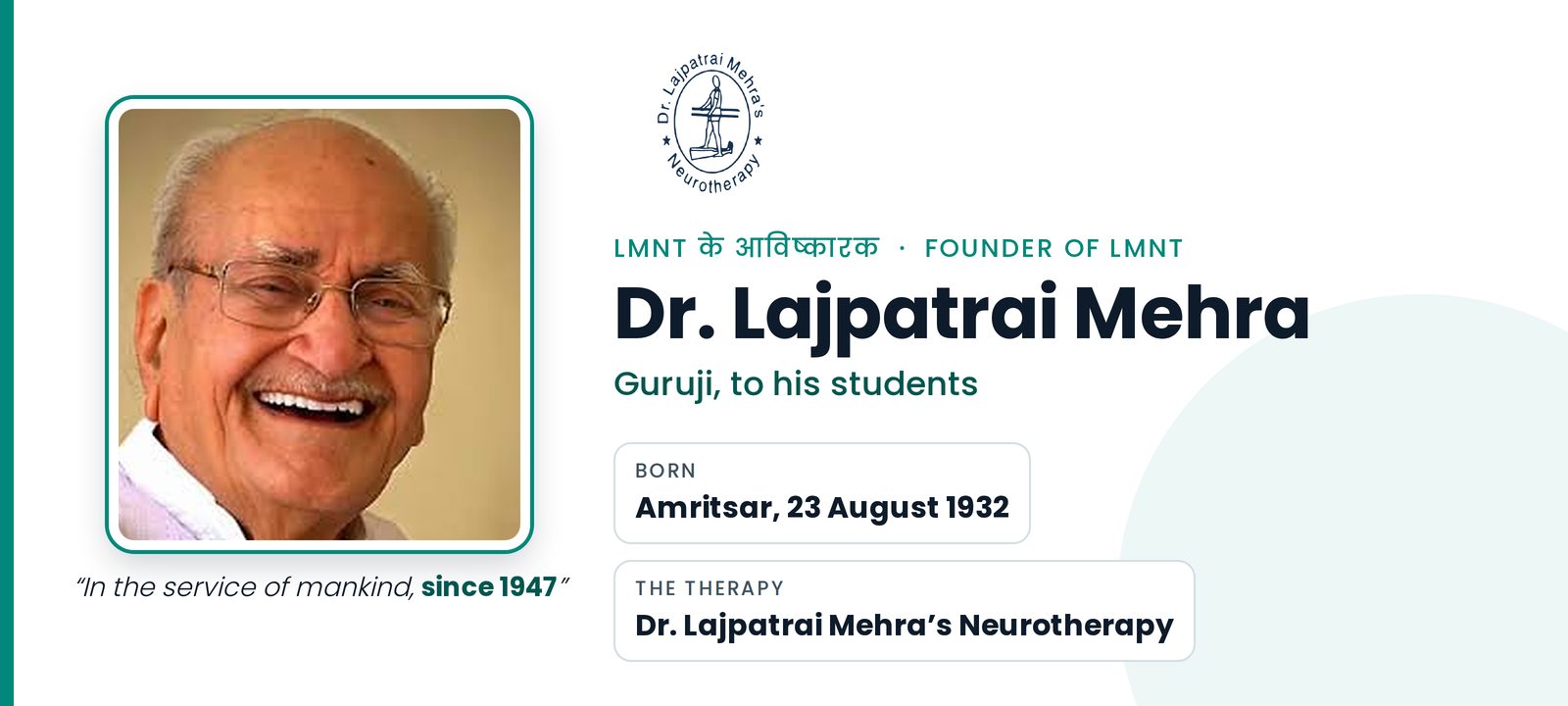
The portrait carries a line beneath it: in the service of mankind, since 1947. Notice what it dates the service from. Not from the clinic, not from the name, not from the first fee. From the year the house was lost. (Figure 2.1)
The pain that lasted months
The illness at eleven, the old man, and a navel set face down
At the tender age of eleven he was afflicted with a severe stomach ache. It did not pass. It lasted several months — roughly eight to ten months, in the fuller telling — and the best medical help available at the time could not relieve it. In 1943, in a family with money and standing, that means everybody was tried, and it means a boy who stopped eating properly, woke in the night, and was carried from one hopeful door to another while the household grew quietly frightened.
Then, by what the telling calls providence, he met an old man.
The old man asked few questions. He told the boy to lie face down — prone, on his stomach — and then, by a simple indigenous technique, took hold of his hands and his feet and drew them in a particular way. He was setting the navel. The pain went almost at once, and it did not return.
Three details in that scene carry the weight of everything in Parts Two, Three and Four of this wiki.
He was placed face down. Prone Nothing whatever was done to the painful stomach itself. The complaint was in the belly, and the treatment was given from behind, with the belly resting on the floor. Position is part of the treatment here, not a convenience.
The correction was made at the four limbs — hands and feet, not the site of the pain. The rule that pressure at a limb relieves a pain in the trunk, which The Hand That Heals states and turns into a hundred formulas, is present in embryo in that one manoeuvre on a floor in Amritsar.
The old man explained nothing and did not come back. He performed, and he left. There was no teacher, no lineage, no notes — only a memory in the boy's own body of where the pressure had been and in what order.
The boy who did not let it pass
The first patient, and why the therapy came to be given with the sole
Most children, relieved of a pain, run off to play. This one did not. He kept turning it over: how had so ordinary and so simple a method produced such a marvel in his body? And with the question came the thing that begins this therapy — a longing to know how he might free other people from pain of that kind. He had no instruction to work from, only the recollection that during the procedure there had been pressure at certain points of his body — a memory not of a diagram but of sensation, from the inside. Everything that followed was reconstructed from that.
His mother suffered often from abdominal pain, and took pills for it. He begged her to let him try, and she gave him permission. That permission deserves a moment's silence: a woman in pain agreeing to let her eleven-year-old work on her is the first act of trust in the history of this therapy, and there have been several lakhs of them since.
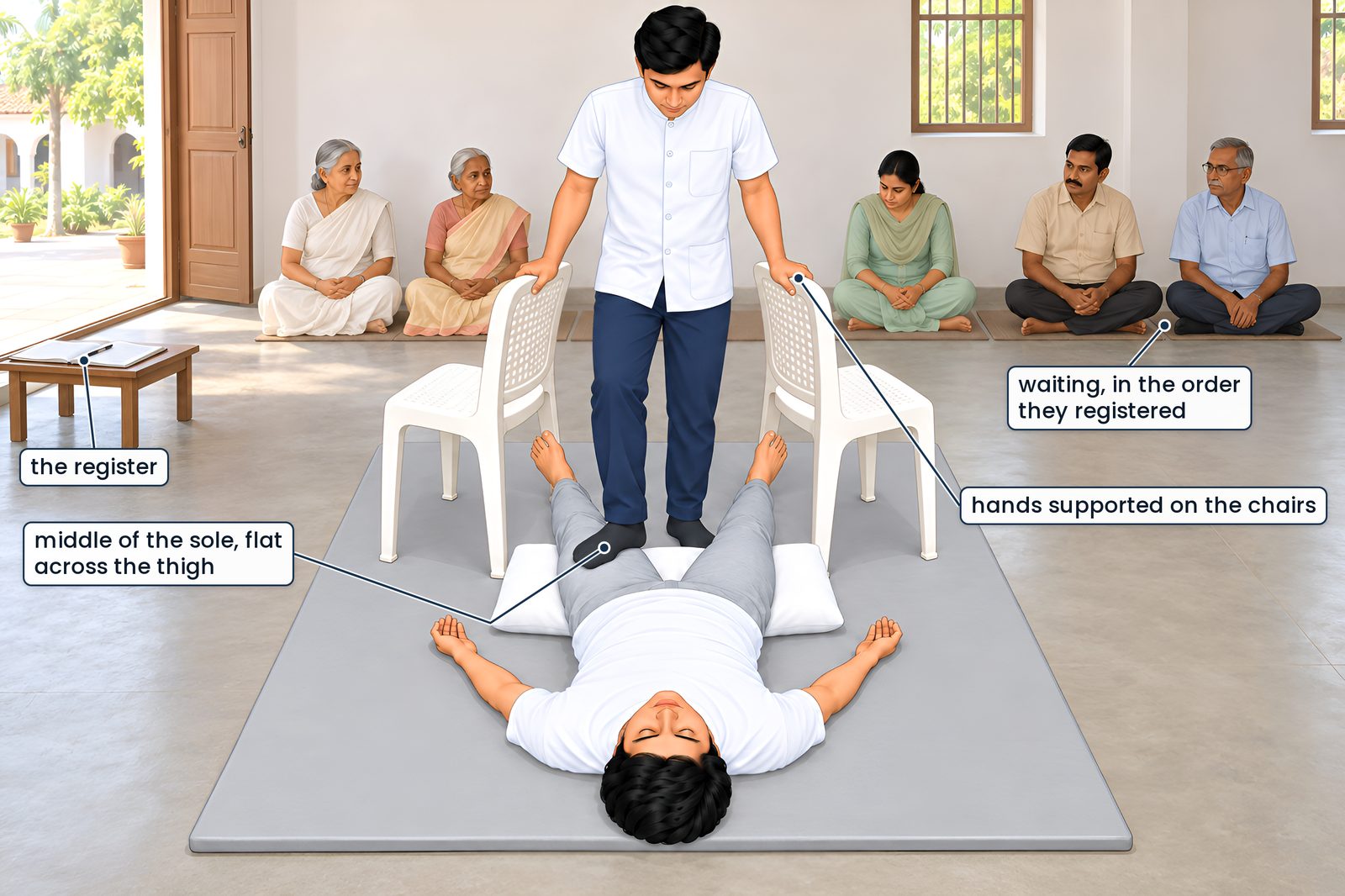
Then came the difficulty that decided the shape of everything. He was a child. A child's hands cannot hold a firm, steady pressure on an adult's thigh even for seconds; the thumb tires, the wrist gives, and the joints of the person pressing pay for it. So, to produce in his mother's body the effect the old man had produced in his, he made a novel use of his own feet — and freed her of her pain.
Why this therapy is given with the sole
The foot was not chosen for effect. It solves three problems at once, and it solves them for a grown therapist exactly as it solved them for a boy.
The weight does the work, not the muscle. A therapist pressing with the hands is spending strength and will run out of it by the fourth patient; a therapist pressing with the foot, hands resting on two chairs, is spending nothing.
The dose is finely graded. Weight is shifted between the standing leg and the treating foot, and can be taken back in an instant.
The load is spread. The sole is broad and soft, and the same push through a broad soft tool is a fraction of the same push through a thumb tip — which is why this therapy does not hurt.
And the rule that follows, which you will be tempted to forget in your first month: weight is not the variable. Place, angle, count and order are.
The queue at his father's door
Free treatment of bellies, and a boy known across Amritsar at twelve
Having become skilled in his new technique, he began treating other people in his own neighbourhood, free of charge. Word travels fastest through households, and what travelled was that a boy at the Mehra house could do something for a belly.
Soon a crowd came. People suffering from constipation, dysentery and other disorders of the abdomen, from nearby areas and then from distant ones, formed a line in front of his father's house — and he treated them, with great success, by his newly invented technique.
By 1944 he was proficient in navel setting and in the disorders of bowel movement, and well known in Amritsar and the surrounding areas for treating abdominal patients successfully and free of charge with a technique he had developed himself. He was twelve years old.
Two things about that queue decided the architecture of this wiki. The complaints were digestive — constipation, dysentery, disorders of the abdomen. Not knees, not migraines, not paralysis; those came later, to a man whose formative years had been spent with his hands on bellies. It is why diagnosis begins at the navel, why undigested food has articles of its own, and why a patient who comes about a shoulder is so often given ten days of digestive work first.
1947 — the year the house was lost
Partition, a refugee household, and a habit that did not stop
The riots at the time of the partition of the country consumed his home in the earliest stage. A family that had been prosperous lost everything it had and came to Mumbai — then Bombay — as refugees, in 1947–48.
A household of eleven arrived in a strange city where nobody knew them, with no house, no shop, no capital and no standing — the standing being the hardest to replace, because in Amritsar the name had been enough and in Bombay it meant nothing. The responsibility of maintaining that family fell on the shoulders of an adolescent boy. Do the arithmetic slowly: fifteen or sixteen years old, the only son, and the earner for ten people.
He worked. And despite being taken up entirely with what the language of the north calls नून तेल — "salt and oil", the daily grind for necessities — that youth did not abandon the habit he had formed at eleven. He spent the largest part of his day he could spare treating people free of charge, and in the course of it invented many new techniques and developed a remarkable method of treating many kinds of illness without medicines.
The habit came before the therapy
The free treatment did not begin when he could afford it. It began when he could not.
From the age of eleven, treating without charge was already a habit; the partition did not interrupt it, and forty years of business failure did not interrupt it either. The therapy was built inside that habit, not alongside it — and a therapy developed by somebody with nothing to sell was free to follow the findings wherever they went. A practice built on fees would have had to protect something.
The certificate, and the reading
A certificate declined, and a lifetime of reading physiology
His formal education went as far as the tenth class, and because of the partition and the formation of Pakistan he could not sit the examination in Amritsar. He had been doing free seva in the refugee camps for several hours a day, and in appreciation of that he was awarded the matriculation certificate although he had not sat the examination. To him that was anathema. After about four years he sat the examination and successfully completed it.
Family circumstances did not permit further study. Nothing dampened the obsession, though. From a very young age he had been reading on his own — books on nature cure, human anatomy and physiology — and he went on reading for the rest of his life. In course of time he qualified in naturopathy.
Read that as a student of the therapy rather than as an admirer of a man. Every point code you will memorise in — every name drawn from a hormone, an enzyme or a nerve — is the residue of that reading. It is not decoration borrowed for prestige; it is what an autodidact does when he finally has words for what his hands have been doing for thirty years.
The forty years nobody puts on a poster
Failing factories by day, free treatment before and after
Here is the stretch admirers hurry past and a student should slow down for. From 1948 onwards he undertook a series of ventures, setting up factories, one kind of industry after another. They failed — not dramatically, but in the ordinary grinding way, through sustained losses, and one after another they had to be shut down. That went on for the better part of four decades.
Through all of it the entry is the same every time: he continued his habit of giving free treatment to patients before and after office hours, at his residence. Patients who could not come to him he went to — at their homes, at his own expense.
Put an ordinary day around those words. A man rises early and treats whoever is waiting. He goes to a factory that is losing money and spends the day keeping it alive. He comes home and treats whoever is waiting there now. If somebody is too ill to be brought, he pays his own fare across Bombay and treats them on their own floor. Then he reads physiology. Then he does it again tomorrow, for forty years, with a household depending on him and a business dying under him.
What forty years of unpaid practice bought
Nobody plans a training like this, and no institution could provide one — but it explains why the formulas in are shaped as they are.
Volume without selection. Whoever turned up was treated, including the vague, the elderly, the hopeless and the ones others had given up on.
Follow-up you cannot escape. These were neighbours. If a treatment did not hold, the man was in the same lane next week, with the same complaint and an opinion about it.
No incentive pulling the conclusions. No fee to justify, no reputation yet to defend — nothing preventing him from abandoning a formula that failed, giving a family the technique so they need not come back, or handing a discovery to a rival the week it was made.
And time. Two things here could not have been found quickly — that the treatment must change from day to day in the same person, and that a chronic disease is a matter of months. Both need years of watching the same faces.
And there is a second lesson in the failed factories, this one for you. The work you do for nothing is not the leftover of your life. For forty years the ledger said this man was a manufacturer who treated patients on the side. The ledger was wrong.
1971 — the canteen at Dadar
Eighteen hundred meals a day for the jawans
In 1971, during the war, he ran a canteen at Dadar for about forty-five days, in which an average of 1,800 jawans were fed every day.
That is one line in a list of achievements, and it deserves opening out. Eighteen hundred meals a day is not hospitality; it is logistics — grain and pulses and oil bought daily in quantities that need a truck, vessels large enough to cook in, fuel, water, a place to wash, and a rota of hands from before dawn until after dark, for forty-five days without a break. And the men fed were jawans, young soldiers moving through a railway city on their way somewhere, hungry, far from their own kitchens, at all hours.
Besides the canteen he donated thirty-six sewing machines to the military, and during earthquakes and similar calamities he gave whatever help he could. The sewing machines are the detail to keep — the same idea as everything else in this article, arriving twenty years before the widows were taught. A blanket is a gift. A sewing machine is a livelihood.
1986 — the year the work stepped outside the house
The Bandra clinic, a nominal fee, and the name Neurotherapy
In 1986 he formally began treating patients outside his own residence, for a nominal fee — from a clinic at Bandra, Mumbai — with phenomenal success. He put the technique gained from all those years into formulas. And in that year his treatment came to be known by the name "Neurotherapy."
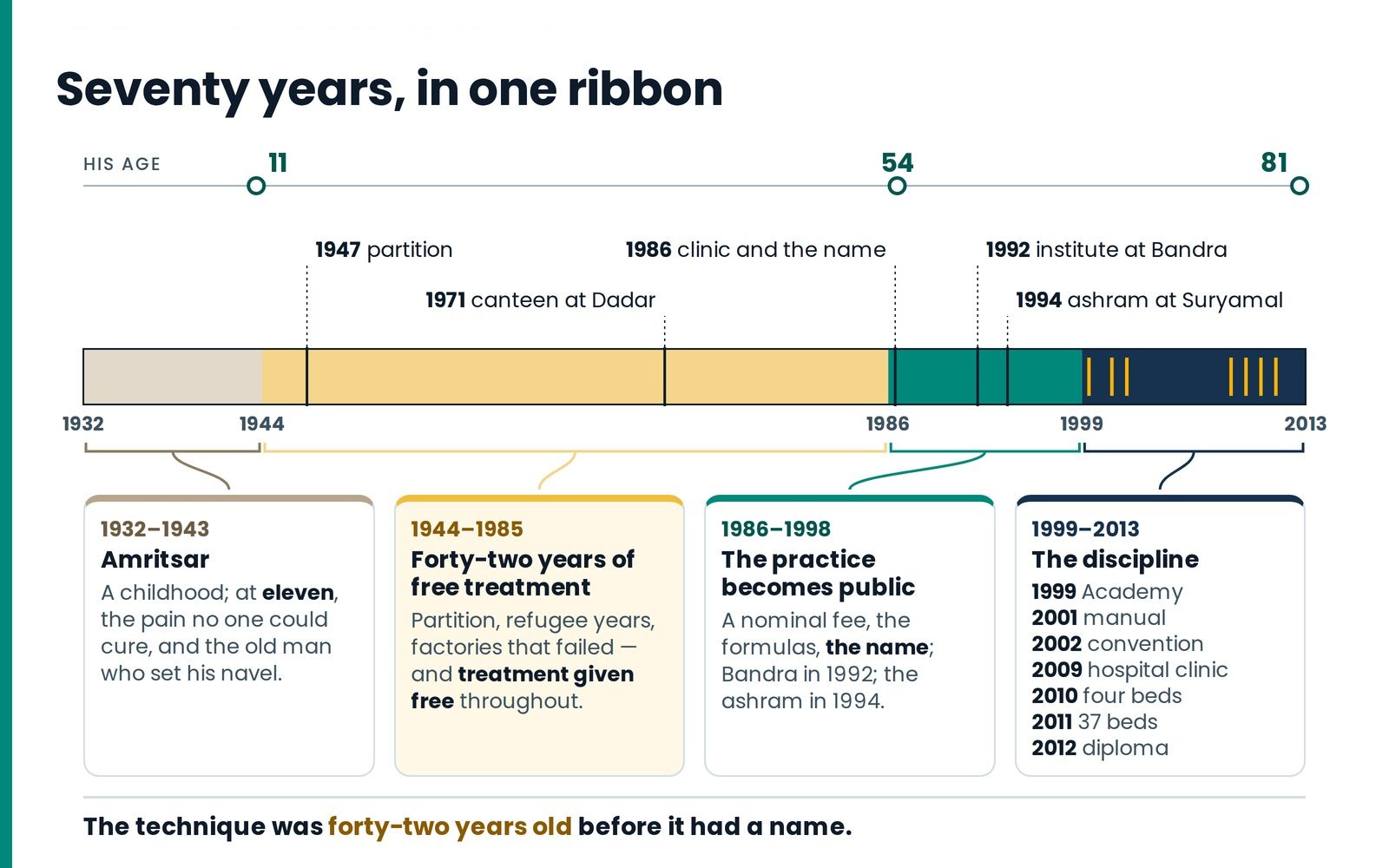
He was fifty-four. The technique was forty-two years old.
Two things about that year repay attention. The nominal fee arrived four decades late and never became more than nominal: even afterwards he continued to give free treatment every Sunday at the "Hindu Seva Samaj" for a number of years, so the fee was added beside the free work rather than replacing it. And the formulas — until then the knowledge lived in one man's hands, and setting it out as ordered sequences, with counts, is what made it teachable. All of exists because of that decision.
The naming is set down in more than one accounting, and each belongs to the setting it is told in.
In the year 1986, in the record of the milestones of the work, the treatment came to be known by the name "Neurotherapy" — the year the practice stepped outside the house, took a fee, and became a public thing needing a public name.
In the year 1976, in the account kept of the centre itself, he gave this therapy the name "Neurotherapy" — the same account which says the foundation of the therapy was laid in Mumbai some forty years ago, in the year 1965, that he had begun correcting the navel in 1947, and that he began this treatment first of all at home, where slowly patients of back pain, neck pain, arthritis and various diseases came to him; first relatives and acquaintances, and later patients from far and wide and from many provinces, until the numbers grew so large that he opened a separate centre.
The name LMNT came later still, and for a plain reason: it was seen that several quite different systems around the world had been given the name neurotherapy, so to state the distinctiveness of this one it is known as LMNT — Dr. Lajpatrai Mehra's Neurotherapy.
And in the strictest sense he did not name it. The therapy was christened by his students and well-wishers — possessive and all. A man does not put his own name in front of a therapy; the people he taught do that, and then he has to live with it.
1992 — a clinic, a school and a research centre, together
The Neurotherapy Institute at Bandra
An institution named the Neurotherapy Institute was established at Bandra in 1992, doing three jobs from the first day: a day clinic treating patients six days a week at a nominal charge; a training centre giving theory and practical classes in the principles and practice of the therapy — a six-month course run twice in a year; and a research centre to study and analyse the results of treatments given for various ailments and, from the conclusions, to prepare still better treatments.
The third limb was not bolted on when the therapy became respectable. It was there at the founding, and it says what research meant here: watch what your treatments actually do, and let the findings change the next version. It is why superseded formulas are still taught beside their successors in .
The training classes at Bandra ran from 1992 to 2010 — twice in a year, one session of six months each — and from them many students learnt the therapy and went on to treat patients successfully; thousands of patients benefited at their hands, and the therapy spread because of them.
At the institute itself, because patients of so many diseases came, he began to research in books of science about those diseases and to find new treatments from them; and in this way patients from the common cold up to diseases like cancer began to obtain relief. More than one lakh fifty thousand registered patients have taken treatment there, of whom seventy to eighty per cent became well, at an average of a hundred patients a day.
Learn that figure with its setting attached — one institute, over decades, among the complaints that institute saw most often — and never repeat it to a patient as a forecast. She is not asking for history; she will hear a promise made to her personally. Tell her instead what you found in her body today, what you intend to do, and when you will look again.
The women — the part of this life you must not read quickly
Treated free, taught free, and taught to earn
Everything so far is the story of a man building a therapy. What follows is what he did with it, and it is the moral centre of the whole life. Read it slowly. You will be asked about it by patients, by families, and one day by a woman standing in your own doorway with nowhere else to go.
Through this therapy there came a great many patients who could see no way ahead — people miserable with extreme mental suffering, for whom no road out was visible. Such people he not only treated free of charge and made well, but also taught neurotherapy to them free of charge, and taught them to earn money along with name and honour, and created in them an interest in life again.
And among them, named plainly:
What was done for the widowed and destitute women
Many widowed and orphaned women — for whom society would perhaps have done nothing at all — were shown such a ray of hope that today they live not merely self-reliant but with pride.
They were treated free of charge.
They were then taught the therapy free of charge.
They were taught to earn a living by it, and with the living, name and honour.
Today they are not only supporting their families but earning fame as well; and having learned the therapy, they have opened their own centres and treat patients successfully.
This is not charity that ends when the giver's mood passes. A woman treated is a woman relieved. A woman taught is a woman nobody has to give anything to again.
Understand what that meant in the India of those decades, or the sentence will sound merely pleasant. It is not merely pleasant; it is the most radical thing in this article.
A widow without land, schooling or capital had a very short list: domestic work in other people's houses, labour in the fields, piece-work at home for a few rupees a day, or dependence on a brother, a son or an in-law — dependence being the option that also cost her the right to an opinion in her own house. Every recognised health profession was shut to her, and shut for the reason poverty makes hardest to fix: each demands years of continuous schooling with fees paid in advance — a matriculation and a multi-year course for nursing, a diploma for pharmacy, five and a half years for the classical systems.
A six-month course asking for literacy, two hands, patience and stamina was the only door in that wall, and it suited her particularly, because in this work the training is the capital. No equipment to buy, no stock, no premises, no licence fee, nothing a creditor or a relative can take from her — a room, a mat, two chairs and the hands she already owns.
There is a second reason, quieter and just as practical. This therapy is given with sustained pressure at the abdomen, the groin, the low back and the chest, and a great many Indian women will not accept that from a man — and are entirely right to decide so for themselves. A body of trained women therapists was not a kindness to those women; it was the condition of women patients being treated at all.
That line is written up at the ashram, in English and in Hindi, in a ruled box everybody walks past. It is not decoration. By which one can stand on one's own feet is the whole argument for free tuition, free lodging, and for teaching a widow a trade instead of handing her alms — and, as it happens, an exact description of what this therapy tries to do to an organ. Not to supply it from outside for ever. To put it back in a condition where it can do its own work again.
The same idea has a further extension, now standard at every serious centre. Many patients come from far away whose treatment will run a long time. Their family members are taught the therapy, so that they may go home and treat that patient themselves. The reason is given without ornament: the patient should get well by whatever means — it is not necessary that treatment be had only by staying here.
Consider that as a business proposition. A centre training a patient's own daughter is deliberately giving away the visits it would have been paid for. Same instinct as the sewing machines, same instinct as the widows.
And the door opened both ways: not only the poor but also great wealthy people come there for treatment and find relief. A therapy that treats a domestic worker free and a mill-owner for the same nominal fee, in the same room, on the same mat, makes a statement about both of them without having to say it aloud.
The people nobody else would sit with
Severe mental distress, and the limits of what a therapist offers
Among those who came with no way ahead were people in severe mental suffering — treated free of charge, made well, taught the therapy free, and given back an interest in life.
Why the generosity was needed is not hard to see. A family with a member in severe distress, in a small town, very often has nowhere to take them: the nearest help is far, expensive, frightening, or wrapped in a shame that keeps the household silent. Such a person is used to being managed, hidden, argued with or prayed over. Very few people simply sit with them for half an hour, touch them respectfully, ask how they slept, and expect them back on Thursday — and that half-hour is worth more than it looks. It is also where a therapist is most exposed and a patient most at risk, so it is taught here with the care the work itself demands.
1994 — the ashram at Suryamal
The Sunday camps for the Adivasi and the poor
It was the fruit of his eagerness to work in the rural areas that in 1994 a Neurotherapy Ashram came into being at a village named Suryamal, 125 km from Mumbai, in Mokhada taluka, Thane district, Maharashtra — a predominantly tribal area. From that year onwards a free treatment camp has run there every Sunday, and it continues to this day.
What moved him was not an idea about rural health but a particular sight, repeated until he could not bear it: people who could not afford even the transport to the nearest health centre. Not the doctor's fee — the bus fare. Seeing the absence of facilities in the rural areas, and the difficulty of reaching the nearest one, his eyes would fill with tears. That is the vacuum this therapy grew into, and it explains its shape: never a rival to hospital medicine in a city, but a presence where, on a given Sunday, nothing else is open.
The ashram stands in the proximity of nature at Suryamal village, Mokhada taluka, Thane district, built away from the city with the Adivasi and poor people of that belt in mind — where, at the time of need, neither the required medicine nor a doctor is available for miles around.
Since 1996, for such needy people, a treatment camp runs there every Sunday, and free treatment is given by this system. Through these camps, in fifteen years more than thirty thousand patients have been treated there, of whom more than eighty per cent became well or obtained very great relief. They come not only from around Suryamal but from Nashik, Sinnar, Palghar, Manor, Vikramgad, Jawhar, Mokhada, Igatpuri and Kasara, and from much further off — Aurangabad, Jalgaon, Jalna, Buldhana, Satara, Pune. Doctor Sahab listens to their sorrows with great love, and treats them. The greatest of diseases — for which there is no treatment anywhere else — can be treated here. For those who come from far there is an arrangement of free food on that day. Because the free camp runs on Sunday only, the ashram is known in that region as रविवारीय दवाखाना — the Sunday Dispensary. (Figure 2.2)
The location is set down for anyone who has to find it: Dr. Lajpatrai Mehra's Neurotherapy Ashram — 170 km from Mumbai, 30 km from Wada, 40 km from Kasara or Igatpuri, and 95 km from Nashik.
1999 — the Academy, and the decision to train villagers rather than centralise
Training villagers rather than centralising the work
The plight of the rural population produced the most consequential decision of his life: he resolved to teach his therapy to the youth of India and induce them to serve the villagers in their own areas. With that end in view, in 1999 he established a residential training centre — Dr. Lajpatrai Mehra's Neurotherapy Academy — at the ashram, where students come from all over India to learn this therapy and in turn to train others in it.
Every healing tradition built around one gifted pair of hands ends when those hands stop. He did the opposite: he built the therapy so that it travelled by teaching, and sent the teaching to the village rather than asking the village to travel — which is why this work counts centres as often as it counts cures.
The Academy (Public Charitable Trust) was established at the ashram in 1999 with two chief limbs:
A training centre — a residential Neurotherapy Certificate Course (LMNTC) for students from all over India and abroad, begun in November 1999, and now of one year's duration. From this point onward Dr. Mehra came to be known as Guruji.
A research centre — in every batch, each student must compulsorily prepare at least one case study during the course, documenting the success of the therapy in some disorder. The projects of every student who has studied there are held in the research library, and over the years their number has grown considerably.
Within the ashram, in 1999, an academy was created in which students come from all over India and stay for four months. For admission it is compulsory to have passed the tenth or twelfth standard. They are taught the necessary body science and how diseases are removed by this therapy, and the direct treatment — the practical — is taught as well. Along with this they are taught about our ancient civilisation and culture, so that these students may return to their own provinces and build a new society. Every day, besides agnihotra and yogāsana, pūjā and bhajan are performed, and once a week a Gāyatrī havan is compulsory for all students. With it they are taught the lesson of walking by moral rules and of sensitivity towards humanity.
At present this residential training is available only for men. If sufficient demand comes from women to stay there and learn, Dr. Mehra is thinking seriously about making the training available for women too. From the year 2010 the duration of the training was increased to one year.
What the Academy costs a student
The giving of learning is free of charge.
The lodging is free.
From students a nominal amount is taken each month for food, much less than the actual cost.
Along with Dr. Mehra there are other teachers and managers who help in the work day and night, and all this work is done without charge.
The purpose is stated plainly: that there should be centres in every state of the country, and every person have this facility, so that in an age of inflation people may become free of disease cheaply, without medicines. What he wishes to create is a gurukul-like atmosphere, in which students need bear no expense at all — for which financial assistance is needed, and beyond money, gentlemen who will give their time to help run the ashram. He has full faith that the well-wishers of society will stand with him.
People come there for training not only from all over India but now from abroad. After the training, in order to gain further success, a student works as an intern for a year or so at some neurotherapy centre in the country; and when sufficient confidence has come, he returns to his own province and opens a centre.
2010 — the hospital
The Arogya-Mandir, and a longer training
For about fifteen years patients at the ashram were treated on Sunday only. As success came, and to meet the demand of people from all over the country, from February 2010 a residential hospital was built within the ashram itself — beginning with four beds and now grown to thirty-seven — where people come from many provinces and from abroad.
The residential health-care unit — the Arogya-Mandir — began in a small way with four beds in 2010, for in-house patients of debilitating diseases such as multiple sclerosis, muscular dystrophy, Parkinson's, paralysis and cerebral palsy. In 2011 it was expanded to thirty-seven beds; the beneficiaries include patients of paralysis, motor neuron disorders, disc bulge, back pain and knee pain, and mentally challenged children. Parents of children with cerebral palsy and autism have conveyed their appreciation of the progress in their children even within a twenty-day stay.
With the hospital came a change in the training: students now stay not for four months but for one to one and a half years, during which they treat patients in this hospital under the supervision of Guruji and the other senior therapists, and so return to their own provinces more successful. A ward gives a student what no classroom can: the same patient on Monday and on Thursday, with a senior therapist standing behind him when the findings change.
The camps
More than a hundred free camps, and how the therapy travelled
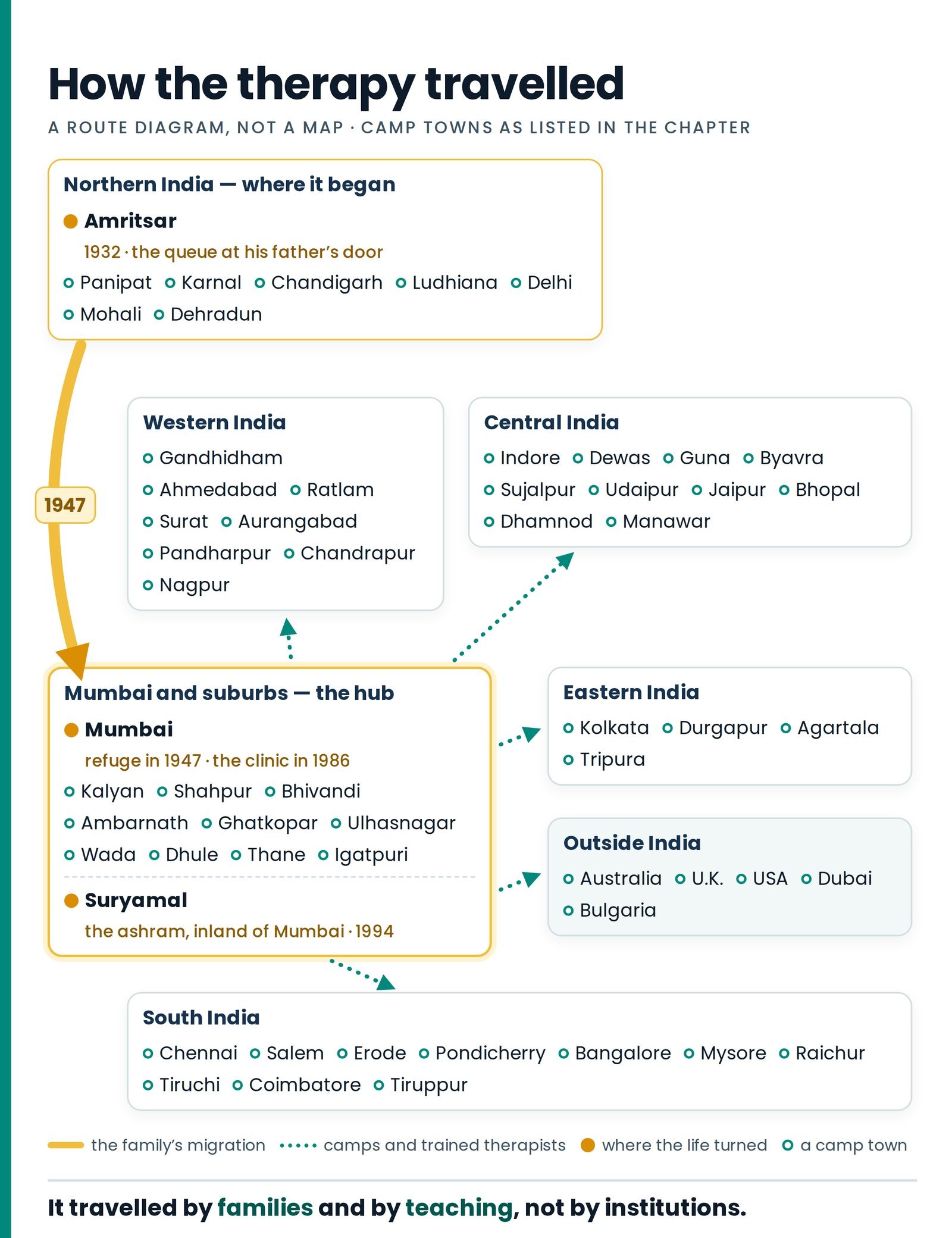
Beside the Sunday clinic there is a second kind of work, and it is what carried this therapy across the country: more than a hundred free Neurotherapy camps conducted all over India, and treatment given to several thousands of patients in India and quite a few abroad. The following is a very small list of just a few of the places where camps have been held in recent years. (Figure 2.3)
The same list is set down again beside the location of the training centre, and there the places outside India are given as Australia, the U.K., the USA, Dubai, Singapore and Bulgaria.
Read the map rather than the names. It begins at Amritsar, where the story began in 1944, runs through the towns of the Punjab and the Mumbai suburbs where the people of that migration settled, and is denser in small industrial and market towns — Ratlam, Dewas, Byavra, Sujalpur, Dhamnod, Manawar, Erode, Raichur — than in the metropolitan centres. It did not travel through the medical establishment. It travelled along family routes and the roads migrants take. Nobody promoted this therapy to you; somebody in your street got better and told somebody else.
The honours, and what each one is
What each recognition is, and what it is not
Recognition came late and from several directions. The dates are in the table that follows; what matters here is what each one actually is, because patients ask, and describing an honour accurately is more impressive than describing it grandly.
The two doctorates are honorary. The title "Doctor of Medicine (Medicina Alternativa)" came in 1994 from the Medicina Alternativa Institute, Colombo, affiliated to The Open International University for Complementary Medicines, in appreciation of his selfless service. The Doctorate in Science was conferred on 31 January 2004 at the convocation of the 18th World Congress of Medica Alternativa Holistic Health and Spiritual Sciences, organised by Zoroastrian College, Mumbai, in recognition of his services in treating the sick without medicines. Both are expressions of regard from private institutions.
The Queensland recognition of 2005 — LMNT recognised as an authorised business venture by the Government of Queensland, Australia — is a commercial permission, granted as a salute to the therapy's success in treating several diseases.
The twenty-three students of 2006 came from villages of Madhya Pradesh under the state government's MPRLP — the Madhya Pradesh Rural Livelihood Project — and with them the therapy gained official standing. Note the department they came through: livelihood, not health. The state had understood what he had, which is that this therapy is a trade a villager can be given.
The clinic inside a hospital, 2009, is the one a working therapist should care about most: the "Centre for Advanced Neurotherapy" at IVY Hospital, a multi-speciality hospital at Mohali, under the senior therapist Sh. Ajay Gandhi, where Guruji's lectures were greatly appreciated by local doctors. Inside a hospital, a patient who needs something else is one corridor away from getting it.
And the invitations — the Forum of Parliamentarians on HIV/AIDS in 2010, an assembly of judges at the Delhi High Court the same month, the officials at Rashtrapati Bhavan in 2013 — mean that somebody wanted to hear him speak.
Three further strands turned a practice into a discipline, and each is set out year by year in the table that follows: the seminars and annual conventions from 2002; the publications — the souvenirs from 2008, the two websites, and the Tamil edition of the wiki in 2010, the point at which this therapy stopped being a northern and western thing and became a national one; and the teaching abroad, at Townsville in 2003, at Kingsbury in 2007, and with Seva Bharati in Tamil Nadu in 2012 and 2013.
The milestones, year by year
From 1944 to 2013 at a glance
Learn this table — not to recite dates at people, but because its shape is the argument: forty-two years of unpaid practice before a fee was taken, and then, after the age of sixty, everything else in a rush. (Figure 2.4)
Table 2 — Milestones of the life and the work, 1944 to 2013
| Year | What happened |
|---|---|
| 1944 | Proficient in navel setting and in disorders of bowel movement at twelve years of age; treating abdominal patients free of charge with his own technique, becomes well known in Amritsar and the surrounding areas |
| 1947–48 | The home lost in the riots of the partition; the family reaches Bombay as refugees; free seva for several hours a day in the refugee camps; the matriculation certificate awarded without examination and declined, the examination sat about four years later |
| 1948 onwards | Factories set up and closed one after another through sustained losses; throughout, free treatment before and after office hours at his residence, and house visits to those who could not come, at his own cost |
| 1971 | During the war, a canteen at Dadar for about forty-five days feeding an average of 1,800 jawans daily; 36 sewing machines donated to the military; help given during earthquakes and similar calamities |
| 1986 | Formally begins treating outside his residence, for a nominal fee; sets the techniques of the years into formulas; the therapy comes to be known as "Neurotherapy"; continues free treatment at the Hindu Seva Samaj on Sundays for a number of years |
| 1992 | Neurotherapy Institute established at Bandra — day clinic six days a week at a nominal charge; training centre running a six-month course twice a year, to 2010; research centre to study results and formulate better treatments |
| 1994 | Inauguration of the Ashram in the tribal belt of Suryamal village, Thane district: free treatment every Sunday, most patients poor Adivasi families, with free food — continuing to this day. Awarded the title "Doctor of Medicine (Medicina Alternativa)" by the Medicina Alternativa Institute, Colombo, affiliated to The Open International University for Complementary Medicines |
| 1999 | Neurotherapy Academy (Public Charitable Trust) established at the ashram: a residential Certificate Course (LMNTC) from November 1999, and a research centre in which every student must prepare at least one case study, kept in the research library. From this point Dr. Mehra is called Guruji |
| 2001 | Documentation of case histories begun for the students of the academy. Neurotherapy Manual released in English, cataloguing the treatments formulated and tested over the previous decades, to fix a uniform schedule of treatment for therapists everywhere |
| 2002 | The Annual Convention of the World Federation of LMNT, 24–26 January, inaugurated with 'Neurotherapy 2002' |
| 2003 | Website launched. At the seminar of 24–26 January, presentation of documented case histories — hole in the heart, writer's cramp, ovarian cyst. 15 November to 15 December: month-long workshop and camp at Townsville, Australia, with Shri S. Ramchandran and Shri Nilesh Singhania |
| 2004 | Doctorate in Science conferred on 31 January at the convocation of the 18th World Congress of Medica Alternativa Holistic Health and Spiritual Sciences, Zoroastrian College, Mumbai. Townsville sends trainees to study at Suryamal |
| 2005 | Recognised as an authorised business venture by the Government of Queensland, Australia |
| 2006 | 23 students sent from villages of Madhya Pradesh under the MPRLP of the state government |
| 2007 | Four-week camp at Kingsbury, London, 29 September to 29 October, with Shri Nilesh Singhania, at the invitation of Shri Chunnilal Dhaka |
| 2008 | 1st National Seminar on Neurotherapy and Yog Vigyan, Delhi, 7–10 June, organised by Sri Ramgopal Dixit, Health Director of the Shri Maa Sharda Rashtriya Sewa Samiti (RAH), with the blessings and guidance of Acharya Dr. Lokesh Muni, Smt. Sushma Swaraj, Dr. Nalini Kaul (Director, Gangaram Hospital), Dr. S. C. Manchanda and Sri Kewal Krishan Kumar. 1st Souvenir on Neurotherapy launched 8 June at the Constitution Club, Delhi, on "Right Attitude to Health", covered by the leading newspapers and by television |
| 2009 | First Annual Souvenir — "एक आशा की किरण" ("A Ray of Hope") — released 26 January at the eighth Annual Convention at the ashram. "Centre for Advanced Neurotherapy" at IVY Hospital, Mohali, from September, under Sh. Ajay Gandhi. 2nd National Seminar, organised by Sri Ramgopal Dixit at the Speaker's Hall, Constitution Club, New Delhi, 20 December, in the presence of Justice Kailash Gambhir and Justice Sunil Gaur, Sh. Dinesh Trivedi (MOS for Health and Family Welfare), Acharya Dr. Lokesh Muni and Sh. Oscar Fernandes — with the souvenir "The Changing Environment and Neurotherapy" |
| 2010 | Residential health-care unit (Arogya-Mandir) begun with 4 beds from February, for multiple sclerosis, muscular dystrophy, Parkinson's, paralysis and cerebral palsy. With Sh. Ram Gopal Dixit, address to the Forum of Parliamentarians on HIV/AIDS, 3 May; lecture on How to maintain good health to an assembly of judges at the Delhi High Court, 20 May, in the presence of Chief Justice Madan B. Lokur; two websites launched by students; Tamil edition of the wiki released by Seva Bharati at Tiruchi, 24 December. Academy training increased to one year; the Bandra classes close |
| 2011 | The residential unit expanded to 37 beds — paralysis, motor neuron disorders, disc bulge, back pain, knee pain, and mentally challenged children; parents of children with cerebral palsy and autism convey their appreciation of progress within a twenty-day stay |
| 2012 | One-year residential diploma course begins in full swing. Workshop for senior therapists at a camp of Seva Bharati, Tamil Nadu, 28–30 October |
| 2013 | Introduction workshop for the officials at Rashtrapati Bhavan, Delhi, 31 August. Treatment camp with Seva Bharati, Tamil Nadu, 27–29 September, with Dr. Krishnamurthy and Anoop ji |
The scale the work reached
Each count with its vantage point attached
Numbers are kept for this work in several places and from several vantage points, and a student learns each with its vantage point attached — a life told across several tellings naturally carries several accountings.
Counted over three decades, from the country as a whole: he and his followers, in about 700 centres all over the country, have brought relief to at least 800,000 patients with various ailments — the same span told again as more than eight lakh people having taken benefit in these past three decades.
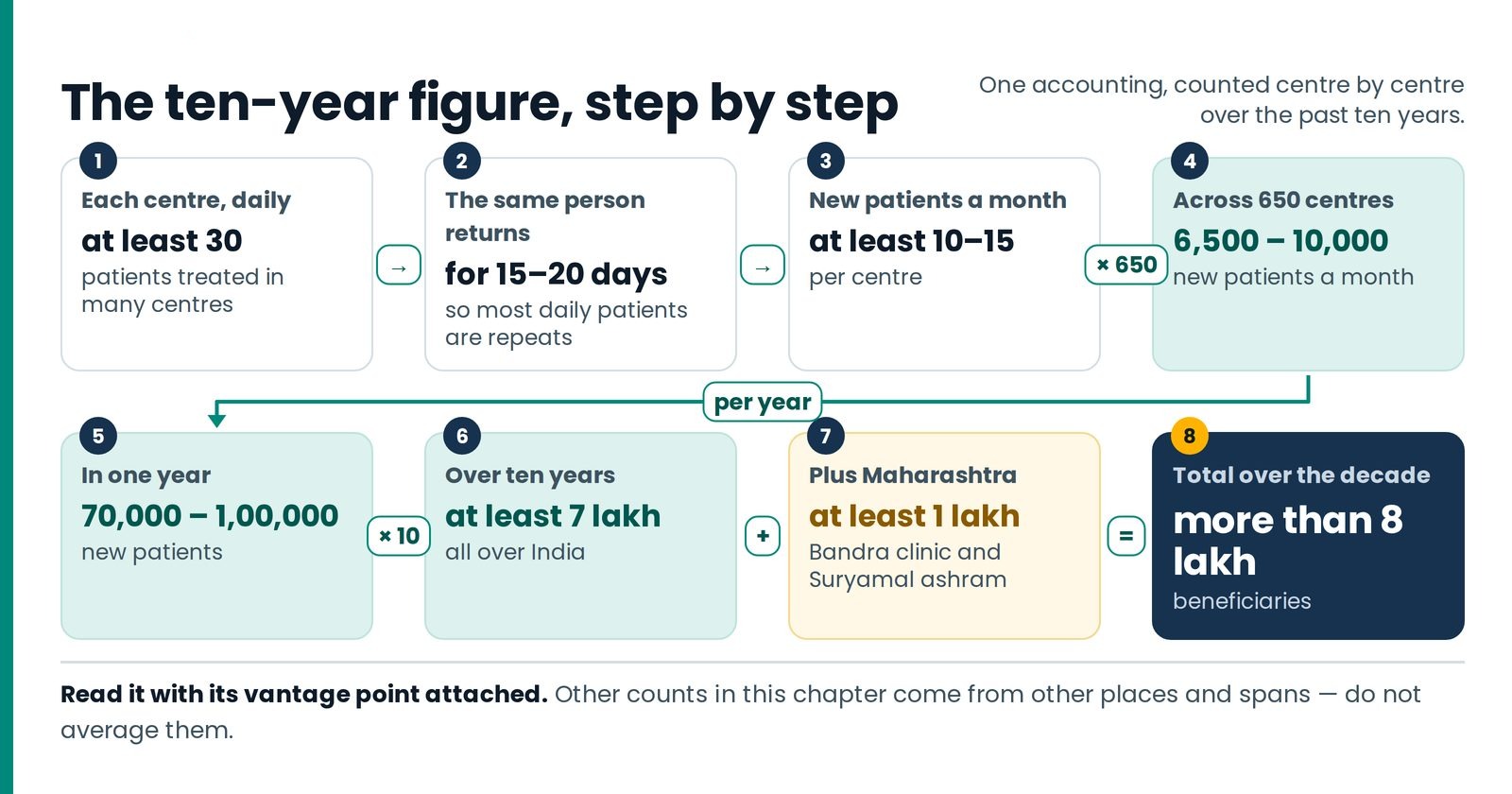
Counted over the past ten years, centre by centre: at present there are more than 800 centres all over India, plus at least one each in Canada, the U.K., Australia and, recently, Bulgaria; most established within the last ten years. As a result more than five thousand families are earning their bread and butter through this therapy — told elsewhere as five thousand families having obtained a respected place in society. The arithmetic behind that decade is set out step by step: (Figure 2.6)
Counted as the therapy describes itself to a newcomer: over the past decade it has been showing phenomenal success in more than 750 centres all over the country.
Counted from the ashram, looking outward at what the students built: in the whole of India, from Kanyakumari to Kashmir, about 800 centres have opened. Many run morning and evening, many at one time only; at every centre thirty to sixty patients do come — that is, in one day, in the whole country, about seven or eight thousand patients obtain benefit. In England, Canada, Italy and Australia too, one or two centres have opened.
Counted as teaching: with just a few dedicated followers he has trained more than 3,000 students, conducted more than a hundred free camps all over the country, and treated several thousands of patients in India and quite a few abroad.
Counted at the two places he himself worked: at Bandra, more than one lakh fifty thousand registered patients, seventy to eighty per cent of whom became well, at an average of a hundred patients a day; at the Suryamal Sunday camp, more than thirty thousand patients in fifteen years, more than eighty per cent of whom became well or obtained very great relief.
Do not average these, and do not pick the largest for a poster or the smallest out of modesty. Each was counted from a particular place, over a particular span, for a particular purpose, and carries its meaning in the way it was counted. What they agree about is the part that concerns you: this therapy reached a very large number of ordinary people, in very ordinary places, because it was given away rather than sold.
The man, and his own estimate of his knowledge
A tenth-class certificate, and a lifetime of study
He had no formal education in modern medicine, and said so himself, all his life, without the least embarrassment. His schooling stopped at the tenth class — and even that certificate he insisted on earning twice over.
So he taught himself. From a very early age he read: books on nature cure, on human anatomy, on physiology. Apart from the hours spent with patients he spent his waking life on it, one standard textbook of medical physiology read through many times over, and then again; in time he took a qualification in naturopathy. And out of that reading, joined to an experience of patients running into lakhs and to the daily disciplines of the older Indian way of living, he did what nobody with a conventional training would have thought to do: he took the findings of physiology and looked at them from an angle in which medicines had no place at all.
State that as the achievement it is. A man with a tenth-class certificate learned physiology well enough that physicians who came to argue stayed to listen — and used it not to explain why a body needs a drug, but to work out what a body would do if you gave it back its own blood supply.
Ask him about that knowledge, though, and this is what you get:
He was not being modest for the room. He called a therapy he had spent seventy years building a thing at the toddler stage, and meant it — which is why superseded versions of formulas are still taught beside their successors, and why this wiki asks you to record what you find rather than confirm what you were told. A man who thinks he has finished does not keep revising.
And the working day behind it, recorded at the age of eighty-two: about sixteen hours, from 5.30 in the morning until 9.30 at night, reading and researching to develop newer techniques for treating diseases faster and without medicines. For the past thirty-five years he had not taken a single day's leave — not even on Sundays, Sunday being the day the ashram treats for free.
His mission, his objectives, the conditions in which the therapy has been found effective, and his wish for 10,000 centres within his lifetime — one for every six villages — are taught in The Hand That Heals, "The Hand That Heals".
Questions students ask
1. I am twenty and just joined. Do I really need a dead man's biography to press a thigh correctly? You need the parts of it that are still in your hands. The prone position and the limb-to-abdomen correspondences came from that first manoeuvre in Amritsar; the sole came from a boy not strong enough to use his thumbs; the ten days of digestive work at the start of a course came from the queue of constipation and dysentery at his father's door. When you know why a rule exists you stop breaking it by accident.
2. My father says a man with a tenth-class education cannot have invented a system of treatment. What do I tell him? Tell him what actually happened, which is more impressive than an argument. He could not sit his matriculation because of the partition, was given the certificate anyway for his work in the refugee camps, refused to keep it, and sat the examination four years later. Then he taught himself physiology from books over seventy years, while running a business that was failing and treating people for nothing morning and evening. Your father is entitled to want evidence about the therapy — that is a separate question from whether a self-taught man can build one.
3. I am a housewife of forty-six with no science at all, and everyone in the class is younger and quicker. Is there a place for me? This therapy was built, taught and spread very largely by people in your position, many with far less. It asks for hands, patience, stamina, a careful memory and the willingness to examine properly every single day. Widows with almost no schooling were trained in six months and run their own centres now. Do not confuse being quick with being good.
- 4. I am a physician. What am I to make of the honorary doctorates? Exactly what you already make of them: expressions of regard from private bodies, not statutory qualifications — and this wiki says so here where it records them. He never claimed a medical training and stated the opposite whenever asked. Judge the therapy by what happens to patients, which is what he asked you to do.
5. I am a village therapist with no laboratory, no reports, and patients who come once a month. What do I take from this article? The Sunday camp method, and the sentence underneath it: design the treatment for the patient's week, not for your schedule. Do properly what only you can do, teach one person in the household the small daily work, say plainly what would mean do not wait for me, and keep a register so that a year from now you know what actually happened.
6. Why do the numbers in this article not agree with each other? Because they were counted at different times, from different places, for different purposes — one from the country as a whole across three decades, one from a ten-year arithmetic built on six hundred and fifty centres, one from the ashram looking outward at what its own students had built. Learn each with its vantage point and quote it that way. A figure without its context is not a smaller truth; it is a different claim.
7. He said the therapy was "in its infancy". Doesn't that undermine the wiki I am holding? It is the reason the wiki is worth holding. A founder who says there is a long way to go is telling you the formulas are the best current version rather than a revelation, that superseded versions are kept beside their successors on purpose, and that what you observe at your own mat matters. A closed system needs obedient students; this one asks for careful ones.
8. Is it wrong for me to charge, when he gave it free? No. He took a nominal fee from 1986 and ran the Bandra clinic on one, while keeping a free Sunday clinic for years afterwards — and the whole point of teaching widows and villagers was that they should earn by it. What this life argues for is not poverty; it is that the fee must never be the thing deciding who gets treated. Keep something free — a day, a morning, a bed — and you are practising the way this was built.
- 9. What do I do about a patient who cannot pay at all? What was done at the door of a house in Amritsar in 1944, in a refugee camp in 1948, and at Suryamal every Sunday since. Treat them. And if you can, do the larger thing: teach somebody in that household the daily work, so they are not dependent on your generosity next month either.
Questions patients ask
1. "Who was this man? What was his qualification?" His name was Lajpatrai Mehra, born in Amritsar in 1932. He had no formal training in modern medicine and never claimed any — he said so himself all his life. His schooling ended at the tenth class, he taught himself physiology from books over seventy years, and he took a qualification in naturopathy. He was given honorary titles by private institutions in recognition of his service. He treated people free of charge for about forty years before he ever took a fee, and he taught this to anybody who wanted to learn, including people who could not pay.
2. "Did he cure everyone?" No, and he would have been the first to say so — at the end of a life's work he said the therapy was still in its infancy and there was a long way to go. What is claimed is what I can show you: a great many people obtained relief, including people who had been told nothing could be done. What will happen to you, I do not yet know. Come for two or three weeks and judge with your own eyes.
3. "Is it true that widows and poor women were taught this for nothing?" Yes, and it is the part of the story I would want you to know. People who came as patients with nowhere to go — many of them widowed or destitute women — were treated free, then taught this therapy free, and helped to earn a living by it. A number of them run their own centres today and support their families. It is why this therapy exists in small towns at all.
- 4. "You are not a doctor. Should I stop seeing mine?" No. I am not a doctor and I do not do a doctor's work. Keep your doctor, keep your tests, and keep taking exactly what he has prescribed. We use no medicines here, and we never ask anybody to stop theirs. If a day comes when your complaint has gone completely, go to him and ask whether the quantity should change — that decision is his.
5. "How much will this cost me? I have already spent so much." Tell me honestly what you can manage and we will work it out; nobody is turned away here for that reason, and there is a reason for it — this therapy was given free for forty years before a rupee was taken for it. And there is something better than a discount: I will teach somebody in your family the daily part, so that most of it happens at your own home, at no cost at all.
6. "My son has cerebral palsy and we were told nothing can be done. What can you honestly promise?" I will promise you nothing, and please be careful of anyone who promises a cure. What I would expect to help with first is his sleep, his eating and his bowels — and those three change a household's whole week. Families who have stayed at the ashram have reported real changes in how their children eat, sleep, sit and manage themselves. We work alongside everything else he receives, never instead of it. Give it three weeks and tell me what you see.
Words used here
| Hindi | English | Neurotherapy code / usage |
|---|---|---|
| नाभि (nābhi) | Navel; also the hub of a wheel | The centre the diagnosis is built around; The Navel Speaks First |
| नाभि सेटिंग / नाभि बैठाना | Navel setting; "to seat the navel" | The folk technique the therapy grew from; learned at eleven, his own by 1944 |
| नाभि खिसकना (khisaknā) | The navel has slipped | The household diagnosis behind navel setting |
| सेवा (sevā) | Selfless service, given without charge | The refugee camps at fifteen; the Sunday camp ever since |
| नून तेल (nūn tel) | "Salt and oil" — the daily struggle for necessities | What he was taken up with while still treating free |
| जवान (jawān) | A young soldier | The 1,800 fed daily at the Dadar canteen, 1971 |
| लंगर (langar) | A free kitchen; food given to all who come | Free food beside free treatment at the ashram on Sundays |
| आदिवासी (ādivāsī) | The tribal people of a region | The population the Suryamal ashram was built for |
| गुरुजी (Gurujī) | Respected teacher | Dr. Mehra, so called by all students from 1999 |
| विद्यादान (vidyādān) | The giving of learning, free of charge | The Academy: teaching free, lodging free, a nominal charge for food |
| गुरुकुल (gurukul) | The old residential school | The atmosphere the ashram training aims at |
| स्वावलम्बी (svāvalambī) | Self-reliant; standing on one's own feet | What the women taught free of charge became |
| अभिमान (abhimān) | Pride, self-respect | What was returned to them along with the living |
| आरोग्य-मंदिर | "Temple of health" | The residential unit at Suryamal — 4 beds in 2010, 37 in 2011 |
| रविवारीय दवाखाना | "The Sunday Dispensary" | What the surrounding villages call the ashram |
| — | LMNTC | The residential Neurotherapy Certificate Course, from November 1999 |
| — | MPRLP | The Madhya Pradesh Rural Livelihood Project — 23 students sent in 2006 |