The seven causes, and the daily habits that rob the belly of blood
Ask why the taps ran thin in the first place and the material answers without mystification. Nothing here is exotic; almost all of it is something a person does to himself most days, without noticing.
Key teaching
Why the organs and glands go slow
The body can make every chemical it needs. But for reasons such as these, the working of its organs and glands is affected, so that their function becomes slow or is spoiled:
No control over आहार-विहार (āhāra-vihāra) — what we eat, and how we conduct our day.
From this, a reduction comes in the chemicals and hormones made by those glands. Because of that the body's acid–alkali balance and the like is spoiled — and from the deficiency of one thing or another, disease arrives.
Notice what is not on that list: no germ, no curse, no bad luck. Notice too that two of the seven are states of mind, and that one — rising and sitting in a wrong manner — is posture, which is where this article goes next.
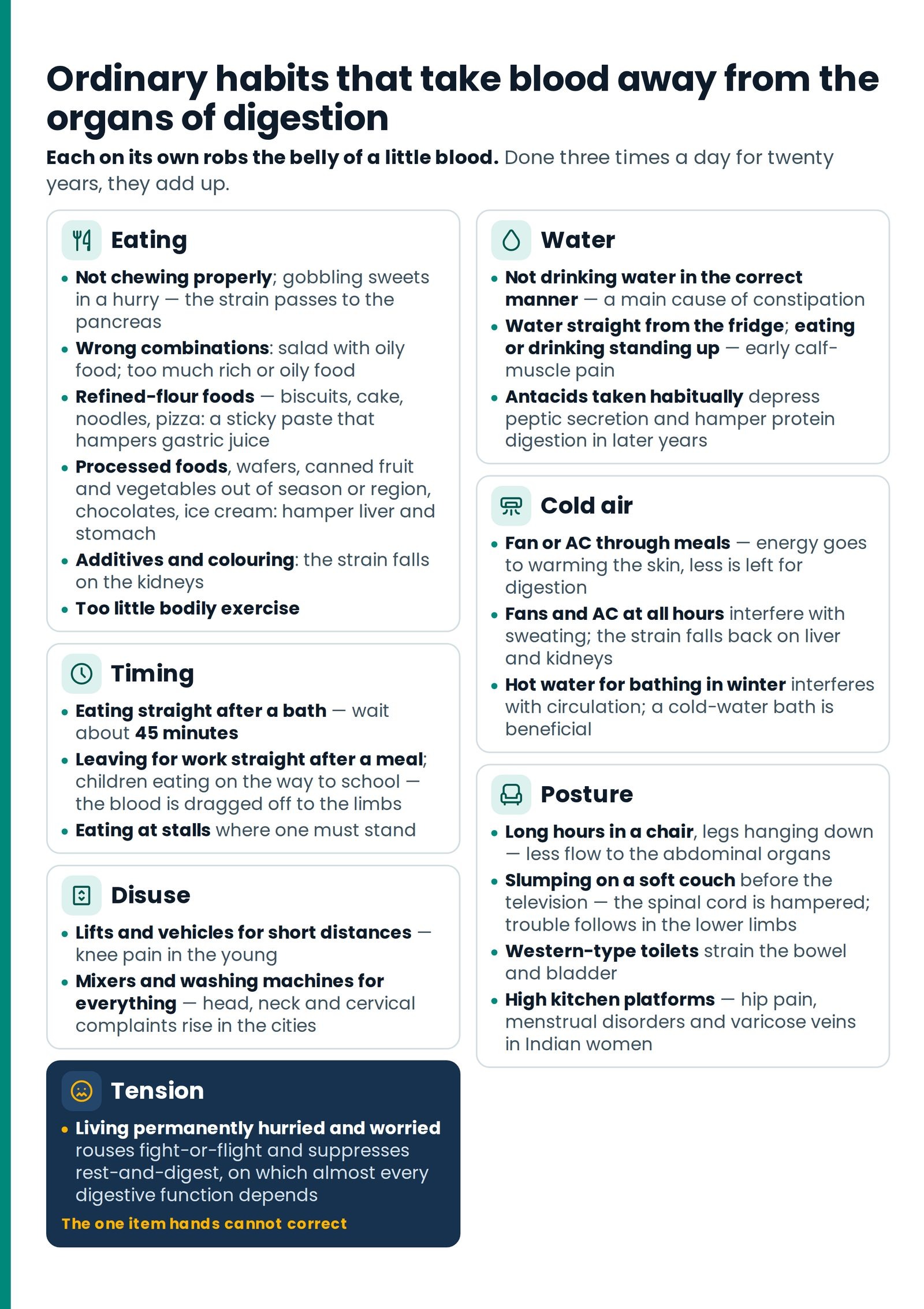
Underneath the seven sit the small daily things, set out in detail because their whole power lies in repetition. Each on its own robs the organs of digestion of a little blood; none on its own makes anybody ill. Done three times a day for twenty years, they are why a belly of fifty is not doing what a belly of twenty did. (Figure 3.13)
The comment on that last row deserves repeating, because it is the only item a therapist cannot correct with her hands. Over two or three centuries we have drifted, without deciding to, into a manner of thinking hostile to health — no time for the body, business carried into the middle of lunch and dinner, no room left for being unhurried. It is high time we reviewed our values and our way of life. Say it to a patient once, kindly, then get on with the treatment; a therapist who says it every week stops being listened to.
Ordinary habits that take blood away from the organs of digestion. The small daily habits, grouped by kind, and what each one costs the belly.
Read next
The Fire and the Ash The Fire and the Ash — the therapy’s own way of finding and clearing the residue of poor digestion
Between Two Sessions Between Two Sessions — the daily rules of eating and living, each given in full with its reason
Why one side is so often short, and the stretch this therapy gives
We come now to a small observation with very large consequences, and it is the one to test on yourself before you finish this page.
Key teaching
Posture is the second great governor of muscle — and therefore of flow
After the state of relaxation of the muscles, the next most important factor influencing the working of the muscles is body posture — a fact which yoga recognises and corrects through the practices called āsana.
In Neurotherapy we hold that the application of pressure on the arms or the legs, over and above its other effects, also mimics the stretching actions found in several of the yogāsanas, and thereby helps to improve the functioning of the muscles.
Now the observation itself, which is the reason posture belongs in a article about chemicals at all.
Key teaching
Most people are not straight
Most persons tend to bend to one side or the other while sitting, while standing, and while walking.
Posture, even at the best of times, is far from ideal.
The consequence is not cosmetic. A body habitually bent to one side is a body in which the structures on that side are compressed for the greater part of every day — and so an organ on that side may not be receiving its proper blood supply for the greater part of the day.
This is why one kidney, and not both, is so often found sluggish; and it is why the first question of the examination is which side is short, not whether a side is short.
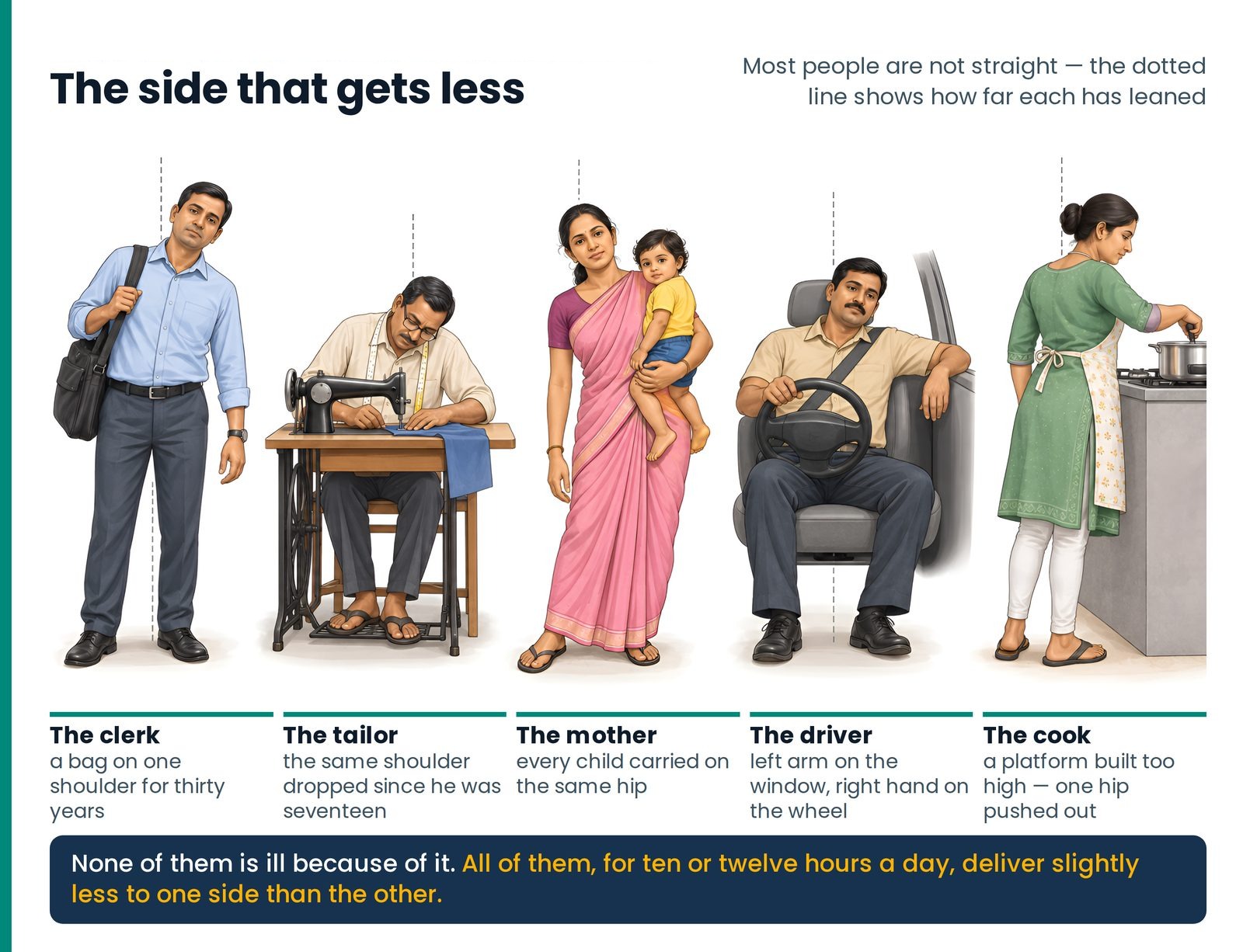
Watch people for a week and you will stop doubting it. The clerk with a bag on one shoulder for thirty years. The tailor bent over the machine with the same shoulder dropped since he was seventeen. The mother who carried every child on the same hip. The driver whose left arm rests on the window and whose right hand never leaves the wheel. The woman cooking at a platform built for a man, standing on the outer edge of one foot with the other hip pushed out. (Figure 3.14)
The side that gets less. Everyday leaning postures of a working life; the dotted line shows how far each person has leaned.
None of them is ill because of it. All of them are, for ten or twelve hours a day, delivering slightly less to one side than the other — and the account has been running for decades.
Two consequences follow, and both are practical.
First, look before you touch. Stand behind a new patient before she lies down and simply look: one shoulder lower, one hip higher, one foot turned further out, the head carried off centre? You are not making a diagnosis from it; you are forming an expectation the hands will confirm or contradict.
Second, understand what your pressure is standing in for.
Key teaching
What yogāsana does for oneself, this therapy does for another
Yogāsana is an ancient and very effective system of India, and India's gift to humankind. By yogāsana the muscles and the nerves are stretched and made flexible, and in that way the body is kept well and free of disease.
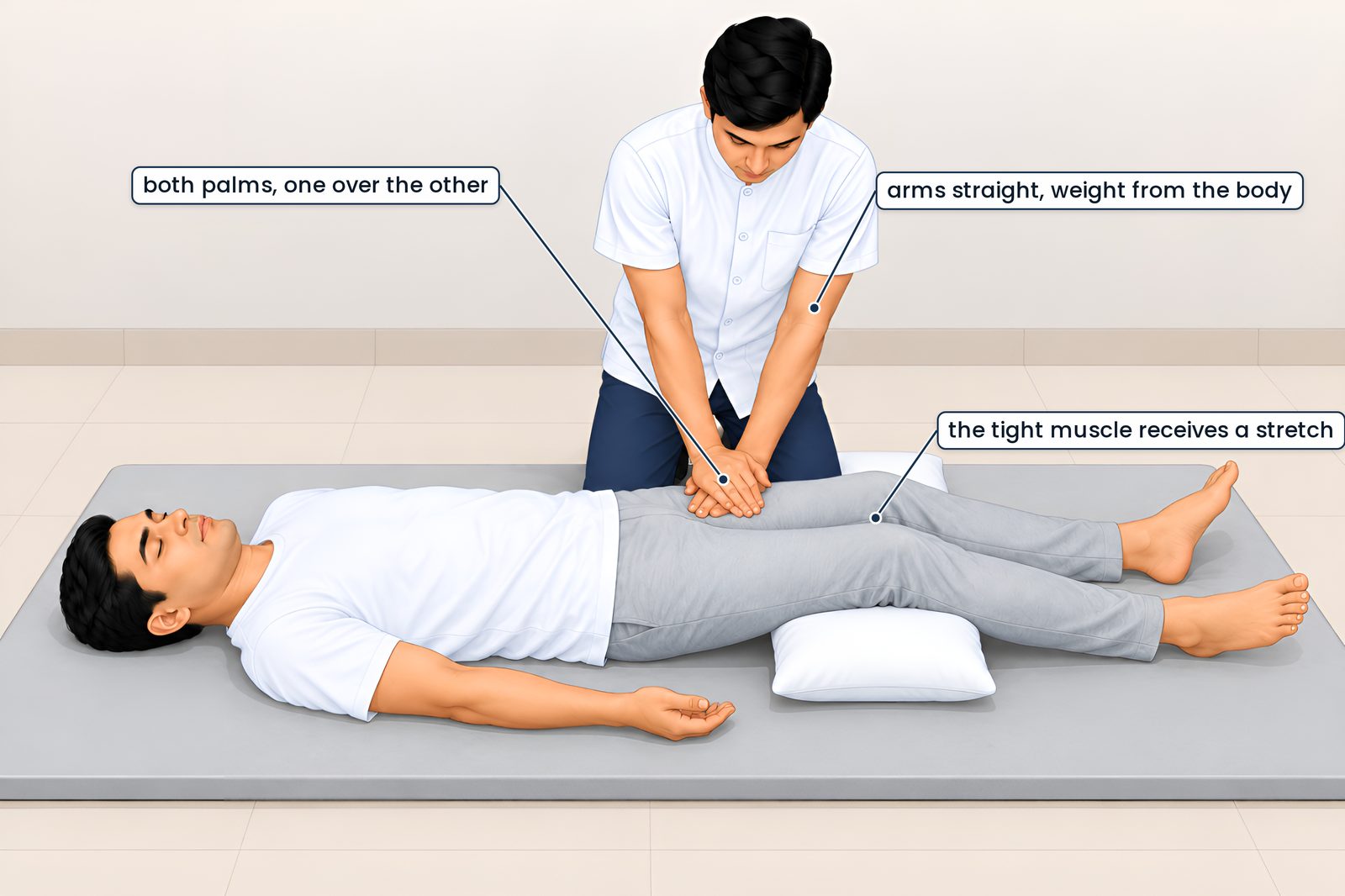
Seen in one way, the work which yogāsana does for oneself is the same work this therapy does for another. When we press with the foot on the thigh or on the arms, the muscles that have become tight or contracted receive a kind of stretch from our pressure, by which they become supple again. (Figure 3.15)
The principal benefit of this is easy to overlook. A patient with paralysis cannot perform a yogāsana. Nor can an intellectually disabled child, nor a very frail elder — and so, on top of everything else they carry, they acquire constipation, indigestion and repeated infections. Through this therapy we are able not only to relieve those, but to bring considerable improvement in their condition.
That is the answer to give when somebody says "then why not just tell people to do yoga?" Tell them to do yoga, by all means, if they can. The therapy exists for the body that cannot make its own stretch, and for the body whose organ is too far gone to be reached by a stretch alone. One heals the organ; the other holds the gain.
The stretch given to another: pressure along the thigh. The patient lies on his back on a mattress on the floor, a pillow under both thighs and none under the head. The therapist kneels at the patient's left side, level with the upper thigh, and lays both palms one over the other across the front of the thigh, fingers pointing towards the other leg; arms straight and shoulders over the hands, so the pressure goes straight down into the muscle. It is held for the determined count and then released completely, and the tight muscle receives a stretch the patient could not have given himself.
A novel approach to disease and its cure
The working assumptions, the paired organs and the four-step cycle
What makes this a different approach, and not merely a gentler one, is this. Modern investigation has assembled an enormous and reliable body of knowledge about how a body works, and this therapy uses that knowledge — but looks at it from a completely different angle, one in which the use of medicines is rejected. It does not dispute the physiology; it declines the pharmacy. How the founder came by that knowledge is told in The Man Who Would Not Accept 'Incurable', "The Man Who Would Not Accept 'Incurable'", and is not repeated here.
Out of that reading, and an experience of patients running into lakhs, come a set of working assumptions. They are the load-bearing beams of the formulary in , and a student who knows them can often work out why a formula is built as it is instead of memorising it blind.
Key teaching
The assumptions this therapy works on
1. Many of the body's principal chemicals are made in two places, or in more than two. If one place goes bad, that chemical will not be made there. We then provoke the other place, from which the chemical is secreted, and the disease is cured.
2. The pituitary gland has an effect on many of the hormone glands. Both parts of the pituitary can be provoked by this treatment — and by provoking the pituitary, disorders of the hormone glands are corrected.
3. The raw materials of all hormones are made from only three substances — cholesterol, tyrosine amino acid and proteins. For these to be formed and absorbed properly the digestive system must be right, which is what this therapy corrects.
4. A shortage of even one of the brain's principal chemicals spoils the working of the central nervous system. We then provoke the enteric nervous system of the intestines, and by that route treat the disease of the brain — as in Parkinson's and motor neuron disorder.
5. Apart from vitamin K and folic acid, the vitamins are not made in the body; they must come from food. Certain pains behind the back are linked with certain vitamin deficiencies. As the digestive system is set right and the pain is drawn out of those points, the symptoms of the deficiency begin to reduce — and vitamin-deficiency diseases are corrected without medicine.
6. When the cells of the thymus gland begin to kill the cells of one's own body, that is called auto-immunity, and the diseases arising from it auto-immune disorders. Such patients are given steroid medicines, whose ill effects follow. This therapy's control is over the adrenal gland, which suppresses the thymus. So to correct such diseases we provoke the adrenal cortex and the steroid is made within the body itself — where it has no side effect.
7. Wherever the body has two glands of one kind, their work is nevertheless not the same.
That seventh assumption is the founder's own discovery, and it changes how a therapist thinks about symmetry.
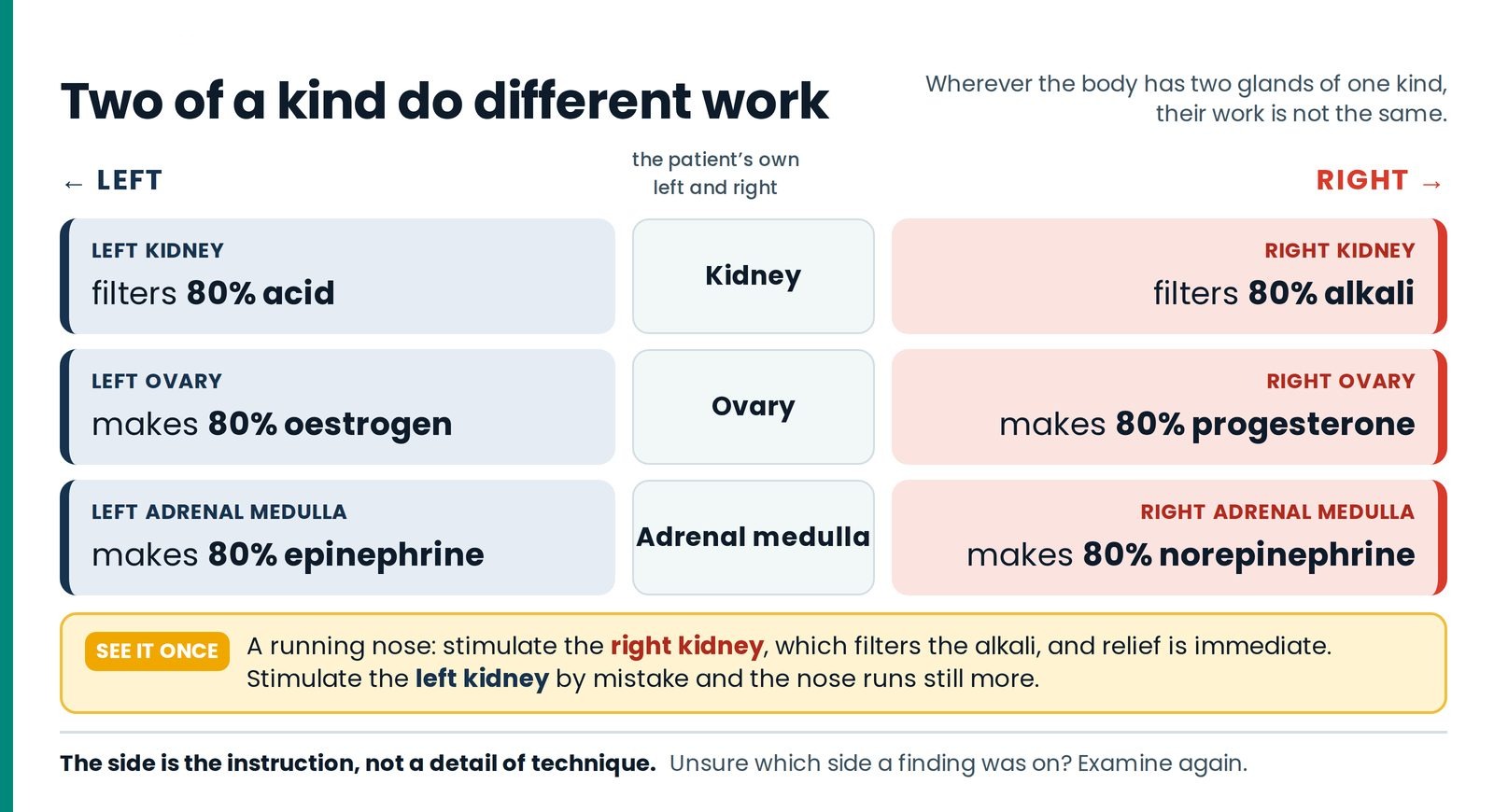
The old yogis knew, the material observes, that the two sides of the nose do not do the same work: the right raises the burning-down side of metabolism and warms the body, the left raises the building-up side and keeps it cool, and from the two working together the body's chayāpachaya — its metabolism — stays right. In the same way, it is this therapy's discovery that both ovaries, both kidneys and both medullae of the adrenal gland do different work. (Figure 3.16)
Two of a kind do different work. Each member of a pair does different work, so the side named in a treatment is the instruction.
This can be demonstrated very easily. If someone's nose is running, stimulate the right kidney Right , which filters the alkali, and the patient gets immediate relief. Stimulate the left kidney Left in that patient by mistake and the nose will run still more and the condition will worsen. A student who has seen it once does not forget it. ▲ Take care
The same asymmetry governs one of the commonest treatments given to women. Because more oestrogen comes from the left ovary and more progesterone from the right, menstrual disorders are corrected by giving the oestrogen treatment — the left ovary Left — for the first fourteen days after the menses, and the progesterone treatment — the right ovary Right — in the following fourteen days. The order and the fortnight are the instruction; give them in the wrong halves of the month and you have given a different treatment whose effects you were not taught.
Finally, the whole method in four steps. Every examination you perform and every plan you write is this, repeated.
Read next
The Two Kingdoms The Two Kingdoms — the direction a body’s findings point in, and its treatment
From Findings to a Plan From Findings to a Plan — how to read several findings as one picture
A pain point is where a shortage inside is reported on the outside
One paragraph, so that nothing is left dangling; the map has its own article.
When there is disease, or the symptoms of disease, in a body, then on pressing certain determined points near the navel, or near the hip bone, or near both, pain or stiffness is felt. Finding them is simple: with the tips of the fingers press gently inwards at the determined places. The presence of pain at any place indicates that in that part, and in the organs related to it, there is some disturbance in the flow of blood — very often a pain the patient did not know she had. Note that this looking-for-pain, and the information taken from it, is a different act from the examination a physician calls palpation.
For convenience the points carry code names, generally indicating the principal organ or symptom of that region; sixteen lie around the navel in front, four near the hip, and two on the back behind the waist. Where each lies, what stands behind it and what a finding at it means is The Navel Speaks First; how to press so that you find what is there and do not create it is The Educated Hand; how to read several findings as one picture is From Findings to a Plan.
Keep only this much from the present article: a pain point is not a magic spot. It is the place at which a shortage inside is reported on the outside. That is why relieving it means something — and why relieving it is not the same as having finished. (Figure 3.17)
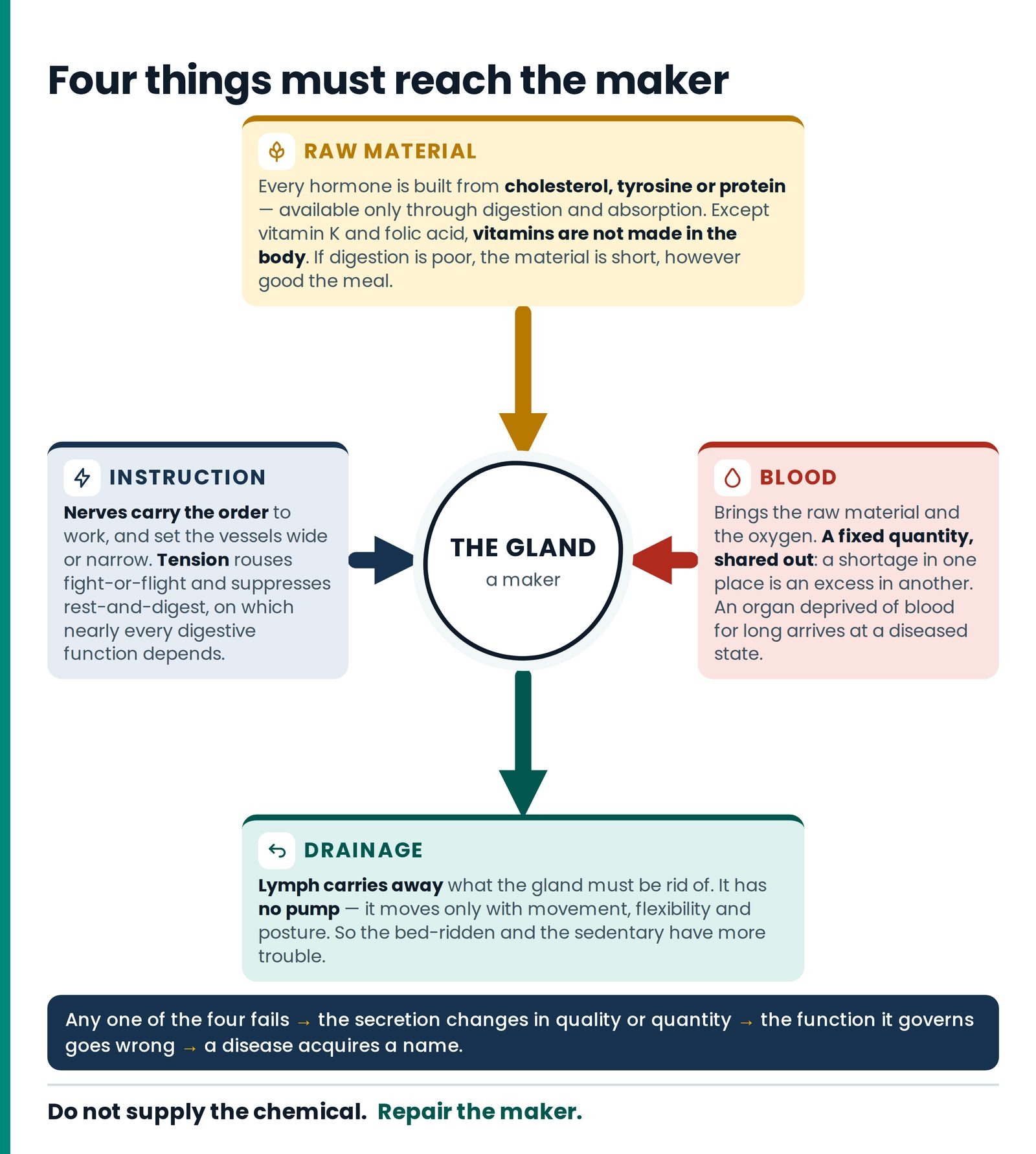
Four things must reach the maker. Raw material, blood, drainage and the nerve’s instruction must all reach a gland before it can make its chemical.
Two bodies, read as this article teaches
Two composite cases, reasoned the way this chapter teaches
Ready to begin?
Send COURSE for course details, or your name, age and health issue for a consultation.