Watch


Snakebite
One incident, held as tightly as its evidence allows
A question arises of its own accord. Removing scorpion poison is one thing. Can this treatment remove the poison of a snake?
The honest answer begins with an admission: as it happens, after a snake bite nobody comes to us for treatment. People go elsewhere, and they are right to. So there is no series of cases. What there is is one incident, from 2006, in the ashram — and from it, it seems this treatment ought to succeed in removing snake poison too.
The snakebite instruction, given whole
Believe it or not — if someone is bitten by a snake, giving this treatment first will certainly give relief. Afterwards, if there is need, other appropriate treatment can certainly be given.
This is a simple and sovereign remedy — rāmbāṇ upāy — which should especially be taught to village people, so that they may protect themselves from the effect of poisonous herbs and from creatures like snakes and scorpions.
Read the second sentence as carefully as the first, because it is part of the instruction and not an afterthought. Afterwards, if there is need, other appropriate treatment can certainly be given. The treatment is offered as the thing done first, in a village, at night, by hands that are already there — not as the thing done instead.
That is the instruction as it stands, and this wiki does not edit its own teaching. The line to be said in the same breath is the one every therapist already knows and which the second sentence above provides for: a poisoning belongs where a poisoning can be reversed. Whatever is done with the hands is done alongside the journey, never in place of it. The boundary of this work, in every condition, is When the Hand Must Stop, "When the Hand Must Stop", and it applies here as it applies everywhere.
मार या अपघात का उपचार
This is an amazing treatment, and it is built on a piece of reasoning you can follow from end to end.
What happens when a blow lands. The skin tears and the capillaries beneath break, and a little blood comes out. If the injury is greater, or the blow deep, this blood flows outside the body — which is called haemorrhage. Otherwise it stays inside and becomes a bruise, gumchoṭ.
What is usually done about it. So that infection should not occur, various medicines called antiseptic are applied to the outside.
And what the therapy noticed. Our own body has a chemical that does an antiseptic's work: bile — which the liver makes and the gall bladder stores.
From there the argument builds in three steps, and each step names a job and the organ that does it.
The three reasons the liver and the gall bladder are treated for an injury
One — the body's own antiseptic. Bile, made by the liver and stored in the gall bladder, does an antiseptic's work.
Two — clearing away the dead. One work of the liver's Kupffer cells is to finish off the dead cells of old tissues, so that new cells can form properly there. A wound is not only a hole; it is a hole with wreckage in it, and nothing new is built until the wreckage is cleared.
Three — the raw materials. For anything to be made anywhere in the body, the responsibility for the raw materials belongs to the liver. New tissue is a building project, and the liver is the yard it draws from.
And a fourth observation, which is this therapy's own. It has also been seen that on giving Thymus or Thymus Chest treatment, pain reduces immediately and new tissues begin to form quickly.
There is no mention of this work in physiology. This is a unique and matchless discovery of LMNT — of Guruji's experience — for the whole human race.
The conclusion: on receiving a blow, if we provoke the gall bladder and the liver and give Thymus Chest, the patient will benefit.
On that inference the following treatment was made, which has proved extremely beneficial at many centres in the country and abroad.
Table 4 — Card: the Injury treatment formula Supine Prone 6 sec × 3 ▲ Take care
| Written | I 60 TF 'Gal – Liv' × 3 treatments · II (1) Gal (1) Liv – 3 points (4) Ch. Only · III (1) Gal (1) Liv – 3 points (4) Thymus+Chest · IV (1) Gal (1) Liv – 3 points (8) Thymus+Chest + (4) Thrd* | ||
|---|---|---|---|
| What it is for | A blow or an accident — bruise, haemorrhage, haematoma, sprain, torn ligament, and the marks of old wounds, burns and scalds | ||
| Part I | 60 TF 'Gal – Liv' × 3 treatments. TF is the toe-finger rub: at every joint of the named toes, rub the three sides as many times as the number written. Here that number is sixty, at each joint. 'Gal – Liv' narrows it to two toes only — the middle toe of the LEFT foot and the toe beside it, since Gal is the left middle toe and Liv the one next to it. Not the other toes. × 3 treatments — three rounds, with the rest of Table 8 between them Supine | ||
| Part II | (1) Gal — one full pass of the therapist's right sole down the patient's left thigh, three or four stations, six seconds at each, without stopping. (1) Liv – 3 points — one pass of three paired stations, left arm and left thigh together. (4) Ch. Only — the chest rub without the thymus: three rubs equal one, so four means twelve rubs on the left side, then twelve on the right 6 sec | ||
| Part III | The same Gal and Liv, and now (4) Thymus+Chest — the thymus point enters. All three contacts of the group, one side complete before the other | ||
| Part IV | The same Gal and Liv, and (8) Thymus+Chest — the thymus dose doubles — plus (4) Thrd, which carries an asterisk | ||
| The asterisk on (4) Thrd | If the injury is fresh — brand new — then giving (4) Thrd has proved beneficial. Perhaps this is because iodine will come out from the thyroid gland, which helps the wound heal quickly. If the wound is very old, there is no need to give (4) Thrd | ||
| The substitution | If there is diabetes, arthritis or any auto immune disorder — in place of (4) Thymus+Chest give (4) Ch. Only (10) ↑\ | ↓ (L1–L5), and in place of (8) Thymus+Chest give (8) Ch. Only (20) ↑\ | ↓ (L1–L5) ▲ Take care |
| How long | 10 to 15 days, or until the serum dries up | ||
| Points taught in | TF and the toe key, Lymph and the chest group — The Front of the Body II; Gal and Liv — The Front of the Body I; Thrd — The Front of the Body II; Round arrow — Face Down |
Reading the four parts
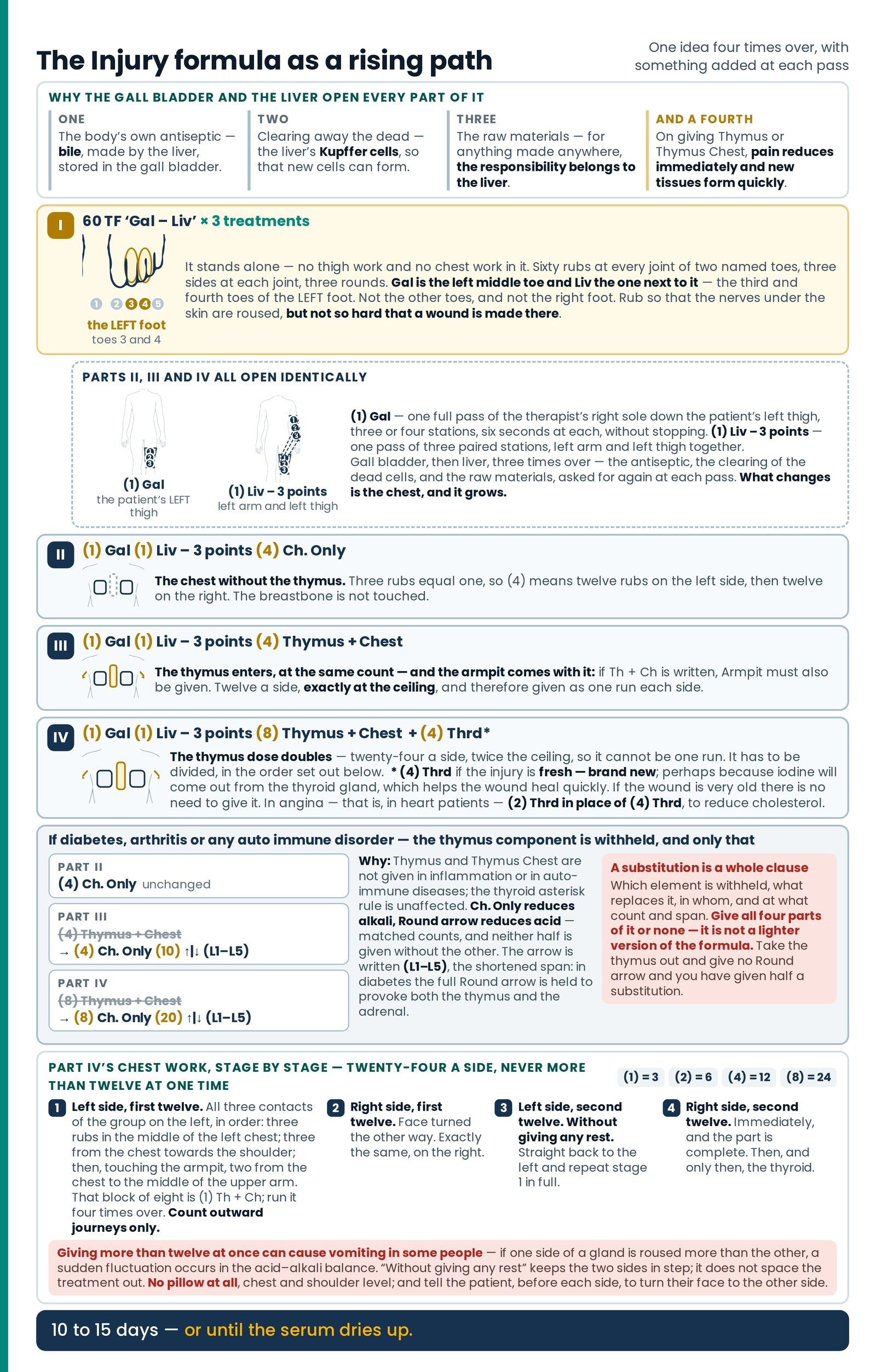
The formula is one idea repeated four times with something added each time, which is why it is easy to learn and easy to give wrong. (Figure 32.4)
Part I stands alone. Sixty toe-finger rubs at every joint of two named toes, three rounds — and nothing else. It is the only part with no thigh work and no chest work in it. 60 TF is a great many; the instruction that governs it is the one printed with the point: rub so that the nerves under the skin are roused, but not so hard that a wound is made there. On an injured patient that warning is not decorative.
Parts II, III and IV all open identically — (1) Gal, then (1) Liv – 3 points. Gall bladder, then liver, three times over. That is the antiseptic, the clearing of the dead cells, and the raw materials, asked for again at each pass.
What changes is the chest, and it grows. Part II gives (4) Ch. Only — the chest without the thymus. Part III gives (4) Thymus+Chest — the thymus enters at the same count. Part IV gives (8) Thymus+Chest — the same treatment at double the count — and adds the thyroid.
Read downward and you can see the design. The chest is opened up before the thymus is asked for anything, and the thymus, once it enters, is doubled. That ramp is the formula.
The word Only, and why it is in this formula twice
Ch. Only is the chest without the thymus and without the armpits. Th. Only is the breastbone alone — not chest, not armpits. Th + Ch is all three, and if Th + Ch is written then Armpit must also be given; a therapist who gives the breastbone and the chest and stops there has not given Th + Ch.
This is exactly why the therapy troubles to give the chest a name of its own. Th + Ch is withheld in inflammation and in auto-immune diseases — and Ch. Only is not, because it is a separate point with a separate entry.
So when the Injury formula's substitution takes out Thymus+Chest and puts in Ch. Only, it is not weakening the treatment. It is keeping the chest work and dropping the one component that is barred in that patient. The word Only was invented for precisely this moment.
The substitution — diabetes, arthritis, and any auto-immune disorder
This is the most instructive substitution in the formulary, because it does two things at once and both are visible here.
Table 5 — The Injury formula's substitution, set out so it cannot be got wrong ▲ Take care
| As written | If there is diabetes, arthritis or any auto immune disorder | ||
|---|---|---|---|
| Part II | (4) Ch. Only | unchanged — (4) Ch. Only | |
| Part III | (4) Thymus+Chest | (4) Ch. Only (10) ↑\ | ↓ (L1–L5) |
| Part IV | (8) Thymus+Chest + (4) Thrd* | (8) Ch. Only (20) ↑\ | ↓ (L1–L5) (the thyroid asterisk rule is unaffected) |
| What has gone | — | The thymus component, and only that | |
| What has arrived | — | Round arrow, restricted to L1–L5 | |
| Why | — | Thymus and Thymus Chest are not given in inflammation or in auto-immune diseases |
Notice the counts that arrived with the arrow. (4) Ch. Only is paired with (10) ↑|↓; (8) Ch. Only is paired with (20) ↑|↓. Those are not arbitrary. They are the matched proportions of one of the four inseparable pairs established in How a Formula Is Built — (8) Ch. Only → (20) ↑|↓, and (4) Ch. Only → (10) ↑|↓ — in which Ch. Only reduces alkali and Round arrow reduces acid, and the two, matched by their counts, hold the internal balance where the rest of the formula has put it. The substitution has not merely removed a thymus. It has put in a balanced pair in its place. The pair itself, in every count and variant, belongs to Water and Salt, "Water and Salt"; here you need only know that the counts travel together and that neither half is given without the other.
And notice the span written after the arrow. (L1–L5) is not the usual Round arrow, which runs from below the neck down the right side of the column to L5 and back up the left. It is the shortened form, given only over the lumbar beads — and that restriction has a reason of its own attached to it: in diabetes, the full Round arrow is held to provoke both the thymus and the adrenal, so that the patient may be harmed by one or the other; there, Round arrow is given only as far as L1–L5. Which is to say: the substitution removes the thymus at the front of the body, and then declines to reach it from the back either. The logic is consistent all the way through.
The thyroid asterisk — fresh wounds and old ones
The footnote to part IV
* If the injury is fresh — brand new — then giving (4) Thrd has proved beneficial. Perhaps this is because iodine will come out from the thyroid gland, which helps the wound heal quickly. If the wound is very old, there is no need to give (4) Thrd.
The perhaps is the therapy's own and it stays. What is not a perhaps is the clinical rule, which is exact and easy: (4) Thrd is for the fresh wound. For the very old wound there is no need of it.
So the same card, given to two patients on one afternoon, ends differently. The man who fell this morning gets part IV with the thyroid. The woman whose burn mark is nine years old gets part IV without it. Nothing else in the formula changes.
And one substitution travels with Thrd itself, from the point's own entry, and it bites exactly where you would expect it to. (4) Thrd raises the metabolism — the body's rate of building up and breaking down. In a heart patient that increase throws a burden onto the heart and the trouble can increase. So in angina — that is, in heart patients — (2) Thrd is given in place of (4) Thrd, to reduce cholesterol. Both halves of a substitution travel together: which count is withheld, which replaces it, in whom, and why.
Note also how Thrd is given, since it is the one point in this formula that goes near the throat: the neck loose and relaxed, no pillow under the head if it is not needed, the flats of both palms on both sides of the hollow of the throat over a broad surface of two to three inches — never a fingertip — and a light push with an immediate release, twice in a single movement, which is (1) Thrd. Larger numbers are done that many times without stopping. And tell the patient beforehand that some people occasionally get a cough during this treatment, so that they are not alarmed.
The twelve-rub arithmetic, which governs part IV
This is where the Injury formula is most often given wrong, and the error is pure arithmetic.
In Thymus Only, Chest Only and Thymus Chest, three rubs equal one. So the written number multiplies:
| Written as | Rubs on the left side, then the same on the right |
|---|---|
| (1) | 3 |
| (2) | 6 |
| (4) | 12 |
| (8) | 24 |
And over that sits the ceiling: in Thymus or Thymus + Chest, do not do more than 12 times on any one side at one time.
(4) Thymus+Chest, in part III, converts to twelve a side — exactly at the ceiling, and therefore given as one run each side.
(8) Thymus+Chest, in part IV, converts to twenty-four a side — which is twice the ceiling, and cannot be one run. It has to be divided, and the division has an order of its own that a table would mangle.
Haematoma, serum, and the ten-to-fifteen-day course
Now the part of the reasoning that decides how long the course runs.
If the injury is deep and the upper skin is not particularly damaged, the blood from the capillaries cannot come outside. It collects beneath the skin instead, and that is called a haematoma.
In blood there are RBC, WBCs, platelets, calcium and many clotting factors. When the blood begins to clot, these substances get set into that clot — and as they do, a light-yellow, water-like liquid separates out. That liquid is called serum.
What the Injury formula is aimed at, and how long it runs
When a blow is received we must first of all finish that collected serum.
For that too the above Injury treatment has proved very effective, and it is to be given for 10 to 15 days, or until the serum dries up.
Read the second half of that sentence as an instruction and not as an estimate. The course has two ends: a stated length, and a stated finishing condition. Ten to fifteen days is what it usually takes. Until the serum dries up is what actually ends it.
And the astonishing thing is that this treatment is also successful in erasing the marks of years-old wounds, or of burns or scalds.
Sportsmen, and an offer that stands
Guruji's keen desire is that sportsmen and their trainers should learn this treatment, so that they may get immediate relief from sprains and wound-pain on the playing field. Even a completely torn ligament has been fully healed after neurotherapy treatments — we have the proof of a case of 2010.
That is an open invitation, printed beside a claim, by a man who kept no records of his own achievements and said so. It is the right thing to say after a sentence about a torn ligament, and a therapist who repeats the claim should repeat the offer with it.
The (8) Medulla question, left open
One line reaches this formula from another family and it is given here exactly as it stands, because it is a question and not an instruction.
When haemorrhage occurs, serotonin is released from the platelets, which constricts the blood vessels at that place, so that the flow of blood there is reduced. In this way serotonin helps the work of the platelets and helps in healing.
So will (8) Medulla give benefit in Injury treatment? This is to be tried.
(8) Medulla is the serotonin treatment, and its whole account — what it is for, and the three conditions in which it is refused — is in The Medulla Family, "The Medulla Family". It is not part of the Injury formula. It is a reasoned suggestion that somebody should find out, written down and left standing. It is not resolved in this article, and no later article resolves it either.
The note that belongs here: (6) Right Swt for bronchial asthma
Right constricts, left dilates: the side is part of the point
Before the viral formulas, one treatment has to be brought across from another article and taught properly, because it was named there only in passing and it belongs to this subject.
The context is the white cells, and specifically the eosinophils — one of the three kinds of granulocyte. Two facts about them were set down together:
Eosinophils destroy parasitic organisms. They release chemicals that cause bronchoconstriction in asthma — that is, narrowing of the airways.
And from infection in the lungs, eosinophils increase.
Put the two together and a lung infection becomes an asthma problem by a chain you can follow: infection in the lungs → eosinophils rise → the chemicals they release narrow the airways.
The treatment for bronchial asthma, that is bronchitis
For bronchial asthma, that is bronchitis — the treatment is (6) Right Swt.
Right, not left. Side is part of the identity of the point, not a detail of technique.
Table 6 — Card: (6) Right Swt Prone Right ▲ Take care
| Written | (6) Right Swt |
|---|---|
| Site | Beside the T6–T12 beads of the back |
| Position | Prone, with one and a half pillows under the chest — compulsory Prone |
| The hands | For Right Swt: the left palm completely flat on the left side of the bead, and only the right hand standing on its edge, giving pressure straight downward with that edge Right |
| The count | Press and release six times. There is no doubling convention at this point — the written number is the number of presses |
| What it is for | Stimulating the medulla part inside the adrenal gland; also stimulating the sweat glands. And here: bronchial asthma, that is bronchitis |
| The polarity | When Right Medulla and Right Swt are given, sphincters or arteries will narrow or constrict. With Left Medulla and Left Swt they open or dilate |
| Point taught in | Face Down, "Face Down" |
The polarity rule in the last row but one is the reason the side is written, and it is taught whole — with all twelve of its cranial-nerve applications — in Cranial Nerve and Brain Formulas, "The Twelve Messengers". Here, take only what the card needs: Left Swt with Left Medulla opens; Right Swt with Right Medulla closes. A card that says Swt with no side has not told you which of two opposite instructions was meant, and is to be sent back.
And note, without merging them, that the asthma patient may meet a second treatment in this article's family from an entirely different direction: from the prostaglandins the bronchioles relax, and in asthma the patient obtains immediate relief from (30) Medulla — an experience proved on many patients, and set out in full in The Medulla Family. Two treatments, two families, two accounts. Each is given for what it is given for, and neither is a version of the other.
A few days ago a person asked a question that every therapist will be asked eventually, usually by somebody who means it sincerely: can we kill virus or bacteria by this treatment? If not, how are you successful in treating diseases caused by virus or bacteria without medicine?
Since such a question naturally arises in anyone unfamiliar with this work, it must be answered — and the answer is the whole design of the formulas that follow.
The answer, in the therapy's own reasoning
Yes indeed.
In our body there are many such cells which have this very capacity. If we can provoke them, we have no need of medicines to kill virus or bacteria.
Since there are many crores of viruses and bacteria in the world, and new ones keep being made, the problem does not end with a few bacteria-killing medicines.
And then the sentence the formula is built on: for those who get infection from a virus or bacteria, the root cause is not that virus or bacteria — the root cause is that the immunity in their body, the power to fight disease, has decreased.
So we need only to increase our immunity. And this work medicine cannot do — because the antibiotics given to kill bacteria also harm the beneficial bacteria of our body, from which our immunity will decrease still further.
The image the therapy uses to explain itself is worth keeping, because patients understand it instantly.
If someone tells us to make a line shorter without erasing it, what should we do? Draw a longer line beside it — and the first begins to look shorter.
In bacterial or viral infection we put things right in exactly this way. When the line of the body's immunity becomes longer than the powerful line of the virus, the virus can do that body no harm at all.
Nothing has been rubbed out. The germ has not been attacked. What has changed is the comparison — and it is the only one of the two lines a pair of hands can do anything about.
Who does the work, and where they live
Only the body can do this work.
In our body there are many cells for fighting external germs — natural killers, gamma globulin, immuno globulins, interleukins and so on. And besides these, in our thymus gland, spleen and lymph nodes there are the special cells of the white blood cells, that is lymphocytes, which maintain our immunity.
By treatment we provoke these cells, so that our immunity increases; then no harm comes to the body from any virus or bacteria, and no harm comes to the beneficial bacteria of the body either. That is why this therapy is successful in these diseases.
And the map that turns all of that into a formula: inside our body many kinds of cells work like bodyguards, saving it from viruses, bacteria and other germs. These are mainly made by the thymus gland, the spleen and the parotid gland, and reside in large quantity in the lymph nodes found in the thighs and in the groin or armpit. We provoke the nodes of the thighs by the treatment named Lymph.
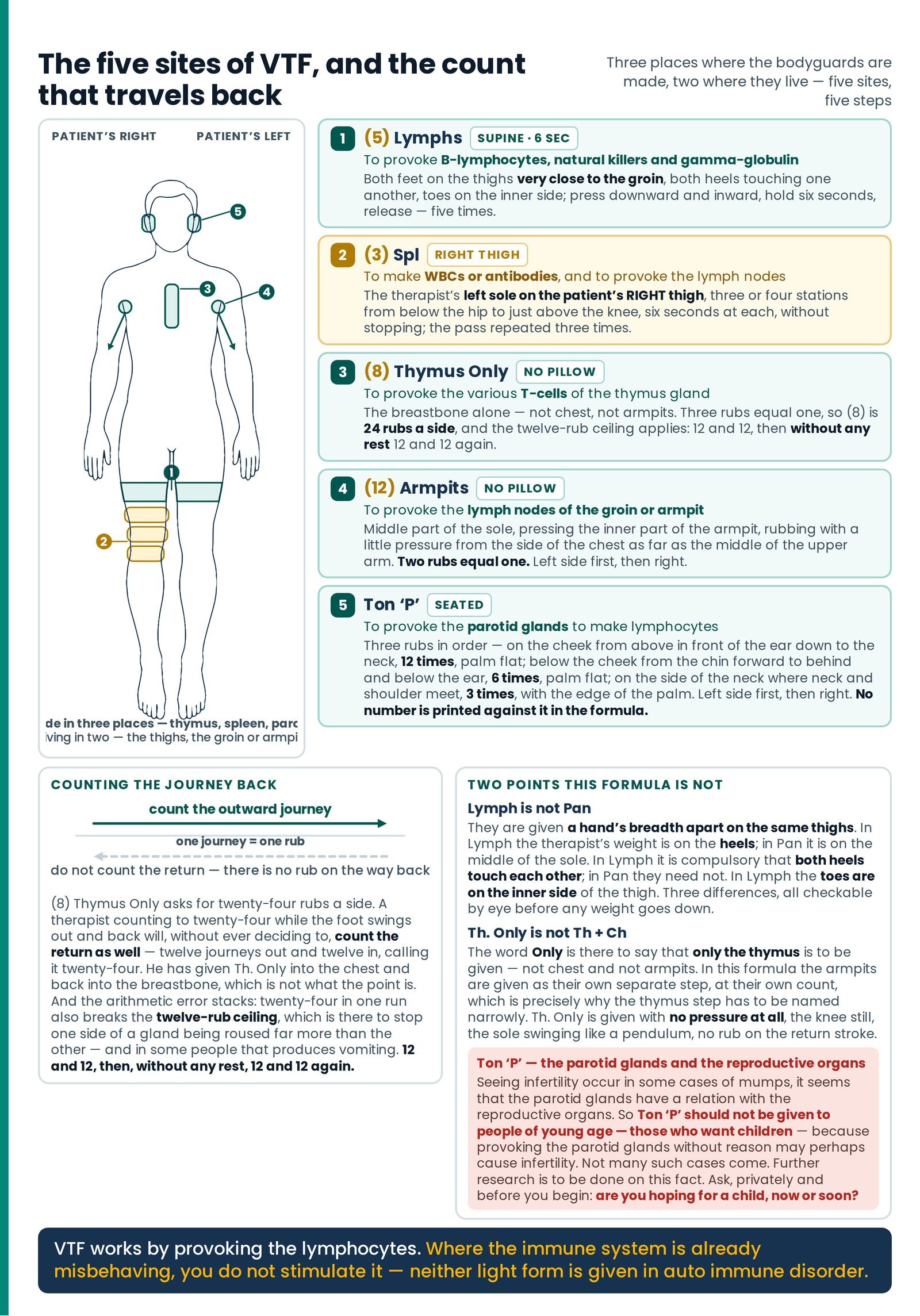
Read that map and the formula almost writes itself. Three places where the bodyguards are made — thymus, spleen, parotid. Two places where they live in quantity — the thighs, and the groin or armpit. Five sites, five steps. (Figure 32.5)
Table 7 — Card: VTF, the Viral Treatment Formula — the original form Supine Seated 6 sec ▲ Take care
| Written | (5) Lymphs (3) Spl (8) Thymus Only (12) Armpits + Ton 'P' |
|---|---|
| What it is for | Increasing the body's immunity, so that its capacity to fight any external or internal virus or bacteria increases. This protects the body from every kind of viral fever or other infection |
| (5) Lymphs | To provoke B-lymphocytes, natural killers and gamma-globulin. Both feet on the thighs very close to the groin, both heels touching one another, toes on the inner side; press downward and inward, hold six seconds, release — five times Supine 6 sec |
| (3) Spl | To make WBCs or antibodies, and to provoke the lymph nodes. The therapist's left sole on the patient's right thigh, three or four stations from below the hip to just above the knee, six seconds at each, without stopping; the pass repeated three times Right |
| (8) Thymus Only | To provoke the various T-cells of the thymus gland. The breastbone alone — not chest, not armpits. Three rubs equal one, so (8) is 24 rubs a side, and the twelve-rub ceiling applies: 12 and 12, then without any rest 12 and 12 again ▲ Take care |
| (12) Armpits | To provoke the lymph nodes of the groin or armpit. Middle part of the sole, pressing the inner part of the armpit, rubbing with a little pressure from the side of the chest as far as the middle of the upper arm. Two rubs equal one. Left side first, then right Left Right |
| Ton 'P' | To provoke the parotid glands to make lymphocytes. Three rubs in order — on the cheek from above in front of the ear down to the neck, 12 times, palm flat; below the cheek from the chin forward to behind and below the ear, 6 times, palm flat; on the side of the neck where neck and shoulder meet, 3 times, with the edge of the palm. Left side first, then right. No number is printed against it in the formula Seated |
| Position note | No pillow at all for Th. Only and Armpits — the chest and the shoulder must be level with one another |
| Restriction | Ton 'P' is not given to those who want children — see the caution below ▲ Take care |
| Points taught in | Lymph, Th. Only, Armpit — The Front of the Body II; Spl — The Front of the Body I; Ton 'P' — Uncommon Problems |
Two details on that card decide whether the formula is given correctly or only approximately.
Lymph is not Pan. They are given a hand's breadth apart on the same thighs. In Lymph the therapist's weight is on the heels; in Pan it is on the middle of the sole. In Lymph it is compulsory that both heels touch each other; in Pan they need not. In Lymph the toes are on the inner side of the thigh. Three differences, all checkable by eye before any weight goes down.
Th. Only is not Th + Ch. The word Only is there to say that only the thymus is to be given — not chest and not armpits. In this formula the armpits are given as their own separate step, at their own count, which is precisely why the thymus step has to be named narrowly. And Th. Only is given with no pressure at all, the knee still, the sole swinging like a pendulum, no rub on the return stroke.
By this treatment we increase the body's immunity, so that its capacity to fight any external or internal virus or bacteria increases. This protects the body from every kind of viral fever or other infection.
Ton 'P', mumps, and a restriction the therapy imposed on itself
Asking the question is your business. Are you hoping for a child, now or soon? — asked privately, plainly, and before this point is used, not after.
VTF (Mild), and the version for chronic disease
Earlier Guruji used to give the heavy treatment above. Nowadays it has been made mild — light.
That word — nowadays — is the therapy's own, and it is how this wiki prints every generation of every formula. The older version is not deleted. It stands above, complete, because a card written in 1995 is still a card somebody may have to read.
Table 8 — Card: VTF (Mild) Supine 6 sec × 3 ▲ Take care
| Written | VTF (Mild) → (1) Lymph (1) point Spl (1) Th. Only × 6 trt. |
|---|---|
| (1) Lymph | One application — both heels close to the groin, touching, pressed downward and inward, six seconds 6 sec |
| (1) point Spl | One point of the Spl pass, not the whole pass |
| (1) Th. Only | The breastbone alone — three rubs a side, no pressure at all, no rub on the return |
| The rounds | × 6 treatments — the whole line performed as one round, six rounds in all, with the rest Table 8, How a Formula Is Built sets for it |
| What it is for | Beneficial for everyone, to protect the body from disease |
| Timing | It can be given even after fever has come |
| Who else | It is also suitable for small children |
| When it must not be given | If a patient has an auto immune disorder, we do not give this treatment, because provoking the lymphocytes may increase their disease ▲ Take care |
| What has gone from the heavy form | Armpits and Ton 'P' — and with Ton 'P', its fertility restriction |
Then, on practising, a further thing was found: when cells are made in the bone marrow, the spleen's cells control inflammation. And from that, a third generation. (Figure 32.6)
Table 9 — Card: VTF for chronic disease Supine 6 sec × 3 ▲ Take care
| Written | (1) Lymph (1) Th. Only × 6 treatments |
|---|---|
| What it is for | Nowadays, in the treatment of old diseases like cancer |
| The rule about the spleen | In old diseases, provoke Spl only when there is need — that is, if there is pain at the Spl point. Otherwise not |
| Why the spleen comes out | Because when cells are made in the bone marrow, the spleen's cells control inflammation |
| The rounds | × 6 treatments |
| When it must not be given | As for Mild — not in auto immune disorder ▲ Take care |
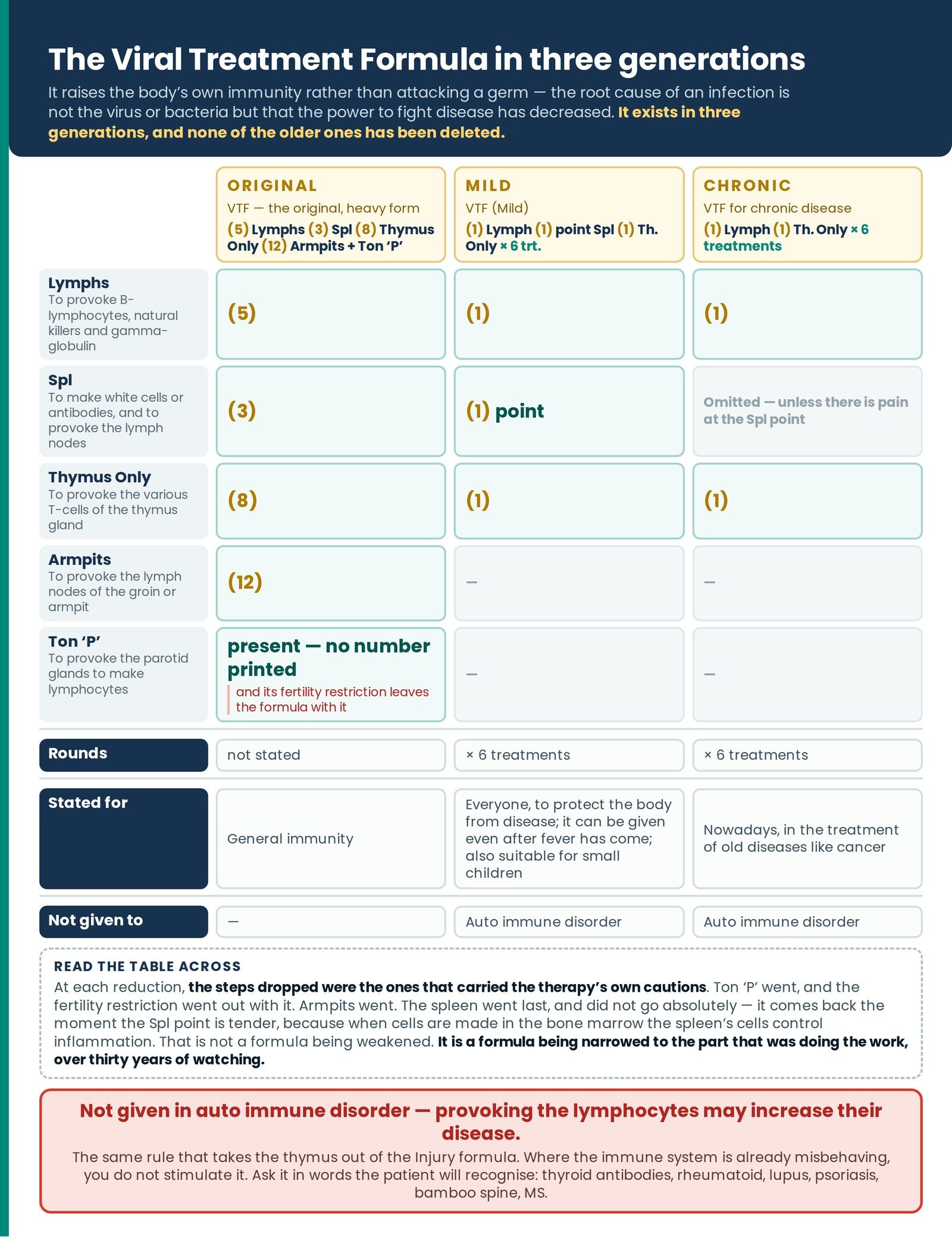
The three generations, and what changed at each step
Table 10 — The Viral Treatment Formula in all three generations
· VTF (original, heavy) · VTF (Mild) · VTF for chronic disease
Lymphs · (5) · (1) · (1)
Spl · (3) · (1) point · Omitted — unless there is pain at the Spl point
Thymus Only · (8) · (1) · (1)
Armpits · (12) · — · —
Ton 'P' · present, no number printed · — · —
Rounds · not stated · × 6 treatments · × 6 treatments
Stated for · General immunity · Everyone; after fever has come; small children · Old diseases like cancer
Not given to · — · Auto immune disorder · Auto immune disorder
Read the table across and one thing is unmistakable. At each reduction, the steps dropped were the ones that carried the therapy's own cautions. Ton 'P' went, and the fertility restriction went out with it. Armpits went. The spleen went last, and did not go absolutely — it comes back the moment the Spl point is tender.
That is not a formula being weakened. It is a formula being narrowed to the part that was doing the work, over thirty years of watching.