Watch


The edge of the thigh bone — Parkhoo, right and left
Two stations at the upper hip, and a count in which two equal one
Two points, one on each side, and they are the reason the knees come up to the chest at all.
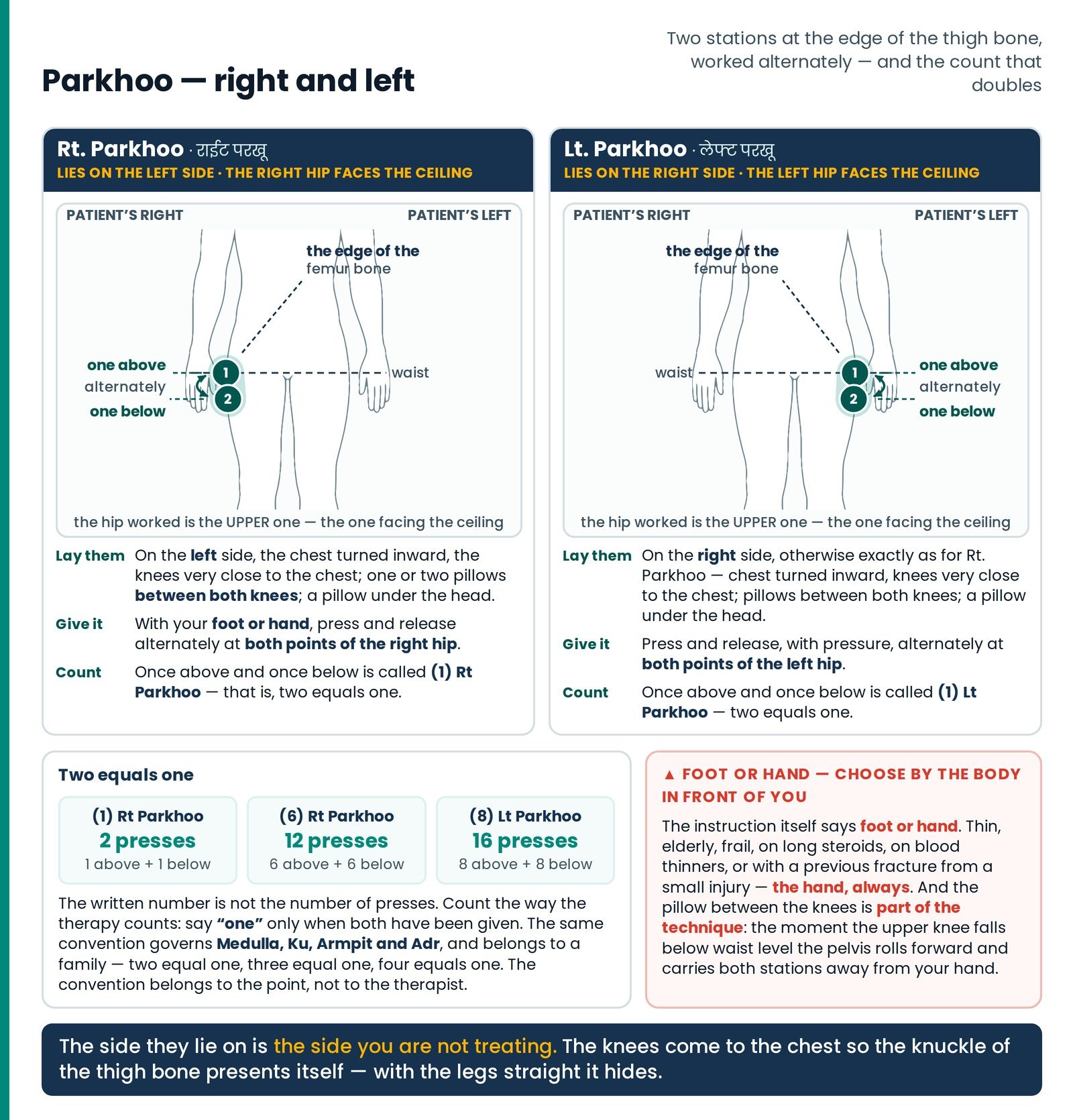
Lay the patient on the left side in such a way that the chest is turned inward and the knees are very close to the chest.
With your foot or hand, press and release alternately at both points of their right hip.
Doing it once above and once below is called (1) Rt Parkhoo. That is, the count is: two equals one.
| Patient's position | Lying on the left side, the chest turned inward, the knees very close to the chest; one or two pillows between both knees so the upper knee is not below waist level — especially compulsory in very thin thighs; a pillow under the head Side-lying Left ▲ Take care |
|---|---|
| Where the hands or feet are placed | The foot or hand at both points of the right hip — one above and one below — worked alternately Right |
| Duration and repetitions | Once above and once below is called (1) Rt Parkhoo — that is, the count is: two equals one |
| What it is for | Not separately stated at the point |
Rt. Parkhoo — राईट परखू
Lt. Parkhoo — लेफ्ट परखू
Lay the patient as above, but on the right side, and press and release with pressure, alternately, at both points of the left hip.
Doing once above and once below is called (1) Lt Parkhoo. That is, the count is: two equals one.
| Patient's position | Lying on the right side, otherwise exactly as for Rt. Parkhoo — chest turned inward, knees very close to the chest; one or two pillows between both knees; a pillow under the head Side-lying Right ▲ Take care |
|---|---|
| Where the hands or feet are placed | Both points of the left hip — one above and one below — worked alternately, with pressure Left |
| Duration and repetitions | Once above and once below is called (1) Lt Parkhoo — two equals one |
| What it is for | Not separately stated at the point |
The hip that is worked is the upper one, and that decides which side the patient lies on: for Rt. Parkhoo the right hip must face the ceiling, so the patient lies on the left. The side they lie on is the side you are not treating. (Figure 20.3)
The pillow between the knees is not preparation for this point. It is part of the technique. Everything Parkhoo aims at depends on the hip staying where you put it, and the moment the upper knee falls below waist level the pelvis rolls forward and carries both stations away from your hand. The pillows go in as the knees come up, and are checked again after the first press. (Figure 20.4)
The knees come to the chest for a stated purpose — *so that it is easy to give the treatment at the edge of the femur bone*. Drawing them up rolls the pelvis and swings the top of the thigh bone outward until its knuckle stands up under the skin, and the two stations sit at that edge. On a patient whose knees have quietly straightened, the same presses land on a hip rolled back flat, and the edge is no longer where it was.
Parkhoo and the count that doubles — two equals one
At Parkhoo the written number is not the number of presses. One press above plus one press below, worked alternately, make one of what the card asks for. So (1) Rt Parkhoo is two presses and (8) Rt Parkhoo is sixteen — eight above, eight below, alternating.
The same convention governs Medulla, Ku, Armpit and Adr, and belongs to a family: two equal one, three equal one, four equals one. Learn the family, not the individual points.
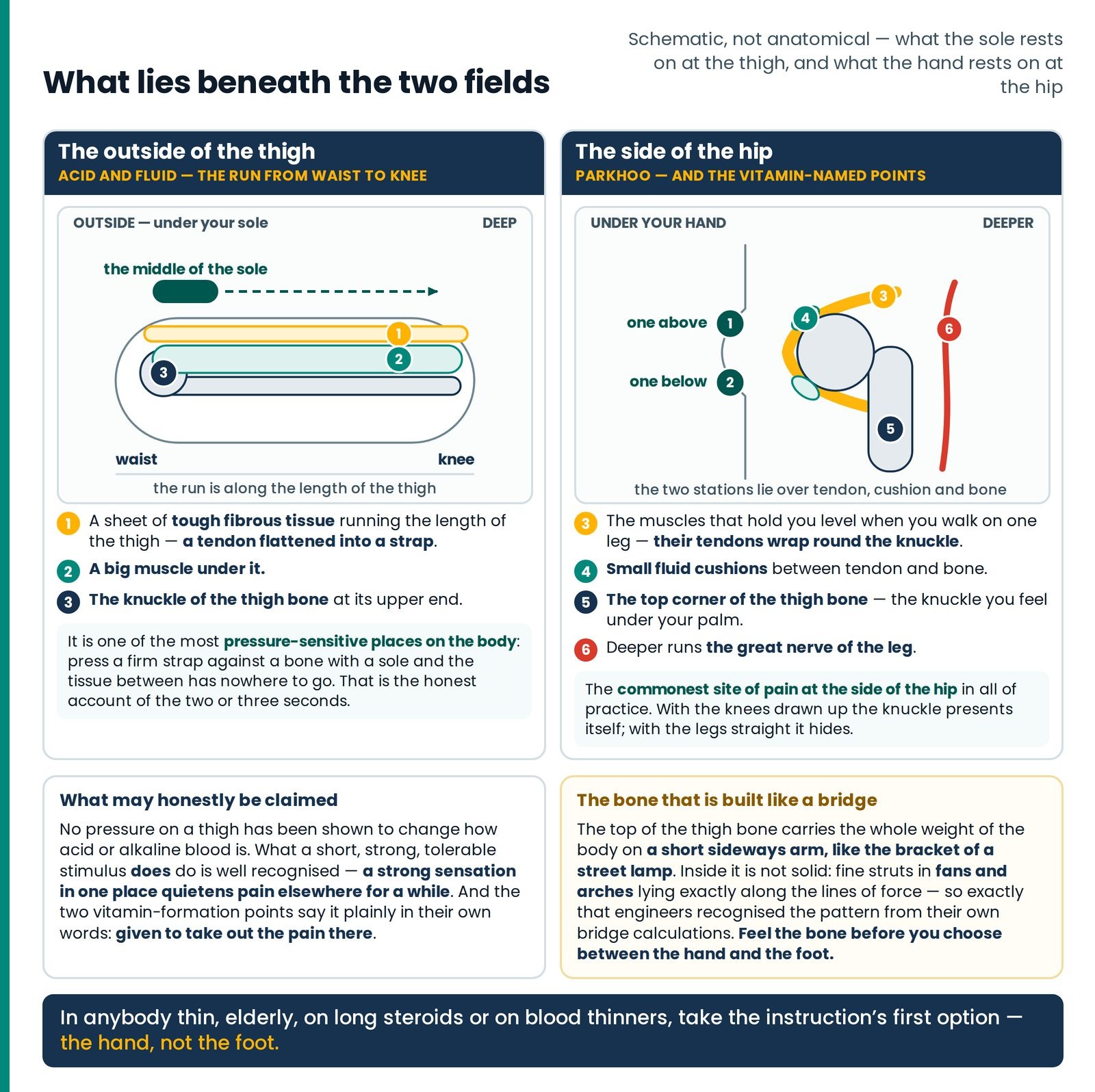
What lies beneath. Put a hand on the side of your own hip, stand on the other leg, and a knuckle of bone stands out under the palm — the top corner of the thigh bone. It anchors the muscles that hold you level when you walk on one leg; their tendons wrap round it, with small fluid cushions between tendon and bone, and deeper runs the great nerve of the leg. So the two stations lie over tendon, cushion and bone — the commonest site of pain at the side of the hip in all of practice. With the knees drawn up the knuckle presents itself; with the legs straight it hides. And in anybody thin, elderly, on long steroids or on blood thinners, take the instruction's first option — the hand, not the foot.
The four points named for vitamins
One arrangement, two differences, and the unusual count 2, 4, 4
Four points now follow that share one arrangement of the body, differ from each other in exactly two things, and are delivered on one unusual count.
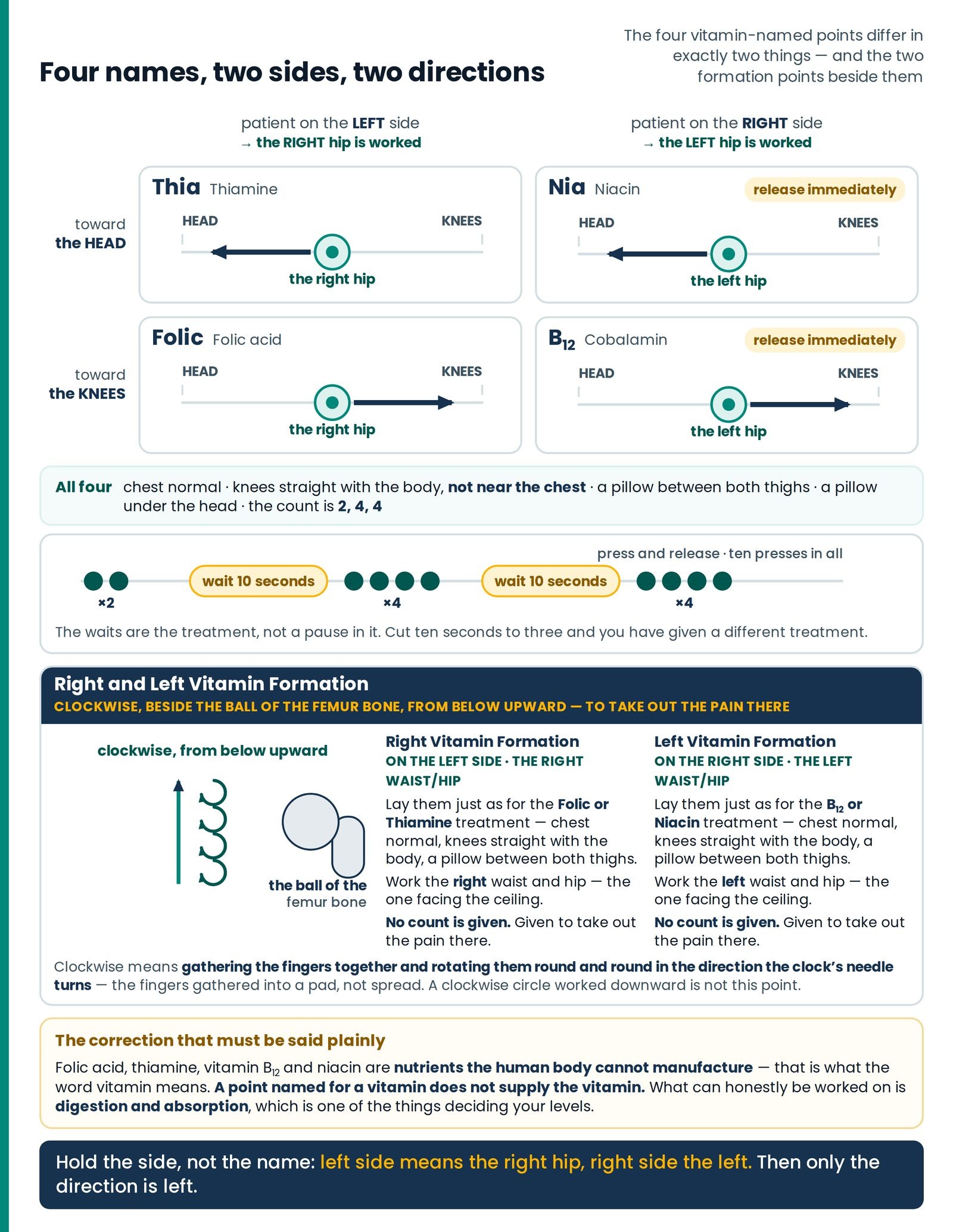
The arrangement. All four are given side-lying with the chest normal and the knees straight with the body — not near the chest. That sentence is the difference between these four and Parkhoo, and it is stated afresh at each of them: Parkhoo curls the patient up, these lay them out long. A pillow is still needed between both thighs.
The two differences. Which side the patient lies on, deciding which hip faces the ceiling; and which direction the pressure travels. Two sides by two directions gives four named points — Folic, left side and right hip toward the knees; Thia, left side and right hip toward the head; B₁₂, right side and left hip toward the knees; Nia, right side and left hip toward the head — and nothing else separates them. (Figure 20.5)
Folic — फोलिक एसिड · folic acid
Lay the patient on the left side and press and release on the right hip, in the direction of the knees.
The difference between the Parkhoo treatment and this, in the laying down, is that the chest stays normal and the knees stay straight with the body — not near the chest.
| Patient's position | Lying on the left side; chest normal; knees straight with the body — not near the chest; a pillow between both thighs; a pillow under the head Side-lying Left |
|---|---|
| Where the hands are placed | On the right hip — the upper one — pressing and releasing in the direction of the knees Right |
| Duration and repetitions | The count for these four is 2, 4, 4 — taught in full at Nia below |
| What it is for | Named for folic acid; no separate indication is stated at the point |
Thia = Thiamine
Lay the patient just as for Folic, on the left side, and press and release on the right hip in the direction of the head.
The difference between the Parkhoo treatment and this, in the laying down, is that the chest stays normal and the knees stay straight with the body — not near the chest.
| Patient's position | Lying on the left side, exactly as for Folic; chest normal; knees straight with the body; a pillow between both thighs Side-lying Left |
|---|---|
| Where the hands are placed | On the right hip, pressing and releasing in the direction of the head Right |
| Duration and repetitions | 2, 4, 4 |
| What it is for | Named for thiamine; no separate indication is stated at the point |
In all these treatments a pillow is needed between both thighs.
B₁₂
Lay the patient on the right side and press on the left hip in the direction of the knees, and release immediately.
The difference between the Parkhoo treatment and this, in the laying down, is that the chest stays normal and the knees stay straight with the body — not near the chest.
| Patient's position | Lying on the right side; chest normal; knees straight with the body — not near the chest; a pillow between both thighs; a pillow under the head Side-lying Right |
|---|---|
| Where the hands are placed | On the left hip — the upper one — pressing in the direction of the knees, and releasing immediately Left |
| Duration and repetitions | 2, 4, 4 |
| What it is for | Named for vitamin B₁₂; no separate indication is stated at the point |
Nia = Niacin
Lay the patient just as for B₁₂ above, on the right side, and press on the left hip in the direction of the head, and release immediately.
The number of these four is 2, 4, 4. That is: press and release twice; then, after ten seconds, press and release four times; then, after ten seconds again, press and release four times.
| Patient's position | Lying on the right side, exactly as for B₁₂; chest normal; knees straight with the body; a pillow between both thighs Side-lying Right |
|---|---|
| Where the hands are placed | On the left hip, pressing in the direction of the head, and releasing immediately Left |
| Duration and repetitions | 2, 4, 4 — press and release twice; after ten seconds, press and release four times; after ten seconds again, press and release four times. This count governs all four of these points |
| What it is for | Named for niacin; no separate indication is stated at the point |
In all these treatments a pillow is needed between both thighs.
The count 2, 4, 4, and the ten seconds that are part of it
Press and release twice. Wait ten seconds. Press and release four times. Wait ten seconds again. Press and release four times.
Ten presses in all, in three sets of two, four and four, with two waits of ten seconds built into the middle of them.
The waits are the treatment, not a pause in it. Pressure squeezes blood out of a place and release lets it flood back, and the flood is the point of the press. Cut ten seconds to three because the hall is busy and you have given a different treatment.
Two of the four release immediately, and two do not say so. At B₁₂ and Nia the instruction is press … and release immediately; at Folic and Thia, press and release. Give each as it stands: nothing is held at B₁₂ and Nia.
What lies beneath — and one correction that must be said plainly. Under the hand in all four is the Parkhoo field. With the knees straight the pelvis lies flatter, so the hand meets a broader, flatter surface than the raised edge Parkhoo works, and "toward the head" and "toward the knees" are directions of drag across it — and the direction tissue is dragged in genuinely does change what the cells inside it experience.
The correction is this. Folic acid, thiamine, vitamin B₁₂ and niacin are nutrients the human body cannot manufacture. That is not an opinion about these points; it is what the word vitamin means. If a patient is short of B₁₂, they need B₁₂.
And yet a real claim sits beside that one. Whether a person absorbs and holds on to these nutrients is a different question from whether they can build them — a question about the stomach, the gut and the liver, where this therapy does most of its work. B₁₂ has a long journey with several places to fail: freed from food by stomach acid, bound to a carrier made by the stomach's own lining, taken up near the end of the small bowel. So the defensible sentence — to a patient, and on a card — is: "this work is aimed at digestion and absorption, which is one of the things that decides your vitamin levels." Testable, and it costs nothing to check.
Right and Left Vitamin Formation
Clockwise beside the knuckle, from below upward — for the pain there
Two more points, given in the same laid-out positions as the four above but worked quite differently — and carrying, unusually for this group, an indication of their own.