Watch



The position is the treatment
Three rules written before a single point — the pillows come first
The four positions, the two-chair method by which the therapist's weight is carried, and the general form of side-lying are taught in Placing the Patient, "Placing the Patient", and are not repeated.
Rule one — the pillow under the head, in every one of these treatments
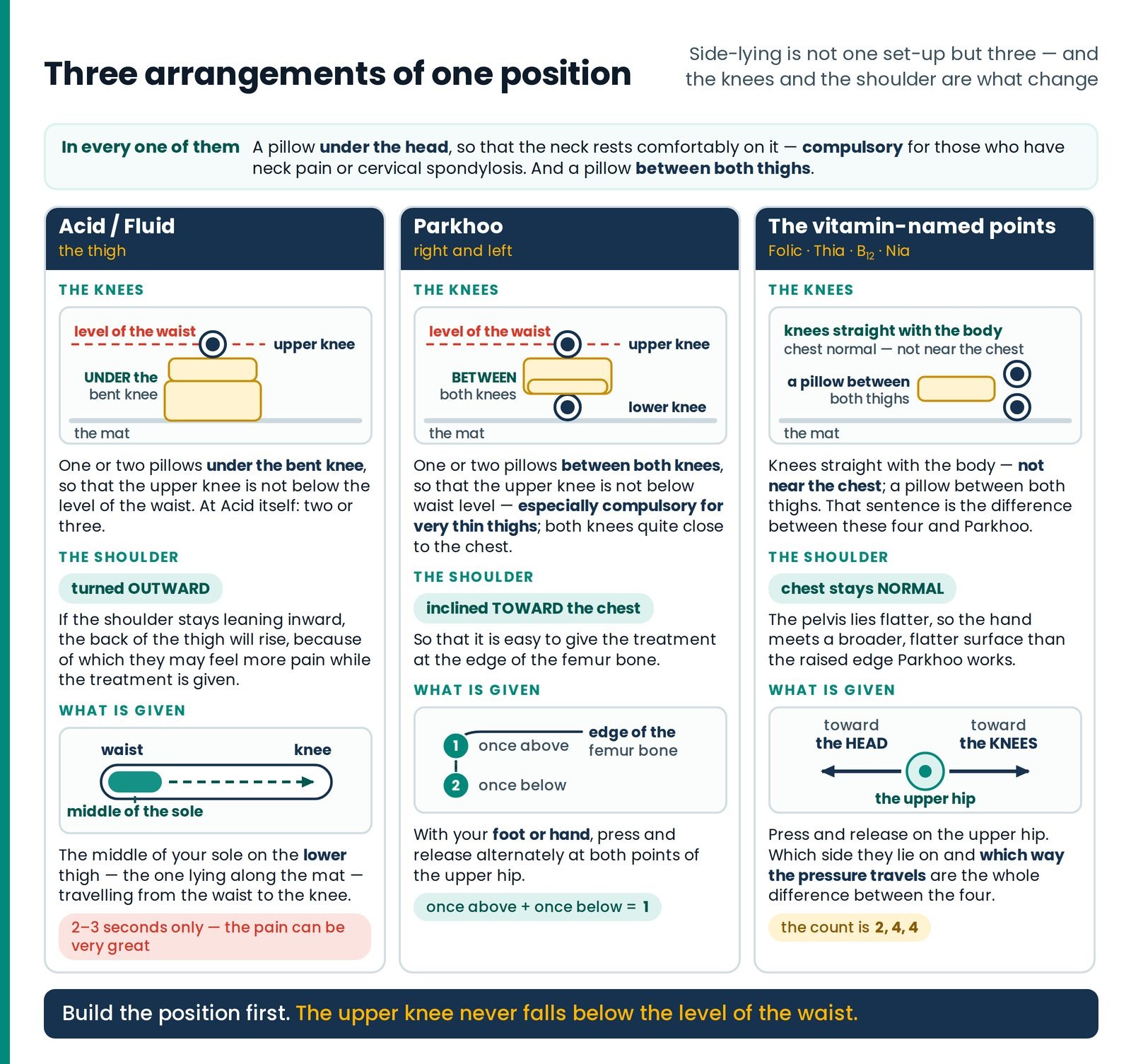
In all the treatments given lying on the side, give a pillow under the head as well, so that the neck rests comfortably on it. Especially for those who have neck pain or cervical spondylosis, this precaution is compulsory. ▲ Take care
Lie on a floor on your side without one and the reason appears in ten seconds: the head sags, and everything from ear to shoulder is held in a sideways bend by the muscles of your own neck for as long as you stay down. A young neck absorbs that and complains later. A neck already stiff and narrowed does not absorb it at all — which is why the rule names cervical spondylosis and calls the pillow compulsory there.
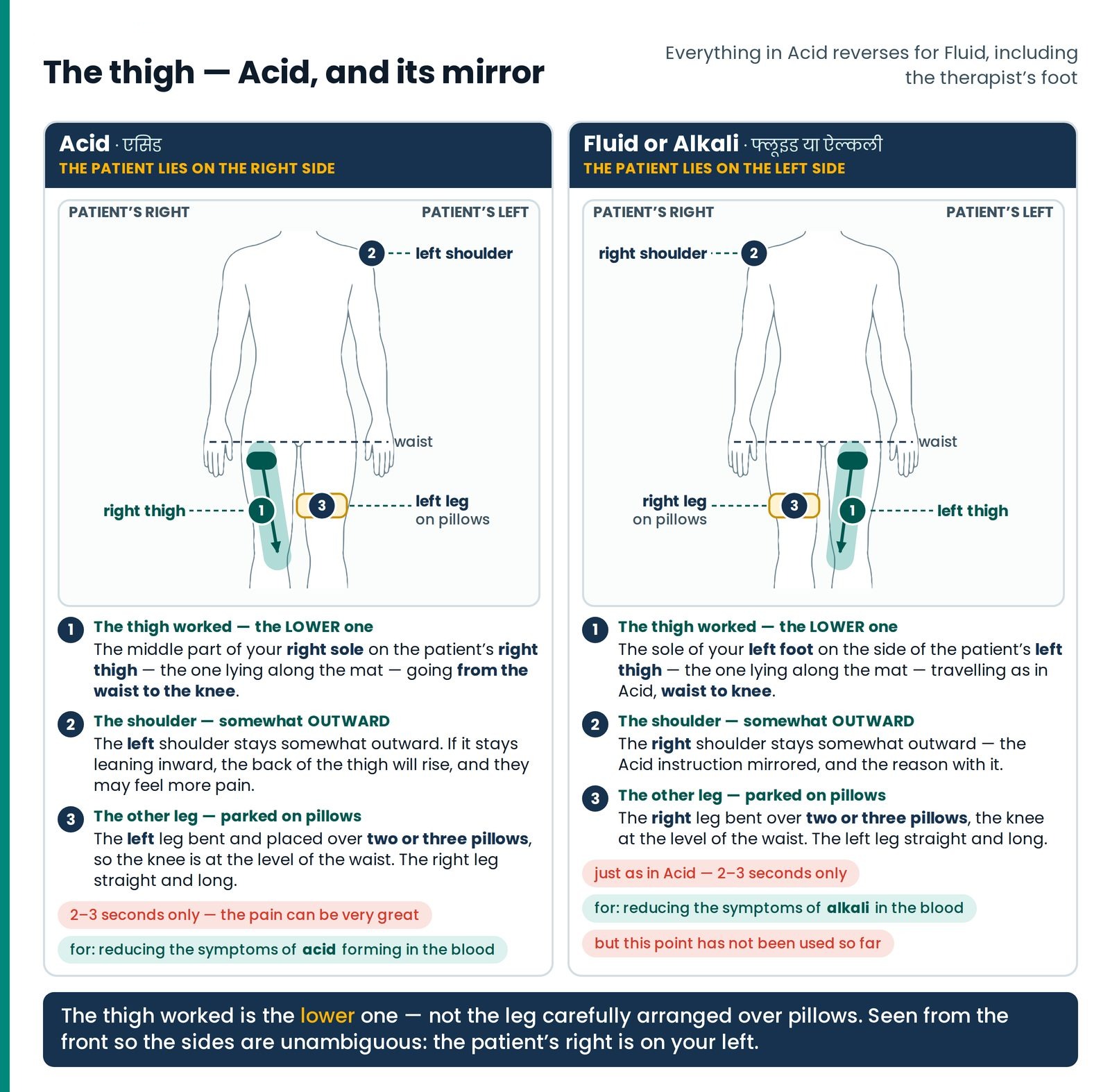
When giving the Acid or Fluid point, place one or two pillows under the bent knee, so that their upper knee is not below the level of the waist.
Besides this, their shoulder should stay turned outward.
Rule two — the knee and the shoulder for Acid and Fluid
If the shoulder stays leaning inward, the back of the thigh will rise, because of which they may feel more pain while the treatment is given.
When giving the Parkhoo point, place one or two pillows between both knees, so that their upper knee is not below the level of the waist.
Rule three — the knees and the shoulder for Parkhoo
This is especially compulsory for those whose thighs are very thin. ▲ Take care
But during the treatment their shoulder should stay well inclined toward the chest, and both knees should be quite close to the chest, so that it is easy to give the treatment at the edge of the femur bone.
The pillows go in different places, and the difference is the point. For Acid and Fluid they go under the bent upper knee, so the upper leg is parked out of the way and the sole has the lower thigh clear from waist to knee. For Parkhoo they go between both knees, filling the gap so the upper leg cannot fall across the lower one. One arrangement clears a thigh; the other supports a pelvis. (Figure 20.1)
Both are measured the same way, and not by counting pillows. The instruction in each is a level — the upper knee is not below the level of the waist. On a broad-hipped woman with one firm pillow that is one; on a thin man with soft ones it is two, and at Acid itself the instruction says two or three. Build to the level, then write the number on the card.
And the rule names whom it is compulsory for. On a very thin thigh nothing lies between the knee bones to hold the upper leg up; the moment you begin, the knee drops, the pelvis rolls after it, and the edge of the thigh bone goes with it.
One further rule stands under the whole group, printed at the foot of its pages: in all these treatments a pillow is needed between both thighs.
The thigh — Acid
The lower thigh, waist to knee, and only two or three seconds