Watch


Four kinds of line, and never a fifth
A finding, a treatment, a change, a standing warning — and no opinions
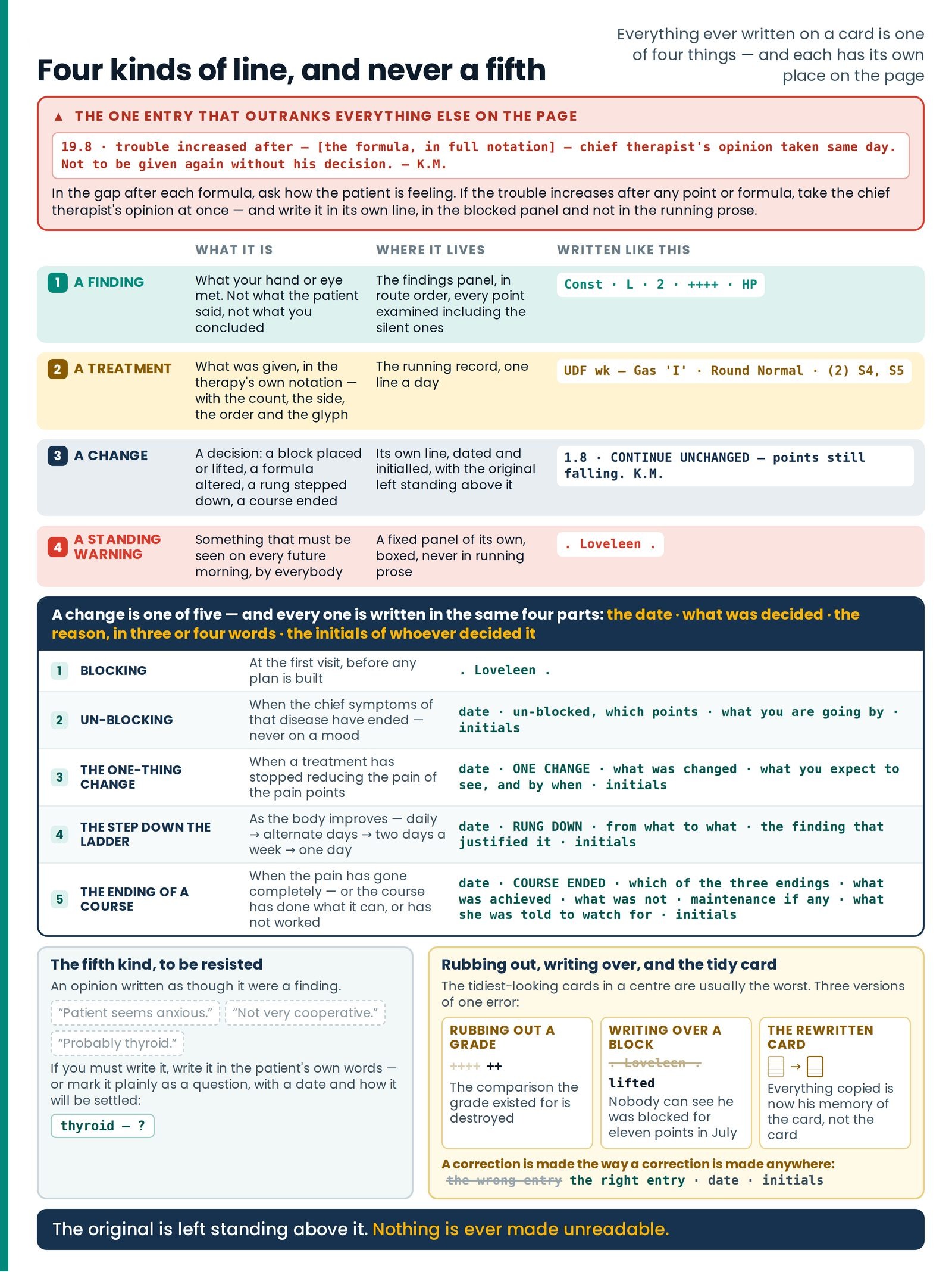
Everything ever written on a card is one of four things. The commonest failure in a practice is that they are written in the same voice, in the same ink, in no particular place — so that a year later nobody can tell a fact from an opinion, or a decision from a note. (Figure 44.1)
A fifth kind creeps in and should be resisted: the opinion written as though it were a finding. "Patient seems anxious." "Not very cooperative." "Probably thyroid." If you must write it, write it in the patient's own words or mark it plainly as a question — thyroid — ?, with a date and how it will be settled.
How a finding is written
Every point examined appears; the before-grade is never touched
The composition of a finding is The Educated Hand's and its grading is Uncommon Problems's. What belongs to the card is the arrangement, and three rules govern it.
The three rules of the findings panel
1. Every point examined appears, including the silent ones.
An empty box means not examined; a minus means examined and silent. These are two entirely different facts and a card that cannot distinguish them is worth very little. Nine minuses on a page are evidence that a hand was calibrated that morning; no minuses at all is evidence of a hand that went looking for pluses.
2. The after-grade is written below the before-grade, and the before-grade is never touched. This is the form the instruction itself gives: the four plus stands where it was written, and the two plus goes beneath it. A card on which a grade has been altered has destroyed the only comparison you own.
3. Write at the point, not afterwards. 6 sec A grade decays in about a minute, and what survives the walk to the desk is the loudest finding, the first finding and the finding you expected — a summary of your own expectations.
The running record is a different sheet with one line to a day, and there the same pair is written across rather than down: Const ⁺⁺⁺⁺ → ⁺⁺. The arrow is the one-line equivalent of the stacked form and says exactly the same thing. On the card's findings panel keep the stacked form, as the instruction gives it.
How a treatment is written
In the therapy's own notation — the glyph and the code, always both
A treatment is written in the therapy's own notation and in no other — which means with its counts, its sides, its order, its rests and its variant letters, exactly as Table 13 in How a Formula Is Built defines them. A card that reads Medulla has told the next therapist nothing; a card that reads (15) Lt. Medulla has told him everything.
And there is a second half to it, which is what the symbol key exists for. Many treatments are written not as words but as glyphs — a ring on a stem, two arrows springing apart, a numbered chevron, a small face with dots along the jaw. Forty-two of them are set out, each beside its code and its full name, in The Shorthand, "The Shorthand". They are fast to write, which is why they came into being in the first place: a man writing dozens of formulas a day in a camp, each of which had to survive being copied by a student and read back a week later.
The glyph and the code, both
Write every formula with the glyph and the code.
The glyph is for speed, on a busy morning, in your own hand. The code is so that a colleague years later — or a doctor reviewing what was done — can reconstruct which manoeuvre was applied.
The rule behind it is short enough to hang on a wall: notation only its author can read is not a record.
The same applies to your abbreviations. Every centre grows its own, and they are harmless until the day somebody else reads them. If you shorten anything, shorten it the same way every time, and put the key on the inside of the register's cover.
How a change is written
Date, decision, reason in four words, initials, original left standing
This is the heart of the article and the part of a card that students simply do not write. A finding is easy to record because your hand has just produced it. A decision has to be noticed before it can be written, and most decisions in a practice are made without being noticed at all — a formula quietly dropped, a block quietly ignored, a patient quietly seen twice a week instead of daily because that is how it worked out.
Every decision in this therapy that changes what will be done to a patient is written in the same four parts, in this order:
The form of a written decision
the date · what was decided · the reason, in three or four words · the initials of whoever decided it
And one rule about the page: the original is left standing above it. A block that is lifted is not rubbed out; a new line is written below with the date and the name, and the old line stays visible so that anyone reading the card can see both what had been true and when it stopped being true.
A decision without a date cannot be reviewed. A decision without a name cannot be asked about. A decision that erased what it replaced has hidden the one thing worth knowing.
Five decisions recur in every practice, and each one has already been specified elsewhere in this wiki as a written line. Here they are gathered, with the exact shape of each.
Table 2 — The five written decisions, and how each is set down
| The decision | When it is made | Written as | Established in |
|---|---|---|---|
| Blocking | At the first visit, before any plan is built — the points not to be given in this patient's conditions | A boxed panel of its own, each point with its reason in three or four words beside it. The model the material itself gives is . Loveleen . — written with a full stop before and after, so that on later days too it is remembered that this point is not to be given | From Findings to a Plan · When the Hand Must Stop |
| Un-blocking | When the chief symptoms of that disease have ended — never on a mood, never on he feels much better | A new dated, named line beneath the original, which stays standing: date · un-blocked, which points · what you are going by · initials. One point back is a normal result; three at once is usually enthusiasm | When the Hand Must Stop · Weeks, Not Sessions |
| The one-thing change | When a treatment has stopped reducing the pain of the pain points — and only after attendance, the twenty-three hours and the body have been looked at first | date · ONE CHANGE · what was changed · what you expect to see, and by when · initials. The expectation is the half everybody leaves out, and it is the half that teaches you something next week | From Findings to a Plan · Weeks, Not Sessions |
| The step down the ladder | As the body improves — daily → alternate days → two days a week → one day. Not on the calendar and not on the patient's convenience | date · RUNG DOWN · from what to what · the finding that justified it · initials. A pause is not a rung and is written as a pause | Weeks, Not Sessions |
| The ending of a course | When the pain has gone completely and the symptoms are all right — or when the course has done what it can, or when it has not worked and is being ended for that reason | date · COURSE ENDED · which of the three endings · what was achieved · what was not · maintenance if any · what she was told to watch for · initials | Weeks, Not Sessions |
The card is built once. The record is built daily, and the whole argument for it is that it costs seconds. A therapist seeing thirty patients a morning cannot write paragraphs and should not try; what he can do, and what turns his year into something readable, is one disciplined line.
What is written after the treatment, and why it is written at all
Three things from the last ten minutes have to reach the paper
The last ten minutes of a session belong to Uncommon Problems and are taught there whole: the re-check of every pain point, the stacked grading, showing or telling the patient where and by how much the pain has decreased, turning onto the side to get up, walking about a little if it is a pain patient, food after half an hour, the giddy patient sat down and supported and given jaggery water in half a glass if need be, the cupped palm behind the neck for a heavy head, the telephone touched by nobody until all of it is done, and the mat cleaned and the pillows laid again before the next patient.
What belongs here is the part of that which reaches the paper. Three of those ten minutes produce entries, and they are the three most often lost.
The three things that must reach the record from the last ten minutes
1. The after-grades, at every point re-checked.
Written below the before-grades on the card, or across the line on the record. Without these the decision rule has nothing to stand on: so long as any treatment reduces the pain of the pain points, there is no need to change it and give another. The rule requires the grades to exist.
2. Anything the patient felt, including the ordinary reactions. Giddiness on rising, a heavy head, soreness or tiredness for a day or two afterwards. These are common, they are usually nothing, and they are exactly the sort of thing a therapist stops noticing after his first year. Writing them down is how a practice learns which patients react and which treatments provoke it — and how you discover, three years in, that one of your own habits produces more of it than the others.
3. What the patient was told. The estimate, on the first day and again at the fourth-week review. The two rules given to the household. The sentence she is to take to her own doctor. A patient who was told many months in July does not panic in August; a patient whose card does not record what she was told will be told something different by the next therapist, and will believe neither of you.
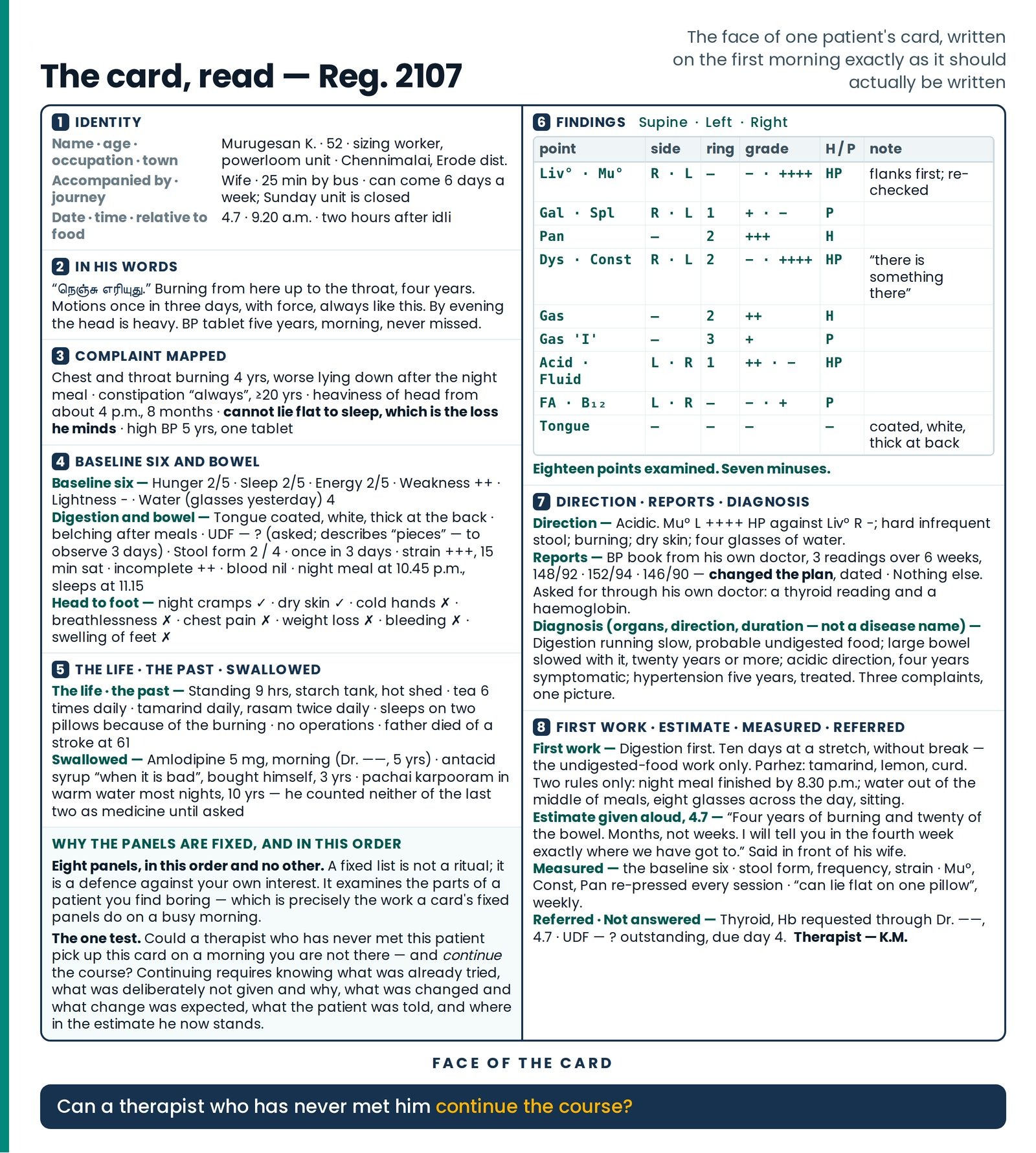
This is the part of the article to copy. What follows is one patient's card and record from the first morning to the last, written exactly as they should actually be written — abbreviations, initials, corrections and all. The clinical reasoning is not the lesson here; the paper is the lesson. Every formula named is taught in its own article and every block is taken from When the Hand Must Stop. (Figure 44.2)
The patient came to the centre in the story above, which is why the initials on every line are the same two.