The seven lines the register at Erode did not have
These are the lines the register at Erode did not have. Each of them is one sentence long and each is the reason the record above can be read by a stranger.
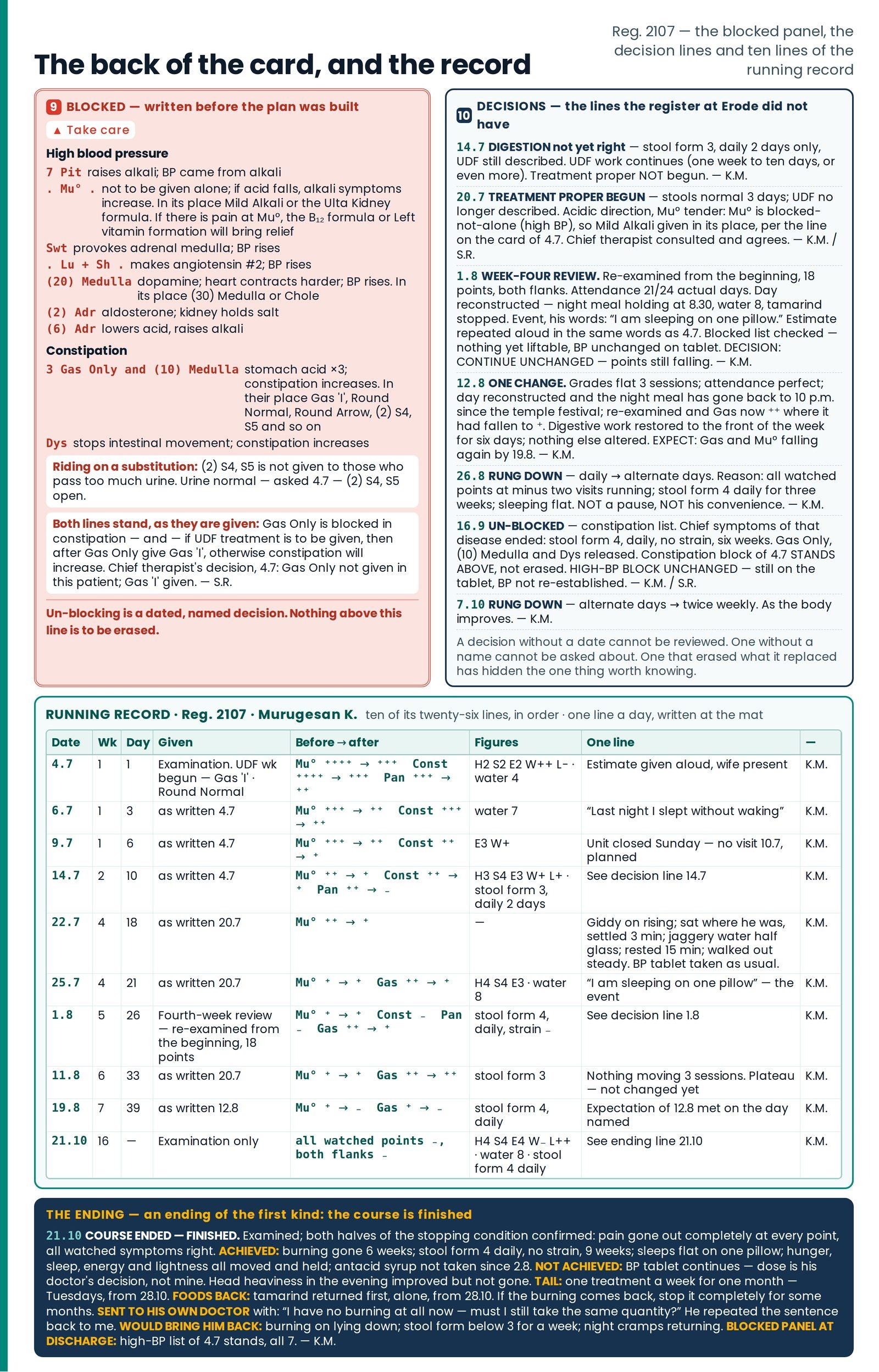
14.7 · DIGESTION not yet right — stool form 3, daily 2 days only, UDF still described. UDF work continues (one week to ten days, or even more). Treatment proper NOT begun. — K.M.
20.7 · TREATMENT PROPER BEGUN — stools normal 3 days; UDF no longer described. Acidic direction, Mu° tender: Mu° is blocked-not-alone (high BP), so Mild Alkali given in its place, per the line on the card of 4.7. Chief therapist consulted and agrees. — K.M. / S.R.
1.8 · WEEK-FOUR REVIEW. Re-examined from the beginning, 18 points, both flanks. Attendance 21/24 actual days. Day reconstructed — night meal holding at 8.30, water 8, tamarind stopped. Event, his words: "I am sleeping on one pillow." Estimate repeated aloud in the same words as 4.7; told he is in week four of months. Blocked list checked — nothing yet liftable, BP unchanged on tablet. DECISION: CONTINUE UNCHANGED — points still falling. — K.M.
12.8 · ONE CHANGE. Grades flat 3 sessions; attendance perfect; day reconstructed and the night meal has gone back to 10 p.m. since the temple festival; re-examined and Gas now ⁺⁺ where it had fallen to ⁺. Digestive work restored to the front of the week for six days; nothing else altered. Night-meal rule renegotiated with his wife, where it actually broke. EXPECT: Gas and Mu° falling again by 19.8. — K.M.
26.8 · RUNG DOWN — daily → alternate days. Reason: all watched points at minus two visits running; stool form 4 daily for three weeks; sleeping flat. NOT a pause, NOT his convenience. — K.M.
16.9 · UN-BLOCKED — constipation list. Chief symptoms of that disease ended: stool form 4, daily, no strain, six weeks. Gas Only, (10) Medulla and Dys released. Constipation block of 4.7 STANDS ABOVE, not erased. HIGH-BP BLOCK UNCHANGED — still on the tablet, BP not re-established. Decided with chief therapist. — K.M. / S.R.
7.10 · RUNG DOWN — alternate days → twice weekly. As the body improves. — K.M.
The ending
An ending of the first kind: what was achieved, and what was not
A course ends with a line, exactly as a block is lifted with a line. This one is an ending of the first kind — the course is finished. (Figure 44.3)
21.10 · COURSE ENDED — FINISHED. Examined; both halves of the stopping condition confirmed: pain gone out completely at every point, all watched symptoms right. ACHIEVED: burning gone 6 weeks; stool form 4 daily, no strain, 9 weeks; sleeps flat on one pillow; hunger, sleep, energy and lightness all moved and held; antacid syrup not taken since 2.8. NOT ACHIEVED: BP tablet continues — dose is his doctor's decision, not mine. Head heaviness in the evening improved but not gone. TAIL: one treatment a week for one month — Tuesdays, from 28.10. FOODS BACK: tamarind returned first, alone, from 28.10. If the burning comes back, stop it completely for some months. SENT TO HIS OWN DOCTOR with: "I have no burning at all now — must I still take the same quantity?" He repeated the sentence back to me. WOULD BRING HIM BACK: burning on lying down; stool form below 3 for a week; night cramps returning. BLOCKED PANEL AT DISCHARGE: high-BP list of 4.7 stands, all 7. — K.M.
Read what that ending does. It names what was achieved and what was not, in the same breath and without embarrassment. It sets the tail the material gives for the small ailments and names the day of the week. It gives back one food at a time with the qualification attached. It sends the tablets question to the person who prescribed the tablets, and it makes the patient say the sentence out loud so that he will say it correctly. It says what would bring him back in findings rather than in come if you have any trouble, which nobody acts on. And it leaves the blocked panel standing, because a blood pressure treated by somebody else is still a blood pressure.
The back of the card, and the record — Reg. 2107. The back of the same card and ten lines of its running record: the boxed blocked panel with all nine blocked entries and their reasons, the substitution checked before it was ridden, the chief therapist's decision of 4.7, the seven dated decision lines, and the ending line of 21.10 in full.
Ruling up your own card and record
Eight panels on the face, two on the back, and four minutes' ruling
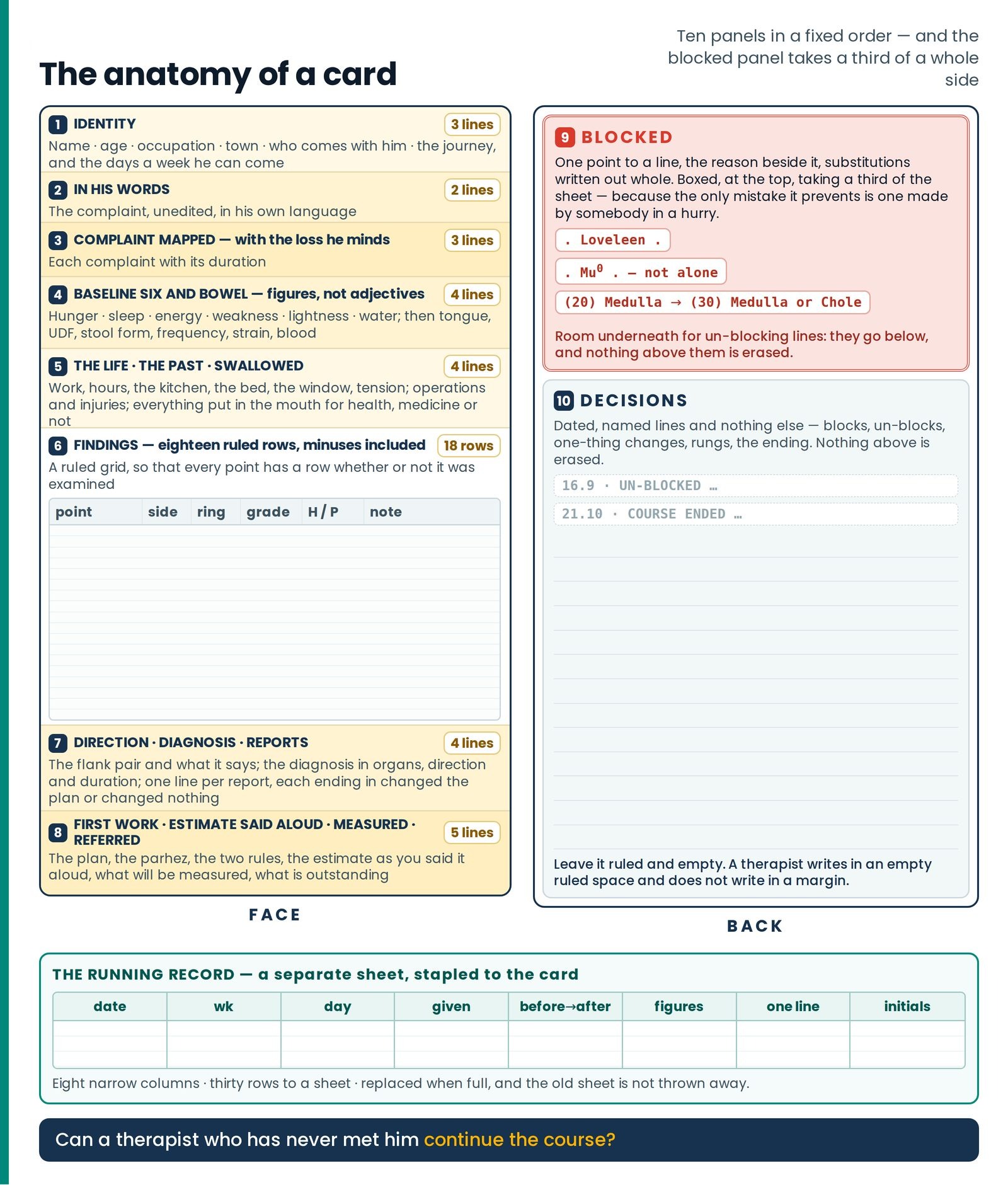
You do not need printed stationery and you should not wait for it. A card is a sheet of paper with lines ruled on it in the right places, and the ruling takes four minutes. (Figure 44.4)
The anatomy of a card. The ten panels of a card in their fixed order — eight bands on the face, each with its depth in ruled lines, and two on the back, the boxed BLOCKED panel taking a third of the sheet and the ruled, empty DECISIONS panel taking the rest — with the eight narrow columns of the running record beneath.
A founder who says there is a long way to go has told you what he expects of you, and it is not admiration. It is that you keep your eyes open and record what you see — which means, once a year, sitting down with your own year and reading it instead of remembering it.
The question nobody asks a therapist out loud
A therapist's memory is a collection of successes, useless as evidence
Of the last hundred people you treated, how many got better — and how do you know?
Every therapist has an answer ready and almost every answer is wrong in the same direction, because it is assembled from the patients who came back to say thank you. Those patients are real, and they are not a sample; they are a selection, made by the patients themselves, of the cases that went well. The ones who stopped in the fourth week did not come back to tell you they had stopped. Nothing happened to make you remember them. A therapist's memory is a collection of successes, honestly formed and completely useless as evidence. (Figure 44.7)
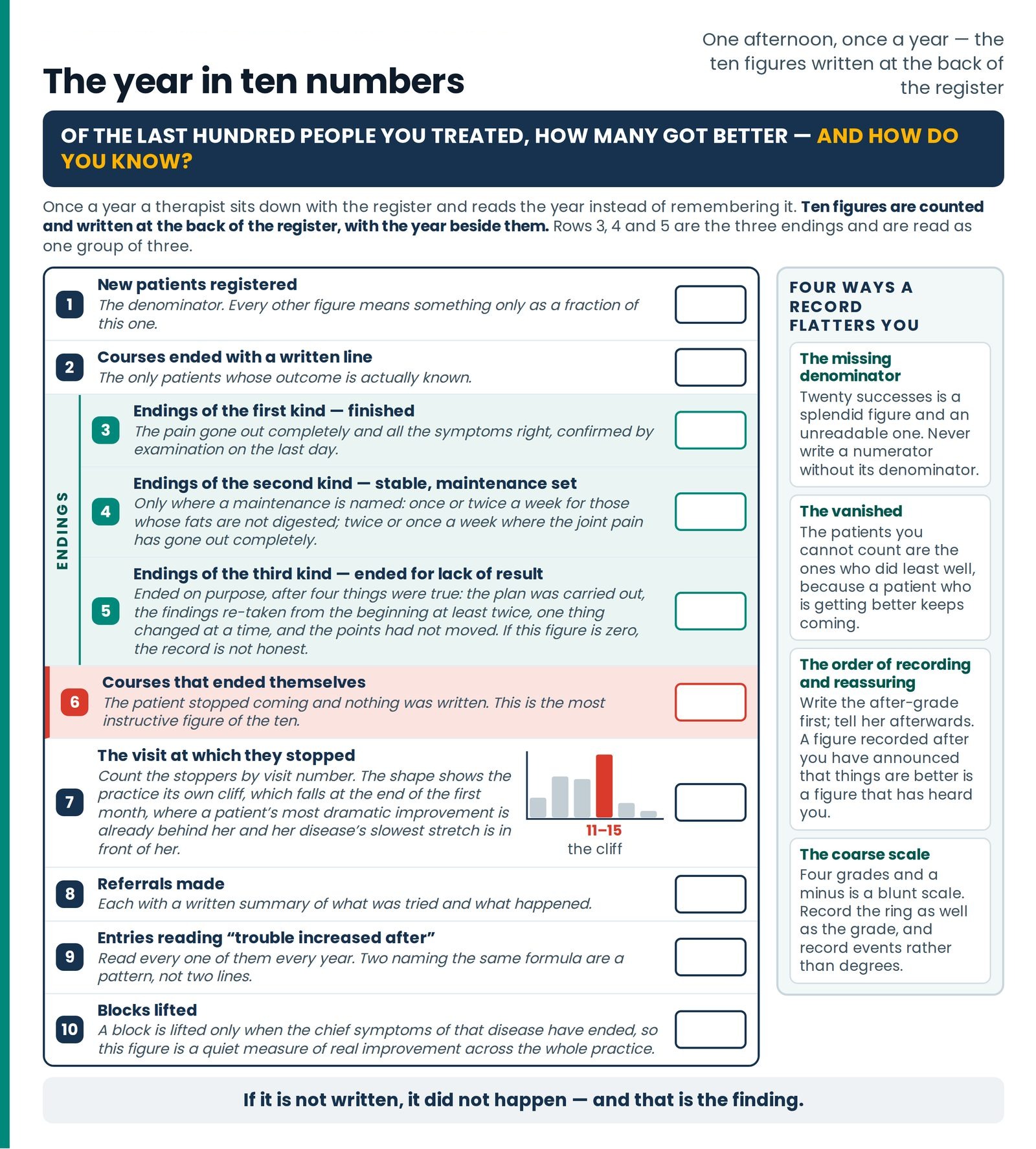
The defence is arithmetic, and it needs only a register with one more column in it than most registers have. (Figure 44.5)
What to count
Ten figures — and the one the Erode register could not produce
Table 3 — What a year must be able to tell you, and why each one
Count this
Why it is the one that matters
New patients registered
Your denominator. Every other number in this table is meaningless as a bare figure and means something as a fraction of this one
Courses ended with a written line
The only patients whose outcome you actually know. If this is small, nothing else in the table can be interpreted
Endings of the first kind — finished
The pain gone out completely and the symptoms all right, confirmed by examination on the last day
Endings of the second kind — stable, maintenance set
Only where the material names a maintenance. A weekly appointment you and the patient have grown fond of is not an ending
Endings of the third kind — ended for lack of result
If this number is zero, your record is not honest. Every practice has these. A therapist who has never ended a course for lack of result has been letting them end themselves
Courses that ended themselves
The patient stopped coming and nobody wrote anything. This is the number the Erode register could not produce, and it is the most instructive figure in the table
The visit at which they stopped
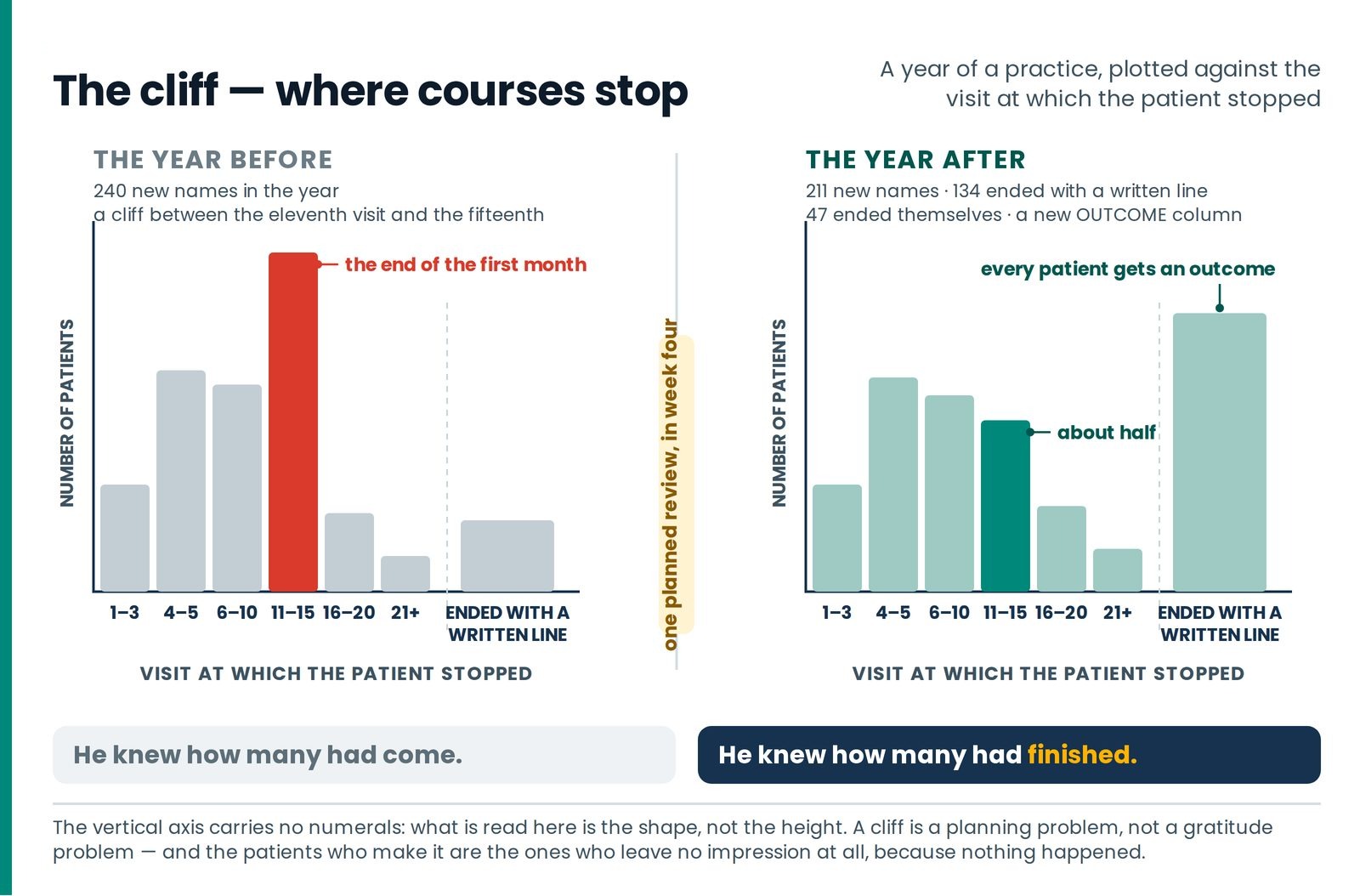
Count the stoppers by visit number: how many at four or five, how many at ten, how many between eleven and fifteen. The shape will show you your own cliff, and a cliff is a planning problem, not a gratitude problem
Referrals made
Patients sent to somebody qualified, with a written summary. A practice that never refers is not seeing the patients it thinks it is seeing
Entries reading "trouble increased after…"
Rare, and they should be. Read every one of them, every year. These are the only cases in which your own practice has taught you something about harm
Blocks lifted
A quiet measure of real improvement across a whole practice, because a block is lifted only when the chief symptoms of a disease have ended
Reading your own year. The afternoon with the register: the eight steps in order, the twelve habits of therapists who go on getting better set beside them as a checklist, the three cases that close the article with the lesson of each, and the therapist who stopped improving in his fourth year.
The four ways a record flatters the person who wrote it
The missing denominator, the vanished, the order, and the coarse scale
The three flatterers of a therapist's judgement — the patient's kindness, the worst day, and your own memory — belong to Weeks, Not Sessions and are not restated. These four are different: they are ways a record that genuinely exists can still mislead, and each has a cheap correction.
The missing denominator. Twenty successes is a splendid figure and an unreadable one. Twenty out of twenty-four is a practice. Twenty out of a hundred and ninety is a different practice. Never write a numerator without its denominator, not in a register, not in a report to a doctor, and not in your own head.
The vanished. The patients you cannot count are systematically the ones who did least well, because a patient who is getting better keeps coming. Any figure computed only from completed courses is therefore kind to you by construction. The correction is the column at Erode: every registered patient gets an outcome, and "stopped coming, no reason known" is an outcome. (Figure 44.6)
The order of recording and reassuring. The instruction to show or tell the patient at which places and by how much the pain has decreased is a good one, and it is kept — it builds the patient's faith, and it gives you the card you will need if she disappears for a month and comes back saying the treatment did nothing. But the order matters for the record's sake. Write the after-grade first; tell her afterwards. A figure recorded after you have announced that things are better is a figure that has heard you. The two acts cost the same and one order protects both of you.
The coarse scale. Four grades and a minus is a good working scale and a blunt one. Two things sharpen it without adding a minute to a session: record the ring as well as the grade, because a finding that travels from the middle ring to the inner one has moved without going away; and record events rather than degrees — how many stairs, how many minutes standing, whether he can sit on the floor, whether he slept through. An event does not re-base itself.
There are therapists in this country who have been giving treatment for thirty and forty years and are still getting better at it, and there are others who stopped improving in their fourth year and have not noticed. The difference is not talent and it is not the number of patients seen. It is a short list of habits, most of which are about writing things down and none of which is difficult.
Table 4 — The habits, and the reason for each
The habit
The reason
Examine before every treatment — including the patient you treated yesterday 6 sec
Neurotherapy treats according to the condition of the body, and Thursday's body is not Monday's. The habit's hard edge is the rule: never repeat yesterday's treatment from memory when the card cannot be found, because from a wrong treatment the patient's trouble can increase
Write at the point, not at the desk
A grade decays in about a minute and what survives is what you expected to find
Write the decision as well as the finding
Findings are easy to write because your hand has just made them. A decision has to be noticed before it can be recorded, and an unnoticed decision is how a practice drifts
Record what went wrong, in your own hand, on the day
Especially where you were at fault. These entries cost something to write, which is why they must be written before you have had time to think about them — and they are the only cases from which your own practice will ever teach you about harm
Ask the chief therapist — and write down the answer with his initials
An opinion taken and not recorded has to be taken again by the next person, who may get a different one
Take somebody else's eyes on your own patients, regularly
You cannot see your own habits. A colleague can see them in ten minutes, and the ones you cannot see are precisely the ones nobody has ever mentioned to you
Give the estimate out loud on day one, and again in week four
It costs forty seconds and it is the cheapest thing that will keep a chronic patient past the cliff
End courses on purpose — all three kinds
A course that ends itself teaches nobody anything, costs the patient her tail of treatment and her sentence for her own doctor, and leaves the next patient with the same disease to be treated by a therapist one case-worth poorer
Read your own cards from three years ago, once a year
The only direct evidence you will ever have that you are still improving. If you would make every one of those decisions again today, be uneasy
Teach somebody
Nothing examines your own knowledge as fast as a student's question, and this therapy has been given away from the beginning — free treatment, free teaching, and widowed and orphaned women taught a trade rather than given alms
Keep a referral list you know by heart, and use it
Knowing when to send somebody elsewhere is a clinical skill, not a confession of poverty.
Count, once a year
Because everything above this line is invisible to you without it
The cliff — where courses stop. A year of the Erode practice before and after, as two identical column charts of patients plotted against the visit at which they stopped: the tall column at visits eleven to fifteen, the end of the first month, cut to about half in the year after, and the final column — courses ended with a written line — grown much taller.The year in ten numbers. A ledger page to be copied by hand into the back of a register: ten numbered rows, each with the count, its one-line reason and an empty box for the figure, the three endings bracketed as one group, courses that ended themselves in the strongest colour, a small cliff chart beside row seven, and the four ways a record flatters you down the right-hand margin.
Now the line that stands behind every habit in that table, and behind every rule in this article. It is a small sentence and it is the whole of a therapist's duty, which is why it is placed at the end of the last article of this wiki as it is placed at the end of a day's work.
Key teaching
The instruction that outranks the others
Whether or not the patient gets immediate benefit from our treatment, let no harm reach him through our carelessness — attend to this.
Read the shape of it before the content. It concedes at once the thing a lesser system would hide: the benefit is not promised. Some patients will improve in three days and some will not improve at all, and no honest therapist can know in advance which of the two is lying on his mat this morning. That half is not in your hands.
The other half is entirely in your hands, and the sentence puts it there. Harm through carelessness is not an accident; it is a decision made by somebody in a hurry, and every specific rule in this wiki is that sentence applied to one situation. Block the card before you plan the treatment. Read the blocked list aloud. Do not repeat yesterday's treatment from memory when the card cannot be found. Check the three-finger gap by hand before any weight goes on. Ask in the gap after each formula how the patient is feeling, and write it down if the trouble increased. Do not walk a giddy patient to a chair. Say what would bring her back, in findings and not in come if you have any trouble.
Not one of those is difficult. Every one of them is skipped by a tired person with four people waiting, and that is exactly the person the sentence is addressed to. ▲ Take care
Ready to begin?
Send COURSE for course details, or your name, age and health issue for a consultation.