Watch


The mat and the sheet, the room set for the day, and the two chairs
The mat and the sheet
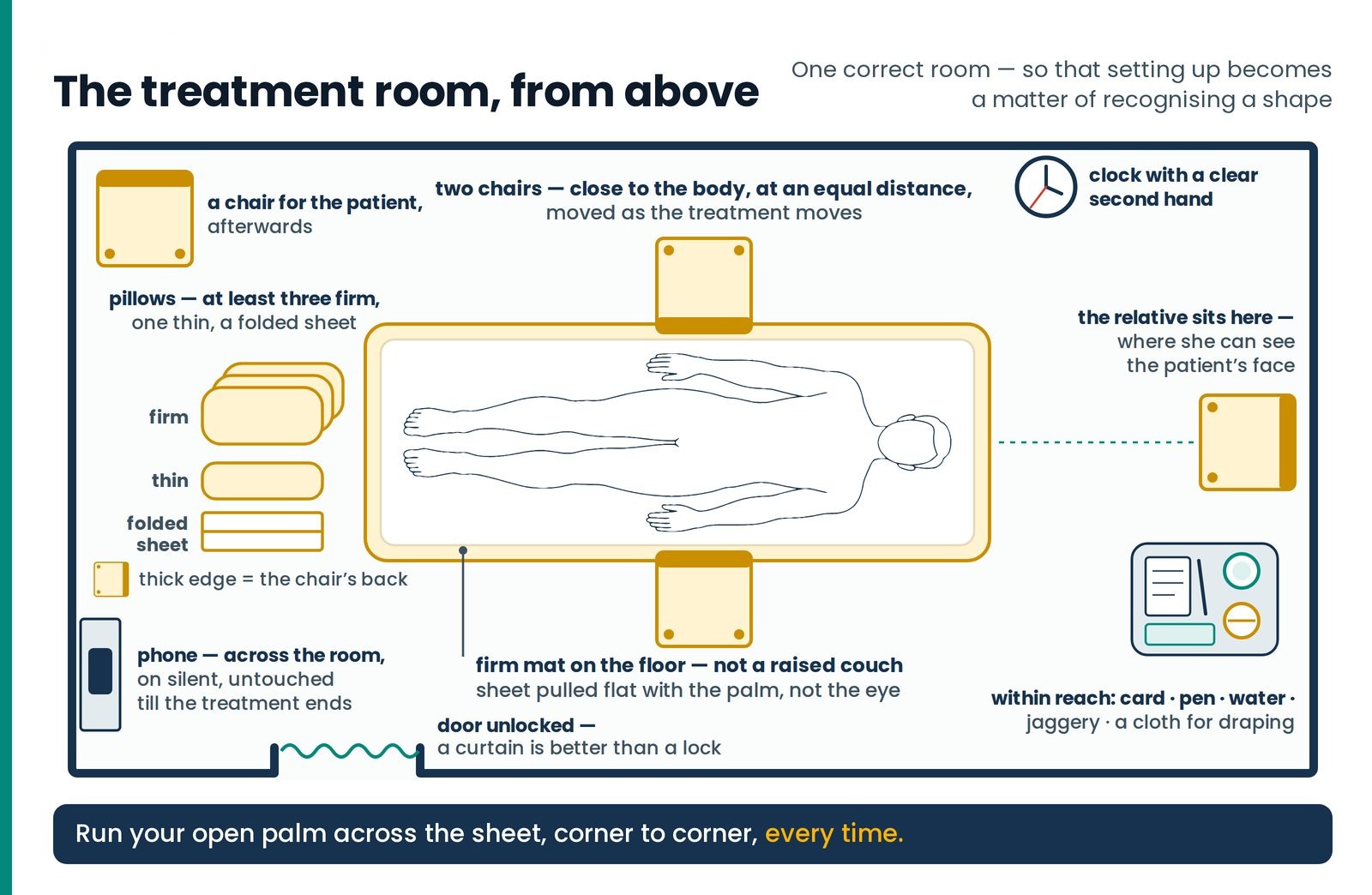
Before making the patient lie down, see that the carpet and the sheet are flat and that nothing small is lying underneath.
A fold in the middle of the sheet can dig into the patient's back during treatment.
And the reason, in a picture nobody forgets: a bone lying on a flat surface can bear even a hundred kilos of weight — but if there is a pen or a pencil underneath the bone, then even a small tin of powder falling on the hand can break that bone.
Take care too that the sheet and carpet are neither too soft nor too hard. ▲ Take care
Pressure is force shared out over the area it lands on: a pencil under one bony ridge sends a whole body's weight through a contact the size of a grain of rice. So run your open palm across the sheet, corner to corner, every time. (Figure 5.2)
The two chairs, and why they are not furniture
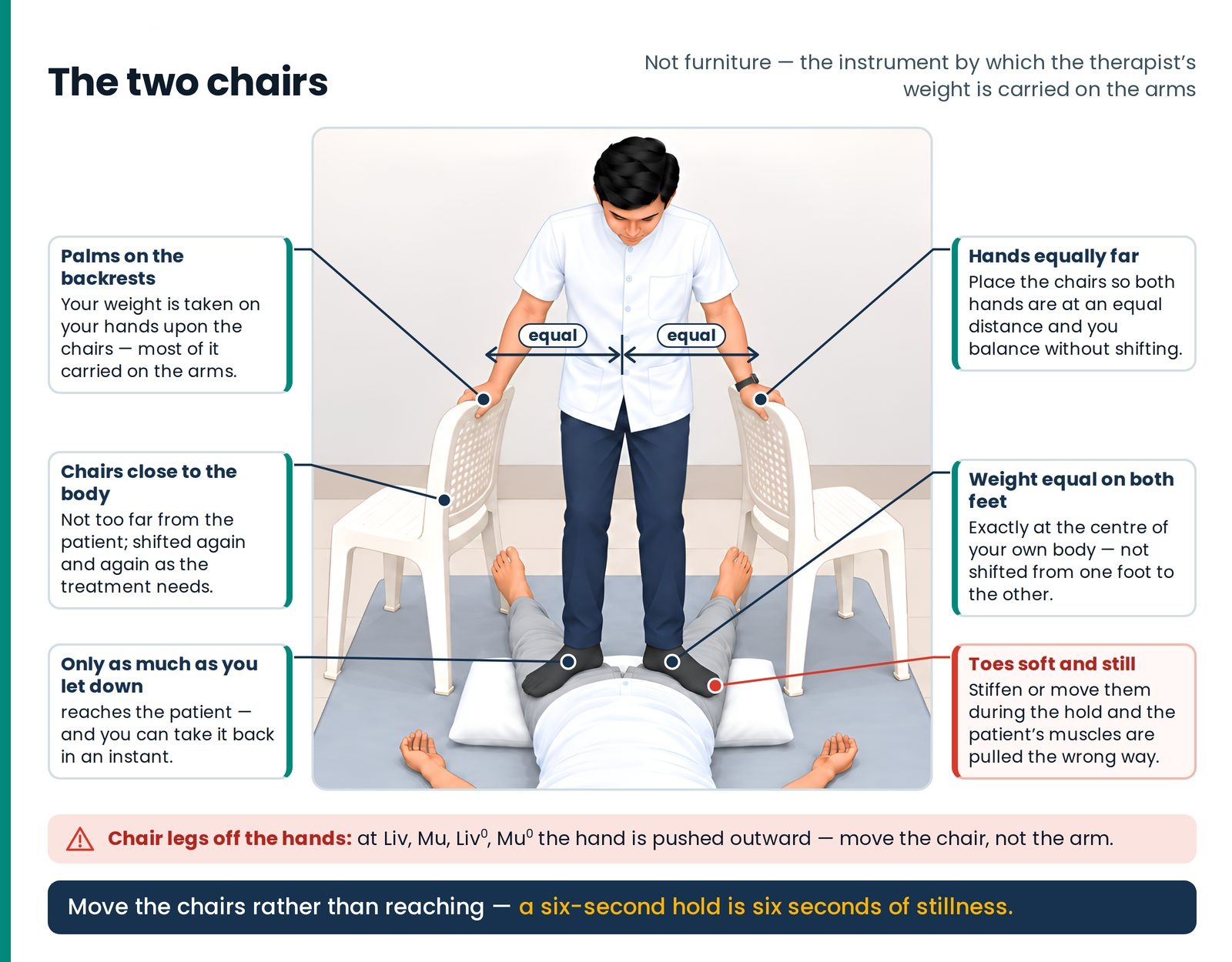
Pressure may be given either with the hand or with the feet. If with the feet, lay the patient down between two upturned chairs and, taking your weight on your hands upon the chairs, give the treatment.
Two ordinary four-legged chairs are stood facing each other and turned over, so their seat and back frames form parallel rails at about hip height. The patient lies supine between them; the therapist stands astride, grips both frames, and carries most of his body weight on his arms. What reaches the patient is only as much of the therapist as he chooses to let down — and he can take it back in an instant.
Where they stand. The chairs should not be kept too far from the patient's body. Depending on the treatment they may have to be shifted again and again. But always place them so that both your hands are at an equal distance between them, and so that you can balance your body weight easily, without shifting.
How you stand. See that the weight stays equal on both feet, and exactly at the centre of your own body. Do not shift the weight from one foot to the other in between. If your own balance does not feel right, the patient too will feel discomfort. If without realising it you stiffen your toes, or move them during the hold, the patient's muscles will be pulled the wrong way and they will have pain for a long time after the treatment. ▲ Take care
Move the chairs rather than reaching: a shift of your centre is felt from below as a wobble, and a treatment given from an awkward stance is one the patient braces against. A six-second hold is six seconds of stillness. (Figure 5.1)