Watch


"Is this not just acupressure?"
How the therapy differs from acupressure, massage and reflexology — and why it does not hurt
You will be asked this in your first month and in your fortieth year. It is an intelligent question — somebody is pressing places on a body and saying something elsewhere will change — so learn the answer, and give it without irritation.
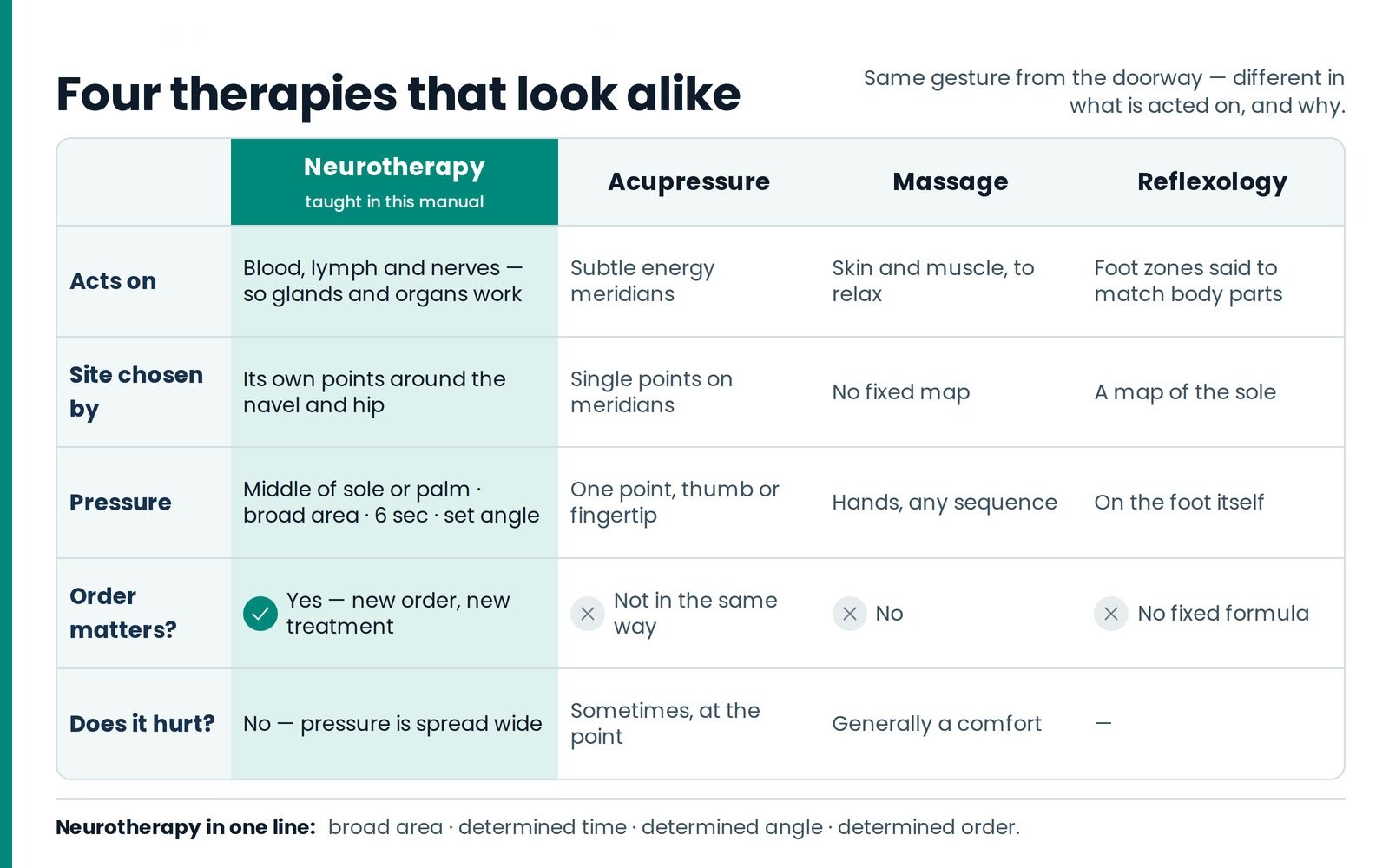
How Neurotherapy differs from acupressure
No. This is a therapy with no relation to acupressure, and none to any other therapy.
The difference is not in the gesture. It is in what is being acted upon, and why.
In Neurotherapy, working on the basis of the elements of physiology, we improve the functions of the glands by stimulating the body's circulation of blood and lymph, and the nervous system.
In acupressure, what is stimulated or improved are the subtle energy meridians beneath the skin.
Those are two different accounts of what a body is. One can be argued about in the language of blood vessels, nerves and glands; the other cannot, and does not try to be.
Three further things belong to Neurotherapy alone, and are the personal discovery of one man's sixty years of tapasyā: its own diagnosis points; the giving of pressure for six seconds 6 sec ; and the sequence in which the organs are to be stimulated.
Why it does not hurt
In acupressure, pressure is given on one point, where there is sometimes a chance of feeling a little pain.
In Neurotherapy it is given over a large area.
That is the whole of it, and it is not a matter of opinion. Pressure is force shared out over the surface it lands on: spread the same push over twenty times the area and you have a twentieth of the sting.
The therapist is trained to apply pressure with the soft part between the soles, so that even a child of six or eight feels no distress. And the angle is adjustable: if a patient does feel pain she must say so, and the therapist changes the angle or the manner of placing the foot — the effect of the treatment is not reduced by this. ▲ Take care
Two more comparisons are worth keeping ready. Massage works on muscle and skin, mainly for relaxation and local softening, and is a good thing in its place; but it has no fixed point map, no second-count, no order that must be kept, and no aim at a particular organ. A massage may run ten minutes or forty in whatever sequence suits the hands and is still a massage — whereas change the order of a formula here and it is no longer that formula. That is the difference between a comfort and a prescription. Reflexology also has a map, but a map of the feet, its logic being that zones of the sole correspond to parts of the body; this map is anchored on the abdomen and hip, its points named for the organ behind them. And in reflexology the foot is what is treated; here it is very often what does the treating.
Say it without scoring points off anybody: "They work with energy channels; we work with blood, lymph and nerves. They press one point; we press a broad area, which is why this won't hurt you." (Figure 1.6)
The same complaint is not the same treatment
Where the patient lives and what he eats help decide the plan
Where the patient lives, and what he eats, help decide the treatment
Even the locale and the diet followed by the people of an area play a part in deciding the treatment to be given.
The therapy's own example: a treatment for knee pain that suits a patient in Ludhiana may not suit a patient in Chennai, because of the difference in the diet of the people of those two places.
This is the same rule as before, arriving from another direction. The treatment is chosen for the condition of this body — and a body is partly made of what the household around it eats.
Which is why one instruction — keep away from sour things — lands differently in a Punjabi kitchen and in a Tamil one. The instruction has not changed; its weight has. A therapist who does not know what the household actually cooks is prescribing in the dark.
A composite of many such patients makes the point. Balwinder Singh, 61, a retired transport contractor of Ludhiana, came with four years of knee pain and had been told the cartilage was finished. His X-ray changed almost nothing — such wear is found in plenty of knees that do not hurt — while his borderline uric acid and sugar, and his account of hard, infrequent stools, changed a great deal. Digestive work first, joint work second, sour things stopped, water raised: by the tenth week he was rising from a chair unaided and walking to the gurudwara.
Then he moved to his son's house in Chennai, carried his treatment card to a centre there, and within a month was going backwards with nothing in the plan changed. That was the trouble: nothing had changed, and everything else had. Tamarind in the kuzhambu most days, curd after every meal, rice where there had been wheat — the restriction that had cost him a lemon in Ludhiana was now broken three times a day, because in that kitchen tamarind is not a "sour thing", it is simply how food tastes. The new therapist re-examined him from the beginning instead of continuing a plan made for another life; the findings were not the same, and neither was the plan. Within six weeks he was where he had been.
A treatment card records what was right for a patient in a place, at a time. It is a history, not an instruction — and a parhez must be translated into the household's actual kitchen before it means anything.
Who may receive this treatment
From one day old to a hundred years — the hand, the foot and the two chairs
From one day old to a hundred years
Every person, from a one-day-old infant up to the age of a hundred years, can take this treatment.
To very small children, and to old and weak persons, treatment is given with the hands.
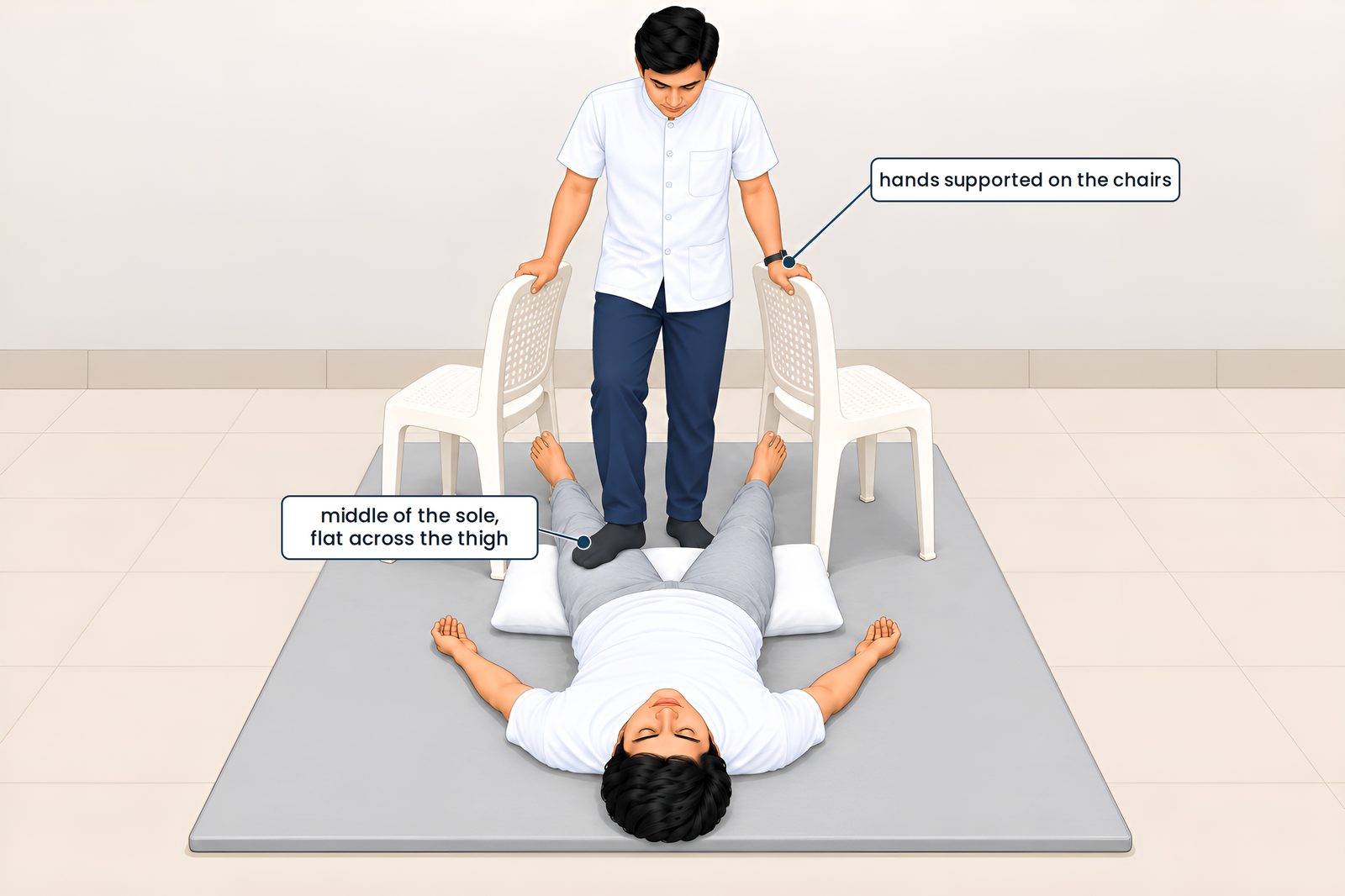
To persons of greater build, it is given with the feet.
The therapist stands between two chairs, taking the support of the chairs on both sides, and gives pressure in a particular manner with the feet on the patient's hands, feet, thighs and so on — by which the patient suffers no discomfort of any kind.
The two chairs are not furniture; they are the instrument by which the dose is controlled. Because the therapist's weight rides on his arms, what reaches the patient is exactly as much of him as he chooses to let down, and he can take it back in an instant. (Figure 1.7)
Some treatments are close cousins of particular postures — the effect of the Gas I treatment resembles vajrāsana, that of Ku resembles vīrāsana — and each is taught in the atlas.