The range of complaints, and where it stands on the ones called incurable
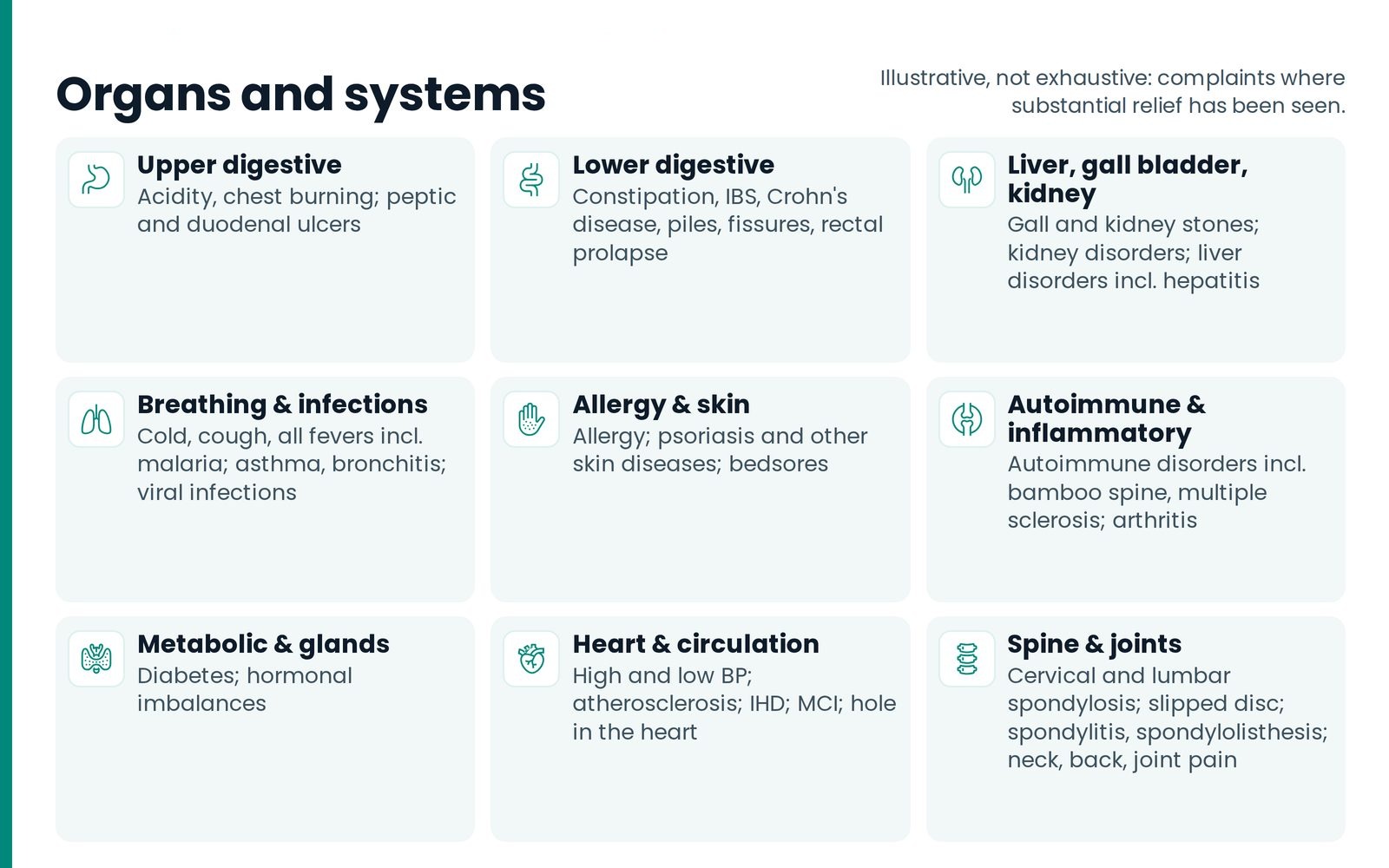
Read the list as a therapist reads it — not as a menu of cures but as the range of complaints in which substantial relief has been brought. It is illustrative and by no means exhaustive. (Figure 1.9)
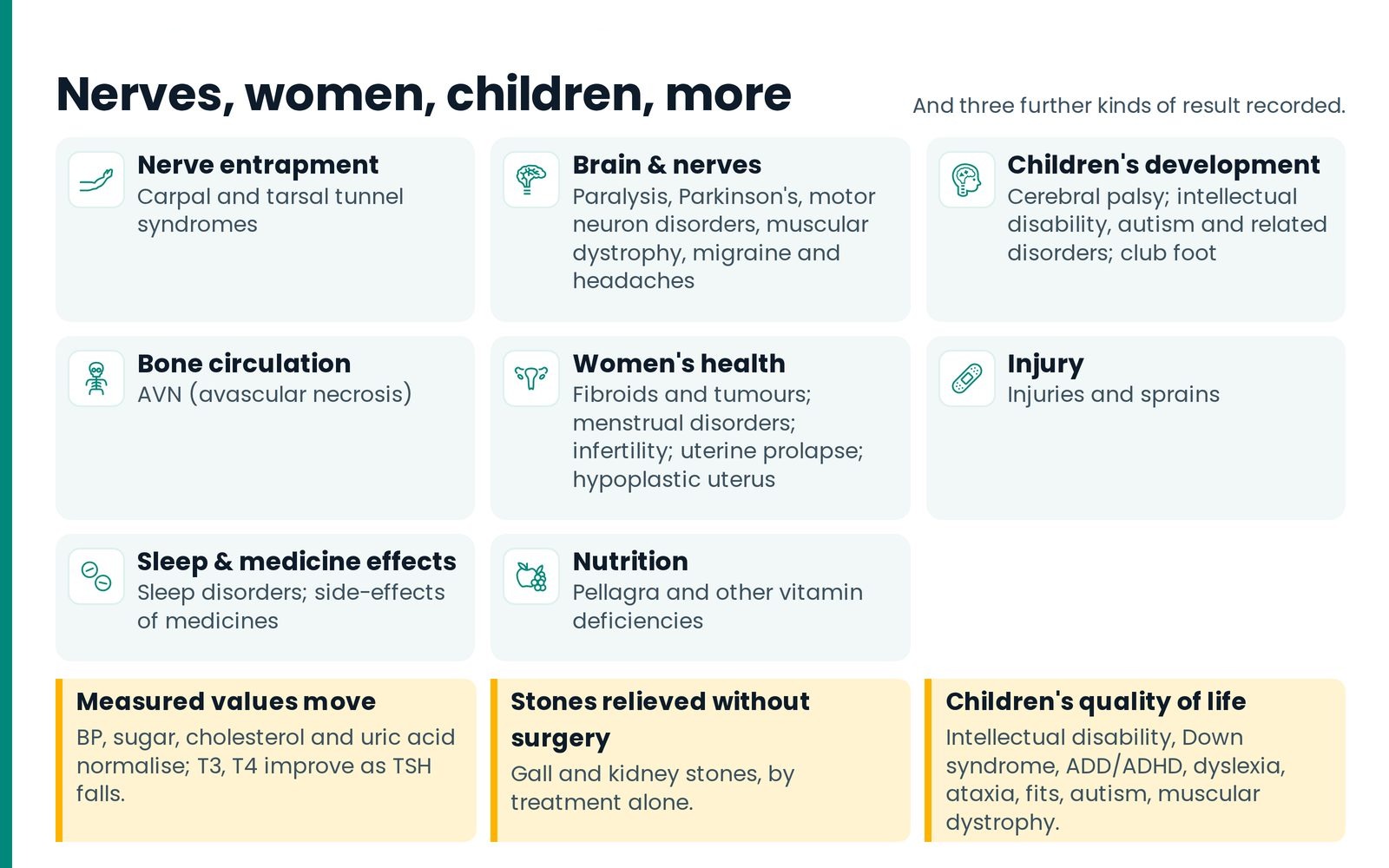
Three further kinds of result are recorded: measured values move — blood pressure, blood sugar, serum cholesterol and uric acid normalise, and T₃ and T₄ improve with a corresponding reduction of TSH; gall stones and kidney stones have been relieved by treatment alone in great numbers, without surgery; and there is substantial improvement in the quality of life of children with mental retardation, Down syndrome, ADD and ADHD, dyslexia, ataxia, fits, autism and muscular dystrophy.
The ailments the therapy addresses — organs and systems. Illustrative, and by no means exhaustive.The ailments the therapy addresses — nerves, women and children. Illustrative, and by no means exhaustive.
Since the treatment is done keeping the root cause in mind, relief is generally obtained in all common diseases.
But of the following diseases or symptoms it is said that there can be no treatment — CP (cerebral palsy), epilepsy (fits), hepatitis, thalassaemias, sickle cell anaemia, aplastic anaemia, MD and DMD, MND, MS, kidney failure, polio, and so on.
Key teaching
The conditions commonly called incurable
The truth is that in these diseases too, many patients have obtained quite good results by this treatment — even in HIV.
And Guruji's most important contribution is this: in the lives of children afflicted with congenital conditions such as intellectual disability, ADHD, dyslexia and autism, this therapy has brought considerable improvement — so their parents themselves say.
Give that to a family exactly as it stands, and notice what it does not say. It does not say these conditions are cured. It says the door is not shut, and that in the children the people best placed to judge — the parents who live with them — report considerable improvement. That is hope without a sale.
Two last observations belong to this list, because they prevent serious errors. Infectious disorders and inflammatory ones are treated in opposite ways — the treatment named Thymus, given at the breastbone, raises immunity and benefits infections; the treatment named ADR, given at the back between the sixth and twelfth thoracic vertebrae, reduces inflammation — and the two are not interchangeable: give either in the other's condition and the situation is aggravated.
The man, and his own estimate of his knowledge
A founder who says there is a long way to go
He has no formal education in modern medicine, and says so himself without embarrassment. His schooling ended at the tenth class; the certificate awarded him for his service in the refugee camps he declined to keep, because he had not sat the examination, and four years later he sat it and passed it.
What he did instead was read. Apart from the hours spent with patients, he has spent his waking life on the study of physiology — the same standard textbook read through many times over. From that reading, and from an experience of patients running into lakhs, he took the findings of physiology and looked at them from an angle with no place for medicines at all. Ask him about that knowledge and he smiles and says this:
He is not being modest for the room. He calls the therapy he built over seventy years a thing at the toddler stage, and means it — which is why old versions of formulas are still printed beside their successors: a man who thinks he has finished does not keep revising. Asked why his name is in no book of records, he answers: "My work is its own reward. In the time I would spend daily maintaining written records to justify such a claim, I can bring relief to another quarter million people."
Students find the humility charming. Find it instructive instead: a founder who says there is a long way to go expects you to keep your eyes open and record what you see.
The case that taught a whole method
The morning pain and the closed window
Why it was given away
Free treatment, free teaching, and a centre in one village in six
This therapy was not sold. Guruji's habit from the beginning was to share whatever he found, at once and free of charge, with anybody who kept in touch with him — unlike those who keep their findings secret in order to charge for them. He treated free for four decades before ever charging a nominal fee.
His stated goal is simple to say and enormous to do: that at least one Indian village in six should have a Neurotherapy centre, so the sick can be treated without medicines — and, in his lifetime, at least ten thousand centres. To that end: free health camps in needy villages; help for villagers at low cost, without side-effects, irrespective of caste, creed, colour and religion; the training of interested people in India and abroad; a centre for research into the cures obtained; and a generation who can use this therapy for their own families and for the welfare of society.
It went further than free treatment, into something rarer. Among the patients were many who could see no way ahead; such people were not only treated free and made well but taught the therapy free, and taught to earn from it. Many were widowed and orphaned women, for whom society would perhaps have done nothing at all, and who today live self-reliant and with pride, supporting their families and running their own centres. And where a patient comes from far and needs months of treatment, the family members are taught, so they may go home and treat that patient themselves.
At the ashram the giving of learning is free, and the lodging is free; from students a nominal amount is taken monthly for food, much less than it costs, and the teachers who keep the place running do so without charge.
That line is written up at the ashram, and it is not decoration. By which one can stand on one's own feet is the argument for free tuition, free lodging, and for teaching a widow a trade rather than giving her alms — and a fair description of what this therapy tries to do to an organ: not to supply it from outside for ever, but to put it back in a condition where it can do its own work again.
Ready to begin?
Send COURSE for course details, or your name, age and health issue for a consultation.