Watch


Everything the material says about time, in one place
Every stated duration, count and interval — and none of them rounded
Learn this table. Not because a patient will ask — although a patient will ask, on the first morning, before you have taken her pulse — but because an estimate given honestly on day one is the single cheapest thing you can do to stop a course collapsing in week four. A patient who was told two to four months in March does not panic in April. A patient who was told nothing decides for herself, and what she decides is always a few weeks.
Table 1 — Every duration, count and interval this therapy states
| The situation | What is stated |
|---|---|
| The first effects, in almost anyone | Within a day or two small and large effects begin to show — hunger and sleep begin to improve, energy increases, weakness reduces, the body feels light, life becomes enjoyable |
| The small warning ailments — fever, cold, cough, indigestion, constipation, stomach ache | Treat at once, without delay: considerable relief within three or four days — this is experience |
| The same small ailments, for a complete cure | At least one treatment a week for a month or two, so that the trouble does not come again |
| Ordinary ailments, whole course | An average of a week to ten days |
| Chronic ailments, whole course | About a year or more |
| Kept regularly, with the parhez kept too | Many diseases are cured in just two to four months |
| Old diseases | Many months |
| Congenital conditions | It may take some years |
| The undigested-food work | Until the stools become normal — between one week and ten days, or even more |
| The digestive block at the start of a course | The first ten days at a stretch, without break — as one centre practises it, only the undigested-food treatment, with the appropriate muscle-relaxation treatment in extreme cases |
| The residential start for an old disease | Admitted 20–25 days, treatment begun after a full investigation; quite a number of those days go simply in improving the digestive system first |
| An ordinary stay at a centre | In many centres one person takes treatment for about 15–20 days |
| Frequency, after the start | Daily for the first few weeks; then alternate days; then two days a week; then one day — reducing in this way |
| Treatment at home, by a taught relative | After some months at home, both come again for a few days for follow-up, so the new treatments can be taught |
| Menstruation | Four days — no treatment at all, with four stated exceptions |
| After a blow | The injury treatment until the serum dries — ten to fifteen days — and only then the heparin that heals the vessel |
| The Vater formula in a heart patient | The angina treatment only, first, for two to four days — given when the health improves a little |
| A child whose mother's blood pressure rose in pregnancy | Only that one treatment for ten to fifteen days first, whatever the child came about; afterwards other suitable treatments |
| The three gene formulas | Given on alternate days — one day on, one day off — the three in turn, with one normal treatment between each; in the case recorded, the factor began to rise within two or three months |
| Rheumatoid arthritis on the modified star formula | Formerly alternate days; nowadays, if there is need, even daily. When the finger pain has gone completely, twice or once a week may be enough |
| Those whose fats are not digested | The same treatment once or twice a week — and they will never get gall stones |
| Sour things, in the acidosis diseases | Not until the health is fully corrected; later, if there is need, they may be eaten. If the pain comes back, stop them completely for some months, until the body is fully corrected |
| The tablet taper, if a patient adopts it on his own responsibility | ¾ for three days, the saved quarters taken on the fourth; ½ for eight days, held a further four or eight if needed; ¼ for four, eight or twelve days; then ¼ on alternate days for two weeks; then ¼ twice weekly for some days; and the treatment is not stopped until the patient has been well for many days without medicine |
Nothing in that table is rounded and nothing in it has been reconciled with anything else in it. A week to ten days for ordinary ailments and at least one treatment a week for a month or two so the trouble does not come again are both stated, and they are not the same statement: one is how long the trouble takes to go, the other is how long you go on so that it does not return. Teach both. Where the material gives no number for a stage of a course, this wiki gives none either, and you should give none to a patient.
The order of correction, across days rather than within a session
Digestion first, whatever the disease; the plan comes on day eleven
Order within one session is How a Formula Is Built's — the five rules of sequence, the written rests, the four inseparable pairs.
The first of those is settled and is not restated here. The digestion is corrected first, whatever the disease, because the raw materials of every gland are made only from the end products of digestion; and one centre's practice of announcing at registration that the patient must come for the first ten days at a stretch, without break, giving only the undigested-food work in that time, is taught whole in From Findings to a Plan, "From Findings to a Plan". What belongs here is the sentence that follows it: afterwards, depending upon their ailments, a further treatment schedule will be prescribed. The ten days are the first stage of a course, not a preliminary to it. The course begins on day one, and the plan you write on day eleven is written out of what the first ten days produced — not out of what you guessed on day one.
The prerequisites, and the stopping condition attached to each
Every “first this, then that” carries the day on which it changes
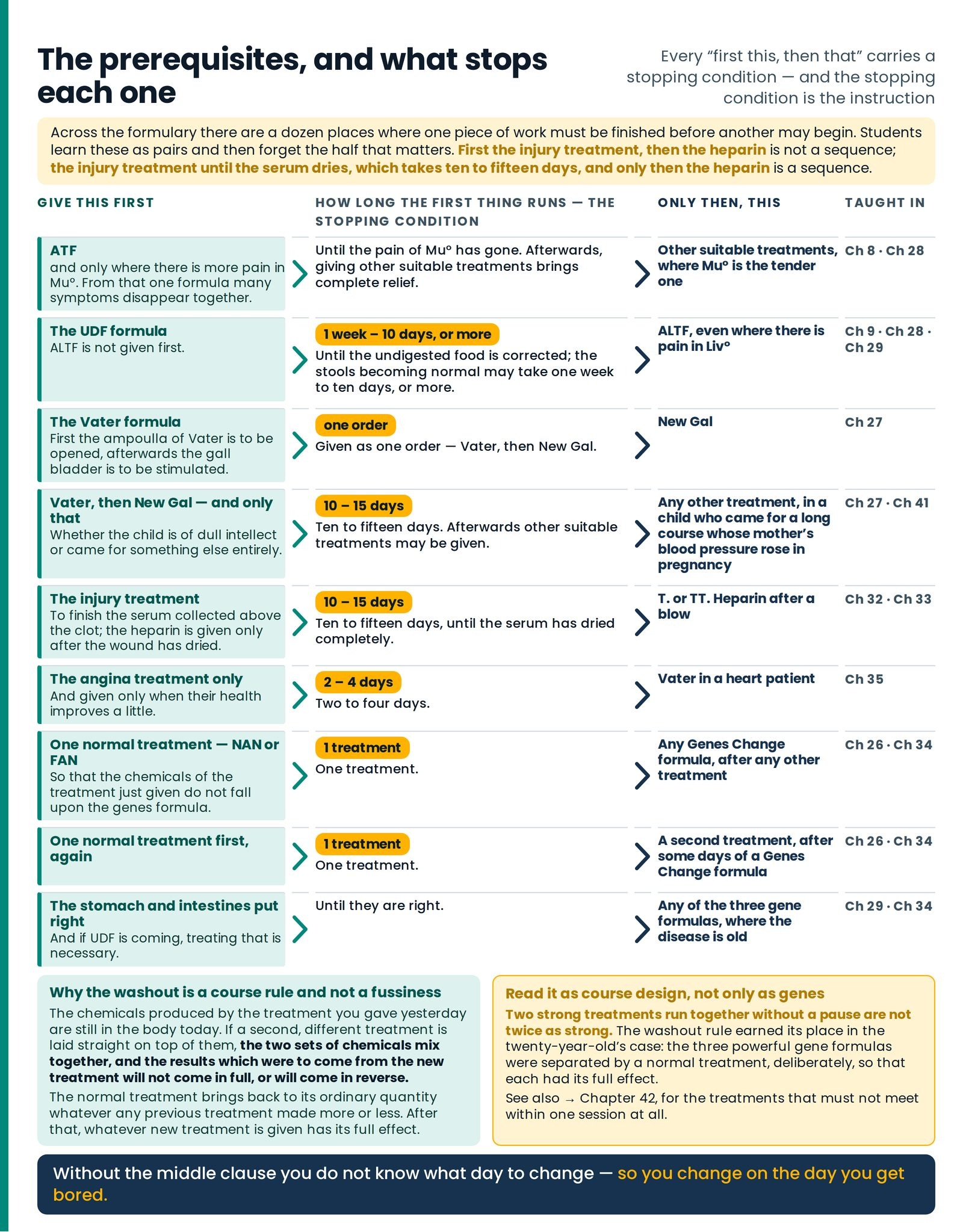
Across the formulary there are a dozen places where one piece of work must be finished before another may begin. Students learn these as pairs and then forget the half that matters. Every "first this, then that" in this therapy carries a stopping condition, and the stopping condition is the instruction. First the injury treatment, then the heparin is not a sequence; the injury treatment until the serum dries, which takes ten to fifteen days, and only then the heparin is a sequence. Without the middle clause you do not know what day to change, so you change on the day you get bored. (Figure 43.1)
Why the washout is a course rule and not a fussiness
The reason given for putting one normal treatment between two powerful treatments is worth holding on to, because it explains a whole family of sequencing rules at once.
The chemicals produced by the treatment you gave yesterday are still in the body today. If a second, different treatment is laid straight on top of them, the two sets of chemicals mix together, and the results which were to come from the new treatment will not come in full, or will come in reverse.
The normal treatment brings back to its ordinary quantity whatever any previous treatment made more or less. After that, whatever new treatment is given has its full effect — and it has been seen that doing it this way brings very good results.
Read that as a general caution about course design, not only about genes. Two strong treatments run together without a pause are not twice as strong.