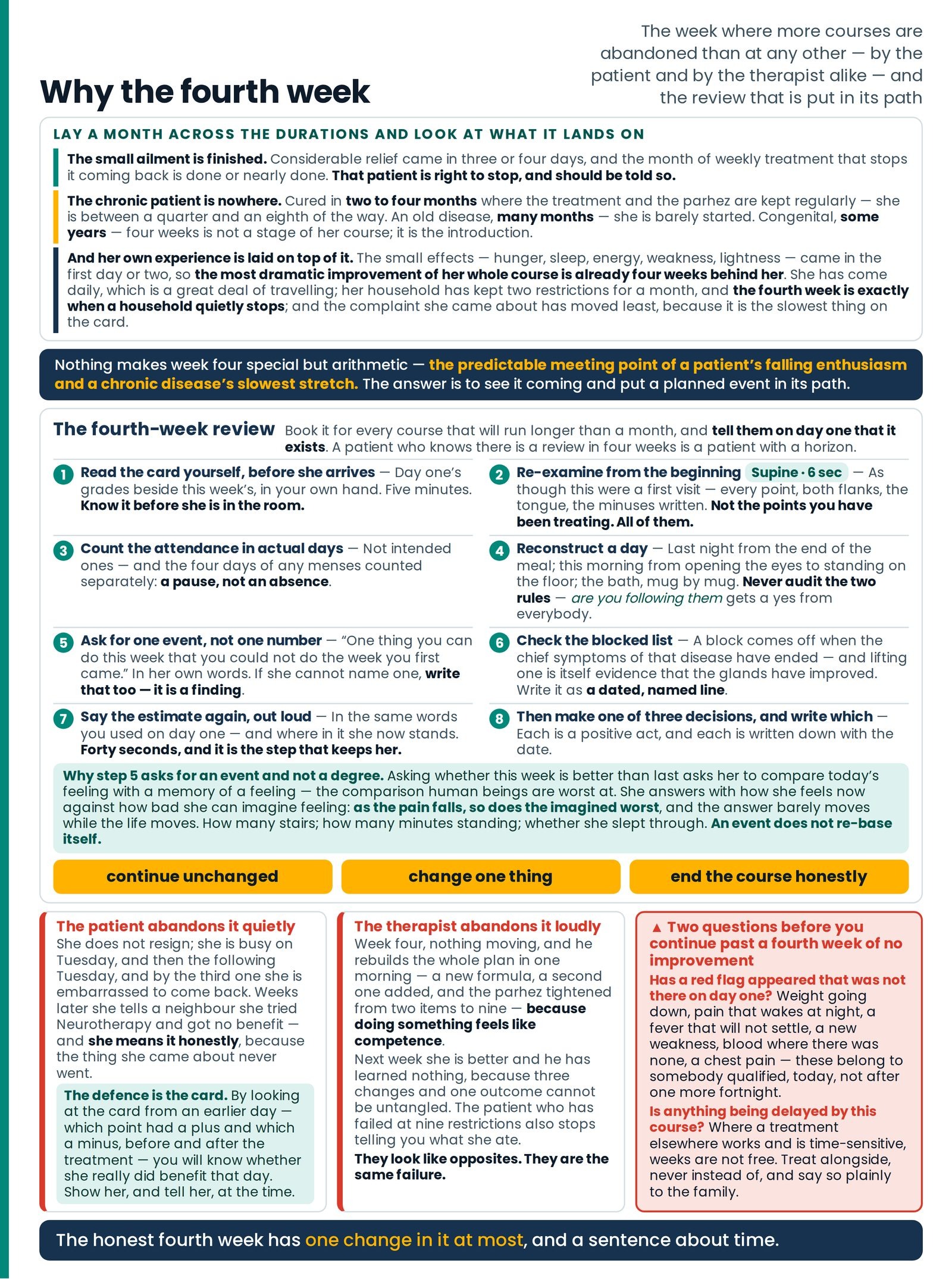
Falling enthusiasm meets the disease’s slowest stretch
Nothing in this therapy makes week four special. What makes it special is arithmetic, and it is arithmetic that runs against you.
Look at Table 1 again and lay a month across it. A small ailment is finished — considerable relief came in three or four days, and the month of weekly treatment that stops it coming back is either done or nearly done. That patient is right to stop, and should be told so.
A chronic patient is nowhere. If she is one of the fortunate ones for whom, treatment and parhez kept regularly, many diseases are cured in two to four months, she is between a quarter and an eighth of the way. If hers is an old disease, taking many months, she is barely started. If it is congenital, and the honest figure is some years, four weeks is not a stage of her course; it is the introduction.
Now put the patient's own experience on top of that arithmetic. She has had the small effects — hunger, sleep, energy, weakness, lightness — and they arrived in the first day or two, which means the most dramatic improvement of her entire course is already four weeks behind her. She has come daily for the first few weeks, which is a great deal of travelling. Her household has been keeping two restrictions for a month, and the fourth week is exactly when a household quietly stops. And the complaint she actually came about has moved least of anything, because it is the slowest thing on the card.
That is the cliff in the Erode register. It is not a mystery and it is not a failure of gratitude. It is the predictable meeting point of a patient's falling enthusiasm and a chronic disease's slowest stretch — and the whole of the answer is to see it coming and to put a planned event in its path. (Figure 43.5)
Why the fourth week. The arithmetic that makes week four the cliff, the eight steps of the planned review with its three decisions, and the two ways — the patient’s and the therapist’s — in which a course is abandoned there.
The rule, and the day it stops holding
Change a treatment when it stops reducing the pain of the pain points
The wiki's most useful decision rule was established beside the after-treatment check in Six Seconds, "Six Seconds", and its full working — the grades written before and after, and the notation they are written in — belongs to Uncommon Problems and to The Record That Shows the Truth, "The Record That Shows the Truth". This article is where it is used, because it is a rule about a course.
Key teaching
The decision rule
In this therapy, removing or finishing the pain of the pain points is the main aspect of the treatment.
Therefore: so long as any treatment reduces the pain of the pain points, there is no need to change it and give another.
Read the consequence, which is where therapists go wrong. A treatment is not changed because the patient is bored, because you are bored, because four weeks have passed, or because the complaint she came about has not gone yet. It is changed when it has stopped doing the thing it is judged by.
And read the second consequence, which is quieter. The rule requires the grades to exist. If the points were not graded before the treatment and again after it, there is nothing to apply the rule to, and the decision falls back on impressions — which is to say, on how much the patient likes you.
The same rule protects you against the returning patient, who is a fixture of every centre. Patients take two or four days of treatment, do not come for many days, and when the trouble comes back they say they got no benefit from the treatment, because their pain came back just as it was. By looking at the card from that earlier day — which point carried a plus and which a minus, before the treatment and after — you know whether that day's treatment benefited them or not. Then you can decide whether the old treatment is to be given again, or a different treatment given. Nine times in ten, the old treatment worked and was stopped.
The plateau in old, chronic disease — the material's own account
The therapy names the plateau itself, and answers it with digestion
Here is the passage every therapist in a fourth week should have read, because it is the therapy saying out loud the thing students think they are the first to notice.
Key teaching
The problem that remained
As the therapy became popular the number of patients went on growing, and good results were coming in all of them — but in old, chronic diseases it was seen that the results came only after many days, and often, after a few days, the effect of the treatment was next to nothing.
That is a plateau, named by the therapy, in its own words, without apology and without tidying.
And it was not accepted as the natural limit of the work. It was taken as a question. Guruji began study and research about this, and the answer that came out of it is the undigested-food formula — which is why the whole of that family of treatments sits where it does in the formulary.
The working instruction that falls out of this is repeated elsewhere in the formulary and is worth stating as a rule of course planning: where a disease is old, the stomach and intestines must be put right before the powerful treatments are used — and if undigested food is coming, treating that is necessary. That is not only the first ten days of a course. It is also what you go back to in the middle of one, when a long course has flattened out. The commonest reason a chronic course stalls in month two is that the digestion has slipped back while you were busy with the disease.
The order in which you look, before you touch the plan
Attendance, then the twenty-three hours, then the body, then the plan
When a course stalls, four things can be wrong, and only the last of them is the treatment. Look in this order, because the earlier ones are commoner, cheaper and more often missed.
Was the plan carried out? Attendance in actual days. The parhez, asked as tell me everything you ate and drank yesterday, from waking. The water, in glasses. A plan that stopped being carried out is not a plan that failed.
What is happening in the twenty-three hours? Reconstruct a day. The window, the bed, the hands under the head, the fridge water, the sour thing nobody in that household thinks of as a food.
Has the body changed under the plan? Re-examine from the beginning. A finding may have moved without going away, and the treatment may now be aimed at where the trouble was rather than where it is. Neurotherapy treats according to the condition of the body, and Thursday's body is not Monday's.
Only then, the plan itself — and then one change, written down, with the date and what you expect to see if it was the right change.
Changing the dose rather than the formula
A written maximum is a ceiling, not a count to be given every day
Students think of changing a plan as swapping one formula for another. There is a gentler move written into the formulary itself, and it is the commonest change a good therapist makes.
Where a formula carries a count marked maximum, the word has a particular meaning: it is not that the maximum is to be given on all days.
Every day, before the treatment, the therapist must check the patient's pain at that point. According to the pain, how much to give that day is to be decided by oneself. For the first few days give the full count; but after some days, as the pain decreases, keep reducing the quantity — a count of three in place of eight, of three in place of ten.
Key teaching
The written ceiling, and how a count comes down across a course
And when the pain has gone completely and all the symptoms are right, stop the treatment.
That is a whole course in four sentences: examine daily, give according to what you find, reduce as it improves, stop when it is done. The Vater formula is where it is written out — see also → Setting the Stomach, "Setting the Stomach" — but the habit belongs to every formula that carries a ceiling.
This is the instruction with no technique attached to it, and it is the one most therapists never learn, because nothing about a busy morning teaches it. A course can end in three quite different ways, and a therapist owes the patient a clear statement of which one is happening.
Ending one — the course is finished
Both halves: the pain gone completely and the symptoms all right
The stopping condition is written into the treatments themselves and it has two halves, both of which must be true: when the pain has gone out completely and the symptoms are all right, stop the treatment. Not when the pain has gone and the symptoms linger. Not when the patient feels well and the points still grade. Both halves. (Figure 43.6)
Three things belong to the ending itself.
Finish the tail where the material gives one. For the small ailments — fever, cold, cough, indigestion, constipation, stomach ache — considerable relief comes in three or four days, but for a complete cure at least one treatment a week for a month or two means the trouble does not come again. A patient who stops the day the symptom goes has taken the relief and left the correction, which is precisely the distinction this therapy was built on.
Hand the medicines back to the person who prescribed them. When the complaint has gone entirely, the patient is told to say to their own doctor: "Now I have no pain at all — must I still take the tablets in the same quantity?" Then the doctor himself tells them what to do. We do not advise anyone to reduce medicine without the doctor's opinion. Where a patient has, on his own responsibility, adopted the gradual taper, remember the sentence that governs it: the treatment is not to be stopped while the taper runs, until he has been well for many days without medicine. The taper itself, quarter by quarter, is taught in The History That Cannot Mislead You, "The History That Cannot Mislead You".
Give back what was taken away. The restrictions are part of the prescription and they end when the prescription ends — with one qualification stated exactly. Those with the diseases of acidosis should not eat sour things until the health is fully corrected; later, if there is need, they may eat them. If the pain comes back, stop them completely for some months, until the body is fully corrected. A therapist who returns a food is believed the next time he takes one away.
Ending two — the course has done what it can, and maintenance begins
Stability is a result — but maintenance only where it is named
Some patients are not finished; they are stable, and stability is the result. The material names this rung only in particular places and you should not extend it beyond them: once or twice a week for those whose fats are not digested, from which they will never get gall stones; twice or once a week for the rheumatoid patient whose finger pain has gone out completely. Where it is named, say what it is for and how often, and write it on the card as a plan rather than as a habit.
Ending three — the course has not worked, and is being ended for that reason
Four things written on the card before you end it for lack of result
This is the hard one, and there is no way to make it comfortable. There is a way to make it honest.
Key teaching
Ending a course that has not worked
Four things must be true before you end a course for lack of result, and all four are written on the card, not held in your head:
1. The plan was actually carried out — the days attended, the parhez, the water, the two rules. A plan that was never carried out has not been tested. 2. The findings were re-taken from the beginning, at least twice across the course, and the plan re-fitted to them. 3. One thing was changed at a time, each with a date and each with what you expected to see. 4. The points have not moved — graded by the same hand, the same way, at the start and now. This is the evidence, and without it you are ending a course on a feeling.
Then say it. You are not sending the patient away — that is a different act, taught in When the Hand Must Stop, "When the Hand Must Stop". You are saying that this course, given properly, has not produced what it should have produced, and that you will not go on taking her Tuesdays for something that is not happening.
Say what was achieved as well as what was not. Almost always something moved — the sleep, the bowel, the hunger — and she is entitled to know that those were real. Then say what you would do next: a re-start after a gap, a different therapist's eyes, or a referral with a written summary of what was tried and what happened.
Three endings. The three ways a course ends — finished, stable on a named maintenance, or ended honestly for lack of result — with the fourth that nobody admits to, and the eight steps of a last visit.
You will have to make this judgement about your own work, with nobody to check it, several times a week for the rest of your life. Three things flatter you and three things protect you. (Figure 43.7)
The three flatterers
Her kindness, the worst day, and your own memory
The patient's kindness. She is being treated free, or nearly free, by someone who is plainly working hard on her behalf, in a culture that treats a healer with reverence. Asked how she feels, she will say better — and she is not lying; she is being decent. The therapist who asks "are you feeling better?" will be told yes for eleven weeks.
The worst day. People come to a healer when they are at their worst, and by its nature a worst is unusual for that person. Some of what improves in the first fortnight of any course, anywhere, in any system, would have improved anyway, because the patient arrived at the bottom of a swing and the swing was going to come back up. This is not an argument against the therapy. It is an argument for measuring, because the only defence against it is a record long enough to show a trend rather than a bounce.
Your own memory. You remember the patients who got well; they came back and thanked you. You do not remember the ones who stopped in the fourth week, because nothing happened to make you remember them. Every therapist's memory is a collection of successes, honestly formed and completely useless as evidence.
The three defences
Grades by the same hand, events not degrees, the untreated complaints
Grades written before and after, by the same hand. This is the therapy's own measure and it is the only one that is independent of the patient's mood. Pan at four plus on day one and one plus in week four is not an opinion.
Events, not degrees. How many stairs; how many minutes standing; whether she can sit on the floor; whether she slept through; whether she has stopped the afternoon nap she needed every day. Record them in her words on day one and read them back in week four.
The complaints nobody is treating. Where the picture really is one picture, the things you were not aiming at move — and families notice what no card records. In the ten-day account from one centre, what the relatives reported was not the disease at all: the patient's disposition had become remarkably better, and irritability drastically reduced, within ten days. Ask the daughter. One sentence from a daughter outranks a session of guessing.
Key teaching
The honest sentence, and the two dishonest ones
When a course is going slowly, there are three things you can say and only one of them is defensible.
Dishonest, in the encouraging direction: "It is working, you will see, be patient." You do not know that. If it turns out to be false she will remember that you said it, and so will her family, and so will her village.
Dishonest, in the modest direction: "I'm sorry, I don't think this is doing very much." — said in week three of a chronic course that is running exactly on schedule. This is not humility; it is a therapist managing his own discomfort at the patient's expense, and it ends courses that were going to work.
Honest: "Here is what has moved" — naming it — "and here is what has not. This is a disease of nine years, and the time I gave you on the first day was many months. We are in week four of that. I am not changing the treatment, because it is still reducing these pains, and I will tell you the day it stops."
That answer contains a measurement, a timescale, a decision and a promise. It is also, in the ordinary sense of the word, true.
Judging your own work. The three things that flatter a therapist set against the three that protect him, the measure that cannot move inside a fortnight, and the three things that can be said when a course is going slowly — only one of them defensible.
Ready to begin?
Send COURSE for course details, or your name, age and health issue for a consultation.