Daily, alternate days, two days a week, one day — and four pauses
The therapy gives one plain ladder for how often a patient comes, and it runs downward as the patient gets better.
Key teaching
The ladder of frequency
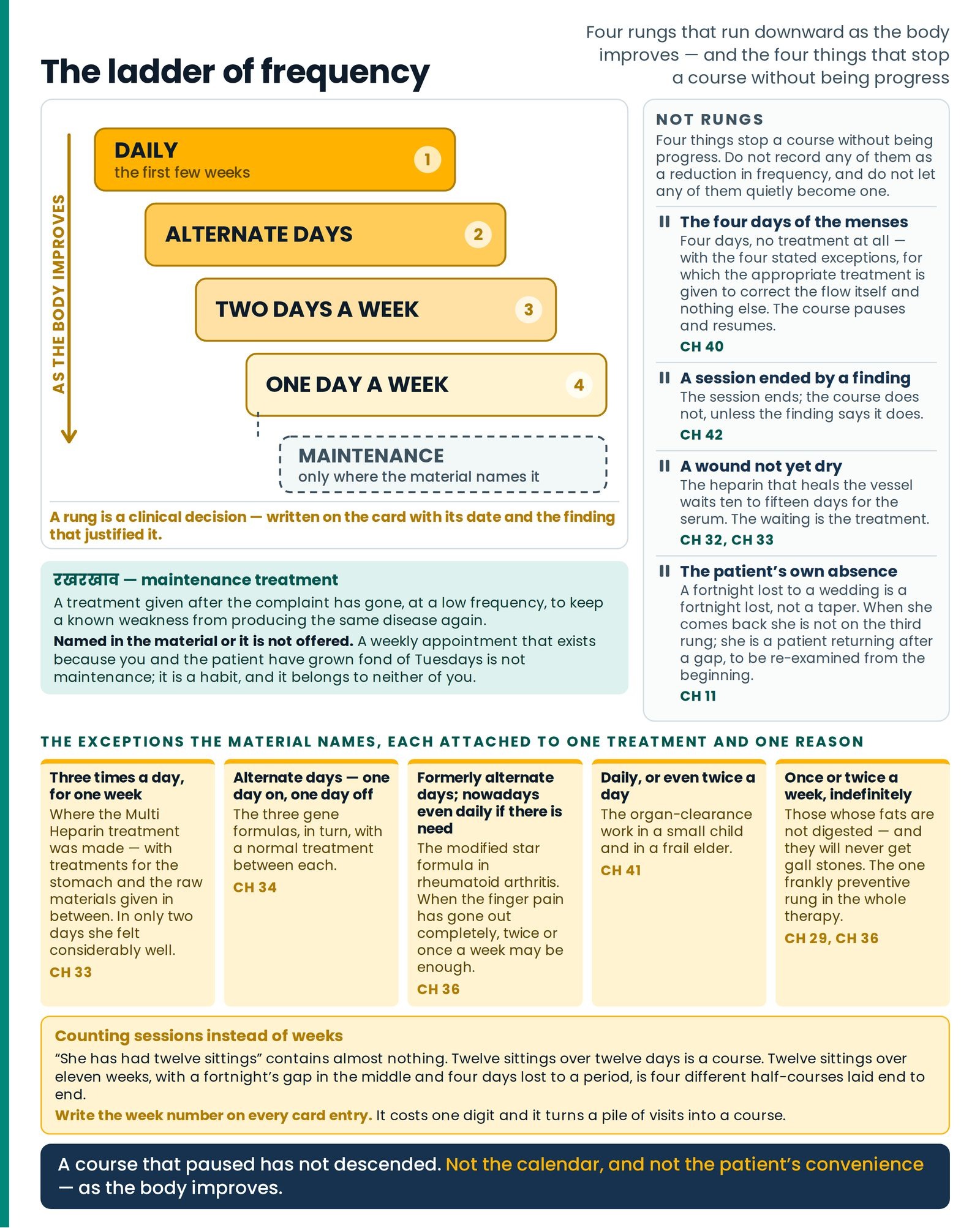
For the first few weeks, take treatment daily. Then, as the body improves — alternate days, then two days a week, then one day. Reducing in this way.
Four rungs. Note what moves a patient down a rung: not the calendar, and not the patient's convenience. As the body improves. The rung is a clinical statement, and it should be written on the card as one, with the date and the finding that justified it.
The whole residential arrangement this ladder belongs to — the 20–25 day admission after a full investigation, the days that go simply in improving the digestive system, the return to the nearest centre, and the relative taught to treat at home where no therapist is available — is taught in The History That Cannot Mislead You, "The History That Cannot Mislead You". What is used here is the ladder itself, because it is the backbone of every course you will ever plan.
The ladder is a default and the material names its own exceptions, each attached to a particular treatment and a particular reason. Carry them exactly: (Figure 43.2)
Three times a day, for one week. Where the Multi Heparin treatment was made, for a therapist whose left side had begun to go numb, it was given three times a day for a week, with treatments for the stomach and the raw materials given in between; in only two days she felt considerably well, and at one week the imaging that had shown ischaemic foci read as an essentially normal study.
Alternate days, one day on and one day off. The three gene formulas, in turn, with a normal treatment between each.
Formerly alternate days, nowadays even daily if there is need. The modified star formula in rheumatoid arthritis — and this is one of the places where the material has openly changed its own practice over time and says so. When the finger pain has gone out completely, twice or once a week may be enough.
Daily, or even twice a day. The organ-clearance work in a small child and in a frail elder.
Once or twice a week, indefinitely. Those whose fats are not digested — and they will never get gall stones. This is the one frankly preventive rung in the whole therapy.
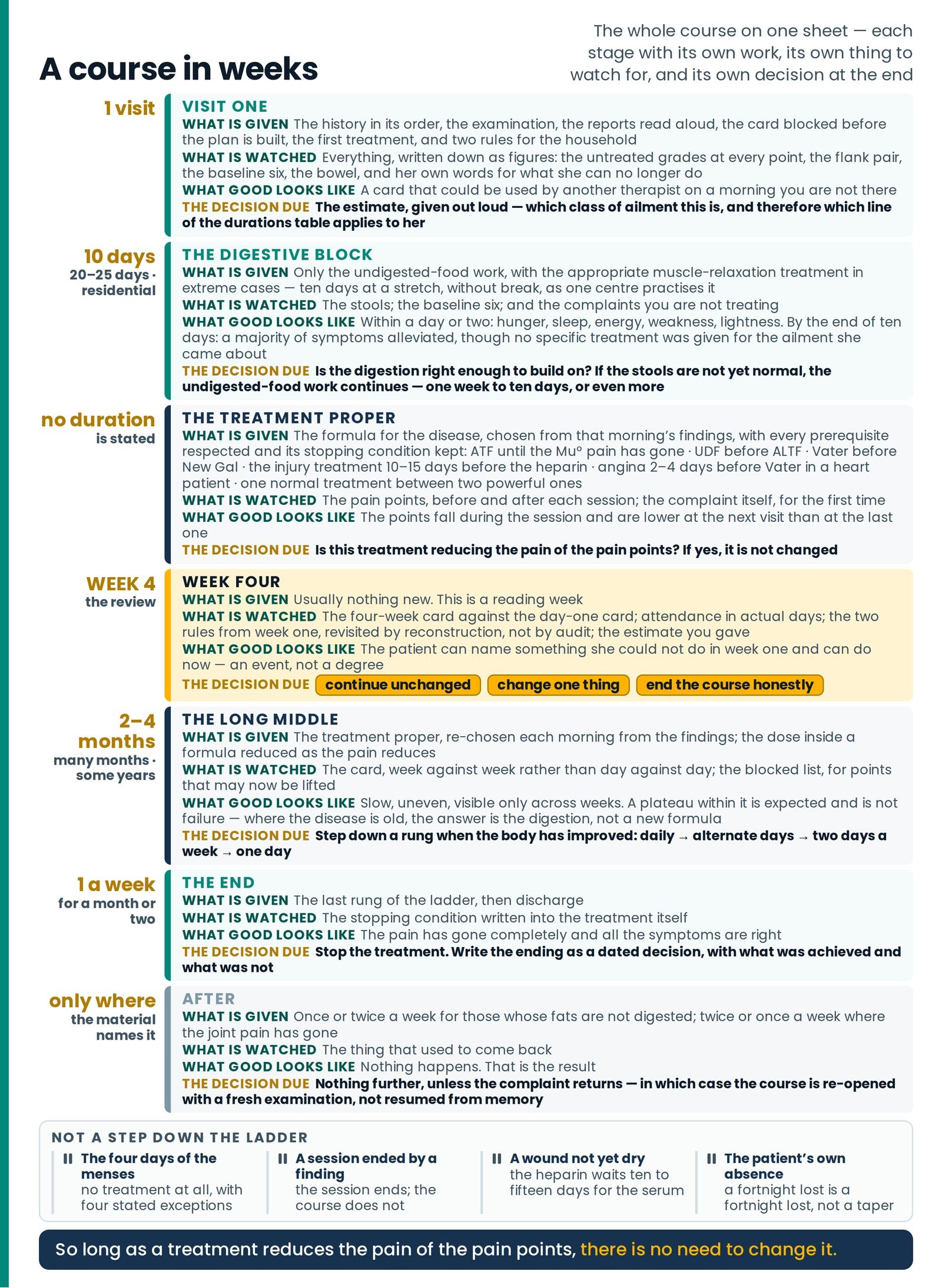
This is the part of the article to photocopy and keep inside the register. (Figure 43.3)
Two warnings before you use it. First, the stage names are ours and the numbers are the material's. Where a stage has a stated duration it is printed; where it has none, the column says no duration is stated, and you are not to supply one — not to a student, not to a patient, not in your own head. Second, the aid does not choose treatments. It tells you what kind of work belongs to a stage, what to watch for, and what decision is due. Which formula is decided by the findings of that morning, in the ordinary way.
The ladder of frequency. The four rungs that run downward as the body improves, with maintenance drawn below them as a dotted bar; and beside the ladder the four things that stop a course without being progress, each marked with a pause symbol.A course in weeks. The whole course on one sheet: seven stages down a spine, each with its stated duration printed in the margin, what is given, what is watched, what good looks like and the decision due — with the three fourth-week decisions set as buttons and the four pauses that are not steps down.
Reading a week
Five things can be true at the end of a week, and each has an answer
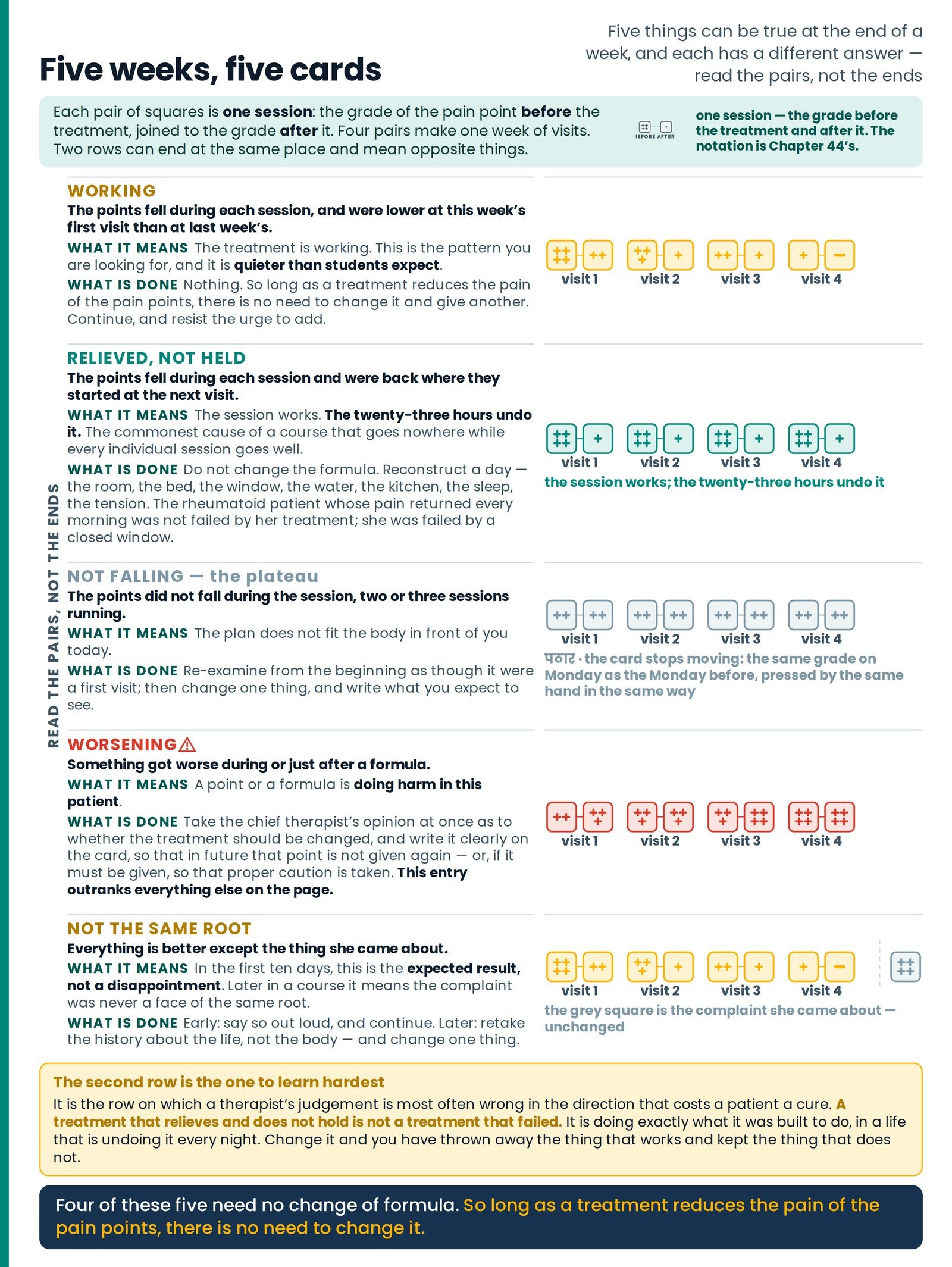
Five things can be true at the end of a week, and each has a different answer. Most therapists know three of them. (Figure 43.4)
The second row of that table is the one to learn hardest, because it is the row on which a therapist's judgement is most often wrong in the direction that costs a patient a cure. A treatment that relieves and does not hold is not a treatment that failed. It is a treatment doing exactly what it was built to do, in a life that is undoing it every night. Change the treatment and you have thrown away something that works and kept the thing that does not.
Five weeks, five cards. The five patterns a week can show, each as a row of four before-and-after pairs of grades, so that ‘relieved but not held’ can be told from ‘not working’ — with what each pattern means and what is done about it.
Ready to begin?
Send COURSE for course details, or your name, age and health issue for a consultation.