Twelve stages, three rules, and the three words kept apart on the card
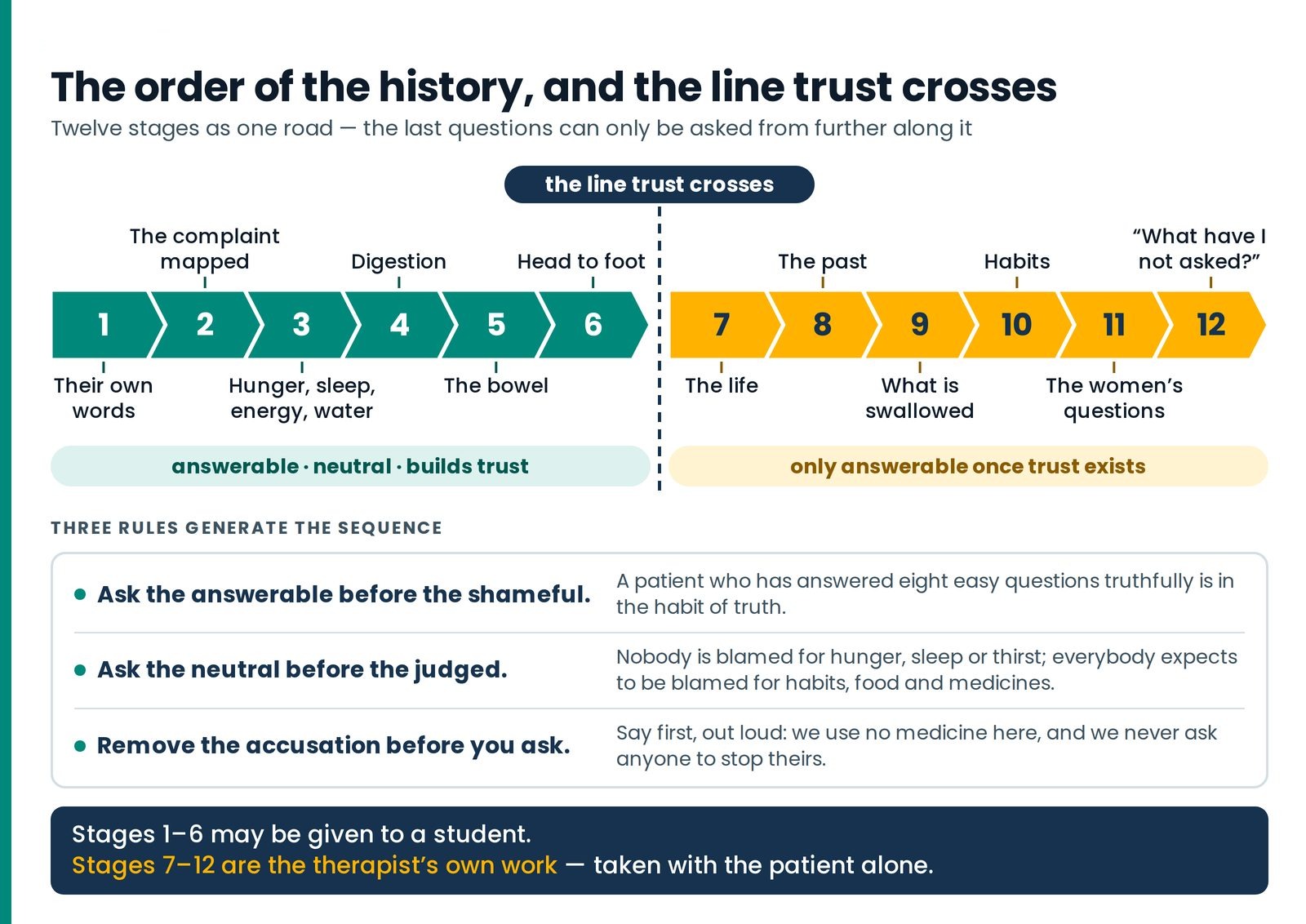
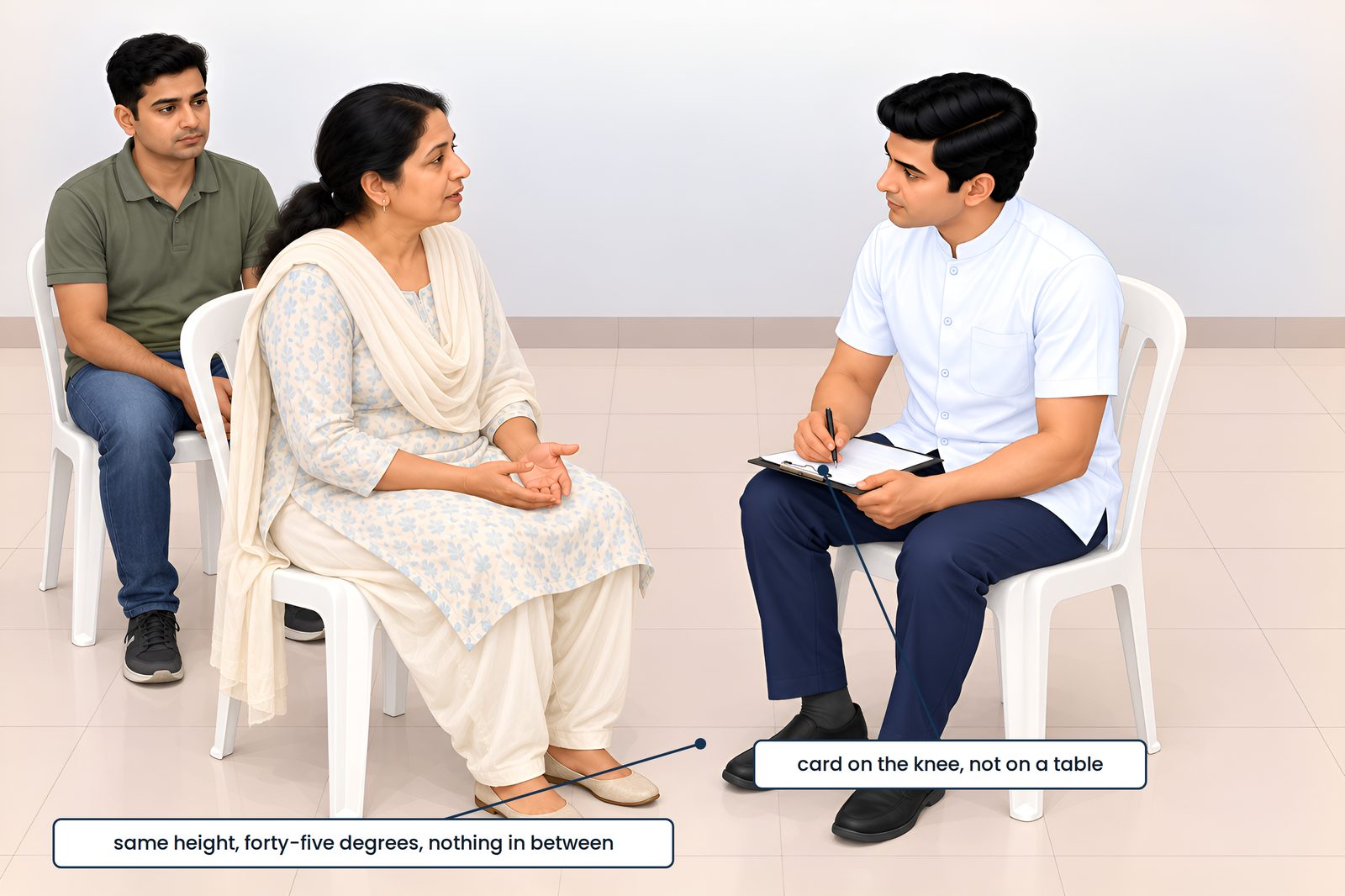
There is an order for a first history, and it is not the order a sensible person would invent — because the answer to a question is changed by the questions that came before it. (Figure 11.1) (Figure 11.2)
Three rules generate the sequence. The answerable before the shameful: a patient who has answered eight easy questions truthfully is in the habit of truth; one whose second question was about alcohol has learnt that this is a place of judgement, and everything afterwards is curated. The neutral before the judged: nobody is blamed for hunger, sleep or thirst; everybody expects to be blamed for habits, food and medicines. And never ask a question whose honest answer is a confession of disobedience until you have removed the accusation from it — "are you taking your tablets regularly?" asks a man to admit he ignored his doctor, and he will not; say first, out loud, we use no medicine here and we never ask anyone to stop theirs, and the answer changes.
The order of the history, and the line trust crosses. The twelve stages of a first history as one road: stages 1–6 answerable, neutral and trust-building; stages 7–12 only answerable once trust exists. Below, the three rules that generate the sequence.The first consultation: seated, at the same height, card on the knee. Therapist and patient sit at the same eye level, turned about forty-five degrees to one another, with nothing between them. The history card lies on a clipboard on the therapist's own knee, tilted away from the room, his pen still while she speaks; the relative sits behind and to the side, in sight but outside the conversation.
Read next
The Fire and the Ash The Fire and the Ash — the undigested-food questionnaire belongs at stage 4
What the Bowel Tells You What the Bowel Tells You — the bowel questions of stage 5, in a flat voice
Treating Women Treating Women — the women's questions of stage 11, never across a hall
How to ask a question a patient will answer honestly
Nine devices, the question with its answer inside, and elicitation
The question that carries its own answer
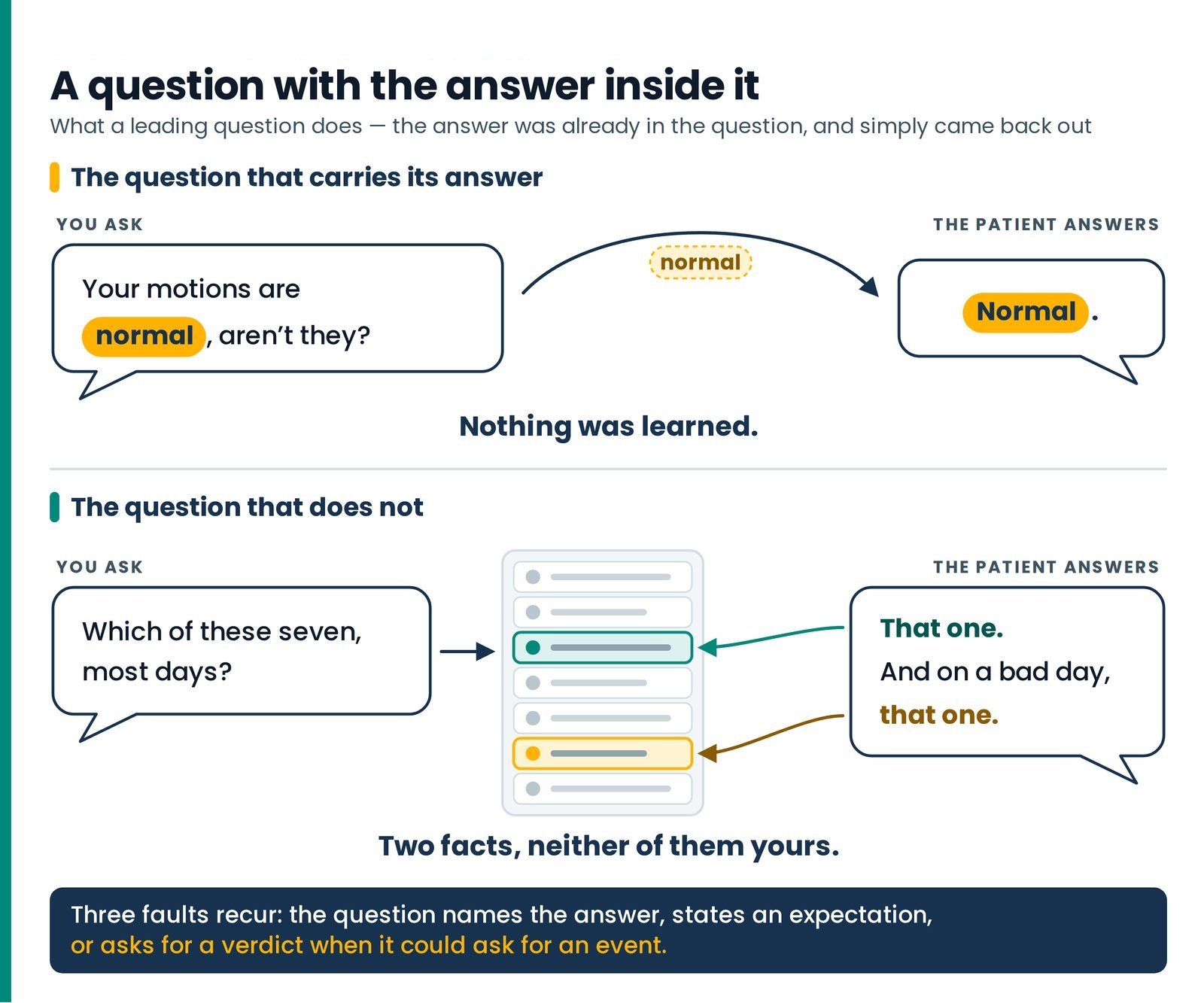
The commonest fault in a beginner's history is not shyness but a question with the answer already inside it. (Figure 11.3)
A question with the answer inside it. A leading question gives its own answer back: 'normal' goes in and 'Normal.' comes out, and nothing is learned. A question that asks the patient to point at one of seven rows returns two facts, neither of them the therapist's.
Table 1 — The same enquiry, two ways
Carries its answer
What it gets you
Does not
"You don't get burning in the chest, do you?"
A no. You asked for one
"What happens in your chest after food?"
"Are your motions normal?"
His own definition of normal
"Which of these seven, most days?" — pointing at the chart
"You are following the food advice?"
Yes
"Tell me everything you ate and drank yesterday, from waking."
"You have not stopped your tablets, have you?"
Of course not
"Show me what you swallowed yesterday."
"Is it better?"
Yes, always, to be kind to you
"What can you do this week that you could not last week?"
Three faults recur on the left: the question names the answer; it states an expectation the patient must meet or contradict; or it asks for a verdict when it could ask for an event. Ask for an event, a number, a place or a pointing — never a verdict.
The elicitation method — for a question the patient finds repugnant
The Fire and the Ash teaches this method on the hardest such question in the wiki — whether undigested food appears in the stools. It works on every repugnant question you will ask.
Ready to begin?
Send COURSE for course details, or your name, age and health issue for a consultation.