Watch



The front chart, complete
Every front point — where it lies, what is beneath, why the name
The front chart is a line drawing of the trunk from neck to upper thighs, with the rib margins sketched in, the crests of the hip bones, the creases of the groin, and a small open circle for the navel. Three structures are marked on the midline above the field of points — the thyroid at the base of the neck, the thymus behind the upper breastbone, the pancreas as a small oval at the very bottom of it. Around and below the navel lies a field of small numbered boxes carrying 1, 2 or 3, and eighteen labelled call-outs run down the two margins of the page to reach them. (Figure 6.1)
Here is the whole front list. Learn the table first and the reasoning afterwards; the reasoning will not stay in a mind that has no pegs to hang it on. (Figure 6.8)
Table 1 — The pain points of the front chart
| Code | Full name — organ or symptom | Where it lies, by feel |
|---|---|---|
| Pan | Pancreas | The pit of the stomach — the soft dip at the bottom of the breastbone, where the two rib margins meet in a shallow V |
| Gal | Gall bladder | Under the right rib margin, where the outer edge of the straight belly muscle crosses it Right |
| Spl | Spleen | Under the left rib margin — the mirror of Gal Left |
| Liv | Liver | To the right of the navel, level with it, in the middle ring Right |
| Mu | Mucus — the mucous membrane of the entire gastrointestinal tract | To the left of the navel, level with it, in the middle ring Left |
| Gas | Stomach and duodenum | The midline of the upper belly, below the breastbone, above the navel |
| Gas 'I' ("Gas eye") | Jejunum and ileum | Immediately around the navel |
| Const | Constipation — kabjī | Left upper quadrant, middle ring, between navel and left rib margin Left |
| Dys | Dysentery — loose motions | Right upper quadrant, middle ring, between navel and right rib margin Right |
| WD | White discharge — uterus and prostate gland | The midline, below the navel |
| Rt.Ov | Right ovary / right testis | Right lower quadrant, midway between the navel and the bony front point of the right hip Right |
| Lt.Ov | Left ovary / left testis | Left lower quadrant — the mirror of Rt.Ov Left |
| Acid | Corrects the symptoms of acidosis | Over the left groin and the crest of the left hip bone Left |
| Fluid ("Alkali or Fluid") | Corrects the symptoms of alkalosis | Over the right groin and the crest of the right hip bone Right |
| FA / Folic | Folic acid deficiency | Above the front of the right hip bone, at the groin and crest Right |
| B₁₂ | Vitamin B₁₂ deficiency | Above the front of the left hip bone, at the groin and crest Left |
How the labels sit around the page. The chart is an anterior view, so the patient's right is on the reader's left. Down the reader's left margin — the patient's right — run GALL, DYS, GAS, LIVER, RT.OV., and at the foot THIAMIN, FOLIC and ALKALI OR FLUID. Down the reader's right margin — the patient's left — run SPLEEN, CONST, MUCUS, NAVEL, LT.OV., and at the foot NIACIN, B₁₂ and ACID.
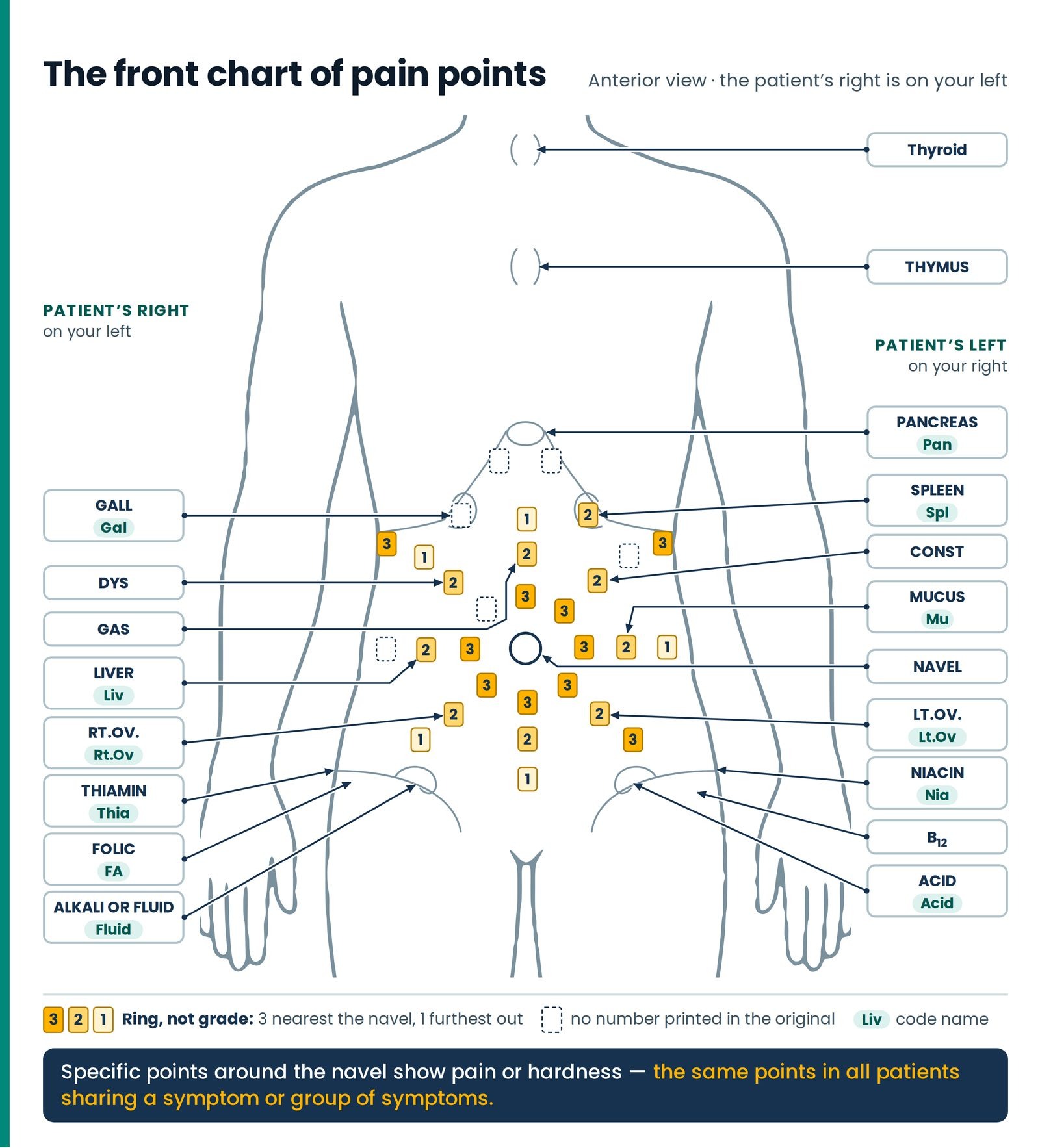
Now take them one at a time: how to find each on a living body, what is under your finger, and why it carries that name.
Pan — the pancreas point
Finding it. Run two fingers up the midline from the navel until the belly wall ends and bone begins. Where the rib margins meet, at the bottom tip of the breastbone, there is a small soft dip — the spot a person rubs with the heel of the hand and calls the pit of my stomach.
What is beneath. The midline seam where the two straight muscles meet edge to edge; behind it the left lobe of the liver and the upper stomach; and crossing the back wall at about the first lumbar bone, lying across the great artery like a wet cloth over a rope, the body of the pancreas.
Why the name. In diseases connected with the pancreas, pain or stiffness is found around the navel at just this place. The chart marks the pancreas here as a small oval — the one front point where the named organ genuinely lies more or less behind the mark.
Gal — the gall bladder point
Finding it. Lay your hand flat under the patient's right rib margin and find the outer edge of the straight belly muscle — ask her to lift her head an inch and it stands up under your fingers, then let her lie back. Where that edge crosses the rib margin, at the tip of the ninth rib cartilage, is the point. Right
What is beneath. The rounded end of the gall bladder, poking out from under the liver's edge; behind and above it the right lobe of the liver, beside it the bend of the large bowel, just deeper the first part of the duodenum.
Why the name. In gall bladder trouble, pain or stiffness is found in just this part. It is also the exact spot a surgeon presses when he suspects an inflamed gall bladder — two traditions arriving at one square inch from opposite directions, worth saying to a doctor who asks.
Spl — the spleen point
Finding it. The mirror image of Gal, under the left rib margin. Left
What is beneath. Not the spleen — that sits further back and higher, under ribs nine to eleven, and in health cannot be felt at all. Under your finger here are the stomach, the bend of the large bowel under the spleen, and the great apron of fat over the intestines.
Why the name. Because in diseases connected with the spleen, pain or stiffness is found here — an observation about tenderness, not a claim that you are touching a spleen.
Liv — the liver point
Finding it. Two to three finger-breadths to the right of the navel, level with it, in the middle ring. Right
What is beneath. The straight belly muscle in its sheath; behind it, in a thin patient, the lower edge of the right lobe of the liver; below and behind, the ascending colon, with small-bowel loops between.
Why the name. In liver disease, pain or stiffness is found here. Remember its side — right of the navel — because it is half of the memory device naming the kidney points at the back.
Mu — the mucus point
Finding it. The mirror of Liv, the same distance to the left of the navel and level with it. Left
What is beneath. Straight belly muscle; behind it the descending colon, and coils of jejunum and ileum.
Why the name. Whenever slimy mucus — āṃva — is coming in the motions, there is pain at this point. And a second observation pushed the name outward from the bowel to the whole body: if a person has a blocked nose or a dry mouth, a particular treatment is given on the right thigh and hand, and moisture then comes into the nose and the mouth. This has been proved on many patients. From it Guruji says that our treatment provokes the mucous membrane — and it is for that reason that the treatment was named Mucus.
So the hash mark on the chart is not a footnote to skip. Mu does not stand for mucus in the bowel; it stands for the mucous membrane of the entire gastrointestinal tract — one continuous wet lining from the lip to the far end, behaving as the lining of nose and mouth behaves.
Gas — the stomach and duodenum point
Finding it. The midline of the upper belly, between navel and breastbone, in the middle ring; the chart reaches it on a long leader.
What is beneath. The body and outlet of the stomach; the first and second parts of the duodenum curving right; below them, running across, the transverse colon.
Why the name. Not "gas" in the sense a patient uses the word. Gas codes for the stomach and duodenum — the first stretch of the tube, where food is broken down and handed on. A student who reads Gas as wind will misread half the formulary.
Gas 'I' — the jejunum and ileum point
Finding it. Immediately around the navel itself.
What is beneath. The small intestine — coils of jejunum and ileum on their fan of mesentery, mobile enough to slide under your finger.
Why the name. Gas 'I' is the small-bowel point as Gas is the gastro-duodenal one; read the I as intestine and the pair keeps itself straight. This is where absorption happens — where the raw materials every gland depends on either get into the blood or fail to.
Const — the constipation point
Finding it. The left upper quadrant, middle ring, on a line from the navel towards the left rib margin. Left
What is beneath. The descending colon and the bend of the bowel under the spleen — where formed stool waits before it moves on. Press it in a constipated patient and you may feel not only tenderness but a firm, sausage-like fullness that does not yield.
Why the name. One of the two points named for a symptom rather than an organ, asterisked on the chart to say so. In constipation there is sharp pain at just this point.
Dys — the dysentery point
Finding it. The right upper quadrant, in the middle ring — the mirror of Const. Right
What is beneath. The ascending colon and the bend of the bowel under the liver; below them the caecum and the last stretch of small intestine.
Why the name. The other symptom-named point: in loose motions there is sharp pain at just this point. The side is part of the instruction — the finding that licenses the Dys treatment is pain in the upper part to the right of the navel. Right
WD — the white discharge point
Finding it. The midline below the navel, between navel and pubic bone.
What is beneath. The midline seam; behind it the dome of the bladder when full — one good reason a patient passes urine before a session — the uterus resting above the bladder in a woman, and loops of sigmoid colon.
Why the name. Whenever women have the problem of white discharge, pain or stiffness is found at just this place below the navel; and as soon as the treatment named WD is given, both the pain and the discharge come to an end. The code covers the corresponding organ in either sex: uterus and prostate gland.
Rt.Ov and Lt.Ov — the gonad points
Finding them. Put a fingertip on the navel and another on the bony point at the front of the hip — the knob you feel with your hands on your hips. Halfway along that line, in the lower quadrant, is the point: Rt.Ov on the right Right , Lt.Ov on the left Left .
What is beneath. The hollow of the iliac fossa; the great vessels running down to the leg; the tube from the kidney crossing the brim of the pelvis. The ovary itself lies deep on the side wall of the pelvis and cannot be reached by a finger on the belly, and in a man no gonad lies here at all.
Why the name. In diseases connected with these organs, pain or stiffness is found at just these places. The codes cover left ovary or testis and right ovary or testis — one point, either sex.
Why two separate codes and not one pair. Because the two are not interchangeable. Wherever the body has two glands of a kind, their work is nevertheless not the same: more oestrogen comes from the left ovary, more progesterone from the right — which is why the treatments for menstrual disorder are given on one side for the first fortnight after the menses and on the other for the second.
Acid and Fluid — the two balance points
Finding them. Not around the navel but down at the hip. Acid lies over the left groin and the crest of the left hip bone Left ; Fluid — labelled on the chart as ALKALI OR FLUID — over the right groin and crest Right .
What is beneath. The crest of the hip bone and the muscle sheets taking origin from it; the ligament of the groin and the canal running along it; the two nerves supplying this strip of skin; and just below the ligament, the great vessels passing into the thigh.
Why the names — and the trap in them. These two are named neither for an organ nor for a symptom but for what pressing them does. Acid corrects the symptoms of acidosis; Fluid corrects the symptoms of alkalosis. So Acid is not the acidosis point — it is the anti-acidosis point, and a student who reads it the other way will give the wrong one of the pair. Note their sides and hold them until The Two Kingdoms: Acid sits on the left, and pains on the left of the navel generally keep company with the symptoms of acidosis; Fluid sits on the right, with alkalosis.
FA and B₁₂ — the two vitamin points of the front
Finding them. Near the hip, above the front of the hip bone, at the groin and the crest — FA, folic acid, on the patient's right Right ; B₁₂ on the left Left . Pain at these points is connected with the symptoms of deficiency of just these vitamins, and each carries the name of the deficiency it answers. They are two of the four pain points near the hip; the other two lie above the back of the hip bone and belong to the back list.