The ring rule — how to read the numbers on the chart
Rings, not grades: the nearer the navel, the further down the limb
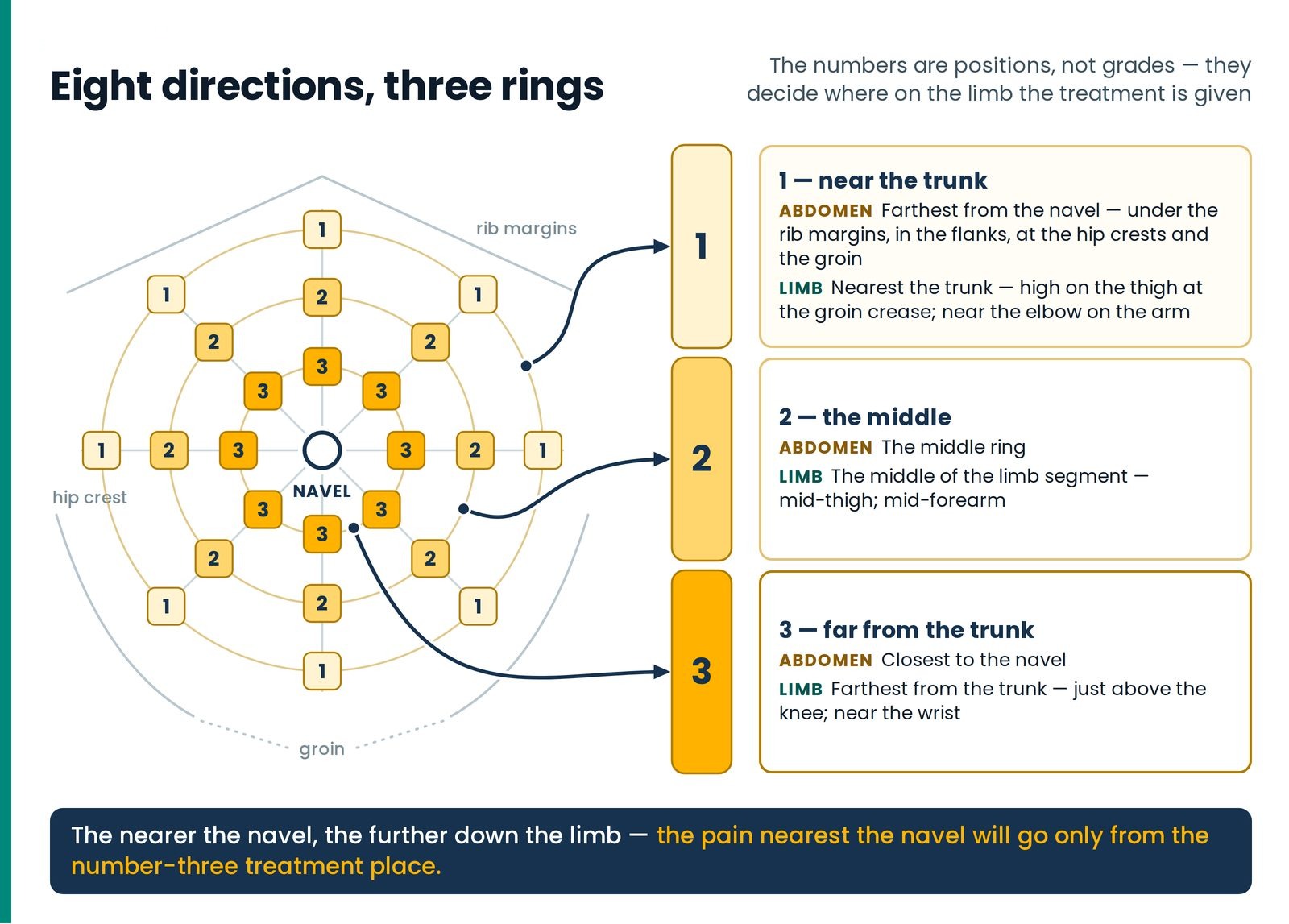
Now the part of the chart beginners skip and should learn before any point name: those small boxes carrying 1, 2 and 3. They are not grades of severity — a 3 does not mean worse than a 2 — but coordinates, and they decide where on the limb the treatment is given. (Figure 6.3)
In the eight directions around the navel — the four cardinal directions and the four diagonals — numbers such as one, two and three have been given along with each name.
Key teaching
The eight directions and the three rings
These numbers are connected with the order of our treatment. They tell which pain will go by giving treatment where — that is, the pain of a number-one place will go from the number-one treatment place.
Along every one of the eight directions, the same named point recurs at three distances from the navel:
the 3s cluster immediately around the navel;
the 2s form a middle ring;
the 1s lie furthest out — towards the rib margins, the flanks, the crests of the hip bones and the groin.
And the general rule that binds it together:
The pain nearest the navel will go only from the number-three treatment place.
Read that last line again, because it holds the surprise: the relationship is inverted. As the tender point moves inward towards the navel, the treatment site moves outward along the limb.
This is not an arbitrary convention to be memorised item by item but a single consistent transformation, which a student can apply to a point he has never seen before — a large part of why this system passes intact from teacher to student. Combine it with the four correspondences already taught — legs for pains above the navel, arms for pains between the navel and the perineum, left limbs for the right of the navel and right limbs for the left — and any square inch of the abdomen has an address on a limb.
Eight directions, three rings. The front-chart geometry as a wheel: eight directions round the navel, the same point at three distances. Arrows take ring 1 to the station nearest the trunk and ring 3 to the station farthest from it, with the table's abdomen and limb positions for each ring.
The two worked examples
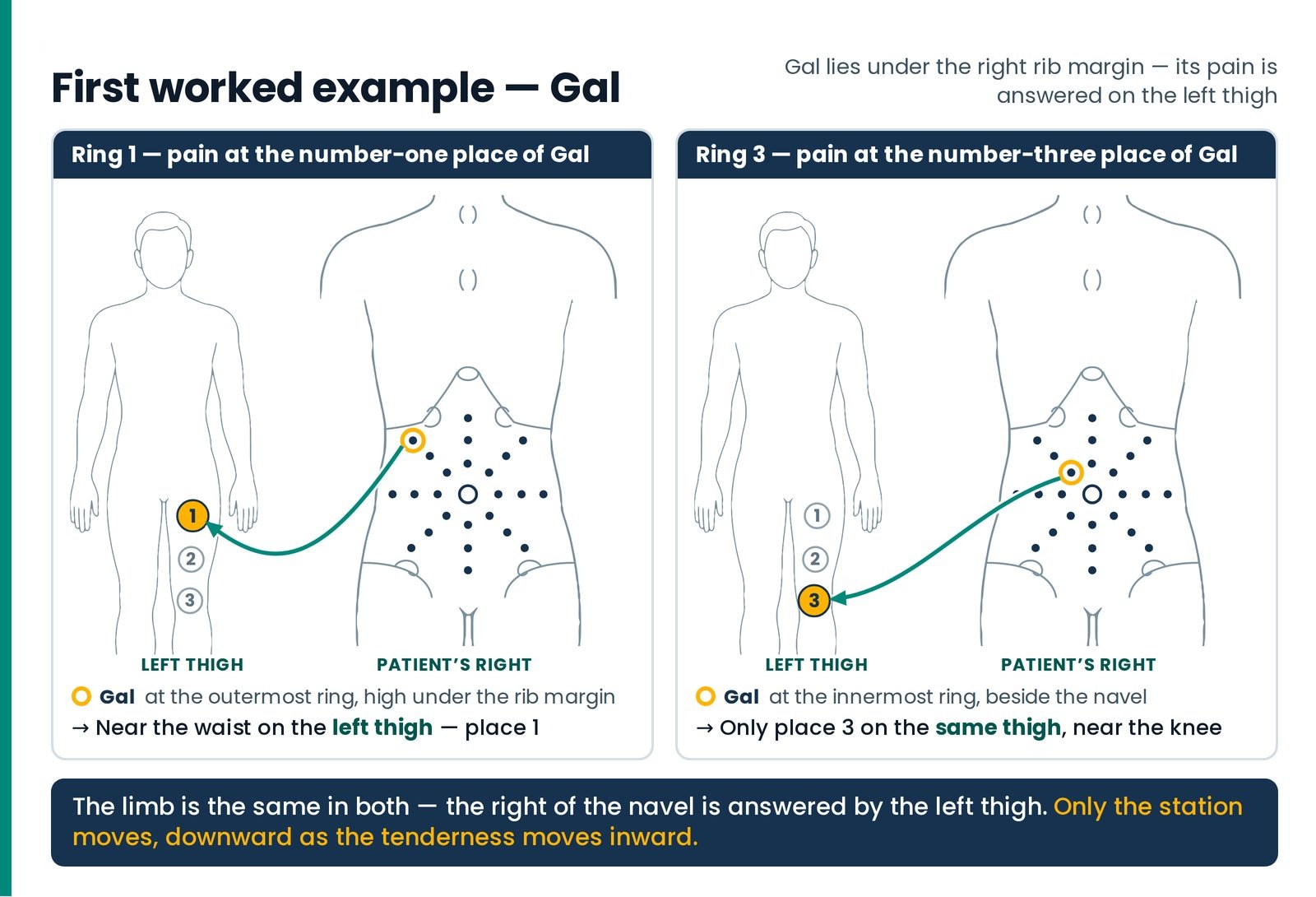
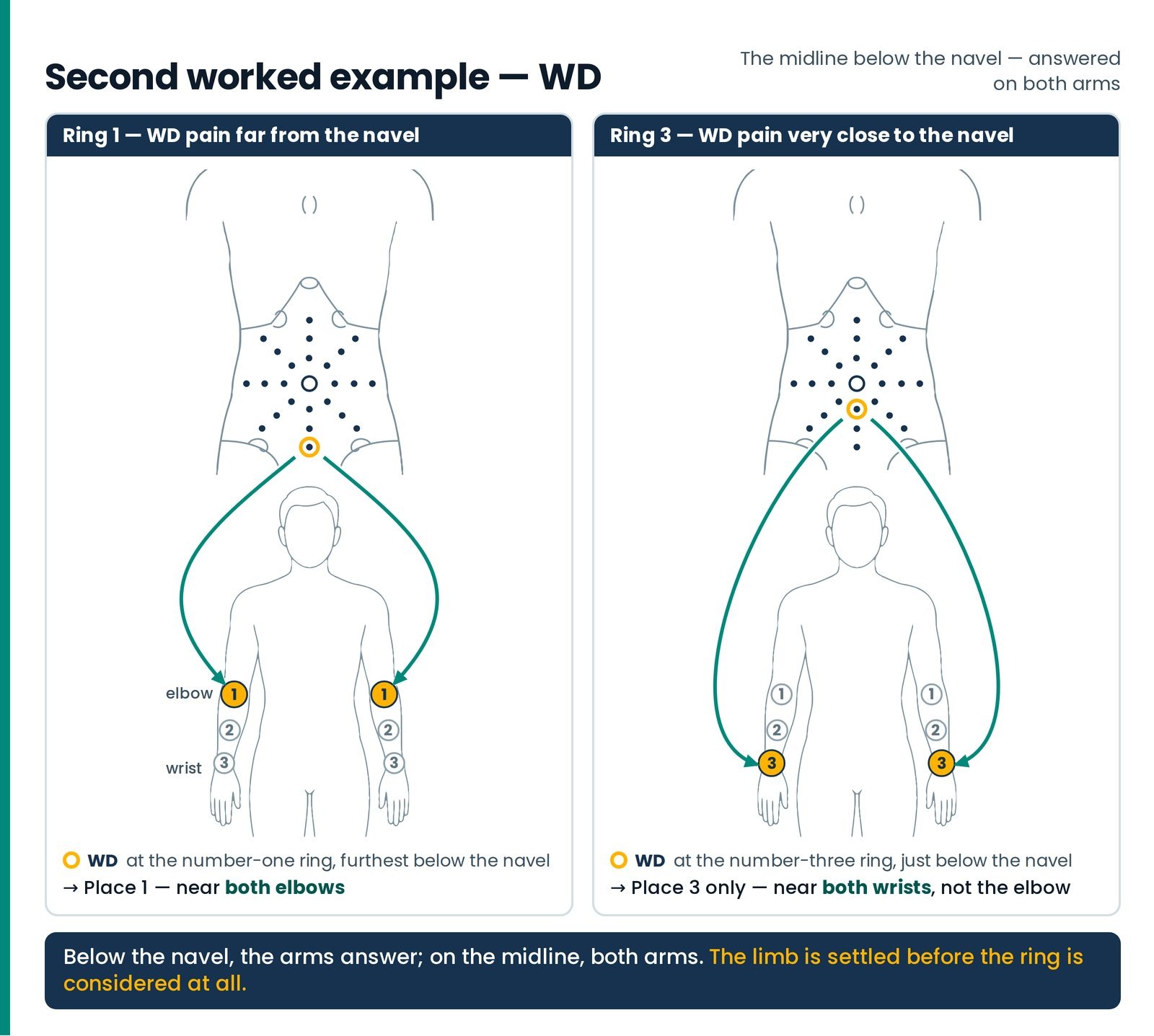
Two worked examples carry the rule, covering both limbs, both directions of the crossed rule and both ends of the ring. (Figure 6.4) (Figure 6.5)
First worked example — Gal. Two paired scenes. Gal pain at ring 1, high under the right rib margin, is answered near the waist on the left thigh (place 1). Gal pain at ring 3, beside the navel, is answered only at place 3 on the same thigh, near the knee.Second worked example — WD. WD, on the midline below the navel, is answered on both arms. Three stations run along each forearm: 1 at the elbow, 2 mid-forearm, 3 near the wrist. Pain far from the navel goes from place 1 at both elbows; pain very close to the navel goes only from place 3 near both wrists.
Read next
The Hand That Heals The Hand That Heals — legs above the navel, arms below, crossed sides