Work with the bowel’s own wave — and the two sides of the sixth bead
One rule of order belongs to this article rather than the formulary, because it is a rule about the belly itself — and without it no student will understand why any formula is arranged as it is.
Key teaching
The peristaltic principle — right follows left
Pressure cannot be applied in any random sequence.
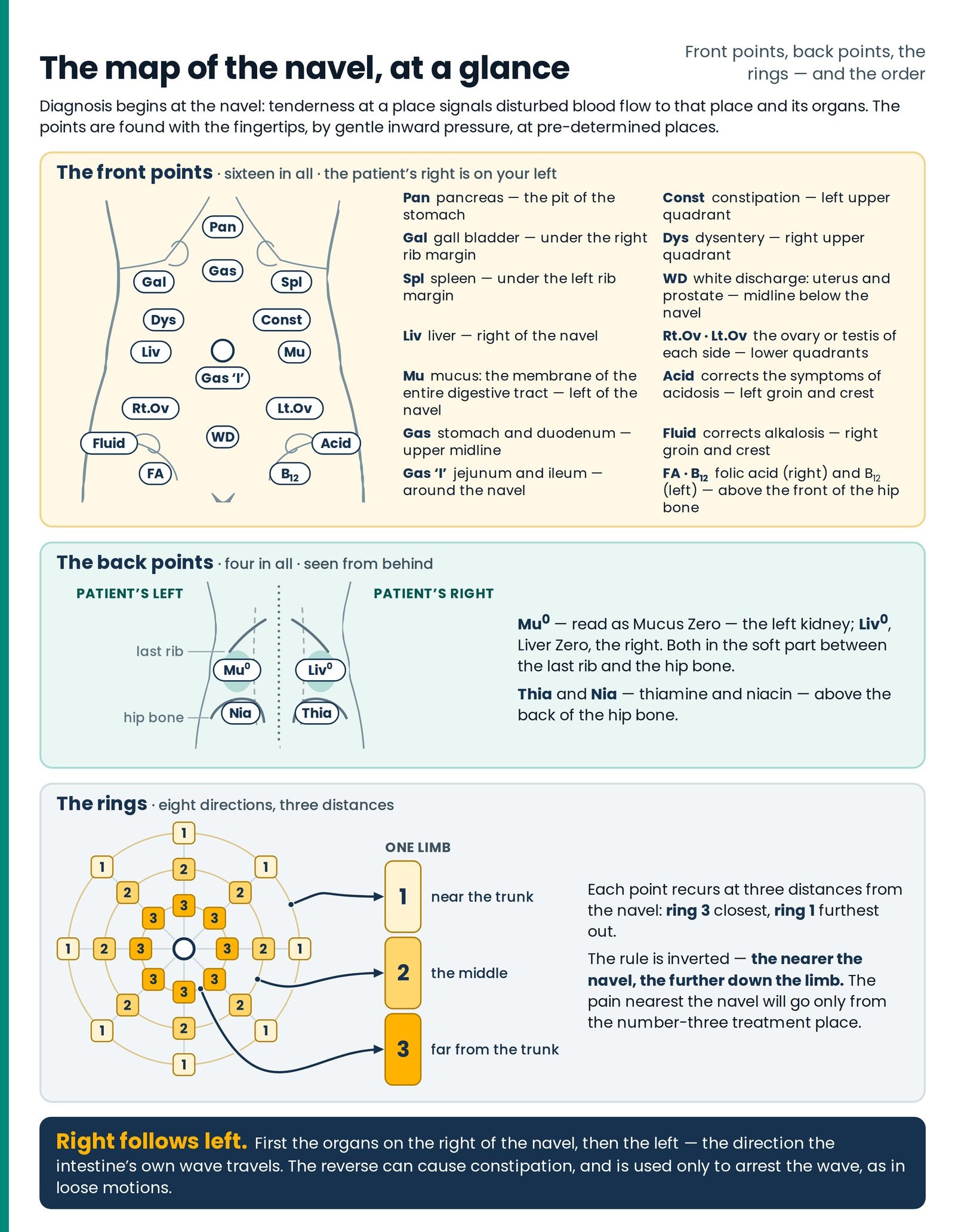
The general rule for proper peristaltic movement is: right follows left. That is — first stimulate the organs on the right side of the navel, and then stimulate the organs on the left side of the navel.
A reverse order can cause constipation, and is to be resorted to only when we wish to arrest the peristalsis — for example while treating loose motions.
Peristalsis is worth a sentence of plain English, because the whole rule hangs on it. The intestine is a long muscular tube that moves its contents along by squeezing behind and relaxing in front, in a travelling wave — the way you work a stiff toothpaste tube from the closed end. That wave has a fixed direction: up the right side of the abdomen, across the top, down the left, out. Right, then left. Everything in the belly runs that way.
So the ordering rule is not a ritual but a decision to work with the wave. Stimulate the right-hand organs first and the left after, and you have pushed in the direction the bowel was already going. Reverse it and you have pushed against it — which slows the bowel and, in a patient already sluggish, constipates him. And precisely because reversing it slows the bowel, reversing it deliberately is a treatment: for loose motions, arresting the wave is the object. That is why reversed forms of certain formulas exist, why they are given for a short time only, and why the normal order must be restored afterwards.
The same principle of sided opposites appears in a second place a therapist meets early, and the two teach one lesson.
Key teaching
The two sides at the sixth thoracic bead
Pressure applied on the left side of the spine, in the region of the sixth thoracic vertebra, in a particular fashion, has a dilatory function — it opens — and is used in situations associated with narrowing of arteries or of the ring-shaped closing muscles of the body: for example, narrowing of the food pipe. Left Prone
A similar pressure applied on the right side of the spine constricts — it closes — and has been used to relieve, effectively and in a great many patients, the swelling in the legs caused by varicose veins. Right Prone
Same bead. Same manner of pressure. Two sides. Opposite results.
Nothing makes the point about sides more sharply. Two treatments, an inch or two apart on the same back, and one opens what the other closes. A therapist vague about which side he worked has not been slightly imprecise; he has possibly given the opposite treatment.
What you are actually pressing over
Four fields of the trunk, and why a code name is not an address
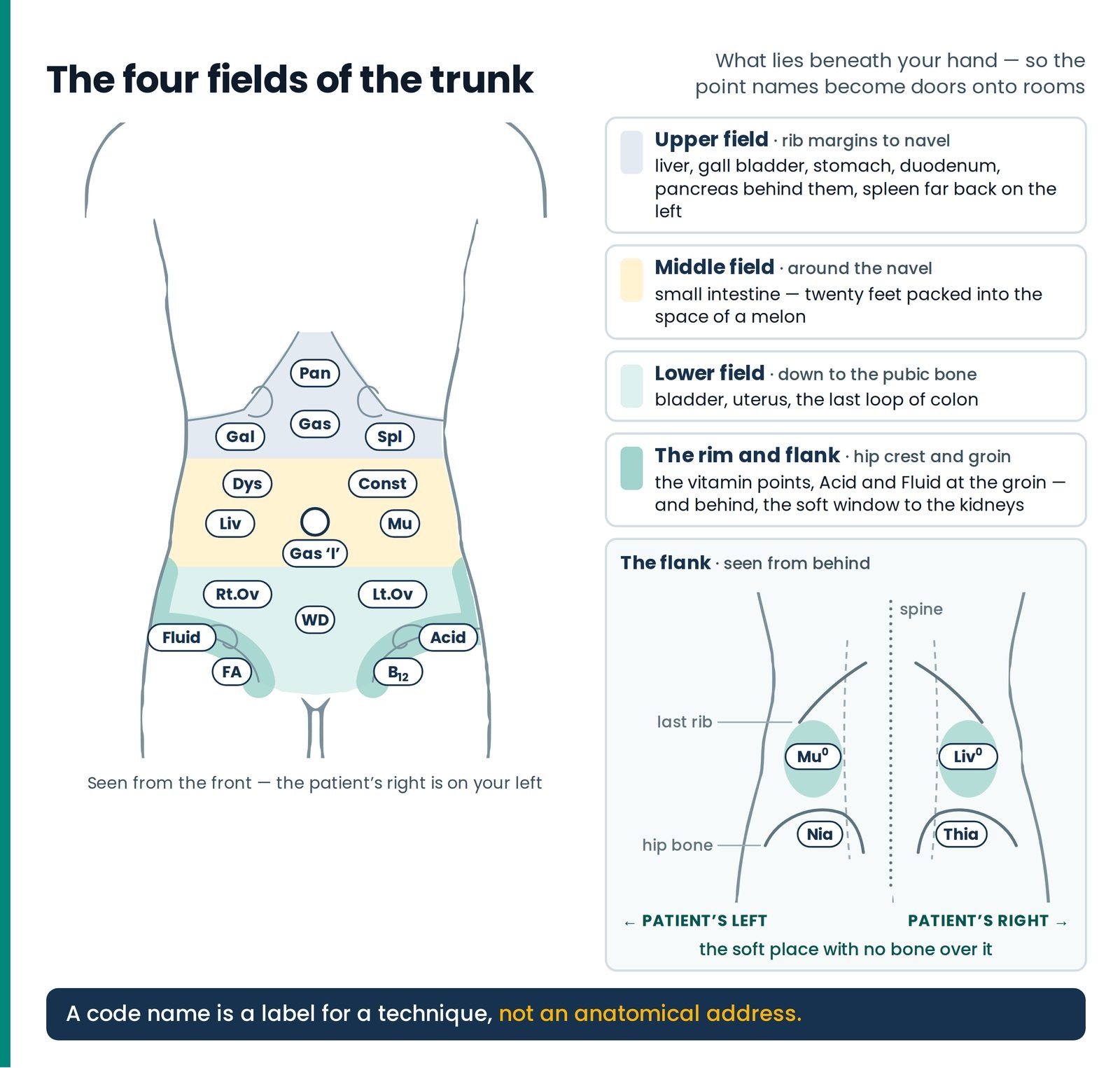
A therapist who knows what is beneath his hand presses differently, and stops at the right moment. Four fields hold the whole map: the upper field, rib margins to navel — liver, gall bladder, stomach, duodenum, pancreas behind them, spleen far back on the left; the middle field around the navel — small intestine, twenty feet packed into the space of a melon; the lower field down to the pubic bone — bladder, uterus, the last loop of colon; and the rim and flank, carrying the vitamin points, Acid and Fluid at the groin, and behind, the soft window to the kidneys. (Figure 6.7)
The code names are, the teaching itself says, in general indicative of the major organ of that area — though not necessarily always so, and the qualification is load-bearing. Spl is the clearest case: a healthy spleen sits high and far back on the left, behind ribs nine to eleven, and cannot be felt through a belly wall at all. Lt.Ov is another — an ovary lies deep on the side wall of the pelvis, and in a man there is no gonad in that quadrant. So the honest statement of the map is: tenderness at the place named Spl accompanies disorders connected with the spleen, and treating it helps. A claim about a finding and a technique, not a claim about what your fingertip is resting on. (Figure 6.6)
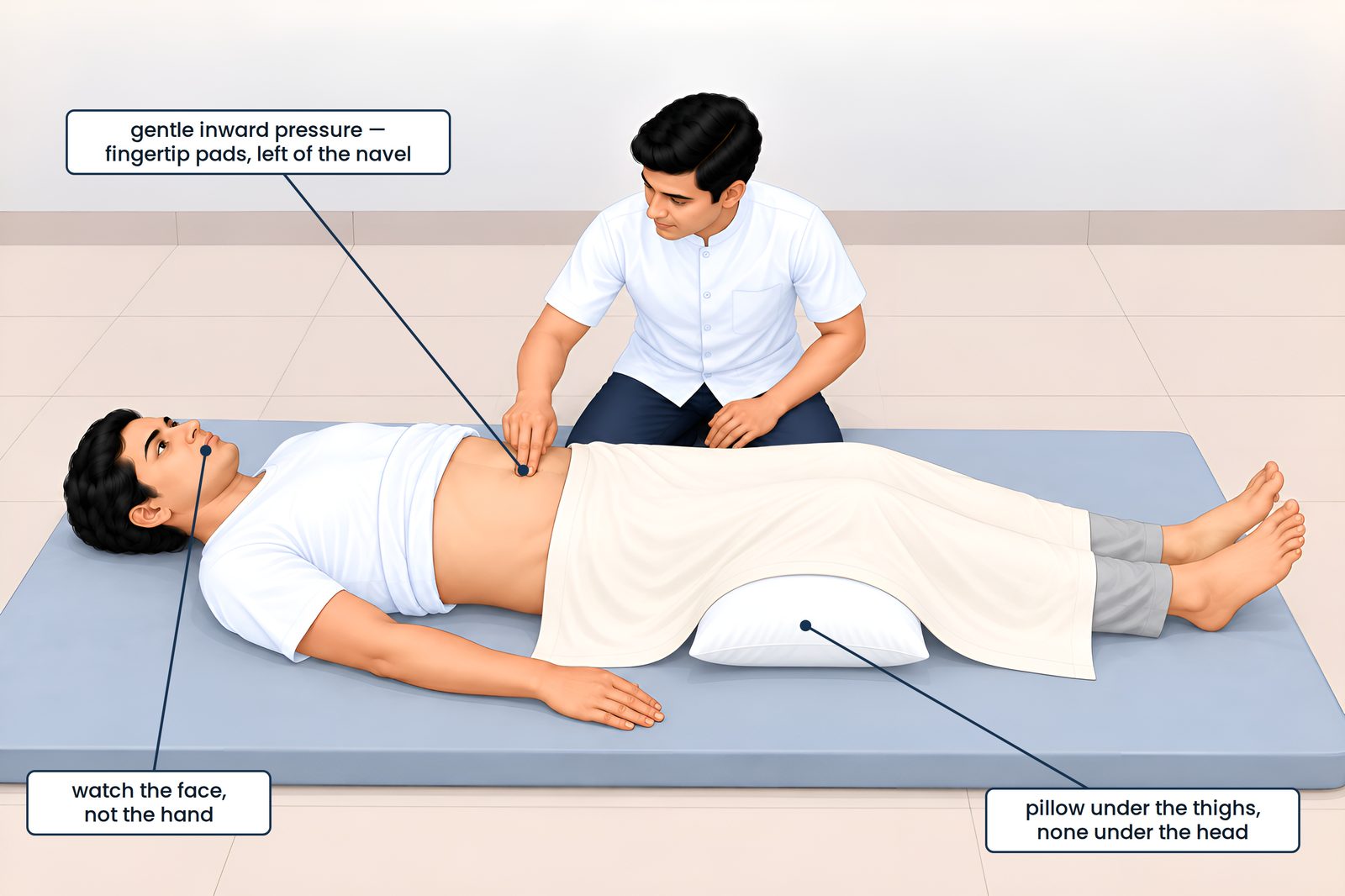
Finding a point at the navel. Kneeling at the patient's side, two fingertip pads rest a little to the patient's left of the navel and press gently inward; the pillow lies under the thighs, none under the head; the eyes stay on the patient's face.The four fields of the trunk. The trunk from the front divided into upper, middle and lower fields and the rim, each with what lies beneath and its point codes, plus an inset of the flank from behind showing Mu° and Liv° in the soft place with no bone over it.
Two bodies, read from the navel
A camp lesson and a four-complaint case, read from the pain points
The map of the navel, at a glance. A one-page summary: the sixteen front codes in their places, the four back points on the flank, the three rings and their inverted rule, and the order — right follows left.
Ready to begin?
Send COURSE for course details, or your name, age and health issue for a consultation.